
The Amazon frontend engineer interview evaluates how well you build real user-facing systems. It focuses on JavaScript fundamentals, modern frontend frameworks, browser behavior, performance trade-offs, and behavioral judgment.
The process typically includes a coding screen followed by multiple interview rounds that test both technical depth and decision-making. This structure exists because Amazon does not hire frontend engineers based only on UI skills.
Interviewers look for engineers who can reason about scale, accessibility, performance, and ownership while communicating clearly under ambiguity. Strong candidates show how they think, not just what they code.
In this article, we’ll explain how the Amazon front-end engineer interview works end-to-end, what Amazon evaluates at each stage, and how to prepare strategically without guessing.
Key Takeaways
- Prepare by focusing on the domains and signals Amazon prioritizes.
- Master JavaScript, React patterns, and browser fundamentals for coding rounds.
- Start system design answers from user flows and show a scalable frontend architecture.
- Keep behavioral stories compact, metric-driven, and show explicit ownership.
- Run timed mocks regularly and iterate on mistakes to improve performance.
What Does a Frontend Engineer Do at Amazon?
A frontend engineer at Amazon builds user-facing systems that millions of customers interact with daily. This role combines strong frontend fundamentals, product thinking, and close collaboration with multiple teams to deliver reliable and scalable customer experiences.
Core Responsibilities of a Frontend Engineer at Amazon
A frontend engineer at Amazon typically works on responsibilities such as:
- Build and optimize UIs with HTML, CSS, JavaScript, and React
- Ensure performance, accessibility, and cross-device reliability
- Write unit and integration tests for code quality and stability
- Participate in code reviews and design discussions
- Collaborate with UX, backend, and product teams to deliver solutions
Scope of Ownership
The scope of ownership for a frontend engineer at Amazon extends beyond individual UI components, such as:
- Own features from design through deployment and long-term maintenance.
- Influence frontend architecture for performance and scalability.
- Set and improve standards for accessibility testing and code quality.
- Iterate using real customer usage data and business metrics.
Salary Expectations and Overview
Amazon frontend engineer compensation varies by experience, location, and job tier. Knowing base salary, bonus, and stock ranges helps candidates set expectations and plan negotiations. Total pay often exceeds base alone, reflecting competitive packages compared with other major tech firms.
Typical Frontend Engineer Compensation
| Experience / Level | Base Salary Range | Stock + Bonus | Estimated Total Comp |
| Front End Engineer I | $105K – $121K | ~$31K – $43K | ~$137K – $180K1 |
| Front End Engineer (General) | ~$140K – $170K | ~$45K – $60K | ~$186K – $264K |
| Front End Engineer III | ~$140K – $179K | ~$100K+ | ~$240K – $366K |
| Frontend Engineer II | ~$170K – $181K | ~$74K – $79K | ~$228K – $371K2 |
How Does This Role Differ From Similar Roles at Other Companies?
Compared to similar roles elsewhere, Amazon frontend engineers are expected to think at a system level.
- UI decisions focus on long-term impact, not just quick delivery
- State management, rendering, caching, and code splitting affect business metrics
- Engineers must justify trade-offs with data and customer impact
This emphasis is why your responses to Amazon frontend engineer interview questions and frontend engineer interview questions should show both practical code and long-term judgment.
Typical Amazon Frontend Engineer Interview Process
The Amazon frontend engineer interview process follows a structured process designed to evaluate frontend fundamentals, problem-solving depth, and alignment with Amazon’s engineering and ownership standards.
| Stage | Interview Format | Duration | What Amazon Evaluates |
| Recruiter Screen | Phone or video | 20 to 30 minutes | Role fit, experience alignment, and communication clarity |
| Frontend Technical Screen | Live coding interview | 45 to 60 minutes | JavaScript fundamentals, DOM logic, problem-solving |
| Virtual Interview Loop | 3 to 5 interviews | 45 to 60 minutes each | Coding depth, frontend architecture, and behavior signals |
| Hiring Review | Internal review | Not a candidate facing | Bar raising, consistency across rounds |
Understanding this structure early helps candidates prepare deliberately instead of reacting round by round during the Amazon frontend engineer interview.
Also Read: Amazon Front-End Engineer Interview Prep
What Does Amazon Evaluate in a Frontend Engineer Interview?
The Amazon Frontend Engineer Interview is built to answer one core question:
Can this engineer be trusted to own customer-facing systems at Amazon scale?
Interviewers do not score you based on how well you perform in individual rounds. They evaluate recurring signals that show up across coding, design discussions, and behavioral stories.
Below are the actual evaluation pillars Amazon uses, based on how frontend engineers are hired and promoted internally.
1. Frontend Technical Judgment
Amazon does not hire frontend engineers who only build UI. Interviewers assess whether you can make correct technical decisions that hold up under scale, latency, and change.
What is explicitly evaluated?
- JavaScript fundamentals beyond syntax
- UI architecture choices
- Performance awareness
- Accessibility and correctness
Depth at different levels?
- Entry to mid-level: Can you explain why your solution works and where it might break?
- Mid to senior: Can you defend architectural decisions and reject bad trade-offs?
- Senior: Can you anticipate second-order effects before they show up in production?
2. Structured Problem Solving Under Ambiguity
Amazon frontend problems are intentionally underspecified. Interviewers want to see how you think when the problem is messy, not when it is neat.
How is ambiguity introduced?
- Requirements that conflict with each other
- UI problems have no single correct solution
- Constraints revealed mid discussion
Here’s what different candidates do:
| Strong Candidates | Weak Candidates |
| Clarify the scope first | Start coding immediately |
| State assumptions | Optimize prematurely |
| Break problems into layers | Freeze under challenge |
Interviewers in the Amazon frontend engineer interview care deeply about how you reason out loud. Silent problem-solving is treated as a risk signal, not a strength.
3. Ownership and Leadership Principles in Practice
Behavioral evaluation is not a formality at Amazon. It is a hiring gate. Frontend engineers are expected to own the customer experience end-to-end. Interviewers test whether your past behavior matches that expectation.
What Amazon is actually listening for?
- Ownership beyond assigned tasks
- Decisions made in the face of incomplete data
- Trade-offs between speed and long-term quality
- Willingness to challenge bad decisions respectfully
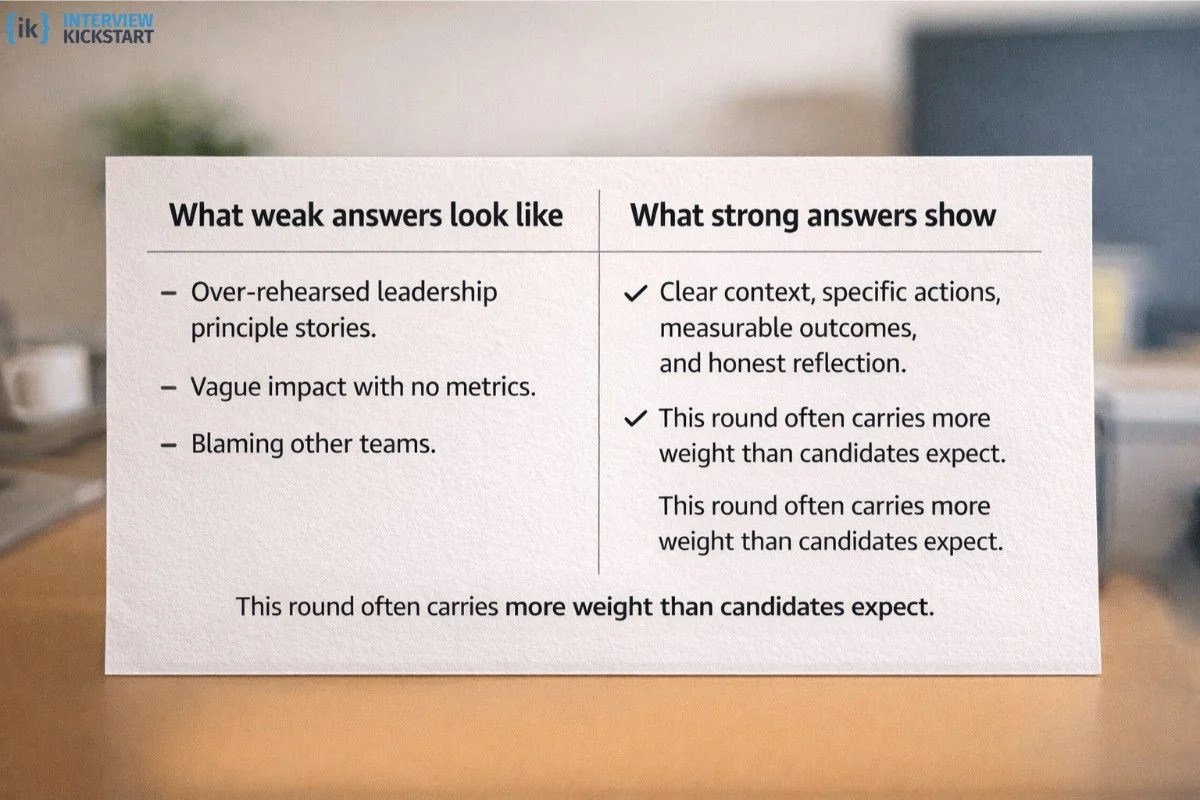
Red flags that quietly fail candidates:
- Stories that credit the team but hide personal responsibility
- Answers optimized for leadership principle keywords
- Blaming product, design, or backend teams
- Over-coached STAR responses with no tension or learning
In borderline cases, behavioral signals often decide the offer in the Amazon frontend engineer interview.
Amazon Frontend Engineer Interview Rounds Deep Dive
The Amazon frontend engineer interview is designed to reduce hiring risk for customer-facing systems that operate at a massive scale. Each round exists for a specific reason, and interviewers are trained to look for different signals at each stage.
Round 1: Recruiter Screen
This round filters out candidates who look strong on paper but are misaligned with Amazon’s frontend role expectations, ownership model, or level calibration.
What is actually assessed?
- Whether your frontend experience maps to Amazon’s definition of ownership
- Whether you have worked on customer-facing systems with real scale or constraints
- Whether your expectations around scope, level, and growth match reality
Structure and format
- 30 to 45-minute call
- Resume-driven, but not linear
- Focused follow-ups on impact and ownership
Topics typically covered
- Frontend features you owned end-to-end
- How has your work affected customers or business metrics?
- Why do you want Amazon specifically, not just the brand?
Types of questions asked and intent
- “Tell me about a frontend project you owned.” (Intent: Did you actually make decisions or just implement tasks?)
- “What kind of frontend work excites you?” (Intent: Are you aligned with Amazon’s customer-first UI problems?)
How to approach this round?
Frame your experience around decisions, trade-offs, and outcomes. Avoid listing tools. Explain why choices mattered.
Common failure patterns
- Describing frontend work as UI implementation only
- Talking about team achievements without personal accountability
- Giving generic FAANG motivation
Round 2: Frontend Technical Screen
This is the first hard technical filter in the Amazon Frontend Engineer Interview. It eliminates candidates who rely on frameworks without understanding fundamentals.
What is the interviewer really testing?
- JavaScript fundamentals under pressure
- Ability to reason about browser behavior
- Clarity of thought while coding
Structure and format
- 45 to 60 minutes
- Live coding in a shared editor
- Continuous discussion expected
Types of questions asked and intent
- Build a small interactive UI behavior (Intent: Can you reason about state, events, and edge cases?)
- Modify or debug existing frontend logic (Intent: Can you read and improve real code?)
How to approach this round?
Clarify requirements plan, briefly code for correctness, then discuss optimizations. Treat your solution like production code. Practice Amazon frontend engineer interview questions that include DOM and async behavior.
Common mistakes
- Jumping straight into React abstractions
- Coding silently
- Optimizing prematurely
Strong candidates show discipline. They prioritize correctness, then discuss performance trade-offs. Interviewers often note that strong frontend engineers think in browser behavior, not libraries.
Round 3: Virtual Onsite Interview Loop
This loop usually includes multiple interviews, each mapped to a different evaluation pillar. Together, they decide the outcome of the Amazon frontend engineer interview.
A. Frontend Coding and Architecture Interview
Purpose: Validate the depth of frontend judgment beyond basic coding ability
Typical failure pattern: Candidates solve the immediate problem but cannot explain how the solution scales or evolves.
What is evaluated:
- Component boundaries and data flow
- State ownership and side effects
- Long-term maintainability
B. Frontend System Design Interview
Purpose: Assess whether the candidate can design frontend systems that operate reliably at Amazon scale.
What is evaluated:
- Rendering strategy and performance trade-offs
- API interaction and failure handling
- User experience under latency and errors
Types of problems discussed
- Designing a complex customer-facing flow
- Reasoning about performance bottlenecks and fallbacks
Werner Vogels, Amazon CTO, has consistently emphasized this mindset:
“Everything fails, all the time. What matters is how you design for it.” Front-end system design interviews test exactly this.
C. Behavioral and Leadership Interview
Purpose: Confirm long-term ownership and leadership readiness.
What interviewers look for
- Decision-making under ambiguity
- Willingness to take responsibility for outcomes
- Ability to challenge decisions respectfully
Round 4: Hiring Decision and Bar Raiser Review
This stage protects Amazon’s hiring bar across teams.
What happens in this round?
- Interview feedback is reviewed collectively
- The Bar Raiser focuses on long-term impact, not short-term need
- One strong negative signal can block an offer
What candidates misunderstand is that Amazon does not average performance across rounds. Consistency matters more than brilliance in one interview.
As Jeff Bezos has stated, “We never hire someone to meet the bar. We hire people who raise it.”
Amazon Frontend Engineer Interview Questions
Amazon frontend interview questions test what you can actually build, design, and own. You’ll work on JavaScript, React, and browser fundamentals, design scalable customer-facing UI, and demonstrate ownership through real examples.
Before diving into questions, here is the mental model Amazon uses internally.
How does Amazon Map Interview Domains?
| Domain | Subdomains | Interview Rounds | Depth |
| Coding | Arrays, Trees, Graphs, JS fundamentals | Phone Screen, Onsite | High |
| System Design | Scalability, APIs, Component Architecture | Onsite | Medium–High |
| SQL & Data | Joins, Window Functions, Aggregations | Phone Screen | Medium |
| Behavioral | Amazon Leadership Principles | All Rounds | High |
Coding Technical Questions
Interviewer expectations: Amazon expects correct, readable code that handles edge cases and maps to UI behavior. Show clear state shape, avoid silent assumptions, and speak while you code.
Q1. Implement debounce in JavaScript with cancel support.
Answer:
function
debounce(fn, delay) {
let
id =
null;
const
debounced =
function(…args) {
if
(id)
clearTimeout(id);
id =
setTimeout(() =>
fn.apply(this, args),
delay);
};
debounced.cancel =
function() {
if
(id)
clearTimeout(id);
id =
null;
};
return
debounced;
}
Handles repeated calls and exposes cancel so UIs can abort pending work.
Q2. Fix stale closure with async state in a React functional component.
Answer:
import {useRef, useEffect, useState} from ‘react’;
function useLatest(value) {
const ref = useRef(value);
useEffect(() => {
ref.current = value;
}, [value]);
return ref;
}
function Example() {
const [count, setCount] = useState(0);
const latestCount = useLatest(count);
useEffect(() => {
const id = setInterval(() => {
console.log(‘latest’, latestCount.current);
}, 1000);
return () => clearInterval(id);
}, []);
}
Prevents callbacks from closing over stale state.
Q3. Correctly handle controlled inputs and validation.
Answer:
function EmailInput() {
const [value, setValue] = useState(”);
const [error, setError] = useState(”);
function onChange(e) {
const v = e.target.value;
setValue(v);
setError(/\S+@\S+\.\S+/.test(v) ? ” : ‘Invalid email’);
}
return <input
value={value}
onChange={onChange}
aria-invalid={!!error}
/>;
}
Q4. How would you efficiently update the DOM in a web app to avoid unnecessary re-renders?
Answer:
- Compute minimal changes to the DOM rather than full rerender
- Batch updates using requestAnimationFrame/
- Avoid layout thrashing by separating reads and writes/
Sample coding questions
- Implement debounce
- Build an autocomplete component with keyboard support
- Flatten a nested array of arbitrary depth
- Fix a bug with stale state in an async callback
- Implement a memoized function or partial application
- Render a large list efficiently and explain optimizations
- Build a dynamic table with add and delete rows
- Debug event handling issues in a UI widget
- Implement a controlled React component with validation
- Explain and fix my memory leak in a SPA
How to approach coding questions?
Approach coding questions by clarifying inputs, outputs, and constraints, sketching state and edge cases, writing a correct baseline solution, and adding tests. Optimize only if time allows, explaining trade-offs.
Frontend System Design Questions
Q5. Design product listing with filtering, pagination, and caching.
Answer:
- Client fetches paged results via cursor based API
- Cache pages on the client and reuse when filters toggle
- Use skeleton UI for perceived performance
- Server-side support for stable cursors and filtering
- Use optimistic UI for small interactions and safe rollbacks
Interviewer expectations: Design answers must start with user experience, then map to technical choices. Show performance-conscious decisions and fallback behaviors for errors and poor networks.
Q6. Implement an autocomplete input that handles millions of queries efficiently. How would you ensure responsiveness and prevent unnecessary requests?
Answer:
- Wait 200ms after typing stops, cancel pending requests
- Cache popular queries at the CDN to reduce server load
- Store recent queries locally for instant results
- Rank efficiently and limit request rate
- Show cached suggestions or “Loading…” when the API is slow
Interviewer Expectations: Candidate is expected to show understanding of UX, scalability, and correctness.
Q7. Optimize a landing page with many images for fast loading across devices.
Answer:
- Responsive images (srcset) to serve correct sizes per device
- Lazy-load below-the-fold images with blurred placeholders
- CDN & compression to reduce payload and speed delivery
- Preconnect/preload key image domains for faster LCP
- Tune CLS/LCP to minimize layout shifts and load times
Interviewer Expectations: Candidates are expected to show awareness of performance metrics, optimization, and user experience.
Q8. How would you manage state in a large React app to maintain performance?
Answer:
- Local state for ephemeral UI elements
- Global store for shared cross-component data
- Normalize API responses to reduce duplication
- Selectors & memoization to limit re-renders
Interviewer Expectations: Candidate must show knowledge of scalable state management, performance, and maintainable architecture.
Front-end system design questions:
- Design a product listing page with filters and pagination
- Design an autocomplete that supports millions of users
- How to optimize an image-heavy landing page
- Architect a real-time dashboard with live updates
- Design client-side caching and invalidation
- Handle pagination and infinite scroll at scale
- Discuss bundling and code splitting strategy
- Design accessible UI for complex controls
- Strategy to reduce Time to Interactive and LCP
- Plan for graceful degradation on slow networks.
How to approach system design questions?
For system design questions, define user flows and success metrics, state assumptions on scale and traffic, sketch client architecture and API interactions, and highlight performance, caching, offline support, and accessibility.
Also Read: Amazon System Design Interview Questions & Answers (2026 Guide)
SQL & Data Interview Questions
Q9. Write a query to compute total sales per product category.
Answer:
SELECT p.category_id, SUM(o.amount) AS total_sales
FROM orders o
JOIN products p ON o.product_id = p.id
GROUP BY p.category_id
ORDER BY total_sales DESC;
Q10. Return the top 5 customers by total spend.
Answer:
SELECT customer_id, SUM(amount) AS total_spend
FROM orders
GROUP BY customer_id
ORDER BY total_spend DESC
LIMIT 5;
Q11. Count distinct users per day.
Answer:
SELECT DATE(event_time) AS day, COUNT(DISTINCT user_id) AS dau
FROM events
GROUP BY DATE(event_time)
ORDER BY day;
Sample SQL questions:
- Find top-selling products by category.
- Compute cumulative monthly revenue.
- Calculate the percent change in daily sales.
- Use window functions to rank users by activity.
- Join orders and customers to compute the average order value.
- Detect duplicate records in a table.
- Pivot product sales by region.
- Identify users with no activity in the last 30 days.
- Aggregate engagement metrics by cohort.
- Count orders per customer using efficient grouping.
Interviewer expectations: Expect short, practical SQL questions covering joins, aggregations, and window functions. Answers should be correct, concise, and handle NULLs, edge cases, and basic performance considerations.
How to approach SQL questions?
For SQL questions, confirm schemas and null handling, start with a correct simple query, then add window functions or optimizations. Highlight indexes, query cost, and handle ties/NULLs, showing both straightforward and scalable solutions.
Behavioral / Leadership Interview Questions
Q12. Tell me about a frontend feature you owned end-to-end.
Answer:
Situation: The listing page had 3s load and poor conversions.
Action: Rewrote render path, lazy loaded images, added skeletons, and added monitoring.
Result: LCP improved from 3s to 1.2s, and conversions rose 6 percent.
Q13. Describe a time a release caused a regression.
Answer:
Situation: A deploy caused checkout errors on mobile.
Action: Rolled back, shipped a patch, added mobile regression tests, and a preflight checklist.
Result: Fix deployed in 45 minutes, and mobile errors dropped 90 percent.
Q14. Give an example of disagreeing with a product decision.
Answer:
Situation: PM wanted to skip tests for speed.
Action: Proposed a phased rollout with feature flags and a small pilot.
Result: Pilot exposed issues early, and full rollout was safe and on time.
Sample behavioral questions:
- Tell me about a time you owned a customer problem end-to-end.
- Describe a challenging technical problem you solved.
- Give an example of taking ownership beyond your role.
- Tell me about a time you disagreed with a teammate.
- How do you prioritize competing tasks under tight deadlines?
- Describe a project that failed and what you learned.
- Give an example of mentoring a colleague to raise quality.
- How do you make decisions with incomplete data?
- Tell me about a time you automated a repetitive task.
- Describe a proactive initiative you started.
Interviewer expectations: Behavioral rounds test real ownership, measurable impact, and how you make trade-offs. Use short concrete stories with results and what you learned. Be honest and metric-driven.
How to approach behavioral questions?
When answering behavioral questions, use a compact STAR format with 1–2 lines per part and lead with the result. Always include a measurable metric to show impact and explain what you learned or what you would do differently next time.
Also Read: Amazon Behavioral Interview Questions & Answers
Preparation Framework & Study Plan for Amazon Frontend Engineer Interview
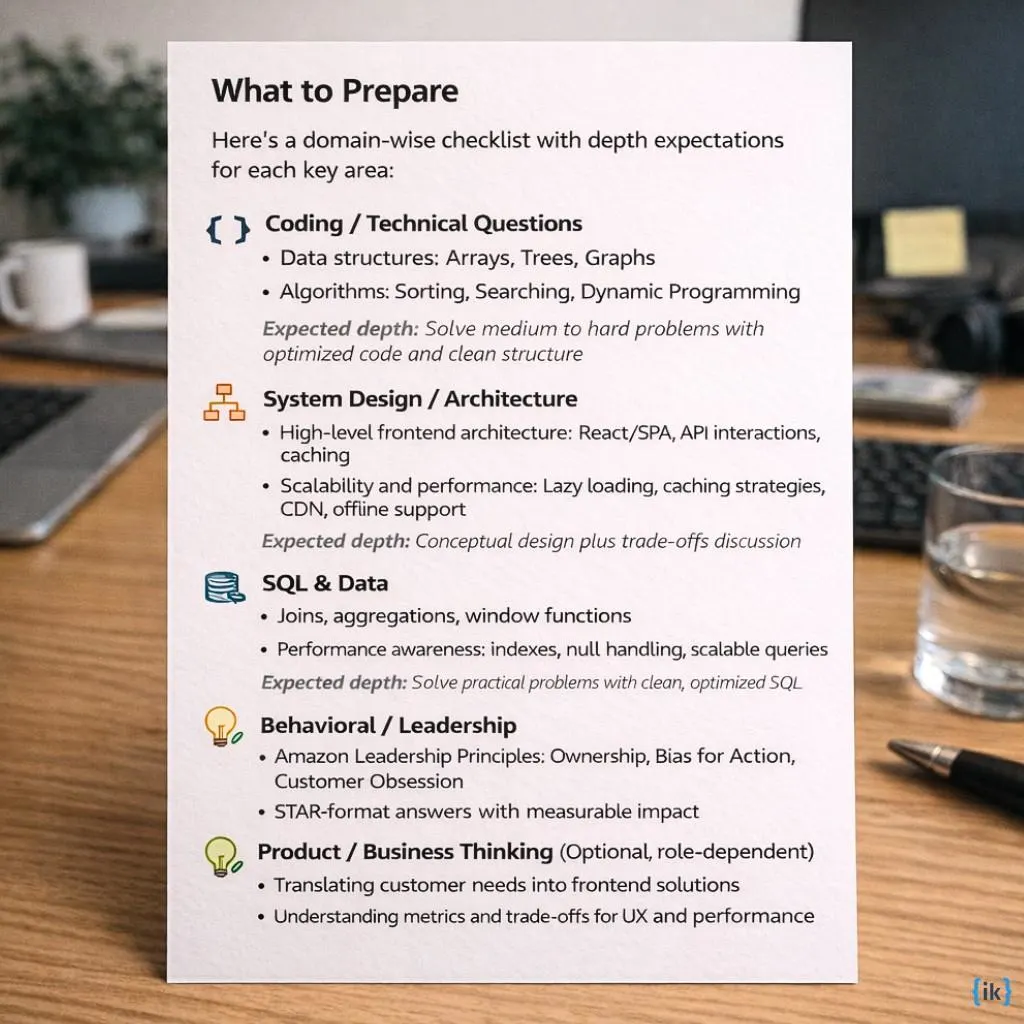
Preparing for the Amazon Frontend Engineer Interview requires a structured plan covering coding, system design, SQL, and behavioral skills, with time for practice and review.
Suggested Timeline
A 5-week timeline helps break preparation into manageable phases, allowing mastery of fundamentals, practice, and interview simulation.
| Weeks | Focus | Key Activities |
| Week 1–2 | Fundamentals | Coding challenges on arrays, trees, graphs; basic SQL queries; frontend concepts. |
| Week 3–4 | Company-specific prep | Amazon-specific frontend patterns, system design drills, advanced SQL, and leadership-aligned behavioral prep. |
| Week 5 | Mock interviews & review | Timed coding tests, system design mocks, behavioral practice, and targeted gap review. |
Amazon Frontend Engineer Interview Tips
Success in the Amazon frontend engineer interview isn’t just about preparation. It comes from executing under pressure, asking the right questions, managing time, communicating clearly, and recovering gracefully from roadblocks.
1. Ask Clarifying Questions
Summarize the problem in one sentence and confirm edge cases. Ask about constraints like data size, libraries, or null inputs, and clarify UX expectations if relevant. Confirm acceptance criteria before coding to reduce rework.
2. Get Comfortable Coding on Various Mediums
Practice on a laptop, plain text editor, and whiteboard or paper. Learn shortcuts, code without autocomplete, and rehearse on unfamiliar setups. If asked, state your preferred medium briefly.
3. Company-Specific Nuances for Amazon
Tie technical choices to customers or metrics, and show ownership in first-person statements. Weave short behavioral signals into technical answers and tailor prep to the loop breakdown provided by the recruiter.
4. Manage Time and Communicate While Coding
Follow a rough 60-30-10 split: 60% planning, 30% coding, 10% testing. Narrate your plan before typing, explain what you tried if stuck, and pivot calmly to fallback solutions. Silence is a red flag.
5. Live Debugging and Thinking Out Loud
Read code aloud, hypothesize bugs before changing anything, and create minimal test cases. Explain fixes clearly and note what you would add to prevent regressions.
Prepare for Amazon Frontend Engineer Interviews with Interview Kickstart
Interview Kickstart’s Frontend Engineering Interview Masterclass is designed for engineers targeting high-bar roles like Amazon’s frontend engineer positions. The program mirrors real Amazon front-end engineer interview questions across coding, system design, and leadership evaluation.
You practice data structures and algorithms with clean, optimized code, tackle frontend system design using tradeoff-driven frameworks, and refine behavioral answers around ownership, measurable impact, and decision-making.
A key feature is live mock interviews with senior FAANG engineers, including former Amazon interviewers, who provide actionable feedback to identify gaps and improve performance.
Conclusion
The Amazon Frontend Engineer Interview challenges both technical skill and strategic thinking. Success comes from focusing on the domains Amazon prioritizes, practicing real Amazon frontend engineer interview questions, and frontend engineer interview questions and executing clearly under time pressure.
Candidates who focus on the core domains, practice real questions, and execute with clarity under time pressure stand out. Behavioral stories should be concise, metric-driven, and showcase ownership, while coding and system design answers should reflect scalable, maintainable solutions.
Preparing with a structured study plan, timed mocks, and deliberate practice of high-impact areas ensures that you not only answer questions correctly but also demonstrate the judgment and problem-solving Amazon values.
FAQs: Amazon Frontend Engineer Interview
Q1. Do I need a portfolio or personal projects to get a Frontend Engineer interview at Amazon?
Not strictly required for experienced hires, but public projects help junior candidates and can speed recruiter interest when you lack large-company experience.
Q2. Are take-home assignments common, and how should I treat them?
Take-home tasks are common for frontend roles and are your chance to show production-quality code, docs, and a short design note rather than just a working prototype.
Q3. Will Amazon sponsor my work visa for a frontend role?
Large tech employers like Amazon do sponsor visas, but hiring and sponsorship vary by location and timing, so treat sponsorship as possible but not guaranteed.
Q4. How important is an active GitHub or open source contribution?
Helpful but not mandatory. It signals coding habit and ownership, and it matters more for early career hires than for well-established senior engineers.
Q5. What is the best way to get noticed by Amazon recruiters as a frontend engineer?
Keep a concise resume with links to projects or GitHub, highlight measurable impact, and surface relevant keywords so initial screeners can quickly see product scale and ownership.
References
Related Articles:


