
Meta frontend engineer interview questions revolve around testing the candidates ability to build fast, scalable, and reliable user interfaces using strong fundamentals. They assess the candidate’s ability to build interactive user interfaces and create, modify, and/or test software applications or systems for various Meta products and services.
Meta reports1 3.58 billion daily active people across platforms like Facebook, Instagram, WhatsApp, and Threads. At this scale, even a small UI bug or a 100 millisecond delay can negatively impact user engagement and cost millions in revenue.
Therefore, frontend engineers at Meta are expected to write clean, efficient, and production-ready code that performs consistently across devices and network conditions. This level of expectation makes the interview process highly practical and detail-oriented.
To help you clear the interview smoothly, we have listed 40 Meta frontend engineer interview questions across HTML, CSS, JavaScript, React, performance optimization, and system design. Each section is structured to match real interview rounds, helping you focus on the exact skills Meta evaluates while hiring.
Key Takeaways
- Understand why Meta frontend engineer interview questions focus heavily on real-world UI problem solving, performance optimization, and building scalable interfaces used by billions of users.
- Learn how strong fundamentals in HTML, CSS, and JavaScript are essential, especially the ability to write semantic markup, handle DOM manipulation, and implement core concepts like closures, event loop, debounce, and throttle.
- Discover why deep knowledge of React and modern frontend architecture is critical, including hooks, Virtual DOM, performance optimization (memoization, lazy loading), and state management at scale is a non-negotiable.
- Interviews test your ability to design frontend systems, such as news feeds, chat apps, and search components, while handling challenges like caching, real-time updates, and network efficiency.
- Explore why performance, accessibility (a11y), and clean production-ready code play a major role, as Meta expects engineers to build fast, reliable, and inclusive user experiences across devices.
What Does a Meta Frontend Engineer Do?
A frontend engineer at Meta builds and optimizes large-scale user interfaces used by billions of people. They develop scalable systems with React and ensure fast, reliable performance across devices through high-quality production code. Here are the key responsibilities of a Meta frontend engineer:
- Building Scalable UIs: Designing and developing highly reusable, modular components using React along with strict typing systems like TypeScript or Flow. These components power complex interfaces such as news feeds, messaging systems, notifications, and dashboards, while maintaining consistency across large and evolving codebases.
- Performance Optimization: Ensuring near-instant load times and smooth interactions across devices, including low-end smartphones and slow network connections. Engineers optimize bundle sizes, reduce unnecessary re-renders using memoization techniques, and implement strategies like code-splitting and lazy loading to improve performance.
- Data Fetching and State Management: Handling complex and real-time data flows using GraphQL and Relay. Engineers structure queries efficiently, manage caching layers, and ensure consistent synchronization of UI state across large-scale applications where millions of updates can occur simultaneously.
- Designing for Scale and Reliability: Building frontend systems that can handle extremely high traffic without breaking. This includes writing defensive code, handling edge cases such as partial data failures, and ensuring that the user interface degrades gracefully when backend services are slow or unavailable.
- Cross-Team Collaboration: Working closely with product managers, designers, and backend engineers to translate business requirements into functional and visually consistent user interfaces. Engineers are expected to contribute to product decisions and ensure technical feasibility.
- Ensuring Accessibility (a11y): Writing semantic HTML (for example, using proper elements like <button>, <nav>, <header> instead of generic <div> tags), implementing ARIA (Accessible Rich Internet Applications) attributes where necessary, enabling full keyboard navigation, and ensuring compatibility with screen readers. This ensures that users with visual, auditory, or motor impairments can effectively use the platform.
- Testing and Debugging at Scale: Writing unit tests using tools like Jest, integration tests with frameworks such as React Testing Library, and end-to-end tests using tools like Cypress or Playwright. Engineers also monitor production systems, analyze logs, and debug issues that may affect millions of users in real time.
- Driving Product Impact: Going beyond implementation by analyzing user behavior through metrics, running A/B tests, and iterating on UI features to improve engagement, retention, and overall user satisfaction.
Process and Timeline of Meta Frontend Engineer Interview
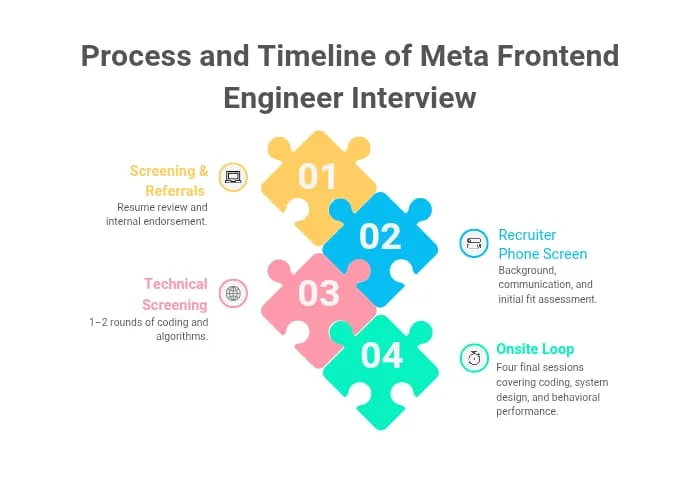
Meta’s frontend engineer interview process is highly competitive and structured to assess both technical expertise and real-world problem-solving ability at scale. The entire process typically takes around two months and consists of multiple stages. Here’s a clear breakdown of what to expect.
- Resume Screening and Referrals (Week 1): Recruiters review your resume to determine if your experience aligns with the open role. This is the most competitive stage, where many candidates are filtered out. Tailoring your resume to the specific position is critical. Having an internal referral can significantly improve your chances of moving forward.
- Recruiter Phone Screen (Week 1-2): A 15 to 30-minute conversation with an HR recruiter to evaluate your background, communication skills, and overall fit for Meta. Expect common behavioral questions such as “Tell me about yourself” and “Why do you want to work at Meta?”, along with a few basic JavaScript questions. If you pass, the recruiter will guide you through the next steps and share preparation resources.
- Technical Screening (Week 2-4): One or two 45-minute online interviews focused primarily on coding. Most of the time is spent solving data structures and algorithms problems, with some behavioral discussion. You will use a simple code editor without features like auto-completion, so practicing in a similar environment is recommended.
- On-site Interviews (Week 4-8): A full interview loop consisting of four 45-minute interviews, usually conducted onsite. It includes two coding interviews focused on data structures and real-world frontend scenarios, one design and architecture interview where you discuss building scalable web applications and UI components, and one career-focused interview that combines behavioral questions with additional coding.
Candidates may also have an informal interaction with a Meta engineer to learn about the work culture, which is not officially evaluated but should still be approached professionally.
Top 40 Meta Frontend Engineer Interview Questions
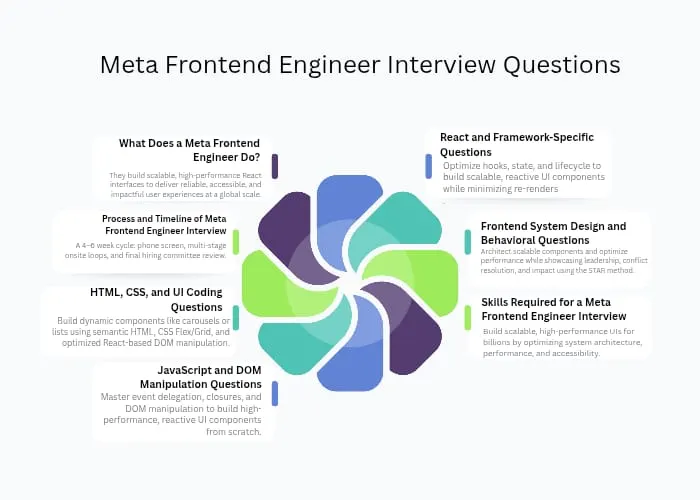
To streamline your preparation, we have compiled the ultimate list of the top 40 Meta frontend engineer interview questions. These are drawn from real-world interview scenarios and cover everything from basic styling to massive system design.
We have divided these into four distinct sections to help you structure your study sessions effectively.
HTML, CSS, and UI Coding Questions
In the UI coding rounds, interviewers want to see how quickly you can translate visual requirements into clean, semantic code. You will often be asked to build a small widget from scratch without relying on external libraries like Bootstrap or Tailwind. Here are the top 10 questions focused on UI creation:
- Build a star rating component. Write the HTML, CSS, and JavaScript to create a 5-star rating widget. It must update visually when the user hovers over the stars and save the value when clicked.
- Center a div perfectly. This is a classic question. Explain at least three different ways to perfectly center a child div inside a parent div (e.g., using Flexbox, CSS Grid, and absolute positioning).
- Implement a progress bar. Create an animated progress bar component that takes a percentage value as a prop and smoothly transitions to that width.
- Build a nested accordion menu. Write the code for an accordion that allows users to expand and collapse sections. Ensure that only one section can remain open at a time.
- Explain the CSS Box Model. Describe how margins, borders, padding, and content interact to form the final size of an element on the screen.
- What is semantic HTML, and why does it matter? Explain the difference between using generic <div> tags versus semantic tags like <header>, <article>, and <nav>, particularly focusing on SEO and screen readers.
- Implement an accessible custom checkbox. Standard checkboxes are hard to style. Build a custom checkbox using CSS that remains fully accessible to keyboard navigation and screen readers (using ARIA attributes).
- Explain CSS Specificity. How does the browser decide which CSS rule to apply when multiple rules target the same element? Explain the hierarchy of IDs, classes, and inline styles.
- Responsive vs. Adaptive design. What is the difference between these two approaches, and how do you use CSS Media Queries to build a responsive layout?
- Build a sticky footer. Write the CSS required to ensure a website’s footer always stays at the bottom of the browser window, even if the page content is very short.
Once you prove you can build beautiful interfaces, the interviewers will test your raw logic and programming knowledge.
JavaScript and DOM Manipulation Questions
The next batch of Meta frontend engineer interview questions focuses heavily on core JavaScript concepts. Meta expects you to deeply understand JavaScript, as you will often need to write custom polyfills or optimize slow code. Here are 10 essential JavaScript and DOM questions:
- Implement a debounce function. Write a wrapper function that delays the execution of a passed function until a certain amount of time has passed since its last invocation. (Highly common for search bars).
- Implement a throttle function. Write a function that ensures a given event (like window scrolling) only triggers a callback function at most once every specified number of milliseconds.
- Write a polyfill for Promise.all(). Without using the native Promise.all(), write a function that takes an array of promises and resolves only when every single promise in the array has resolved.
- Explain Event Delegation. Describe how event bubbling works in the Document Object Model (DOM) and how you can attach a single event listener to a parent element to handle clicks on multiple dynamic child elements.
- Write a function to deeply flatten an array. Given a highly nested array (e.g., [1, [2,[3, 4]]]), write a recursive JavaScript function that flattens it into a single-level array.
- Implement Function.prototype.bind() from scratch. Show your understanding of the this keyword and closures by writing a custom polyfill for the bind method.
- Deep clone a JavaScript object. Write a function that creates an exact, deep copy of a nested object without using JSON.parse(JSON.stringify(obj)), handling edge cases like Dates and undefined values.
- Explain Closures. What is a closure in JavaScript? Provide a practical code example of how closures are used to create private variables.
- How does the JavaScript Event Loop work? Explain the Call Stack, the Web APIs, the Callback Queue, and the Microtask Queue. How does JavaScript handle asynchronous operations despite being single-threaded?
- Traverse the DOM tree. Write a function that takes a DOM node and searches for all elements with a specific class name, mimicking the behavior of document.querySelectorAll().
React and Framework-Specific Questions
Since Meta created React, it is no surprise that React-focused interview questions are an integral part of Meta’s frontend engineers’ interviews. You must understand component lifecycles, hooks, and advanced rendering optimizations. Here are 10 deep-dive React & framework questions:
- Explain the Virtual DOM. How does React’s Virtual DOM differ from the actual browser DOM? Explain the “reconciliation” process and why it makes React so fast.
- What is the difference between useEffect and useLayoutEffect? Explain the exact timing of when each hook fires during the browser’s paint cycle and when you would specifically choose one over the other.
- Build a custom useFetch hook. Write a reusable React hook that takes a URL, fetches the data asynchronously, and returns the data, a loading state, and an error state.
- Prop Drilling vs. Context API. Explain what “prop drilling” is and write a brief example of how to solve it using React’s Context API.
- How do you optimize re-renders in React? Discuss advanced performance techniques using React.memo, useMemo, and useCallback to prevent child components from rendering unnecessarily.
- Implement Lazy Loading. Explain how to use React.lazy() and Suspense to split your code into smaller chunks, ensuring users only download the JavaScript they need for the current page.
- What are Error Boundaries? How do you catch JavaScript errors anywhere in a child component tree, log those errors, and display a fallback UI instead of crashing the whole application?
- Controlled vs. Uncontrolled Components. What is the difference between these two concepts in React forms? Why is one generally preferred over the other?
- Explain Server-Side Rendering (SSR). What are the benefits of SSR (like SEO and initial load time) compared to traditional Client-Side Rendering (CSR), and how do frameworks like Next.js handle it?
- How do you manage complex global state? Discuss your preferred state management solutions (like Redux, Zustand, or Recoil) and explain the specific scenarios where built-in React state is no longer sufficient.
Frontend System Design and Behavioral Questions
The final rounds separate mid-level coders from advanced engineers. Frontend system design questions are open-ended, meaning there is no single correct answer. Instead, interviewers want to see how you break down complex requirements, design network protocols, and plan for massive scale. Mixed into this are behavioral questions that assess your cultural fit. Here are 10 critical system design and behavioral questions:
- Design the Facebook News Feed. Walk the interviewer through how you would architect an infinitely scrolling feed. Discuss data fetching, caching, handling massive image assets, and recycling DOM nodes to prevent memory leaks.
- Design Facebook Messenger. How would you architect a real-time web chat application? Discuss the trade-offs between WebSockets and Server-Sent Events (SSE) for receiving messages instantly.
- Design an Autocomplete Search Component. Architect a search bar that queries a database as the user types. Discuss debouncing API calls, managing network race conditions, and caching previous search results.
- Design a scalable Image Carousel. How would you build a photo gallery that supports lazy loading, touch swiping on mobile, and pre-fetching the next image for a seamless user experience?
- How do you ensure accessibility at scale? In a system design context, explain how you would enforce strict accessibility (a11y) rules across a codebase containing thousands of components built by hundreds of different developers.
- Tell me about a time you strongly disagreed with a Product Manager. Use the STAR method (Situation, Task, Action, Result) to explain how you resolved a technical disagreement using data and logic rather than emotion.
- What is the most difficult frontend bug you have ever fixed? Describe a highly complex issue (like a memory leak or a race condition), how you used profiling tools to track it down, and how you ultimately resolved it.
- Tell me about a time you missed a critical deadline. Take accountability. Explain the root cause of the delay, how you communicated the bad news to stakeholders, and what you changed in your estimation process afterward.
- How do you balance shipping fast vs. writing perfect code? Meta’s famous motto used to be “Move Fast and Break Things.” Discuss how you handle the trade-off between technical debt and delivering immediate business value.
- Why do you want to work at Meta? Avoid talking about salary. Focus on your passion for building user interfaces at an unprecedented global scale and your desire to work alongside industry-leading engineers.
Skills Required for a Meta Frontend Engineer Interview
Meta Frontend Engineers are expected to build highly scalable, high-performance user interfaces that serve billions of users. The role demands a strong combination of core frontend fundamentals, systems thinking, and product awareness.
Engineers must not only write clean code but also understand how their decisions impact performance, accessibility, and user engagement at scale.
Below is a structured overview of the key skills a Meta frontend engineer should possess.
| Skill Area | Key Points |
|---|---|
| HTML, CSS & UI Fundamentals | Semantic HTML, Flexbox, Grid, responsive design, cross-browser compatibility |
| JavaScript Fundamentals | Closures, event loop, promises, async/await, DOM manipulation, event delegation |
| React & Frontend Frameworks | Hooks, Virtual DOM, component lifecycle, state management, performance optimization |
| Data Structures & Algorithms | Arrays, strings, hash maps, recursion, basic tree traversal (DOM as tree) |
| Performance Optimization | Code-splitting, lazy loading, memoization, reducing re-renders, bundle optimization |
| System Design (Frontend) | Designing scalable UIs like feeds, chat apps, caching strategies, API handling |
| Accessibility (a11y) | Semantic tags, ARIA roles, keyboard navigation, screen reader compatibility |
| Testing & Debugging | Unit testing (Jest), integration testing, debugging browser issues, performance profiling |
| Cross-Browser & Device Compatibility | Handling different browsers, screen sizes, and low-end devices efficiently |
| Version Control & Tooling | Git workflows, build tools (Webpack, Vite), package managers |
| API Integration | REST APIs, GraphQL, error handling, data fetching strategies |
| Problem-Solving | Breaking UI problems, optimizing logic, writing efficient and maintainable code |
| Collaboration & Communication | Working with designers, backend engineers, and product managers |
| Product Thinking | Understanding user behavior, improving UX, focusing on engagement, and usability |
| Adaptability & Learning | Keeping up with evolving frontend tools, frameworks, and best practices |
Conclusion
Meta requires a deep, fundamental understanding of how web and mobile browsers work, how to optimize JavaScript, and how to architect applications for billions of users. Mastering these Meta frontend engineer interview questions is the first step toward landing a highly coveted role at the company.
Remember that the interviewers are not just looking for the right answers. They want to see how you communicate, how you handle edge cases, and how you approach problem-solving when you get stuck.
The best approach is to practice writing code without an IDE, speak your thoughts out loud, and conduct mock system design interviews with peers or platforms like Interview Kickstart. With dedicated preparation and the right mindset, your dream job at Meta is entirely within reach.
FAQs: Meta Frontend Engineer Interview Questions
Q1. Do I need to know React perfectly to pass the Meta frontend interview?
While Meta created React and heavily relies on it, you do not technically have to use it in your interview. Most interviewers allow you to use plain “Vanilla” JavaScript or another framework you are comfortable with (like Vue or Angular) for the UI coding rounds. However, having a deep understanding of React will give you a massive advantage and make communicating with your interviewers much easier.
Q2. Are Data Structures and Algorithms (DSA) tested in the frontend loop?
Yes, but not as intensely as they are for backend engineers. You usually will not be asked complex dynamic programming or hard graph theory questions. However, you must be very comfortable with arrays, strings, hash maps, and basic tree traversals (since the DOM is essentially a massive tree structure).
Q3. Will I be asked to write CSS from scratch without tools like Tailwind?
Yes. Meta interviewers generally want to see your core understanding of CSS. You should be fully prepared to write pure, vanilla CSS to style your components during the UI rounds. You must deeply understand Flexbox, Grid, positioning, and the box model.
Q4. How long does it take to hear back after the onsite interview?
Meta moves relatively fast compared to other tech giants. You can generally expect to hear back from your recruiter within one to two weeks after completing your final onsite loop. The delay is usually due to aligning the schedules of the hiring committee members who need to review your packet.
Q5. What happens if I fail the interview? Can I apply again?
Failing a FAANG interview is very common and is not the end of your career. Meta typically enforces a “cooling-off” period, which is usually around 6 to 12 months. After this period, your record is cleared, and you can apply again. Use this time to study the areas where you struggled and practice more intensely.
References
Recommended Reads:


