Applied Agentic AI: Build and Operate Enterprise AI Platforms

Lead, design, and scale agentic AI systems the way top engineering leaders will in 2026, owning architecture, orchestration, evaluation, and production rollout with confidence.

Built for Engineering Managers responsible for modern AI platforms, not just teams shipping features.
4.8
4.7
4.8

Next webinar starts in

00

DAYS

:

00

HR

:

00

MINS

:

00

SEC

Program Overview

Who It Is For

  • EMs leading teams that build and operate agentic AI systems
  • EMs transitioning into AI first platform ownership roles
  • EMs accountable for scaling AI powered workflows and outcomes

Instructors

  • Senior FAANG plus Engineering Managers and platform leads
  • Practitioners running agentic AI systems in production
  • Experience grounded guidance from real ownership roles

Program Duration

  • 15 weeks of structured, outcome focused learning
  • Covers agentic AI foundations through enterprise scale launch
  • Designed to fit alongside active EM responsibilities

Applied Agentic AI Interview Readiness

  • Interview preparation focused on agentic AI and platform roles
  • Learn to explain architecture decisions, tradeoffs, and metrics
  • Practice system design and leadership scenarios expected of EMs

Live Learning

  • 40 plus hours of live instruction with FAANG plus EMs and AI architects
  • Guided system builds with real time feedback
  • Sessions focused on decision making, not theory

Real-World Projects

  • 3 live guided agentic system build projects
  • 3 enterprise grade capstone projects
  • Emphasis on architecture, orchestration, evaluation, and scale

This program prepares Engineering Managers to own AI platforms end to end, the way EM roles will be defined in 2026 and beyond.

Average package for alumni
$ 112275
Careers transformed
0 K+
Average ROI on course price
0 x

30+ Tools & Tech You’ll Learn

Why EMs Choose This Applied Agentic AI Program

Built for Real Production Platforms

  • Design and build agentic AI systems through live guided projects
  • Reflect how AI platforms operate in real engineering organizations
  • Go beyond demos to systems that run at enterprise scale

What EMs Actually Use at Work

  • Learn agentic AI concepts relevant to platform and system ownership
  • Focus on real business workflows, not academic exercises
  • Apply proven patterns directly to ongoing engineering initiatives

Own the Shift to AI Platforms

  • Understand how agentic AI is changing day to day engineering work
  • Gain skills to design, implement, and operate AI platforms
  • Take ownership of AI adoption, not just experimentation

Learn from EMs Building It Today

  • Guided by 700+ FAANG+ Engineering Managers and platform leaders
  • Learn directly from professionals running agentic AI systems in production
  • Get practical insights grounded in real ownership roles

Applied Agentic AI Interview Preparation

  • Interview preparation for agentic AI and platform focused EM roles
  • Learn to explain architecture decisions, tradeoffs, and evaluation clearly
  • Practice system design and leadership scenarios expected in senior EM interviews

Results EMs Trust

  • Trusted by thousands of professionals globally
  • NPS of 55 and learner rating of 4.75 plus
  • Outcomes driven by applied learning and real platform work

This program prepares Engineering Managers to own AI platforms end to end, the core EM mandate in 2026 and beyond.

Next webinar starts in

00

DAYS

:

00

HR

:

00

MINS

:

00

SEC

Detailed Curriculum: Applied Agentic AI for Engineering Managers

Applied Agentic AI Core for EMs
Foundations and Low-Code Setup
  • Core concepts including LLMs, agents, and multi agent systems
  • Low code stacks such as LangFlow, Relevance AI, and Flowise
  • Architecture layers covering data, model, agent, and orchestration
  • How prompts, retrievers, and agents connect in real systems
Outcome: Build intuition for agentic AI systems and deploy a first working agent.
Agentic Fundamentals
  • Reflex, goal based, utility, and LLM driven agents
  • Memory design including buffer, summary, and vector memory
  • Tool usage, prompt templates, and logic control
  • Cost, latency, and determinism tradeoffs

Outcome: Understand agent behavior and make informed design tradeoffs.

RAG Knowledge Agents
  • Embeddings and chunking strategies
  • Vector database concepts and retrieval pipelines
  • Grounded response generation and evaluation techniques
Outcome: Design reliable RAG systems that reduce hallucinations.
Multi-Agent Orchestration
  • Task decomposition and role based agents
  • Planner, executor, and critic coordination patterns
  • Visual message passing and debugging
Outcome: Design and operate coordinated multi agent systems.
Conversational and Multimodal Agents
  • Memory retention strategies for long running agents
  • Conversational UX and persona design
  • Voice and multimodal interfaces
Outcome: Build stateful conversational systems with voice and multimodal inputs.
Agent Communication Protocols
  • Asynchronous workflows and message graphs
  • Replay logs and debugging techniques
  • Protocol based negotiation patterns

Outcome: Understand and design structured agent communication.

Specialized Domain Agents
  • API integrations and domain logic
  • Validation, routing, and hybrid pipelines
  • Structured and unstructured data handling
Outcome: Build domain specific agent workflows suitable for enterprise use.
Technical Fine-Tuning and Integration
  • Fine tuning concepts including LoRA and PEFT
  • Evaluation metrics such as BLEU, ROUGE, and perplexity
  • Serving models through managed endpoints
Outcome: Evaluate when fine tuning is justified and integrate custom models responsibly.
Enterprise Agentic AI System
  • Full workflow orchestration using production tools
  • Architecture diagramming
  • Evaluation and safety reporting
Outcome: Design and review a complete enterprise grade agentic AI system.
Agentic AI System Design and Interview Preparation for EMs
AI Use Case Framing and Metrics
  • Problem framing and AI fit assessment
  • Deterministic versus AI versus agentic decisions
  • Success metrics, guardrails, and MVP scope 
Architecture and Workflows
  • End to end architecture for agentic products
  • Orchestration patterns and integrations
  • Permissions and non functional constraints
Data and Retrieval
  • Approved data sources and retrieval behavior
  • Data quality, freshness, and ownership
  • Traceability and versioning for enterprise trust
Evaluation and Monitoring
  • Offline evaluation strategies
  • Online monitoring and feedback loops
  • Release gating and rollback decisions
Risk and Governance
  • Risk tiers and human in the loop design
  • Security, privacy, and prompt misuse controls
  • Responsible AI and compliance alignment
Launch and Scale
  • Rollout strategy and change management 
  • Cost, ROI, and operating constraints 
  • Build versus buy decisions and pilot de risk planning
Data Quality and Integration Challenges
Getting ready for AI Solutions
Technical Feasibility and ROI of GenAI Projects

Detailed Curriculum: Applied Agentic AI for Engineering Managers

Applied Agentic AI Core for EMs
Foundations and Low-Code Setup
  • Core concepts including LLMs, agents, and multi agent systems
  • Low code stacks such as LangFlow, Relevance AI, and Flowise
  • Architecture layers covering data, model, agent, and orchestration
  • How prompts, retrievers, and agents connect in real systems
Outcome: Build intuition for agentic AI systems and deploy a first working agent.
Agentic Fundamentals
  • Reflex, goal based, utility, and LLM driven agents
  • Memory design including buffer, summary, and vector memory
  • Tool usage, prompt templates, and logic control
  • Cost, latency, and determinism tradeoffs

Outcome: Understand agent behavior and make informed design tradeoffs.

RAG Knowledge Agents
  • Embeddings and chunking strategies
  • Vector database concepts and retrieval pipelines
  • Grounded response generation and evaluation techniques
Outcome: Design reliable RAG systems that reduce hallucinations.
Multi-Agent Orchestration
  • Task decomposition and role based agents
  • Planner, executor, and critic coordination patterns
  • Visual message passing and debugging
Outcome: Design and operate coordinated multi agent systems.
Conversational and Multimodal Agents
  • Memory retention strategies for long running agents
  • Conversational UX and persona design
  • Voice and multimodal interfaces
Outcome: Build stateful conversational systems with voice and multimodal inputs.
Agent Communication Protocols
  • Asynchronous workflows and message graphs
  • Replay logs and debugging techniques
  • Protocol based negotiation patterns

Outcome: Understand and design structured agent communication.

Specialized Domain Agents
  • API integrations and domain logic
  • Validation, routing, and hybrid pipelines
  • Structured and unstructured data handling
Outcome: Build domain specific agent workflows suitable for enterprise use.
Technical Fine-Tuning and Integration
  • Fine tuning concepts including LoRA and PEFT
  • Evaluation metrics such as BLEU, ROUGE, and perplexity
  • Serving models through managed endpoints
Outcome: Evaluate when fine tuning is justified and integrate custom models responsibly.
Enterprise Agentic AI System
  • Full workflow orchestration using production tools
  • Architecture diagramming
  • Evaluation and safety reporting
Outcome: Design and review a complete enterprise grade agentic AI system.
Agentic AI System Design and Interview Preparation for EMs
AI Use Case Framing and Metrics
  • Problem framing and AI fit assessment
  • Deterministic versus AI versus agentic decisions
  • Success metrics, guardrails, and MVP scope 
Architecture and Workflows
  • End to end architecture for agentic products
  • Orchestration patterns and integrations
  • Permissions and non functional constraints
Data and Retrieval
  • Approved data sources and retrieval behavior
  • Data quality, freshness, and ownership
  • Traceability and versioning for enterprise trust
Evaluation and Monitoring
  • Offline evaluation strategies
  • Online monitoring and feedback loops
  • Release gating and rollback decisions
Risk and Governance
  • Risk tiers and human in the loop design
  • Security, privacy, and prompt misuse controls
  • Responsible AI and compliance alignment
Launch and Scale
  • Rollout strategy and change management 
  • Cost, ROI, and operating constraints 
  • Build versus buy decisions and pilot de risk planning
Data Quality and Integration Challenges
Getting ready for AI Solutions
Technical Feasibility and ROI of GenAI Projects

Live Guided Projects

First LLM-powered Agent

Build your first LLM-powered agent to understand how agents differ from chatbots. Learn how LLMs act as reasoning engines, how tools and memory fit into agent architecture, and how agent behavior is controlled.

Knowledge Assistant (RAG with Evaluation)

Build a document-grounded knowledge assistant using Retrieval-Augmented Generation (RAG). Ingest PDFs and text files, design chunking strategies, retrieve relevant context, and evaluate retrieval quality to prevent hallucinations.

Multi-Agent Research Team

Design a multi-agent system using a Planner → Executor → Critic pattern. Agents collaborate to research, summarize, and critique outputs, demonstrating task decomposition, coordination, and quality loops.

Conversational Research Assistant

Build a stateful, voice-enabled conversational agent with memory. Handle multi-turn conversations, track intent across sessions, and explore memory drift and summarization trade-offs in long-running agents.

Negotiation Simulator

Create a buyer–seller negotiation system where agents communicate using structured protocol messages instead of free text. Implement state transitions, branching logic, retries, and error handling to prevent loops and ambiguity.

Price Comparison Agent

Build a domain-specific vertical agent that compares data from multiple APIs and sources. Handle authentication, rate limits, retries, caching, and return structured, schema-validated insights.

Decision Support Agent

Design a recommendation pipeline that summarizes information, scores options, ranks results, and presents insights through a visual dashboard. Emphasize faithfulness, bias awareness, and human-in-the-loop review.

Production-Ready Support Agent

Build a production-ready customer support agent with RAG, safety guardrails, evaluation pipelines, and cost/latency dashboards. Learn how to operate agents responsibly under real-world constraints.

Domain-Specific Fine-Tuned Agent

Build a domain-adapted agent by fine-tuning a language model for a specific vertical such as Finance, Healthcare, or SaaS.
Learn how to prepare datasets, apply parameter-efficient fine-tuning techniques, and integrate the fine-tuned model into an existing agent workflow. Evaluate performance improvements against prompting and RAG baselines, and analyze cost–benefit trade-offs to decide when fine-tuning is justified in real-world systems

Projects are subject to change as per industry inputs.

Live Guided Projects

First LLM-powered Agent

Build your first LLM-powered agent to understand how agents differ from chatbots. Learn how LLMs act as reasoning engines, how tools and memory fit into agent architecture, and how agent behavior is controlled.

Knowledge Assistant (RAG with Evaluation)

Build a document-grounded knowledge assistant using Retrieval-Augmented Generation (RAG). Ingest PDFs and text files, design chunking strategies, retrieve relevant context, and evaluate retrieval quality to prevent hallucinations.

Multi-Agent Research Team

Design a multi-agent system using a Planner → Executor → Critic pattern. Agents collaborate to research, summarize, and critique outputs, demonstrating task decomposition, coordination, and quality loops.

Conversational Research Assistant

Build a stateful, voice-enabled conversational agent with memory. Handle multi-turn conversations, track intent across sessions, and explore memory drift and summarization trade-offs in long-running agents.

Negotiation Simulator

Create a buyer–seller negotiation system where agents communicate using structured protocol messages instead of free text. Implement state transitions, branching logic, retries, and error handling to prevent loops and ambiguity.

Price Comparison Agent

Build a domain-specific vertical agent that compares data from multiple APIs and sources. Handle authentication, rate limits, retries, caching, and return structured, schema-validated insights.

Decision Support Agent

Design a recommendation pipeline that summarizes information, scores options, ranks results, and presents insights through a visual dashboard. Emphasize faithfulness, bias awareness, and human-in-the-loop review.

Production-Ready Support Agent

Build a production-ready customer support agent with RAG, safety guardrails, evaluation pipelines, and cost/latency dashboards. Learn how to operate agents responsibly under real-world constraints.

Domain-Specific Fine-Tuned Agent

Build a domain-adapted agent by fine-tuning a language model for a specific vertical such as Finance, Healthcare, or SaaS.
Learn how to prepare datasets, apply parameter-efficient fine-tuning techniques, and integrate the fine-tuned model into an existing agent workflow. Evaluate performance improvements against prompting and RAG baselines, and analyze cost–benefit trade-offs to decide when fine-tuning is justified in real-world systems

Projects are subject to change as per industry inputs.

Capstone Projects

Projects are subject to change as per industry inputs. Choose from one of 3 Capstone Projects.

Multi-Agent BRD-to-Engineering System Generator

This project equips Engineering Managers with an AI-powered multi-agent system that transforms complex BRDs into structured engineering plans and technical designs. Using n8n for orchestration, LLMs for parsing and generation, and a user-friendly UI, learners build agents for planning, scheduling, architecture, PoC scoping, and tech stack recommendations. The solution streamlines project initiation, enforces standardization, and accelerates decision-making, enabling EMs to produce stakeholder-ready artifacts quickly and efficiently.

Multi-Agent Hiring Process Intelligence System

This Project enables Engineering Managers to gain real-time visibility and insights into the hiring funnel using a multi-agent intelligence system. Built with n8n orchestration and LLM-driven analysis, agents track sourcing quality, rejection trends, panel workloads, and offer declines. The system generates actionable recommendations, highlights bottlenecks, and presents metrics via a dashboard-style UI. By standardizing insights and automating interventions, learners build tools that enhance hiring efficiency, improve candidate experience, and accelerate role closures.

Multi-Agent Team Sentiment & Growth Feedback System

This project empowers Engineering Managers to build a multi-agent system that automates team surveys, extracts insights, and drives actionable improvements in culture, learning, and career growth. Using n8n orchestration, LLM-powered survey generation, adaptive feedback logic, and dashboard-style interfaces, learners design agents for survey cycles, sentiment analysis, action recommendations, and follow-up tracking. The system helps EMs foster engagement, track progress over time, and translate team feedback into tangible outcomes for morale, retention, and performance.

Projects are subject to change as per industry inputs. Choose from one of 3 Capstone Projects.

Capstone Projects

Projects are subject to change as per industry inputs. Choose from one of 3 Capstone Projects.

Multi-Agent BRD-to-Engineering System Generator

Resume/ATS scoring assistant

This project equips Engineering Managers with an AI-powered multi-agent system that transforms complex BRDs into structured engineering plans and technical designs. Using n8n for orchestration, LLMs for parsing and generation, and a user-friendly UI, learners build agents for planning, scheduling, architecture, PoC scoping, and tech stack recommendations. The solution streamlines project initiation, enforces standardization, and accelerates decision-making, enabling EMs to produce stakeholder-ready artifacts quickly and efficiently.

Multi-Agent Hiring Process Intelligence System

This Project enables Engineering Managers to gain real-time visibility and insights into the hiring funnel using a multi-agent intelligence system. Built with n8n orchestration and LLM-driven analysis, agents track sourcing quality, rejection trends, panel workloads, and offer declines. The system generates actionable recommendations, highlights bottlenecks, and presents metrics via a dashboard-style UI. By standardizing insights and automating interventions, learners build tools that enhance hiring efficiency, improve candidate experience, and accelerate role closures.

Multi-Agent Team Sentiment & Growth Feedback System

This project empowers Engineering Managers to build a multi-agent system that automates team surveys, extracts insights, and drives actionable improvements in culture, learning, and career growth. Using n8n orchestration, LLM-powered survey generation, adaptive feedback logic, and dashboard-style interfaces, learners design agents for survey cycles, sentiment analysis, action recommendations, and follow-up tracking. The system helps EMs foster engagement, track progress over time, and translate team feedback into tangible outcomes for morale, retention, and performance.

Projects are subject to change as per industry inputs. Choose from one of 3 Capstone Projects.

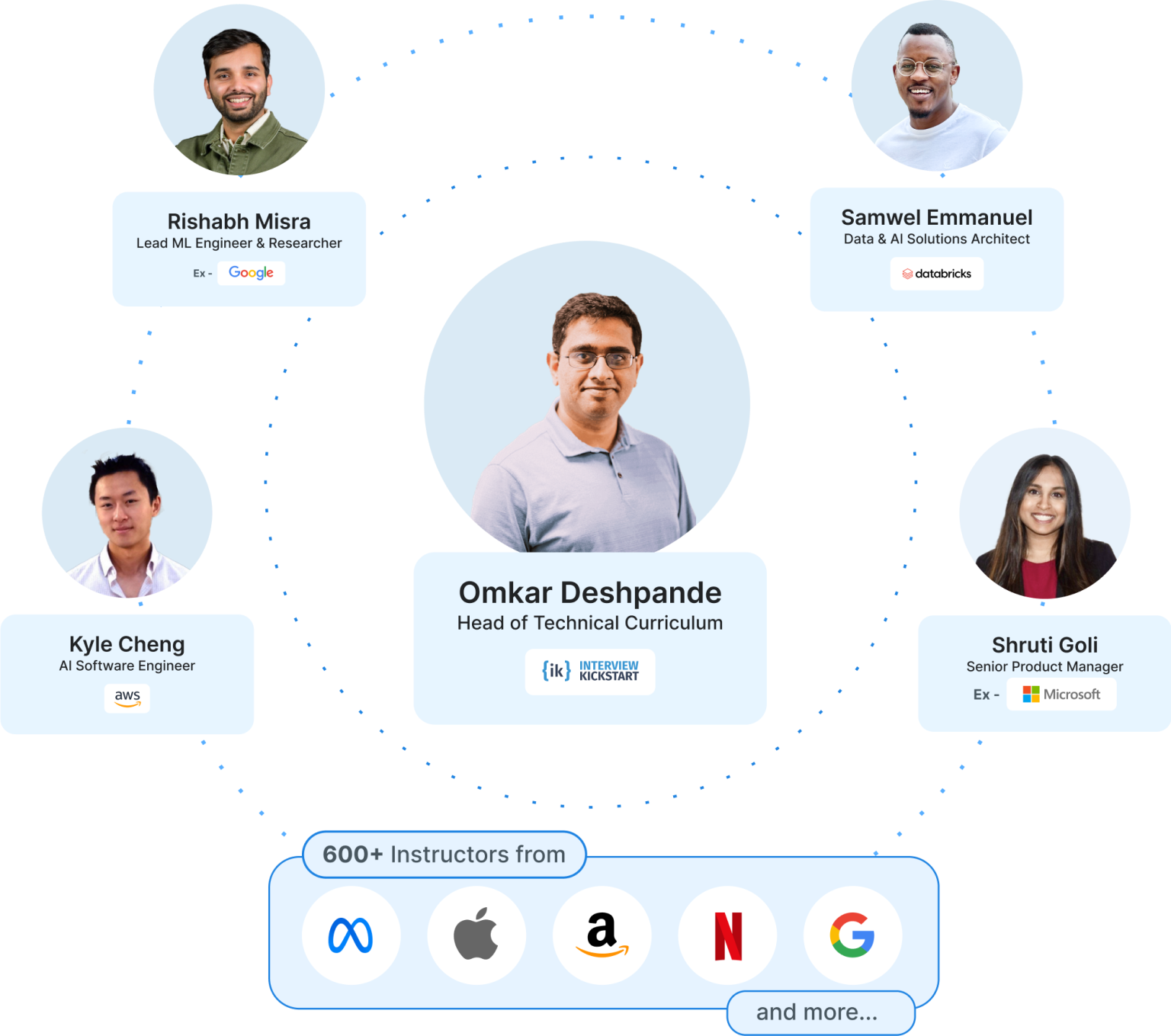
falag FAANG+ Instructors to Train You

Get mentored by AI/ML leaders who are driving Agentic AI innovation at top global companies.

The IK Experience: What Our Alumni Are Saying

Our engineers land high-paying and rewarding offers from the biggest tech companies, including Facebook, Google, Microsoft, Apple, Amazon, Tesla, and Netflix.

Next webinar starts in

00

DAYS

:

00

HR

:

00

MINS

:

00

SEC

Select a course based on your goals

Agentic AI

Learn to build AI agents to automate your repetitive workflows

Switch to AI/ML

Upskill yourself with AI and Machine learning skills

Interview Prep

Prepare for the toughest interviews with FAANG+ mentorship

FAQs

Agentic AI focuses on autonomous systems that operate proactively to achieve goals using LLMs and other tools, without constant human intervention. Unlike traditional AI, which is often reactive and generally requires explicit instructions for each task, Agentic AI understands its environment, thinks through the goals and how to achieve them, makes decisions, takes actions, learns from its experiences, and adapts its behavior over time.

Applications of Agentic AI include:

  • Tech & Program Management:Deploying agents that track sprint progress, monitor PR velocity, generate engineering reports, and flag burnout risks, allowing teams to operate with greater autonomy and precision.
  • Healthcare: Agents that can monitor patients, analyze medical data, assist with diagnoses, and personalize treatment plans.   
  • Finance: Systems that can manage investments, detect fraud, and provide personalized financial advice autonomously.   
  • Customer Service: Intelligent virtual assistants that can understand user intent, access information, and take actions to resolve issues independently.   
  • Supply Chain Management: Autonomous systems that can analyze demand, predict disruptions, and optimize logistics in real-time. 
  • Robotics: Robots capable of performing complex tasks in unstructured environments, adapting to changes and making decisions on their own.

This course teaches Engineering Managers how to integrate Agentic AI into engineering workflows to drive automation, efficiency, and strategic decision-making.

No, our Applied Agentic AI Program for Engineering Managers is beginner-friendly and designed for EMs from diverse technical backgrounds. A Python crash course is included.

You’ll build hands-on projects like an AI agent for stock analysis, a multi-agent healthcare system, an automated data insights generator, using python and low-code platform like n8n.

Yes. Specialized sessions focus on technical guidance, AI leadership, ROI evaluation, and managing AI/ML professionals.

Through live sessions led by FAANG+ practitioners, FAANG-focused interview prep, and mock interviews with hiring managers and tech leads. You’ll also build a compelling portfolio with capstone projects reviewed by mentors from companies like Google, Amazon, and Meta.

Expect around 10 hours of learning per week , covering live sessions, project work, and domain-specific learning. The structure is of 14 weeks—9 weeks of core curriculum, 5 weeks of domain-specific Capstone Projects, with live sessions and peer feedback.

All our instructors are current or former FAANG+ Engineering Leaders with deep expertise in Generative AI, LLMs, and AI/ML.

You’ll work with LangChain, LangGraph,n8n, Streamlit, Pinecone, LlamaIndex, FastAPI, and more.

You get access to: 

  • Technical Coaching session—one per week
  • Practice sessions/assignment review sessions—Weekly 
  • TA support over email—Any time

This course focuses on real-world engineering use cases, with no-code/low-code tools, leadership development, and Agentic AI—not abstract theory or deep ML.

All live sessions are recorded and accessible on-demand. You can catch up anytime and even rewatch for revision.

Yes! We offer multiple financing options to make the course more accessible to working professionals.

Register for our webinar

How to Nail your next Technical Interview

Loading_icon
Loading...
1 Enter details
2 Select slot
By sharing your contact details, you agree to our privacy policy.

Select a Date

Time slots

Time Zone:

Almost there...
Share your details for a personalised FAANG career consultation!
Your preferred slot for consultation * Required
Get your Resume reviewed * Max size: 4MB
Only the top 2% make it—get your resume FAANG-ready!

Registration completed!

🗓️ Friday, 18th April, 6 PM

Your Webinar slot

Mornings, 8-10 AM

Our Program Advisor will call you at this time

Register for our webinar

Transform Your Tech Career with AI Excellence

Transform Your Tech Career with AI Excellence

Join 25,000+ tech professionals who’ve accelerated their careers with cutting-edge AI skills

25,000+ Professionals Trained

₹23 LPA Average Hike 60% Average Hike

600+ MAANG+ Instructors

Webinar Slot Blocked

Interview Kickstart Logo

Register for our webinar

Transform your tech career

Transform your tech career

Learn about hiring processes, interview strategies. Find the best course for you.

Loading_icon
Loading...
*Invalid Phone Number

Used to send reminder for webinar

By sharing your contact details, you agree to our privacy policy.
Choose a slot

Time Zone: Asia/Kolkata

Choose a slot

Time Zone: Asia/Kolkata

Build AI/ML Skills & Interview Readiness to Become a Top 1% Tech Pro

Hands-on AI/ML learning + interview prep to help you win

Switch to ML: Become an ML-powered Tech Pro

Explore your personalized path to AI/ML/Gen AI success

Your preferred slot for consultation * Required
Get your Resume reviewed * Max size: 4MB
Only the top 2% make it—get your resume FAANG-ready!
Registration completed!
🗓️ Friday, 18th April, 6 PM
Your Webinar slot
Mornings, 8-10 AM
Our Program Advisor will call you at this time