
Landing a role as an AWS Cloud Architect is one of the most rewarding career moves in tech — but cracking the Amazon Cloud Architect Interview is no small feat. Amazon’s hiring process is famously rigorous, combining deep technical assessments with its unique Leadership Principles-based behavioral rounds that trip up even seasoned professionals.
Whether you’re a cloud engineer eyeing your first architect title or a senior professional making the leap to AWS, preparation is everything. From designing fault-tolerant, scalable architectures to articulating cost-optimization strategies under pressure, the Amazon Cloud Architect Interview demands both breadth and depth of knowledge.
This guide breaks down everything you need to walk into that interview with confidence — covering the most frequently asked technical questions, real-world scenario walkthroughs, Leadership Principles tips, and proven strategies to showcase your expertise. Let’s get you interview-ready.
Key Takeaways
- The Amazon cloud architect interview process is spread over several phases and rounds.
- These phases are the recruiter screen, the technical screen, the onsite/ virtual screen, and the final bar raiser.
- Amazon hires cloud architects from L4-L7+ levels.
- You are matched for a project and department, and the intensity of interviews depends on the level.
- Technical questions focus on cloud architecture and AWS, large-scale system design, enterprise migration and modernization, security, compliance and governance, cost optimization, and business alignment, behavioral, and culture fit.
- Leadership interviews are focused on the 16 Amazon leadership principles, and you must be strongly aligned with these principles.
- Prepare use case stories based on the STAR framework and follow the preparatory plan and timeline.
Role Overview: What Does the Amazon Cloud Architect Do?
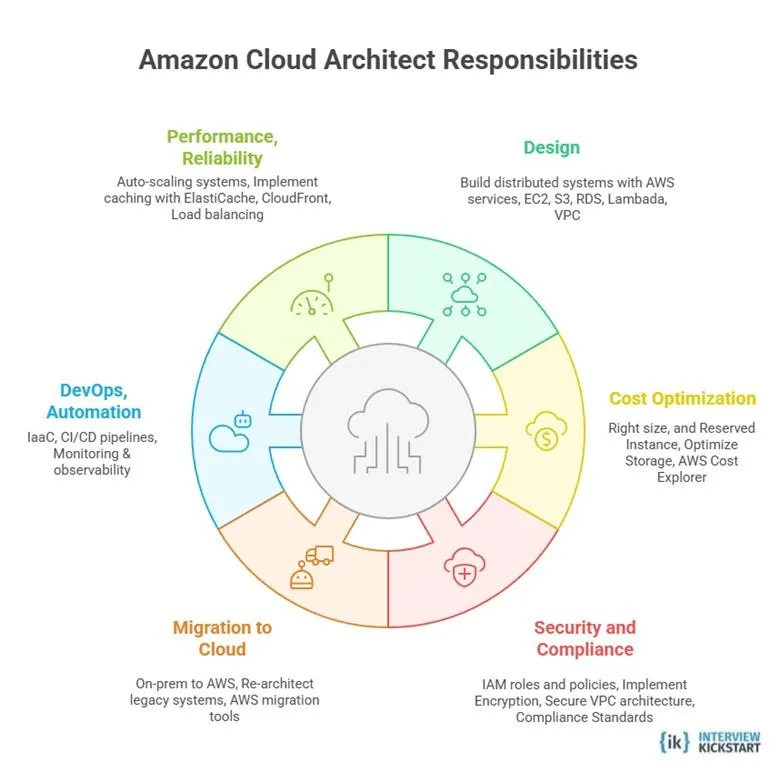
An Amazon cloud architect manages designs, deploys, and manages secure, scalable, and cost-effective infrastructure on Amazon Web Services. They align business goals with technical solutions, creating designs and pathways for cloud migration, optimizing system performance, and selecting appropriate services like EC2 or S3.
Let us look at their responsibilities.
| Level | Role Title | Responsibilities | Typical Experience | Total Annual Comp USD, US |
|---|---|---|---|---|
| L4 | SA1 Associate | Implementing AWS solutions, assisting with proof-of-concepts, and developing basic cloud architecture skills. | 0–3 Years | 160,000 – 162,000 |
| L5 | SA2 Mid-Level | Own technical relationships with customers, design scalable, secure, and reliable systems, and influence customer technical decisions. | 5+ Years | $540,000 – 590,000 |
| L6 | SA3 Senior | Act as a subject matter expert (SME), lead large-scale migration or modernization projects, mentor junior architects, and define best practice | 5–10+ Years | 226,000 – 228,000 |
| L7 | Principal SA | Set technical strategy for high-stakes, organization-wide projects, influence product roadmaps, and solve highly complex architectural problems | 10+ Years | 429,000 – 439,000 |
Typical Amazon Cloud Architect interview Process
| Stage | Format | Duration | Focus Areas |
|---|---|---|---|
| Round 1 | Recruiter | — | Role alignment, online assessment — with technical MCQs and personality/culture questions, past technical leadership, customer engagements, and cloud strategy work |
| Round 2 | Phone Technical Screen with AWS/Cloud Architect. | 1-2 rounds of 45–60 mins each | Technical Deep Dive AWS architectural concepts, design patterns, scalability, performance, cost optimization, and real-world architecture decisions, multi-cloud strategies, enterprise migration patterns, hybrid networking, security models, and critical trade-offs.
System Design and Architecture high-level architecture design for complex scenarios |
| Round 3 | Onsite / Virtual Loop | 4-6 rounds | Architecture Deep Dive on designing large-scale, fault-tolerant, secure, and cost-optimized cloud solutions
Scalable System Design complex architectural problems multi-region, disaster-recovery, microservices, event-driven systems Business & Customer Alignment, simulate customer scenarios Behavioral / Leadership Principles |
| Round 4/ Bar Raiser | Hiring Decision | — | Amazon’s hiring bar — both technically and culturally, leadership thinking and long-term impact |
What Amazon Evaluates for Cloud Architect Roles?
Amazon cloud architects are evaluated on several areas of deep technical competency, problem-solving and thinking, and behavioral and cultural fit. The important areas are system design, project delivery, mentoring, creating a collaborative culture, and the ability to act as a two-way interface between strategy and team execution.
Amazon wants applied scientists with deep technical expertise, business acumen, and a strong alignment with their 16 Leadership Principles. Amazon applied scientists should have structured and logical thinking, the ability to solve complex, ambiguous problems, and transform data into actionable insights.
- Hard Skills (Technical Competencies): AWS Service Mastery, System Design & Problem Solving
- Soft Skills (Leadership Principles & Behavioral): Customer Obsession and Ownership, Dive Deep and Deliver Results, Innovation and Judgment, Culture and Adaptability, Science Leadership, Communication, Mentorship
Domains Evaluated in Amazon Cloud Architect Interviews
Before you start preparing, it’s essential to understand exactly what Amazon evaluates during the Amazon Cloud Architect Interview process. Rather than testing random technical trivia, Amazon assesses candidates across specific, well-defined domains that reflect the real responsibilities of the role. These domains span everything from core AWS service knowledge and solution design to security, cost management, and operational excellence. Understanding which areas carry the most weight allows you to focus your preparation strategically — so you’re not just studying hard, you’re studying smart. Here’s a breakdown of the key domains you can expect to be evaluated on.
| Area | Domain | Sub Domains |
|---|---|---|
| Technical Competency | Cloud Architecture and AWS | Expertise in AWS core and advanced services, multi-account architecture (Control Tower, Organizations), Multi-region and global deployments, High availability & disaster recovery (RTO/RPO modeling), Cost-aware architecture decisions, Security-first architecture design |
| Large-Scale System Design | Designing internet-scale systems, Microservices and event-driven architectures, API gateways and service mesh, Data architecture (OLTP vs OLAP decisions), Streaming systems and real-time processing, Observability (monitoring, logging, tracing) | |
| Enterprise Migration and Modernization | Rehost / Replatform / Refactor strategies, Hybrid connectivity (Direct Connect, VPN), Legacy system modernization, Containerization and Kubernetes strategy, DevOps and CI/CD pipelines, Cloud adoption frameworks | |
| Security, Compliance and Governance | IAM strategy and least privilege models, Network segmentation, Encryption at rest and in transit, Key management (KMS strategies), Compliance frameworks (SOC2, HIPAA, GDPR basics), Identity federation & SSO | |
| Problem-Solving and Thinking | Cost Optimization and Business Alignment | Cost modeling and TCO discussions, Reserved Instances vs Savings Plans trade-offs, Autoscaling and right-sizing strategies, Storage tiering decisions, Business case justification |
| Behavioral and Culture Fit | Alignment with 16 Amazon leadership principles | Scenario questions, case studies, Executive Communication and Presentation Skills, STAR framework answers on alignment with 16 Amazon leadership principles |
Now let’s understand these domains and the questions asked in them in detail.
1. Cloud Architecture and AWS
What do they evaluate?
Amazon cloud architect interview questions on cloud architecture and AWS are on scenario-based design, cost optimization, security, and highly available architecture. Important topics are designing for failover (multi-AZ), migrating on-premises to cloud, leveraging serverless, optimizing database performance, and implementing Infrastructure as Code (IaaC) to meet the Well-Architected Framework pillars.
Your knowledge of hybrid cloud, CloudFormation, and Terraform to create cost-effective, planet-scale solutions is evaluated. Auto migration and upgrading legacy operations are important areas in which you are evaluated.
Sample Questions and Answers
Q1. Describe the design of a multi-region active-active web application with low latency and zero downtime.
The architecture recommended is: Route traffic with Route 53 latency-based routing + health checks, and use CloudFront for global edge caching. Deploy applications in multiple regions and use ALB + Auto Scaling groups. Implement stateless services and externalize session state to ElastiCache/DynamoDB.
Database strategy is to use DynamoDB Global Tables for active-active writes, or Aurora Global Database if a strong relational model is required.
State and consistency: Handle eventual consistency in the app layer and use idempotent writes.
DR strategy with RTO: near zero, and RPO: near zero global replication.
Q2. Describe the method to optimize AWS costs at enterprise scale.
Several steps are involved. They are:
- Step 1 Visibility: Use Cost Explorer to examine cost and usage reports, and tag compliance audit.
- Step 2 Optimization: Carry out rightsizing EC2, check the savings plans and Reserved Instances, and spot instances for batch. Define storage tiering with S3 IA, Glacier, and start graviton migration.
- Step 3 Governance: Check the budgets + alerts, FinOps review cadence, and the automated idle resource cleanup.
Q3. Explain the process to manage distributed system failures.
Consider that all systems will fail. Set multi-AZ minimum, circuit breakers, and retry with exponential backoff. Use chaos testing with observability for metrics, logs, and traces.
Practice Questions
- Present the design DR for 15-minute RTO and 5-minute RPO.
- Explain the process to secure a Public-Facing AWS Application.
- Describe your method for cost optimization in AWS.
- Detail important components of the AWS Well-Architected Framework.
- Explain the reasons to select DynamoDB and RDS.
- What are Lifecycle Hooks in Auto Scaling?
- Explain the methods to achieve network separation and secure communication between two VPCs.
- Describe the process to migrate a monolithic, on-premises application to AWS.
2. Large-Scale System Design
What do they evaluate?
Amazon cloud architect interview for large-scale system design, fault-tolerant, scalable, and secure systems. These interviews focus on the Well-Architected Framework and include AI/ML integration and multi-region patterns.
Candidates are questioned on DNS routing, CDN, networking, databases, and storage of petaflop speed data, networking and security, and resilience and disaster recovery. Candidates should have expertise in designing and running planet-scale cloud systems with high availability.
Sample Questions and Answers
Q4. Give the high-level design of a Global Content Delivery Platform with static and worldwide dynamic content delivery and low latency.
The requirements are: Global low-latency content delivery, high availability, automatic scaling, DDoS protection, and Cache invalidation. The high-level architecture is Clients, Edge Locations, Regional Caches, and Origin Servers.
AWS Architecture has these components: Amazon CloudFront – CDN layer, Amazon S3 – static content storage, Amazon EC2 / AWS, Lambda – origin services, Amazon Route 53 – DNS routing, AWS Shield – DDoS protection, and AWS WAF – web security.
Advanced design points are: Multi-layer caching (edge + regional), Cache invalidation via versioning, Origin failover, and Geo-routing for latency optimization.
Q5. Show the design of a cloud-native global file storage system like Dropbox.
The functional requirements are: Upload and download files, file synchronization across devices, maintain version history, and large-scale storage. The base architecture is Client, API Layer, Metadata Service, and Object Storage.
The AWS architecture components are: Amazon S3 for file storage, Amazon DynamoDB for metadata, Amazon CloudFront for global file access, AWS Lambda for processing, and Amazon SQS for asynchronous processing.
The scaling techniques recommended are chunked uploads, deduplication, content hashing, and multi-region replication.
Q6. How will you build a real-time streaming analytics platform to process millions of events per second?
The requirements are real-time analytics, High throughput ingestion, Stream processing, and Long-term storage
The architecture components are Producers, Streaming Platform, Stream Processing, and Analytics Store.
AWS implementation includes Amazon Kinesis for event ingestion, AWS Lambda for processing, Amazon EMR for large analytics, Amazon Redshift for data warehouse, and Amazon S3 for long-term storage.
Practice Questions
- Present a design of a global distributed database.
- What points will you consider for a Multi-Tenant SaaS Architecture design?
- Explain the top-level design of a disaster recovery for a global system.
- Describe the steps to obtain a 99.99% availability SLA.
- Explain the process to optimize costs for a large-scale architecture.
- Describe the top-level architecture for a generative AI application on AWS.
- Explain the methods for connecting an on-premises data center to AWS for high bandwidth and low latency.
- Detail the steps to secure data at rest and in transit in a large-scale application.
3. Enterprise Migration and Modernization
What do they evaluate?
Amazon cloud architect interview on enterprise migration and modernization, evaluate your expertise in migrating and modernizing large applications to the cloud. You should have deep expertise in methodologies of 7Rs – rehost, replatform, refactors, repurchase, retire, relocate, and retain.
You should provide expert reasoning to select the appropriate 7R strategy, why, when, how, and cost factors. Strong expertise and knowledge are needed in technical aspects of architecture, planning and assessment, process and operational skills, and stakeholder management.
Roll-back mechanisms must be in place in case the migration goes wrong, and all functionalities of legacy applications must be retained.
Sample Questions and Answers
Q7. Explain the method and design of a strategy for an enterprise cloud migration for thousands of applications.
The migration is done in three phases:
Phase 1 Assess: Use AWS Migration Hub. Evaluate the business criticality, complexity, compliance, and dependencies.
Phase 2 Mobilize: Build AWS Landing Zone with components: multi-account architecture, IAM governance, network architecture, logging, and use AWS Control Tower.
Phase 3 Migrate and Modernize: Use the migration factory model. Automate the process with Infrastructure as Code, CI/CD pipelines, and follow Standard migration playbooks.
Q8. Describe the strategy to migrate a petabyte-scale enterprise database to AWS?
The main challenges are downtime, data consistency, and network bandwidth. The process is done in 4 steps.
- Step 1: Initial bulk transfer using AWS Snowball
- Step 2: Continuous replication with AWS Database Migration Service
- Step 3: Schema conversion with AWS Schema Conversion Tool.
- Step 4: Validation with Data integrity verification. Perform final sync and switch traffic.
Q9. Describe the mitigation methods to reduce cloud migration risk for critical enterprise systems.
The risk mitigation strategies are:
Pilot migrations with low-risk apps first. Take up parallel environments and run on-prem and cloud simultaneously. Carry out data replication in Continuous sync. Implement automated rollback with blue-green deployment using Amazon Route 53 traffic shifting.
Practice Questions
- Describe cost optimization after enterprise migration to AWS.
- Explain the method to migrate an enterprise data center to AWS in six months.
- What are the modernization patterns for enterprises?
- Describe the 6 Rs of migration use cases for each.
- What will you do to manage a large-scale data migration with limited bandwidth?
- Explain the design for modernization after the Rehost migration.
- What is the use of AWS Organizations and SCPs in an enterprise migration?
- Describe the methods to ensure data security during a mass migration.
4. Security, Compliance, and Governance
What do they evaluate?
Amazon cloud architect interview questions and answers on security, compliance, and governance focus on technical proficiency, deep knowledge of regulatory frameworks, and developing mechanisms for compliance.
Candidates are evaluated on knowledge of the AWS Shared Responsibility Model, IAM, and network security. Deep knowledge of implementing NIST CSF, ISO 27001, SOC 2, GDPR, and HIPAA. Frameworks are essential.
Sample Questions and Answers
Q10. Explain the steps for implementing Zero-Trust architecture in AWS.
The main principles are never trust, always verify, provide least privilege access, and continuously monitor the traffic.
The implementation steps are: Implementation: For identity-first security, use AWS IAM, with strong multi-factor authentication, and conditional access.
For network segmentation, use private subnets and security groups. For service authentication, use IAM roles between services. For continuous monitoring, use AWS CloudTrail and Amazon CloudWatch.
Q11. Describe the process of designing enterprise-grade encryption across AWS.
The encryption Strategy is encryption at rest, and uses AWS Key Management Service. Services that use KMS are Amazon S3, RDS, and EBS. For encryption in transit, use TLS 1.2+, and load balancers with SSL termination. For client-side encryption, use sensitive data encrypted before storage. Key Management is done with key rotation, separate keys per environment, and use hardware security modules with AWS CloudHSM.
Q12. Explain the process of securing APIs in large AWS architectures.
Key controls are by authentication, and use Amazon API Gateway. The options are OAuth, JWT, and IAM authentication.
For protection, use AWS Web Application Firewall. For private APIs, use VPC endpoints.
Practice Questions
- Detail the process to provide centralized logging for enterprise AWS environments.
- Describe the methods of preventing data exfiltration in AWS.
- Explain the steps to secure sensitive data in a multi-tenant architecture.
- Describe the strategy to detect and respond to security threats in AWS.
- Detail the method of enforcing governance across thousands of AWS accounts.
- Explain Just-In-Time access, and how to implement it for administrative tasks in production.
- How will you ensure all resources are created only in approved regions for a multinational organization that must comply with GDPR data residency requirements?
- Explain the method to automate the detection of non-compliant resources, such as unencrypted EBS volumes, public S3 buckets in a multi-account environment.
5. Cost Optimization and Business Alignment
What do they evaluate?
Amazon cloud architect interviews on cost optimization and business alignment focus on considering cost as a constraint in architectural design. Evaluation is about linking measurable business value to technical decisions.
Justification of cost to performance is evaluated for service choices. You must demonstrate pricing model fluency, reserved instances, on-demand plans for unpredictable loads, data lifecycle management, and operational waste, zombie resources removal.
Sample Questions and Answers
Q13. Explain the design of a cost-optimized architecture while maintaining performance?
It is important to optimize cost while meeting SLAs and performance requirements. The steps are:
- Right-sizing resources by using AWS Compute Optimizer to analyze EC2 utilization and downsize over-provisioned instances. Purchase model optimization by using Reserved
- Instances for steady workloads, Savings Plans for flexible compute savings, and Spot Instances for fault-tolerant workloads.
- Manage Storage tiering by shifting infrequently accessed data to Amazon S3 Intelligent-Tiering and archiving long-term data to Amazon S3 Glacier. Use serverless architecture, such as AWS Lambda or AWS Fargate, to pay only for usage. For Auto-scaling, use Amazon EC2 Auto Scaling to dynamically match demand.
Q14. Describe the process of aligning cloud architecture with business goals.
Align technical decisions with business outcomes by mapping architecture to business KPIs. Some examples are to reduce infrastructure cost, use serverless architecture, for faster time to market, use CI/CD automation, and for global expansion, use multi-region architecture.
Q15. Explain the method of optimizing network costs in AWS.
Generally, the network adds 20–30% of cloud costs. To reduce cross-AZ traffic, place microservices in the same AZ. Use Amazon ElastiCache to decrease database calls. Use AWS PrivateLink instead of public endpoints.
Practice Questions
- What metrics do you use to explain cloud costs to business executives?
- When should cost optimization be done?
- Describe the measures taken for cost governance across multiple AWS accounts.
- Describe the process to reduce the gap between engineering spend and business ROI.
- What steps will you take when the production environment’s bill increases by 40%?
- What will you tell the finance team when a multi-region architecture costs twice as much?
- Explain 7Rs with examples.
- Describe the steps to design a cost-efficient data analytics platform on AWS.
Preparation Framework and Study Plan for Amazon Cloud Architect Interview

The eight pillars for the Amazon Cloud Architect interview process are:
- Cloud Architecture & System Design: High availability and fault tolerance, multi-region architecture, Microservices architecture, Event-driven systems, API design, Distributed system trade-offs
- Security, Compliance & Governance: AWS IAM, KMS, AWS Shield, AWS Organizations,
- Migration and Modernization: 7Rs, AWS Migration Hub, Application Migration Service, Database Migration Service
- Cost Optimization & FinOps: AWS Cost Explorer, AWS Budgets, AWS Compute Optimizer, S3, Intelligent-Tiering
- Data Architecture & Analytics: Amazon Redshift, Athena, Glue, EMR
- Event-Driven & Streaming Architectures: Amazon EventBridge, Kinesis, Simple Queue Service, Simple Notification Service
- DevOps & Cloud Automation: AWS CloudFormation, CodePipeline, CodeBuild, CodeDeploy
- Observability, Reliability & Operations: Amazon CloudWatch, X-Ray, CloudTrail
Serious about cloud architect interviews? Prepare Like a FAANG Candidate
You’ve worked through the most asked Amazon cloud architect interview questions and answers 2026 guide. Now it’s time to prepare like a serious cloud architect candidate aiming to land a job with Amazon.
The Cloud Solutions Architect Interview course by Interview Kickstart are designed by FAANG+ engineering leaders who know exactly what top companies expect. The program covers system design, AWS cloud solution architecture, and other interview-relevant topics that matter in real hiring loops.
You get personalized 1:1 technical coaching, homework guidance, and detailed solution discussions. You’ll also go through mock interviews with Silicon Valley engineers in real-world simulated environments, followed by structured, actionable feedback to sharpen your performance.
Beyond technical prep, Interview Kickstart supports your career growth with resume building, LinkedIn optimization, personal branding guidance, and live behavioral workshops.
If you’re targeting high-impact system design roles at Amazon and top-tier companies, this is preparation built for results, not just practice.
Conclusion
The Amazon cloud architect interview guide 2026 presented a detailed process and stages of the interview, along with questions and answers. The interview is spread over 6 weeks and has several stages, like a recruiter screen, a technical screen, an onsite/ virtual screen, and a final interview.
The depth of technical interviews depends on the level at which you are interviewed. L4 and L5 levels see more depth in the technical aspects of coding, system design, and architecture. Senior L6+ levels are interviewed for their technical vision and direction.
All levels are expected to show strong alignment with the 16 Amazon leadership principles. You are evaluated for your ability to lead teams, give direction, think of the future, plan, and show exceptional leadership and mentoring skills.
However, only expertise in people management and less focus on technical competency is a big negative. The Amazon cloud architect interview 2026 guide has given an 8-week preparation plan and timeline. Follow the plan to gain success.
Cracking the Amazon applied scientist interview questions is challenging. You need to have a strong understanding of the technical concepts and other soft skills like problem-solving, communication, collaboration, and other domains.
FAQs: Amazon Cloud Architect Interview
Q1. What is the Amazon Cloud Architect interview process?
The Amazon cloud architect interview process has several stages. These are the recruiter screen, telephone screen, onsite/ virtual screen, and the bar raiser, final interview. Each stage has several rounds.
Q2. What skills are evaluated in Amazon Cloud Architect interviews?
Amazon cloud architect interviews evaluate skills in several technical domains. These are cloud architecture and AWS, large-scale system design, enterprise migration and modernization, security, compliance and governance, cost optimization and business alignment, and behavioral and cultural fit.
Q3. What qualities does Amazon look for in cloud architect candidates?
Amazon seeks cloud architects with expertise in design, operation, and maintenance of planet-scale cloud systems. Candidates should have exceptional problem-solving, analytical skills, and alignment with the 16 leadership principles.
Q4. What is the technical depth of the Amazon cloud architect process?
Expect deep and structured interviews with technical rigors and high-level technical questions.
Q5. How to prepare for Amazon Cloud Architect interviews?
Study the course materials deeply, follow the study and preparatory plan, read blogs, case studies of Amazon, and attend mock interviews.
References
- The 16 Amazon Leadership Principles
- Amazon CEO Andy Jassy explains the 16 Amazon Leadership Principles
Recommended Reads:


