
The Amazon applied scientist interview guide 2026 will walk you through the interview process, detail the steps, and the questions asked. The bar is high in the Amazon applied scientist interview process, and only candidates with exceptional problem-solving and data science skills are recruited.
An Amazon applied scientist performs tasks such as developing and deploying production-ready machine learning models. The main goal of an Amazon applied scientist is to build, deploy, and scale AI/ ML models. They deliver operational software and algorithms, and the work is research and product-focused.
Amazon applied scientists interview questions on Python, SQL, Scala, TensorFlow/PyTorch, ML application, implementation, system design, algorithms, and other tools. Amazon applied scientists’ interview questions focus on alignment with the 16 Amazon leadership principles.
The Amazon applied scientist interview process is spread over several phases with multiple rounds in each. These rounds include a recruiter screen, technical screen, onsite/ virtual screen, and a bar raiser that is the job clincher or bust round.
The technical depth depends on the level at which you are considered, the project, and the practice. Senior-level candidates are considered for their vision and technical direction. The Amazon applied scientist interview guide 2026 presents critical details of all the interview rounds and interview questions with sample answers on key topics.
This Amazon applied scientist interview guide 2026 prioritizes accuracy, specificity, and real interview signals over generic advice.
Key Takeaways
- The Amazon applied scientist interview process is spread over several phases and rounds.
- These phases are the recruiter screen, the technical screen, the onsite/ virtual screen, and the final bar raiser.
- Amazon hires applied scientists from L4-L7+ levels.
- You are matched for a project and department, and the intensity of interviews depends on the level.
- Technical questions focus on technical expertise, vision, problem-solving, machine Learning and Modeling, coding and software engineering, systems, and large-scale data, statistics, and experimentation.
- Leadership interviews are focused on the 16 Amazon leadership principles, and you must be strongly aligned with these principles.
- Prepare use case stories based on the STAR framework and follow the preparatory plan and timeline.
Role Overview: What Does the Amazon Applied Scientist Do?
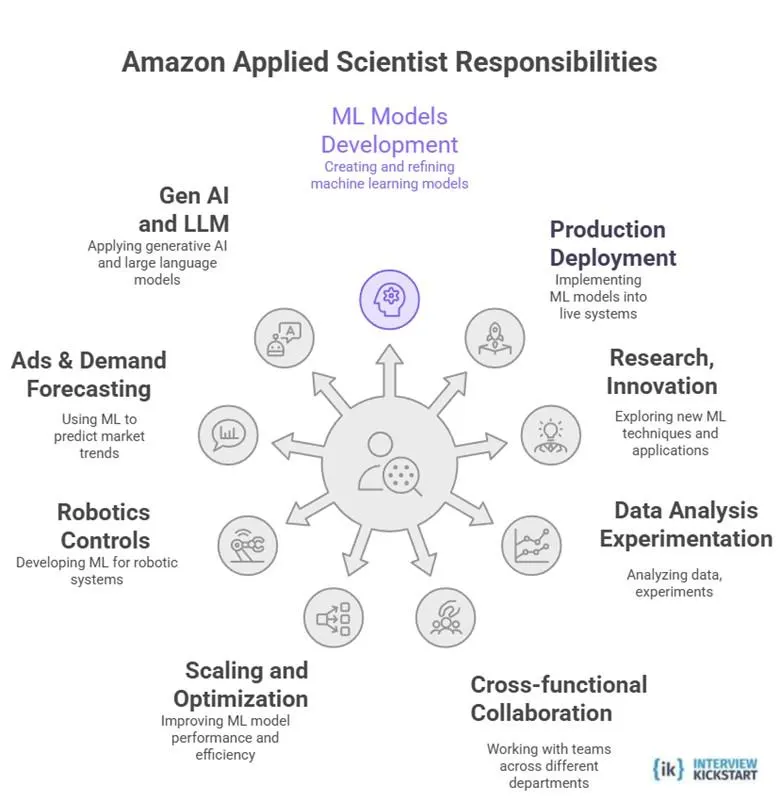
An Amazon applied scientist manages model development and research, and produces the models by testing, scaling, and introducing them for regular production work. They collaborate and partner with software and data engineers and product managers to translate business challenges into actionable scientific solutions.
Let us look at their responsibilities.
What are the Departments Where Amazon Applied Scientists work?
Amazon applied scientists’ work in general and specialized services departments. The focus practices and technologies are cloud computing, AI, and e-commerce optimization. You will be considered for any of these practices, and it is important to know their work.
Let us look at the departments and areas.
- Amazon Web Services (AWS): AWS is the main hub for applied science roles, offering AI/ML services, infrastructure optimization, and helping customers adopt ML through the AWS ML Solutions Lab.
- Amazon Artificial General Intelligence: This department develops LLMs, GenAI, and conversational AI.
- Alexa and Amazon Devices: The department works on Automatic Speech Recognition (ASR), Natural Language Understanding (NLU), and device-specific machine learning.
- Amazon Operations, Logistics, and Transportation: Amazon’s applied scientists work on Supply Chain Optimization Technologies, demand forecasting, last-mile delivery improvements, and inventory planning.
- Amazon Retail and Marketplace: Amazon’s applied scientists analyze customer behavior, optimizing search, improving recommendation systems, and managing seller services.
- Amazon Ads: Amazon applied its applied scientists to ad targeting, performance measurement, and recommendation engines.
- Specialized Teams: Amazon applied scientists work as research scientists and data scientists. Some special teams are:
- Trust and Store Integrity: Focuses on preventing fraud.
- Industrial/Personal Robotics: Developing advanced robotics systems.
- Finance and HR: Analyzing business metrics, employee experience, and HR data.
- Sustainability: Working on The Climate Pledge initiatives
Levels, Responsibilities, and Salary of an Amazon Applied Scientist
Amazon applied scientists are placed at L4 to L7+ levels. The roles, responsibilities, compensation, and business impact depend on the level. Total compensation has several components, such as the base salary, which is the fixed amount, plus bonus, stock options, cash payout for relocation, vacation, insurance, and other payouts.
Base salary and other payouts depend on the city, and Amazon applied scientists in large cities are paid more for the higher cost of living. Table 1 presents indicative details gathered from multiple sources.
Table 1: Amazon applied scientist levels, responsibilities, and salary
| Level | Role Title | Responsibilities | Typical Experience | Total Annual Comp USD, US |
|---|---|---|---|---|
| L4 | Applied Scientist I | Implements existing ML models, data analysis, and supports senior team members | 0–3 Years | $245,000+ |
| L5 | Applied Scientist II 3 | Design and implement complex algorithms, conduct research, and mentor junior scientists. Requires higher autonomy | 5+ Years | $310,000–$383,000+ |
| L6 | Senior Applied Scientist | Lead projects, set technical direction for a team, and bridge the gap between research and production engineering | 5–10+ Years | ~$416,000–$477,000+ |
| L7 | Principal Applied Scientist | Sets the strategy for a product line or business unit, driving high-impact innovation and often holds a PhD with extensive industry experience | 10+ Years | ~$653,000+ |
Typical Amazon Applied Scientist Interview Process
Table 2: Amazon applied scientist interview process
| Stage | Format | Duration | Focus Areas |
|---|---|---|---|
| Round 1 | Recruiter | — | Role alignment |
| Round 2 | Phone Technical Screen | 45–60 mins | Machine Learning fundamentals (breadth + depth); technical explanation of past projects and modeling decisions; domain expertise in algorithms, statistics, data science practices; Coding / data structures and algorithms problems |
| Round 3 | Onsite / Virtual Loop | 4-6 rounds | Machine Learning; Applied ML / Scientific Thinking; Coding Round; System Design / ML System Design; Project/Tech Presentation, Behavioral Questions |
| Round 4/ Bar Raiser | Hiring Decision | — | Questions on fit, problem solving, ownership, long-term potential |
What Amazon Evaluates for Applied Scientist Role?
Amazon applied scientists are evaluated on several areas of deep technical competency, problem-solving and thinking, and behavioral and cultural fit. The important areas are system design, project delivery, mentoring, creating a collaborative culture, and the ability to act as a two-way interface between strategy and team execution.
Amazon wants applied scientists with deep technical expertise, business acumen, and a strong alignment with their 16 Leadership Principles. Amazon applied scientists should have structured and logical thinking, the ability to solve complex, ambiguous problems, and transform data into actionable insights.
Hard Skills (Technical Competencies):
- Machine Learning and Modeling
- Coding and Software Engineering
- Systems and Large-Scale Data
- Statistics and Experimentation
Soft Skills (Leadership Principles & Behavioral:
- Customer Obsession and Ownership
- Dive Deep and Deliver Results
- Innovation and Judgment
- Culture and Adaptability
- Science Leadership
- Communication
- Mentorship
Domains Evaulated in Amazon Applied Scientists Interviews
Let us look at the areas, domains, or pillars, and subdomains for Amazon applied scientist interview questions. Amazon applied scientist interview questions 2026 will be asked in all the Amazon applied scientist interview process rounds.
Let us look at the areas, domains, and sub-domains for an Amazon applied scientist.
Table 3. Interview domains for Amazon applied scientist evaluation
| Area | Domain | Sub Domains |
|---|---|---|
| Technical Competency | Machine learning (understand why algorithms work, not just how to use them) | Bias–variance tradeoff, regularization theory; Optimization -SGD, Adam, convergence behavior; Loss functions and objective design; Probabilistic modeling; Bayesian inference; Generalization theory; Overfitting analysis; Evaluation metrics tradeoffs |
| Deep Learning and Neural Architectures (Architect and debug large-scale models) | CNNs, RNNs, LSTMs; Transformers and attention mechanisms; LLM fundamentals; Training stability and gradient flow; Distributed training; Hyperparameter tuning strategies; Transfer learning and fine-tuning; Embedding systems | |
| Statistics and Experimentation (Heavy emphasize on scientific rigor) | A/B testing design; Hypothesis testing; Confidence intervals; Power analysis; Causal inference; Uplift modeling; Sequential testing; Metric design pitfalls | |
| ML System Design (Production-Scale) | Designing scalable ML pipelines; Real-time vs batch inference; Feature stores; Model monitoring & drift detection; Offline vs online evaluation; Retraining strategies; Latency tradeoffs; Data versioning | |
| Coding and Algorithms (Python / Java / C++) | Data structures – trees, graphs, heaps; Dynamic programming; Complexity analysis; Writing clean, production-ready code; Languages typically | |
| Applied Problem Solving | Translate business problems into ML problems; Define objective functions; Select features; Decide model tradeoffs; Handle messy data | |
| Data Engineering and Large-Scale Data Handling | ETL pipelines; Distributed systems concepts; Spark-like processing; Handling petabyte-scale data; Data leakage prevention | |
| Problem-Solving and Thinking | Applied ML Case Studies (Scenario-Based Logic) | Problem formulation; Scientific Trade-offs; Data & Metrics; Scenarios |
| Technical Deep Dives (Resume-Based Thinking) | Decision Rationale; Experimental Rigor; Complexity Analysis | |
| Behavioral and Culture Fit | Alignment with 16 Amazon leadership principles | Scenario questions, case studies, STAR framework answers on alignment with 16 Amazon leadership principles |
Now, let’s look at these domains and the commonly asked questions in them.
Machine Learning Interview Questions <h3>
What is evaluated in Amazon applied scientist machine learning interview questions?
Amazon machine learning applied scientist interviews are rigorous. Questions are on deep machine learning expertise, software engineering proficiency, ability to operate independently, handle ambiguity, and deliver measurable business impact.
Amazon looks beyond mechanical ML solutions and expects structured logic, reasoning, and analytical thinking, with a focus on a minimalistic, optimized, and cost-effective model.
Sample Interview Questions and Answers
Q1. How will you design a large recommendation system for Amazon?
The following process is recommended:
- Clarify Objectives: Obtain inputs on whether it is to optimize long-term revenue, and not just CTR. Identify and define the main metrics like conversion rate and revenue per session, and the guardrail metrics of latency, diversity, and fairness.
- Data Sources: Obtain data on user behavior with clicks, purchases, product metadata, session context, and user embeddings.
- Candidate Generation: Use collaborative filtering, Two-tower deep retrieval model, and ANN – Approximate Nearest Neighbor search.
- Ranking Layer: Select a gradient boosted trees deep ranking model, or a multi-objective optimization with CTR + margin
- Online Architecture: Detail the real-time inference (<50ms), feature store, model versioning, and fallback rules
- Monitoring: Set the drift detection with A/B testing, and online-offline metric mismatch analysis
Q2. What actions will you take when the model increases CTR but decreases revenue?
Carry out the following: Validate experiment setup, randomization integrity, sample ratio mismatch, check metric alignment, and if CTR promotes low-price items, and analyze distribution shifts. Next, carry out segment analysis, identify the impact by category or user type while considering multi-objective optimization, and if needed, redesign the objective function.
Q3. Describe the method to debug a deep learning model that stopped learning?
Use a structured debugging methodology with steps of establishing baselines, verifying data and preprocessing, checking the ML model and algorithm, monitoring training progress, and checking the code and the environment.
Practice Questions
- Describe the method of implementing a computer vision product that identifies defective or unsafe products in an Amazon warehouse.
- What are the steps to model and solve a warehouse inventory problem to reduce delivery delays?
- Describe Adam and SGD optimizers, and when they are used.
- Explain the design of an ML correction mechanism when Alexa does not correctly understand user intent due to multilingual speech patterns.
- What is the bias-variance tradeoff in production systems?
- Present a design for a model used for a retraining strategy.
- Details methods to reduce customer churn.
- Explain the process to improve an existing transformer model for ranking.
Deep Learning Interview Questions
What is evaluated in Amazon applied scientist deep learning interview questions?
Amazon applied scientists’ interview for deep learning and neural architectures evaluate expertise to bridge advanced theoretical research with scalable, practical production solutions. Experience and deep knowledge of architectures like BERT, GANs, and ResNet, model implementation, training, and optimization are evaluated.
Sample Interview Questions and Answers
Q4. Detail the method to debug exploding and vanishing gradients?
Exploding gradients occur in deep RNN stacks. The method is:
- Diagnosis: Inspect gradient norms, monitor training loss curves, and activation distributions
- Solutions: Use gradient clipping, assign proper weight initialization with He/Xavier, and check residual connections. Use batch normalization, layer normalization, and ReLU variants instead of sigmoid.
Q5. What will you do if the deep model performs well when it is offline but shows poor results online?
The possible causes are data leakage, distribution shift, offline metric misalignment, feature drift, and user interaction feedback loops. The solutions are to use a better validation split, real-time A/B testing, take up drift monitoring, check regularization of dropout L2, and connect to production monitoring.
Q6. Explain the method of training a 10 billion parameter model?
The strategies use data parallelism, model parallelism, and pipeline parallelism with mixed precision (FP16/BF16). Implement gradient checkpointing and ZeRO optimization. Some tradeoffs are communication overhead, synchronization latency, and GPU memory bottlenecks
Practice Questions
- Describe when multi-task learning is to be used.
- Detail the design of a scalable embedding system for 100M users.
- Describe the method to reduce model size without losing performance.
- Explain the process to create a model that avoids feedback loops.
- Describe the steps to build a session-based deep learning model.
- Describe the Transformer architecture, attention mechanisms, encoders, and decoders.
- Explain the process to make convolutional neural networks achieve translation invariance.
- Explain why dropout layers prevent overfitting, and if they are used during inference.
Statistics and Experimentation Interview Questions
What is evaluated in Amazon applied scientist statistics and experimentation interview questions?
Amazon applied scientists conduct interviews on statistics and experimentation, are on rigorous A/B testing design, causal inference, and translating statistical findings into business impact. Questions will cover Simpson’s paradox, power analysis, experimental design tradeoffs, including sample size, duration, and handling biases.
Look for questions that implement statistics on large-scale data, tradeoffs between speed, precision, and costs, and using data to solve Amazon problems. Amazon applied scientist interviews evaluate your overall approach to designing experiments to test ML models.
Sample Interview Questions and Answers
Q7. Describe the method of design and evaluation of an A/B test.
Use the following structured process:
- Objective: Draw the hypothesis to be tested, such as a new recommendation UI increases click-through by 8%.
- Randomization: Describe the assignment of users to control and treatment.
- Sample size: Determine the optimal size by conducting a power analysis, considering the expected effect size and variance.
- Metrics: Select the primary metric, such as CTR, and guardrail metrics such as revenue per user.
- Duration: Provide sufficient exposure to decrease seasonality noise.
- Analysis: Apply statistical tests such as two-sample t tests, confidence intervals, and check p-values and effect size.
Use multiple testing, novelty effects, and noncompliance.
Q8. Explain how regularization L1 and L2 affect a model?
L1 (Lasso) allows sparsity, and it is needed for feature selection. L2 Ridge penalizes large weights evenly — improves generalization without eliminating features.
Q9. Explain the process for handling multiple hypothesis testing?
Define one primary metric to avoid metric fishing. When running several metrics, experiments over many segments, use Bonferroni conservative, Benjamini-Hochberg for FDR control, and pre-register the primary metric.
Practice Questions
- Design an experiment for testing new recommendation algorithms to avoid user interference.
- Explain the factors considered to decide when an experiment is ready for production.
- How will you solve a problem when the treatment group shows a positive effect, but the population metric decreases?
- How do you define and validate metrics such as the North Star metric and measure the long-term business impact?
- Explain the experiment to test new features, calculate sample sizes, duration, and choose metrics.
- Describe the method to interpret OLS or logistic regression results.
- Explain the methods to identify and treat outliers, missing data, and selection bias.
- Describe the process used to determine a sample size and manage normal data in an experiment.
ML System Design Interview Questions
What is evaluated in Amazon applied scientist ML system design interview questions?
Amazon Machine Learning System Design interviews test skills to build end-to-end, scalable, and production-ready ML systems. Evaluation is on problem framing to meet business goals, identify data sources and feature engineering strategies, model selection, and training and evaluation.
Questions evaluate the logic and reasoning for selecting models based on the architecture, data, experimentation, scaling, and monitoring. Answers must be aligned to measurable business outcomes and engineering realities.
Sample Interview Questions and Answers
Q10. How will you design a personalized product recommendation system?
The steps are:
- Gather requirements: Define the business goal, such as increasing revenue per user, and understand the latency constraint, such as <100ms. Analyze traffic scale in terms of millions of users, and implement real-time behavior incorporation.
- High-level architecture: For the offline pipeline, check data ingestion such as clicks, purchases, impressions, feature engineering, model training, validation, and registry. For the online pipeline, consider feature retrieval, candidate generation, and use an appropriate ranking model. Use post-processing with diversity, filtering, and a serving layer.
- Candidate generation: Since ranking more than 100 million products is not possible, separate retrieval from ranking. Use Collaborative filtering and matrix factorization. Implement a deep retrieval model with a two-tower architecture and the approximate nearest neighbor search.
- Ranking model: Select any of the models: gradient boosted trees, deep neural networks, wide and deep models, or transformer-based ranking. Consider losses for binary cross-entropy, pairwise ranking, and listwise ranking loss.
Evaluate the model, the scalability, monitoring, and drift since silent model degradation occurs in large systems.
Q11. How will you solve the Cold Start Problem?
Usually, hybrid models give better performance than collaborative filtering. For users cold start, implement demographic-based initialization, popularity priors, and contextual bandits. For item cold start, use content-based features with text/image embeddings, and zero-shot transfer.
Q12. Describe the process to improve a degrading model.
Perform root cause analysis, develop an experimentation plan, and carry out a business impact estimation. Once the results are known, check data drift and the feature pipeline. Re-evaluate labels, retrain with fresh data, and if these do not work, then change the architecture.
Practice Questions
- Detail the design of a video recommendation system for Prime Video.
- Describe a bot detection system design to identify harmful content in reviews.
- Describe the process to personalize Alexa’s responses for multilingual users.
- How will you manage optimization prediction throughput for an RNN-based model?
- Explain the process of handling a corrupt model seen in the training batch in production.
- Describe the reasoning for selecting a simple and complex model.
- Detail an ML experimentation framework for your team.
- Explain the process of stopping data leakage.
Coding and Algorithm Interview Questions
What is evaluated in Amazon applied scientist coding and algorithm interview questions?
Amazon applied scientist interview questions on algorithms evaluate your understanding of ML depth, algorithmic proficiency, statistics, and implementing them to solve business problems. You need to show strong knowledge of data structures and complexity analysis with a clean and optimized implementation.
Candidates should explain the scale, define the link between the ML problem and algorithms, and explain edge case thinking. Problems will be on bagging, boosting, loss function, and handling imbalanced data. Deep dive into the mathematical intuition behind algorithms like SVM, LDA, or PCA.
Sample Interview Questions and Answers
Q13. For a large directed graph, how will you detect the cycle?
Implement DFS with a recursion stack or Kahn’s topological sort.
Maintain
visited[]
recStack[] (tracks current DFS path)
When a node is revisited in a recursion stack, the cycle exists.
Complexity includes Time: O(V + E), and Space: O(V).
For large graphs, use iterative DFS, consider distributed graph processing, and for streaming graph use incremental cycle detection.
Q14. How will you find connected components in massive datasets?
For Standard, use DFS/BFS, and for optimized, use Union-Find (Disjoint Set).
Set path compression + union by rank with Almost O(1) amortized.
Q15. Explain the process to implement K-Means.
The steps are, initialize centroids, assign points, and update centroids. Repeat until convergence.
Time:
O(nkd)
Practice Questions
- How will you calculate the shortest path between nodes in a large graph, detecting cycles, and navigating complex tree structures?
- Show the method to implement a function that will find the minimum window substring in a large string.
- Describe the process to optimize a machine learning inference algorithm that runs within a tight latency constraint on a mobile device.
- For a stream of user click data, how will you design an algorithm to update the top 10 most clicked items in real-time?
- What is the difference between ADAM and Stochastic Gradient Descent?
- How does an increase in the minimum sample size per leaf affect variance and bias?
- Describe the method to carry out down-sampling on a large dataset while maintaining its distribution properties?
- Explain the design of a recommendation system for the Amazon Grocery App.
Data Engineering and Large-Scale Data Handling Interview Questions
What is evaluated in Amazon applied scientist data engineering and large-sale data handling interview questions?
Amazon applied scientist interviews are about combining ML expertise and handling petabytes of data with distributed systems. Proficiency is expected in PySpark, SQL, AWS services, S3, EMR, Redshift, and algorithm optimization to handle data skew and latency.
Amazon expects plant-level solutions, and you should demonstrate your ability to design and build such massive data systems.
Sample Interview Questions and Answers
Q16. How will you aggregate quantity columns of a CSV file with ID and Quantity columns with 50 million records of 2GB?
Use PySpark to leverage distributed processing. Read the data into a DataFrame, use groupBy(‘ID’) and sum(‘Quantity’), and partition the data by partitioning to prevent data skew and use cache() if the DataFrame is reused.
Q17. Detail the process to maintain data quality in a large, distributed dataset with billions of records.
At Amazon’s massive scale, small data quality issues can degrade model performance and analytics reliability. Implement the following steps.
Start by using automated schema validation and sanity checks with range checks, null rate monitoring early in the pipeline. Implement distribution monitors that will capture drift over batches and time windows. Develop anomaly detection alerts when feature distributions transform over acceptable levels. Introduce fail-fast logic and stop pipelines when important invariants show errors. Log and monitor data lineage for debugging and accountability.
Q18. Describe the process of training a machine learning model on an extremely large dataset?
Cost and scalability trade-offs are important. The steps are: Deploy mini-batch training and distributed training frameworks such as Horovod and Parameter Server. Carry out feature selection with dimensionality reduction before running training loops. Cache intermediate data transforms and reuse them as needed. Modify learning schedules and early stopping to prevent unwanted epochs. Choose approximation techniques, such as sampling strategies, where possible.
Practice Questions
- Write an SQL query to compute monthly user retention rates for a massive dataset with events such as user_id, timestamp, and action.
- Describe the process to manage training for a massively imbalanced dataset with 99.9% negative class.
- Detail the design of a system that processes user clickstream data in real time and updates feature tables used by ML models.
- Explain the method of measuring the performance of ranking models on Amazon’s product search logs.
- How will you compute the top-k frequent user actions for a large Pandas DataFrame?
- Which model will you choose among the two models with 85% and 82% accuracy for a large dataset?
- Detail the strategy to manage missing and corrupted data in large distributed datasets.
- How will you optimize a data pipeline at scale, the challenges, and the method?
Crack Data Engineering Interviews with Interview Kickstart
Breaking into top data engineering roles requires more than basic pipeline knowledge. The Data Engineering Interview Prep program by Interview Kickstart is designed by FAANG+ engineering leaders to help you master the skills companies actually test. You’ll cover data structures, algorithms, and key interview topics with individualized teaching, technical coaching, and guided solution discussions.
You’ll also practice in realistic mock interviews with Silicon Valley engineers who have interviewed candidates at top tech companies. Each session includes structured, actionable feedback to help you improve quickly. The program also supports your career growth through resume building, LinkedIn optimization, and live behavioral interview workshops.
Enroll now to learn how to optimize your LinkedIn profile, build ATS-clearing resumes, personal branding, and more. Watch this Mock Interview to learn more about the different types of data scientist interview questions and how you can answer them to not only leave a good impression but also to clear the interview.
Conclusion
The Amazon applied scientist interview guide presented a detailed process and stages of the interview. The interview is spread over 6 weeks and has several stages, like a recruiter screen, a technical screen, an onsite/ virtual screen, and a final interview.
The depth of technical interviews depends on the level at which you are interviewed. L4 and L5 levels see more depth in the technical aspects of coding, system design, and architecture. Senior L6+ levels are interviewed for their technical vision and direction.
All levels are expected to show strong alignment with the 16 Amazon leadership principles. You are evaluated for your ability to lead teams, give direction, think of the future, plan, and show exceptional leadership and mentoring skills.
However, only expertise in people management and less focus on technical competency is a big negative. The Amazon applied scientist interview guide has given an 8-week preparation plan and timeline. Follow the plan to gain success.
Cracking the Amazon applied scientist interview questions is challenging. You need to have a strong understanding of the technical concepts and other soft skills like problem-solving, communication, collaboration, and other domains.
FAQs: Amazon Applied Scientist Interview
Q1. What is the Amazon applied scientist interview process?
The Amazon applied scientist interview process has several stages. These are the recruiter screen, telephone screen, onsite/ virtual screen, and the bar raiser, final interview. Each stage has several rounds.
Q2. What skills are evaluated in Amazon applied scientist interviews?
Amazon applied scientist interviews evaluate skills in the technical domains, Python, SQL, Scala, TensorFlow/PyTorch, ML application, implementation and system design, algorithms, and other tools.
Q3. What qualities does Amazon look for in applied scientist candidates?
Amazon seeks applied scientists with expertise in ML model design and implementation, algorithm design, statistics, and experimentation, and candidates should have exceptional problem-solving, analytical skills, and alignment with the 16 leadership principles.
Q4. What is the technical depth of the Amazon applied interview process?
Expect deep and structured interviews with technical rigors and high-level technical questions.
Q5. How to prepare for Amazon applied interviews?
Study the course materials deeply, follow the study and preparatory plan, read blogs, case studies of Amazon, and attend mock interviews.
References
- Amazon Applied Scientist Interview Prep
- The 16 Amazon Leadership Principles
- Amazon CEO Andy Jassy explains the 16 Amazon Leadership Principles
Recommended Reads:


