
The Amazon Robotics Software Engineer interview focuses on coding problems, system design challenges, and Amazon’s Leadership Principles. Interviewers test your algorithmic and system design skills and also evaluate how you embody Amazon’s culture and values.
Robotics is growing fast in the US and worldwide. The International Federation of Robotics1 reports 542,000 units were installed worldwide in 2024, and the US added 34,200 industrial robots last year. Amazon2 says its fulfillment network now runs over 1 million robots.
This article provides a structured guide to the Amazon Robotics software engineer role and interview process. We explain what each interview round evaluates and which topics you should focus on. You will also see practice questions, worked examples, and a focused study plan to prepare effectively.
Key Takeaways
- The Amazon Robotics software engineer interview tests both software depth and hardware awareness.
- Prepare STAR+L stories and measurable outcomes to illustrate how you handled fleet-scale problems in the Amazon Robotics Software Engineer interview.
- Practice timed coding and concurrency problems that mirror common Amazon robotics interview questions and practical robotics constraints.
- Add short links to a simulator demo and logs rather than live hardware, so your robotics software engineer interview evidence is reproducible.
What Does an Amazon Robotics Software Engineer Do?
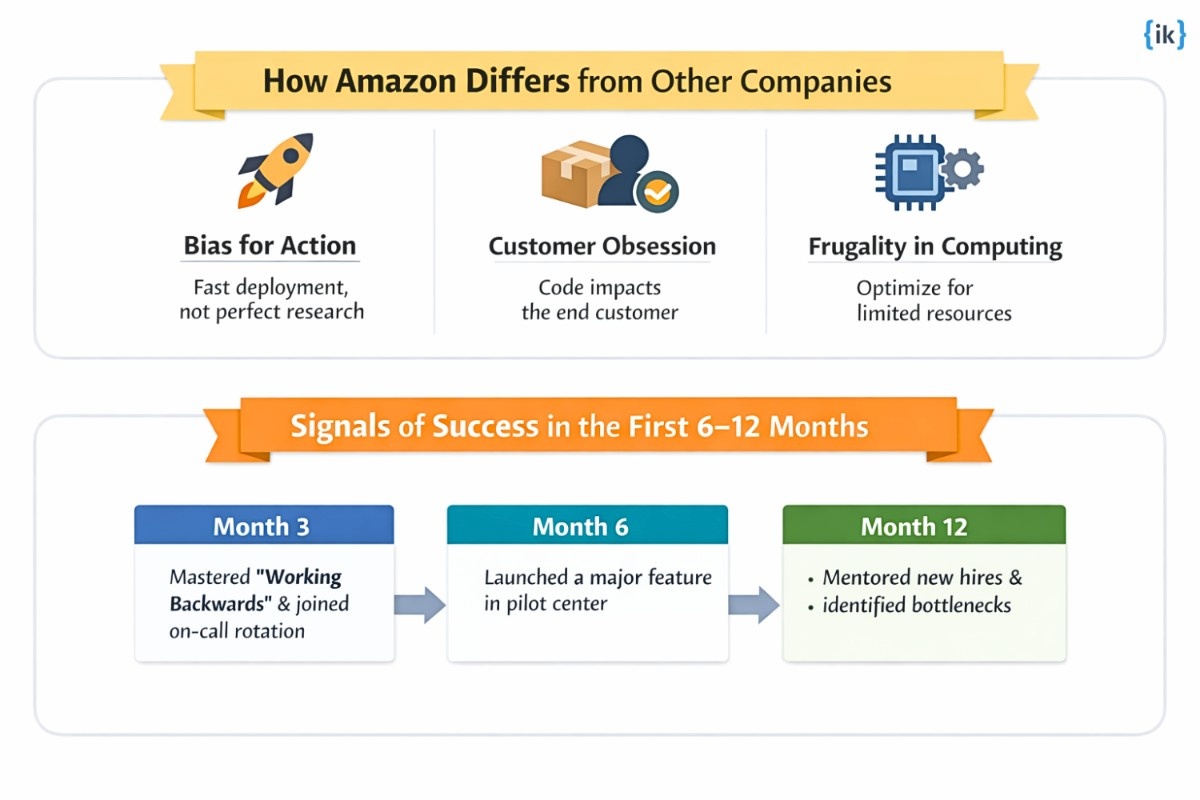
An Amazon Robotics software engineer is the architect behind the nervous system of Amazon’s vast fulfillment empire. Unlike a standard SDE who might focus solely on web services or cloud infrastructure, this role sits at the intersection of the physical and digital worlds.
Core Responsibilities at Amazon Robotics
At its core, the role involves building high-performance software that controls mechatronic systems. When you give examples in the Amazon Robotics software engineer interview, link them to a single measurable outcome that the hiring team can verify.
- Build firmware and mid-level software to interface with sensors, actuators, and motor controllers.
- Design distributed systems for fleet communication, collision avoidance, and real-time path optimization.
- Deploy machine learning for object recognition, autonomous navigation, and predictive maintenance.
- Validate software against physical hardware to ensure safety and reliability before global rollout.
Scope of Ownership by Experience Level
The expectations for an Amazon Robotics software engineer interview shift significantly based on the target level:
- L4: Own the component; build features, debug sensor drivers, and write unit tests for control logic.
- L5: Own the module; manage hardware-software integration, lead design reviews, and oversee robotic subsystems.
- L6+: Own the system; define architectural roadmaps, influence cross-functional hardware teams, and solve billion-scale efficiency problems.
Be explicit about scope when answering Amazon robotics interview questions so interviewers understand whether you owned a component, a module, or a full system.
Also Read: What an L5 Amazon Mock Interview Reveals About Real Engineering Expectations?
Salary Expectations and Overview
Compensation for an Amazon Robotics Software Engineer is highly competitive, often reflecting the specialized nature of the hardware-software hybrid skillset. Here is the breakdown of what to expect after a successful Amazon Robotics software engineer interview.
Compensation Breakdown
Amazon’s Total Compensation (TC) model is famously back-heavy, with significant Restricted Stock Units (RSUs) vesting in years three and four3.
| Base Salary | Bonus Structure | Total Compensation | Stock |
| $116K – $158K | $8K – $16K | $144K – $211K | $20K – $37K |
To stand out, you must master the specific Amazon Robotics software engineer interview questions that blend standard CS fundamentals with low-level systems knowledge. Be prepared to discuss memory management, concurrency in real-time systems, and how you handle unhappy paths in hardware.
Also Read: 9 Robotics Engineer Skills That Actually Matter in 2026
Typical Amazon Robotics Software Engineer Interview Process
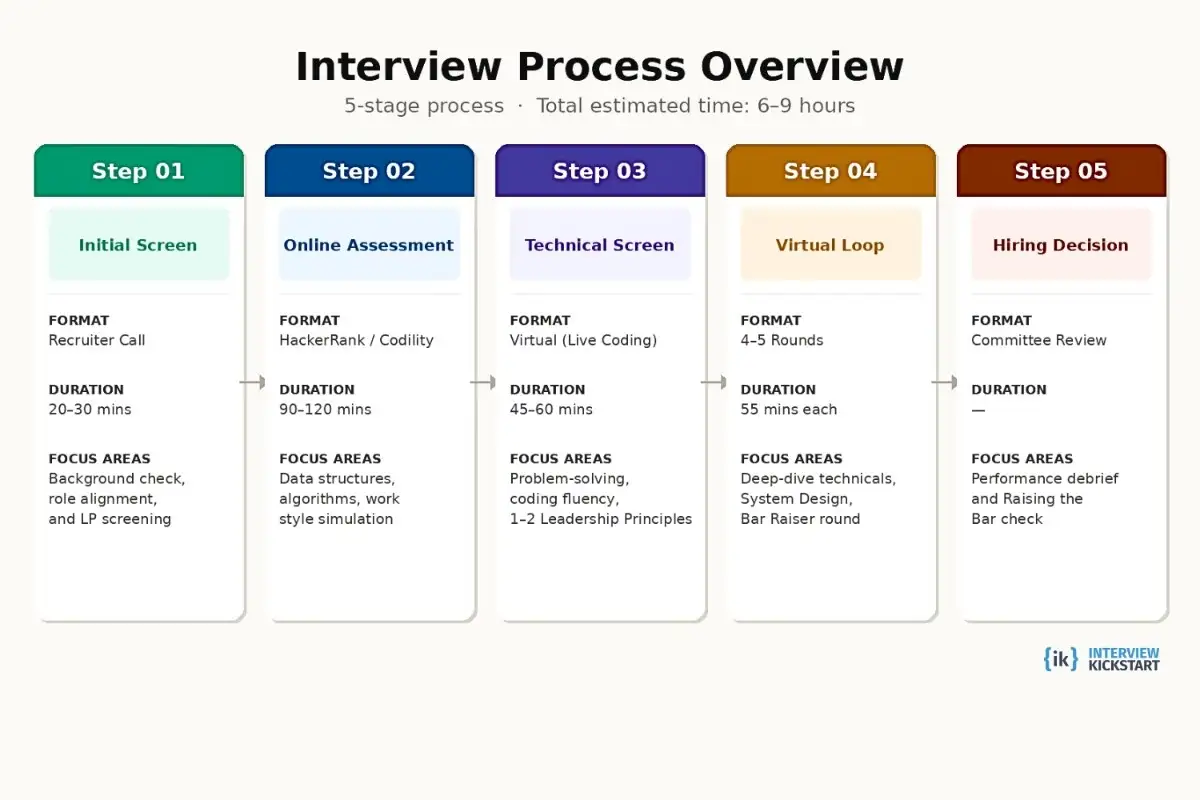
The Amazon Robotics software engineer interview is a multi-stage marathon designed to test not only your technical depth but also your alignment with the company’s culture. Unlike other divisions, Amazon Robotics places a premium on candidates who can handle the ambiguity of hardware-software interfaces.
Here’s a roadmap for an Amazon Robotics software engineer interview:
1. Online Assessment (OA)
Purpose of the Round: In the OA, you may face Amazon robotics interview questions about grids or greedy scheduling, so practice clear variable names and edge cases.
Structure:
- Coding Section: 2–3 medium-to-hard problems (70 minutes).
- Work Simulation: 8–12 situational tasks (25 minutes).
- Work Style Assessment: 50–100 personality/culture statements (15 minutes).
Topics Covered:
- Data Structures: Priority Queues (heaps), HashMaps, and Graphs.
- Algorithmic Patterns: Sliding Windows, BFS/DFS, and Greedy algorithms.
- Leadership Alignment: Customer Obsession, Ownership, and Bias for Action.
Type of Questions Asked
Grid-Based Navigation
Robotics software engineer interview questions on grid-based navigation. Example: finding the shortest path in a warehouse with obstacles.
Optimization Problems
“Given a list of robot battery levels and charging station distances, assign robots to stations to minimize total downtime.”
How to Approach This Round: Prioritize passing all hidden test cases. Amazon values correctness over clever one-liners. For the work simulation, always pick the Customer-Obsessed or Safety-First option.
2. Technical Phone Screen
Purpose of the Round: This is a live coding session with a peer. The goal is to see how you think in real-time and how you communicate your logic while solving robotics software engineer interview questions.
Structure:
- Behavioral (LPs): 15–20 minutes.
- Live Coding: 35–40 minutes.
- Q&A: 5 minutes.
Topics Covered:
- Concurrency & Real-time Processing: How to handle data from multiple sensors.
- Systems Programming: Memory management and resource optimization (especially in C++).
- Graph Theory: Managing fleets and paths.
Type of Questions Asked
Producer-Consumer Model
Implement a producer-consumer model where a sensor (producer) sends data to a robot controller (consumer) without losing packets.
Bounding Rectangle
Given a set of 2D coordinates representing robots, find the rectangle that encompasses all active bots.
How to Approach This Round: Think out loud. If you are considering a BFS over a DFS for a navigation problem, explain why. Mentioning latency or memory footprint is a massive signal of a robotics mindset.
3. The Virtual Onsite Loop
When answering system design questions in the Amazon Robotics software engineer interview, frame tradeoffs in latency, safety, and maintainability. Each round focuses on a specific competency pillar.
Round 3A: Problem Solving & Algorithms
Focus: Advanced data structures and algorithmic complexity.
Typical Question: “Design an efficient way to find the K closest robots to a charging station in a dynamic 2D environment.”
Round 3B: System Design (Robotics Focus)
Focus: High-level architecture and scalability.
Typical Question: “Design a firmware update system for 50,000 mobile robots that ensures zero-downtime and safe rollbacks.”
Round 3C: The Bar Raiser Round
Focus: Long-term potential and cultural non-negotiables.
Purpose: An objective third party helps raise the bar for the company. They will hammer you with follow-up “whys” on your behavioral stories.
How to Approach the Loop: Use the STAR+R (Situation, Task, Action, Result + Reflection) method for all behavioral questions. For technical rounds, focus on scaling. Always ask, “What happens if we have 10x more robots?”
4. Hiring Committee & Decision
Purpose of the Round: This round synthesizes all data points collected throughout the Amazon Robotics software engineer interview. It is an internal meeting where the interviewers and the Bar Raiser determine if the candidate’s technical and behavioral signals meet or exceed the current average for that level at Amazon.
Structure:
- Format: Internal meeting (Candidate is not present).
- Time Split: 30–60 minutes of intensive discussion.
- Interview Format: Roundtable consensus-building led by the Bar Raiser.
Topics Covered:
- LP Evidence: Consistency of Leadership Principle signals across all rounds.
- Technical Threshold: Evaluation of the candidate’s performance on robotics software engineer interview questions.
- The Bar Check: Comparison against the existing team’s skill level.
Type of Questions Discussed Internally
Did the candidate show enough depth when explaining the latency issue in their past robotics project?
Was their solution to the concurrency problem robust enough for a production environment?
How to Approach This Round: Since you aren’t present, your strategy happens during the loop. Provide data-rich answers. Use specific metrics so interviewers have concrete evidence to defend you.
Also Read: System Design Interview Preparation: Core Concepts to Master
What Does Amazon Evaluate in an Amazon Robotics Software Engineer Interview?
The evaluation process for an Amazon Robotics software engineer interview is famously rigorous, aiming to find technically elite candidates. Unlike general software roles, the robotics org places equal weight on your ability to handle physical constraints and your alignment with the Amazon Leadership Principles.
1. Technical Competency
In an Amazon Robotics software engineer interview, technical evaluation moves beyond standard web-scale problems into the realm of mechatronics and high-concurrency systems.
- Embedded Systems & Real-Time Constraints: You may face Amazon Robotics software engineer interview questions that require managing buffers, minimizing latency in sensor data, or handling interrupts.
- Algorithmic Depth (C++ & Python): While many SDE roles are language-agnostic, Amazon Robotics often probes deep into C++ memory management (smart pointers, RAII) and Python for orchestration.
- Robotics-Specific Domains: Depending on the team, you may be evaluated on SLAM (Simultaneous Localization and Mapping), path-planning (A*, RRT*), or computer vision basics.
2. Problem-Solving & Thinking
How you navigate ambiguity is the most critical non-coding signal in an Amazon Robotics Software Engineer interview.
- Designing for the Physical World: In system design rounds, you aren’t just designing for the cloud. Your designs must account for real-world constraints like power, latency, and sensor noise.
- Trade-off Reasoning: There is rarely a perfect solution in robotics. Evaluators look for your ability to weigh trade-offs clearly.
- Clarity Under Pressure: If you are hit with a hardware failure scenario during the interview, do you panic or systematically isolate the failure points?
3. Behavioral & Culture Fit
At Amazon, the Leadership Principles (LPs) are not just posters on the wall; they are the grading rubric for every Amazon Robotics Software Engineer interview.
- Ownership & Bias for Action: Interviewers look for stories where you didn’t just do your job but fixed the system. A good answer describes a time you identified a bug in a physical deployment and stayed until it was resolved.
- Dive Deep: This is a favorite for robotics. You must demonstrate that you understand the why behind technical failures. If a robot crashed, did you just reboot it, or did you analyze the log files and sensor noise levels to find the root cause?
Red Flags to Avoid
We vs. I: Overusing “we” makes it unclear what you actually did. Amazon wants to know your specific contribution.
Blaming Others: Discussing a project failure by blaming the hardware team or a vendor is a major red flag for the “Earn Trust” Leadership Principle.
Amazon Robotics Software Engineer Interview Questions
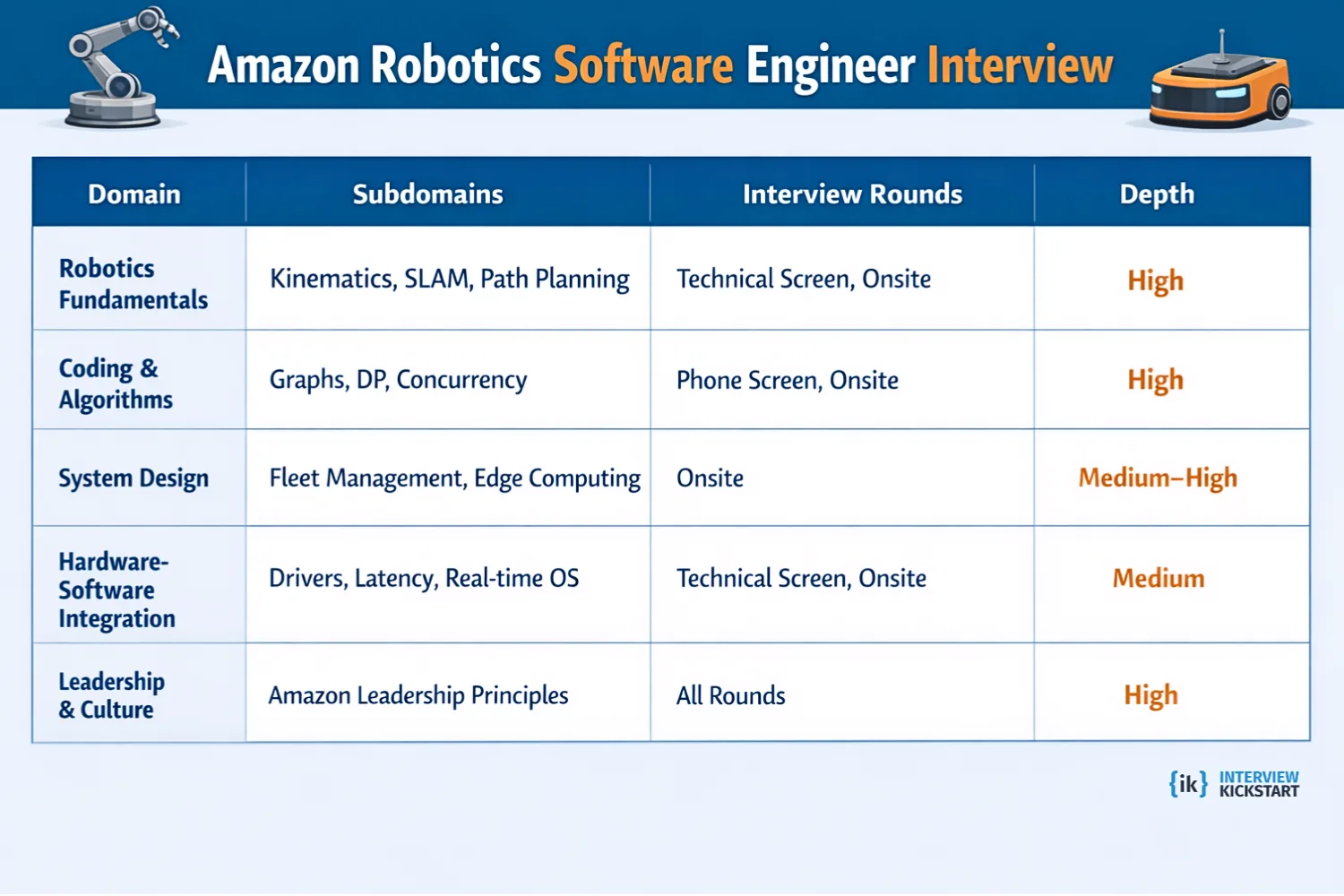
To land a role at Amazon Robotics, you must demonstrate mastery over both abstract software logic and physical constraints. The interviewers utilize a specific set of domains to evaluate your potential. Here is a breakdown of those domains, along with practice questions and the exact logic required to clear the bar.
1. Robotics Fundamentals
This domain focuses on your understanding of how a robot perceives and moves through a warehouse.
Q1: How would you handle a localization failure when a robot enters a hallway with no unique features?
I would rely on sensor fusion by integrating IMU data and wheel odometry to maintain a dead reckoning estimate. Simultaneously, I would trigger a recovery behavior where the robot slows down to look for pre-mapped ceiling fiducials or distinct floor markings to reset the global pose and reduce the accumulated covariance.
Interviewer Expectation: The interviewer wants to see that you understand the limitations of LiDAR or Vision in featureless environments and can propose a multi-layered recovery strategy.
Q2: Explain the trade-off between A* and Dijkstra for path planning in a grid with 50,000 nodes.
Dijkstra is guaranteed to find the shortest path, but it is computationally expensive because it explores in all directions. A* is significantly faster because it uses a heuristic to guide the search toward the goal. For a warehouse grid, A* is preferred as long as the heuristic is admissible and consistent to ensure optimality.
Interviewer Expectation: They are looking for your ability to optimize for compute resources. You should mention time complexity and the importance of the heuristic choice.
Q3: How do you resolve a kinematic singularity in a 6-DOF robotic arm during a pick-and-place operation?
I would implement a singularity avoidance algorithm in the inverse kinematics solver. This involves monitoring the Jacobian determinant and either clamping the joint velocities as they approach the singular configuration or slightly shifting the end-effector trajectory to stay within the reachable workspace without hitting joint limits.
Interviewer Expectation: This tests your deep physics and math knowledge. They expect you to understand how the Jacobian matrix influences control.
- What is the difference between a global planner and a local planner?
- How does the Iterative Closest Point algorithm work for matching point clouds?
- Describe how a Kalman Filter updates its state prediction based on new sensor measurements.
- How do you transform a coordinate from a camera frame to the robot base frame?
- Explain the concept of a costmap inflation layer.
How to approach such questions: Always link the math to the physical reality. Start by explaining the core algorithm and then mention how noise or hardware limits might force you to modify that algorithm for better reliability.
2. Coding and Algorithms
Amazon Robotics engineers are expected to write production-grade C++ or Python that is memory efficient and thread safe.
Q4: Design a thread-safe buffer to store high-frequency sensor data.
I would implement a circular buffer using a mutex and condition variables. This ensures that the producer thread can write data without being blocked by the consumer thread. I would use a fixed size to avoid dynamic memory allocation during runtime, which can cause latency spikes.
Interviewer Expectation: They are testing your knowledge of concurrency and real-time systems. They want to see that you can prevent race conditions.
Q5: Given a warehouse map, find the shortest path for a robot to visit three different picking stations.
This is a variation of the Traveling Salesperson Problem. For only three stations, I would calculate the shortest paths between all pairs using BFS and then evaluate the permutations to find the minimum total distance.
Interviewer Expectation: The interviewer is checking if you can identify the underlying graph problem and choose an efficient search algorithm.
Q6: Implement a function to detect if two 2D robot footprints will collide in the next time step.
I would represent the footprints as polygons and use the Separating Axis Theorem to check for an intersection. By projecting the shapes onto the axes of their edges, I can determine if there is a gap. If no gap exists on any axis, a collision is detected.
Interviewer Expectation: This tests your geometric logic and coding efficiency. They want to see a clean and bug-free implementation.
- How do you find a cycle in a task dependency graph?
- Implement an LRU cache for map tiles.
- Write a function to reverse a linked list of robot instructions.
- Find the K closest charging stations using a heap.
- Given a stream of sensor values, find the median in real time.
How to approach such questions: Think about memory. Robots have limited RAM compared to servers. When you solve a coding problem, explain why your choice of data structure is the most efficient for an embedded or edge computing environment.
3. System Design
This domain evaluates your ability to build large-scale architectures that manage thousands of robots simultaneously.
Q7: Design a system to track the real-time health of 100,000 robots.
I would use a distributed message broker like Kafka to ingest heartbeats from each robot. These messages would be processed by a streaming engine that triggers alerts based on threshold violations. Data would be stored in a time series database for long-term trend analysis and predictive maintenance.
Interviewer Expectation: They want to see that you can handle high throughput and that you understand the importance of observability at scale.
Q8: How would you design a firmware update service for a global fleet?
I would build a multi-stage deployment pipeline. The update would be pushed to a small canary group first. If telemetry shows no regressions, it would be rolled out to larger batches. The system must support atomic updates and automatic rollbacks if the robot fails its self-test after the reboot.
Interviewer Expectation: This tests your focus on safety and reliability. They are looking for a plan that minimizes the risk of bricking hardware.
Q9: Design a traffic controller to prevent congestion in a narrow warehouse aisle.
I would implement a reservation-based system. Before entering a restricted zone, a robot must request a token from a central coordinator. The coordinator manages a queue and ensures only a safe number of robots occupy the space at once to avoid deadlocks.
Interviewer Expectation: The interviewer is looking for your ability to manage shared resources in a distributed system.
- How do you handle a split-brain scenario in a robot cluster?
- Design a logging service that survives network outages.
- How do you optimize API latency between the cloud and the robot?
- Architect a vision system that does edge inference but cloud training.
- How would you scale a map server to handle trillion-point point clouds?
How to approach such questions: Start with a high-level overview and then drill down into specific components. Mention AWS services where relevant, but focus on the architectural patterns like load balancing, sharding, and caching.
4. Hardware-Software Integration
This domain tests your ability to debug code that directly interacts with sensors and motors.
Q10: A motor is not reaching its commanded speed. How do you troubleshoot this using software?
I would first check the PWM duty cycle output and the encoder feedback logs to see if the PID controller is saturated. If the software is sending the correct signals, I would look for mechanical friction or a voltage drop in the power supply by correlating it with battery telemetry.
Interviewer Expectation: They want to see a systematic approach that bridges the gap between code and physics.
Q11: Explain how you would reduce the latency of a camera feed used for obstacle avoidance.
I would implement a zero-copy memory strategy to pass frames directly from the driver to the perception node. I would also move the image processing to the GPU using CUDA or a dedicated DSP to free up the CPU for higher-level logic.
Interviewer Expectation: This tests your understanding of hardware acceleration and low-level data handling.
Q12: How do you handle a watchdog timer timeout in a critical robotic node?
The system should be designed for fail-safe operation. If the watchdog times out, the hardware should immediately enter a safe state, such as engaging mechanical brakes. The software should then attempt a clean restart of the crashed node and log the stack trace for post-mortem analysis.
Interviewer Expectation: They are checking if you prioritize safety over uptime in hazardous environments.
- What is the difference between a soft and a hard real-time interrupt?
- How do you debug a memory leak in a C++ driver?
- Explain how you would calibrate an IMU to remove bias.
- How do you handle data packets that arrive out of order from a sensor?
- Describe the process of flashing firmware via a bootloader.
How to approach such questions: Talk about the tools you use, such as GDB, oscilloscopes, or logic analyzers. This proves you have hands-on experience with real hardware and aren’t just a web developer.
5. Leadership and Culture
Amazon evaluates your leadership skills through the lens of their Leadership Principles.
Q13: Tell me about a time you had to decide with only half the data.
I was working on a sensor integration where the vendor documentation was missing. I built a small test rig to reverse engineer the protocol and validate my assumptions. I made a reversible decision to proceed with a pilot, which allowed us to stay on schedule while we gathered the remaining data.
Interviewer Expectation: This tests your bias for action. They want to see that you didn’t just wait for the answer.
Q14: Describe a situation where you had to push back on a quick fix in favor of a long-term solution.
A teammate wanted to hardcode a coordinate offset to fix a docking issue. I insisted on fixing the underlying calibration script because I knew the hardcoded value would break as the fleet scaled. I spent the extra day fixing the root cause, which prevented hundreds of future failures.
Interviewer Expectation: This maps to insisting on the highest standards. They value quality over speed in the long run.
Q15: Talk about a time you failed to meet a project milestone.
I underestimated the complexity of integrating a new LiDAR driver. I missed the deadline by a week. I took ownership of the error, communicated it early to the stakeholders, and worked with the team to reprioritize other tasks so the final launch date stayed on track.
Interviewer Expectation: This tests Ownership and Earn Trust. Admit the mistake clearly and show how you fixed the process.
- Tell me about a time you had a conflict with a coworker.
- Give an example of how you used data to change a project direction.
- Describe a time you simplified a complex technical process.
- Tell me about your most difficult technical challenge.
- How do you handle a situation where a project you are passionate about is cancelled?
How to approach such questions: Use the STAR method to structure your responses. Ensure your Amazon Robotics software engineer interview questions and answers focus on your personal actions rather than what the team did.
Also Read: Master Behavioral Interview Questions with the STAR Technique
Amazon Robotics Interview Study Plan and Preparation Framework
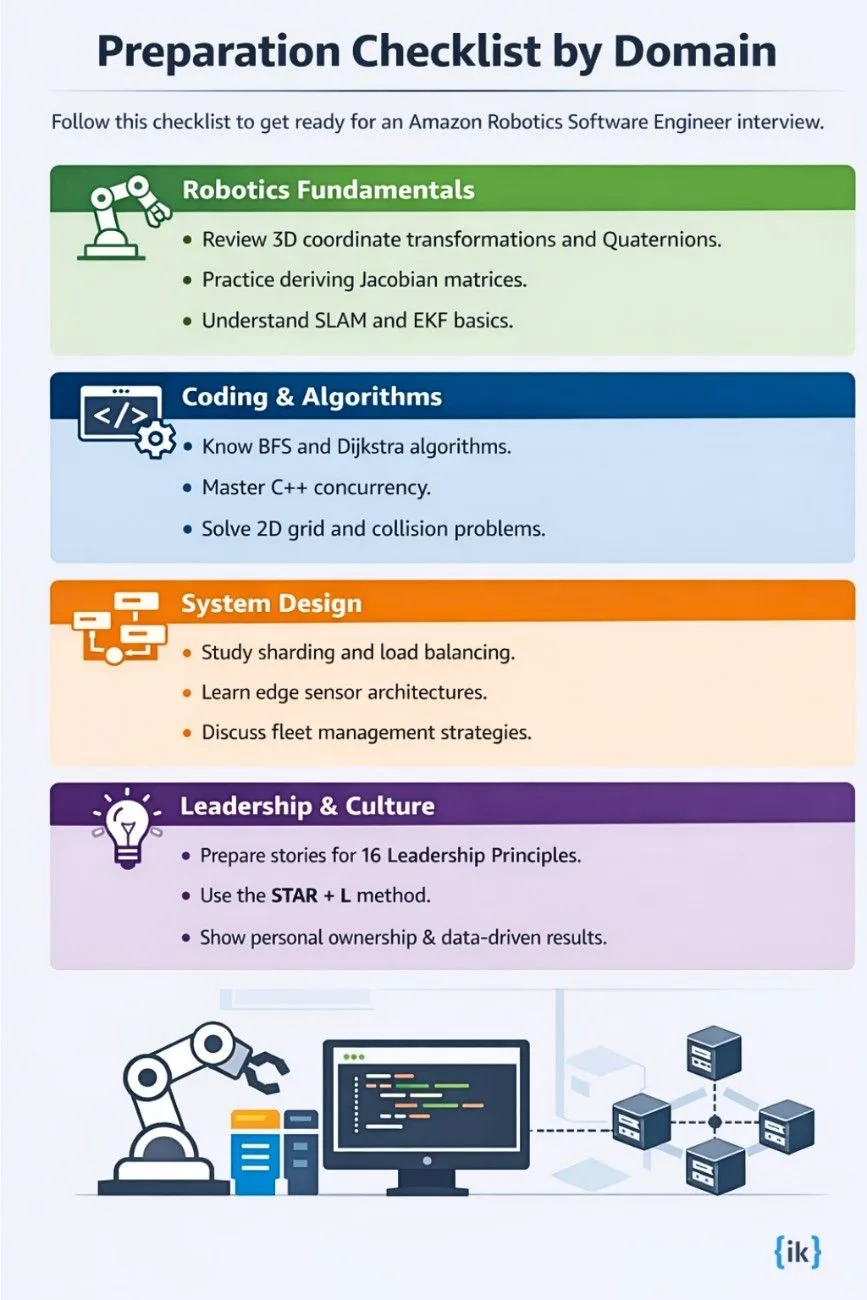
Getting ready for the Amazon Robotics loop requires a structured approach that balances your coding speed with your ability to discuss physical hardware constraints. Because the company uses a data-driven bar raiser system, your preparation must be measurable.
Suggested 6-Week Study Timeline
| Week | Focus Area | Goal |
| Week 1 | Foundations | Refresh linear algebra, kinematics, and basic data structures. |
| Week 2 | Robotics Deep Dive | Work on path planning, SLAM, and hardware software integration logic. |
| Week 3 | Advanced Coding | Practice concurrency and multi-threaded programming in C++ or Python. |
| Week 4 | System Design | Design fleet scale architectures and cloud-to-edge communication protocols. |
| Week 5 | Behavioral Prep | Finalize your responses to Amazon interview behavioral questions and LPs. |
| Week 6 | Mock Interviews | Conduct timed practice sessions and refine your verbal delivery. |
Amazon Robotics Software Engineer Interview Execution Tips
Amazon interviewers look for a specific type of mental agility — the ability to pivot from abstract code to physical troubleshooting without losing your structured approach. Use these execution strategies to stay aligned with the bar raiser expectations during your Amazon Robotics software engineer interview.
1. Lead with Physical and Technical Constraints
In a robotics context, jumping straight into an algorithm is a red flag. Amazon systems operate in the real world where bandwidth, power, and sensor noise are constant hurdles.
- Clarify Environmental Factors: If asked to design a navigation logic, ask about the lighting conditions, the floor surface, and whether the obstacles are static or dynamic.
- Define Hardware Limits: Ask about the available compute on the robot versus the cloud. This shows you understand that edge devices cannot run infinite loops or massive neural networks.
2. Master the Multi-Modal Coding Environment
You might be asked to code on a digital whiteboard, a shared doc, or even explain logic over a video call without a compiler.
- Communicate the Big-O Early: State your time and space complexity before you write the first line. This ensures the interviewer is on the same page as your logic.
- Handle Concurrency Verbally: If you are writing C++, explain where you would place mutexes or why you are choosing a lock-free data structure.
- Talk Through the Physics: While solving a path-planning problem, narrate how the code handles sensor latency or motor lag.
3. Embrace the Dive Deep Nuance
Amazon interviewers are trained to keep asking “Why” until they reach the limit of your knowledge. This is not a sign that you are failing; it is a test of your technical depth.
- Be Ready for Root Cause Analysis: If your story involves fixing a bug, expect to explain the memory dump, the network packet trace, or the specific line of code that caused the failure.
- Stay Receptive to Hints: If an interviewer suggests a different sensor or a different search algorithm, pivot quickly. Being coachable is a core trait they look for in senior engineering hires.
- Balance Humble and Bold: Be honest about what you didn’t know, but show how you took personal ownership to find the solution.
4. Quantify Every Outcome
A vague result is a missed opportunity at Amazon. Every answer in your Amazon Robotics software engineer interview should be anchored by a number.
- Use Precise Data: Instead of saying you made the fleet more efficient, say you reduced idle time by 15% or decreased the error rate by 2.5 per thousand units.
- Connect to Business Impact: Explain how your technical fix saved money, reduced shipping times, or improved safety for warehouse associates.
In the Amazon Robotics software engineer interview, demonstrate ‘Mechanical Sympathy’ by discussing how you’d handle asynchronous sensor jitter. Specifically, mention using a watchdog timer or a Kalman filter to maintain system state when physical hardware inevitably lags or sends noisy data.
Embedded Software Engineering Interview Prep from Interview Kickstart
Robotics software engineers often work close to hardware, so interviews test system-level thinking along with coding ability. The Embedded Software Engineering Interview Prep course from Interview Kickstart helps candidates build the technical depth needed for embedded and robotics software roles.
- Program designed by FAANG+ engineering leaders.
- 1:1 coaching and technical guidance from experienced instructors.
- Mock interviews with Silicon Valley engineers.
- Personalized feedback to improve interview performance.
- Resume building and behavioral interview preparation.
Explore the program to see how it can help you prepare for robotics and embedded software engineering interviews with confidence.
Conclusion
Preparing for the Amazon Robotics Software Engineer interview requires more than strong coding skills. Interviewers expect candidates to show how software decisions perform inside real robotic systems that operate at warehouse scale.
The best responses to Amazon Robotics software engineer interview questions connect algorithms to practical constraints such as sensor latency, hardware limits, battery management, and robot fleet coordination.
Focus your preparation on the areas most common in robotics software engineer interview questions. Strong answers clearly explain design choices, scaling behavior, and failure recovery strategies. This level of reasoning shows you can design reliable robotics software that performs consistently in large automated fulfillment environments.
FAQs: Amazon Robotics Software Engineer Interview
Q1. Do I need to bring a physical robot or run a live demo during an Amazon Robotics interview?
No. Live hardware demos are rare for the Amazon Robotics software engineer interview. Interviewers prefer a clear explanation, a short demo video, or a repo with reproducible logs you can reference in a robotics software engineer interview.
Q2. Is ROS required for Amazon Robotics roles or interviews?
Not strictly mandatory, but hands-on experience with ROS or ROS2 is a fast way to signal fit in the Amazon Robotics software engineer interview.
Q3. Can I use simulators (Gazebo / AWS RoboMaker) or recorded demos instead of hardware for my portfolio?
Yes. Using simulators such as Gazebo or AWS RoboMaker and recorded demos is standard for the Amazon Robotics software engineer interview because they provide reproducible scenarios reviewers can run.
Q4. How should I talk about proprietary or classified robotics work that I cannot show?
Explain the problem at a high level, describe your concrete actions, and state one measurable outcome when asked in the Amazon Robotics software engineer interview. Then offer a sanitized diagram, pseudocode, or a recreated mini demo using dummy data.
Q5. Do Amazon Robotics interviews include take-home assignments, and how are they used?
They can appear, and they act as evidence in the Amazon Robotics software engineer interview, so make the code clean, add tests, and be ready to defend design tradeoffs during the loop.
References
- Global and US Industrial Robot Installations — International Federation of Robotics
- Amazon Robotics Deployment Scale
- Amazon Robotics Software Engineer Salary


