The Amazon machine learning engineer interview is one of tech’s most demanding hiring processes, testing candidates across technical expertise, system design, and leadership principles. This guide breaks down each interview stage, clarifies evaluation criteria, and provides actionable preparation strategies to help you succeed.
Amazon ML engineers design, deploy, and productionize AI models at scale, bridging data science and software engineering to transform research prototypes into high-volume, low-latency production systems. The role demands proficiency in Python, Java, C++, or Scala; expertise in ML frameworks like TensorFlow and PyTorch; strong foundations in data structures, algorithms, and statistics; and familiarity with AWS tools such as SageMaker. A BS/MS degree is required for entry-level positions, while a PhD is preferred for senior roles.
The interview process consists of four stages: an initial resume screen, a 30-minute recruiter call assessing qualifications and cultural fit, 1-2 technical phone screens covering coding and MLOps, and a virtual onsite loop with 5-6 rounds spanning behavioral interviews, system design, and technical deep dives. To prepare effectively, document your projects using the STAR framework, research Amazon’s technology implementations, participate in mock interviews, and build a professional portfolio.
Key Takeaways
- The Amazon machine learning engineer interview process is spread over several phases and rounds.
- These phases are the recruiter screen, the technical screen, the onsite/ virtual screen, and the final interview.
- Amazon recruits engineering managers from L4-L7 levels
- You are matched for a project and department, and the intensity of interviews depends on the level
- Technical questions focus on technical expertise, MLOps, vision, problem-solving, system design, coding, machine learning, and Amazon technologies
- Leadership interviews are focused on the 16 Amazon leadership principles, and you must be strongly aligned with these principles
- Prepare use case stories based on the STAR framework and follow the preparatory plan and timeline
Role Overview: What Does an Amazon Machine Learning Engineer Do?
The responsibilities of an Amazon machine learning engineer vary significantly based on your level, department, and assigned team. ML engineers at Amazon work across multiple business units, including AI/ML cloud services (SageMaker, Rekognition, Comprehend), Amazon Science, Alexa AI, Machine Learning University, internal applications, logistics, supply chain, and warehouse operations.
Your specific role depends on the type of project you’re assigned to. Greenfield projects involve building new systems from scratch, while development work focuses on enhancing existing models and features. Maintenance responsibilities include monitoring production systems and ensuring reliability, whereas migration projects require modernizing legacy infrastructure. Support roles involve troubleshooting production issues and collaborating with cross-functional teams.
Understanding these different contexts will help you articulate your relevant experience and prepare for role-specific interview questions.
Salary Expectations and Overview
Amazon machine learning engineers are placed at L4 to L7+ levels. The roles, responsibilities, compensation, and business impact depend on the level. Total compensation has several components, such as the base salary, which is the fixed amount, plus bonus, stock options, cash payout for relocation, vacation, insurance, and other payouts.
Base salary and other payouts depend on the city, and Amazon machine learning engineers in large cities are paid more for the higher cost of living. Table 1 presents indicative details gathered from multiple sources.
Table 1: Amazon machine learning engineer levels, responsibilities, experience, and compensation
| Level | Role Title | Responsibilities | Typical Experience | Total Annual Comp USD, US |
|---|---|---|---|---|
| L4 | MLE I / SDE I | Implementing and debugging ML models; handling data ingestion and basic pipelines | 0-3 years | $173,000+ |
| L5 | Mid-Level / SDE II) | Takes ownership of complex features, improves model performance, and mentors junior engineers | 3–5+ | $290,000+ |
| L6 | Sr. MLE / SDE III | Architecting end-to-end ML solutions; defining multi-year technical strategies for teams. | 8+ Years | $400,000+ |
| L7 | Principal MLE | Years impacting multiple organizations; solving foundational AI/ML challenges at a company-wide scale. | 10+ | $500,000+ |
Typical Amazon Machine Learning Engineer Interview Process

The Amazon machine learning interview process is rigorous and structured, and the acceptance rate is less than 1%. Your skills are matched with requirements for specific projects and departments.
Figure 1 illustrates the general stages of the Amazon machine learning interview process. The duration, number of stages, and depth of technical and behavioral questions depend on the level and role for which you are considered.
Usually, candidates for L7 and above levels are interviewed more for their technical and team leadership skills, and less for coding tasks. L4 and L5 roles are expected to be active coders and should have a deep knowledge of coding.
However, all levels are expected to have deep tech domain expertise and have an overview of Amazon technology.
Also Read: Dive Deep Amazon Interview Questions
What Amazon Evaluates in Machine Learning Engineer Roles
Amazon evaluates machine learning managers on several areas of deep technical competency, problem-solving and thinking, and behavioral and cultural fit. Important areas are data structures and algorithms, machine learning fundamentals, applied ML, systems design, MLOps, project delivery, mentoring, and creating a collaborative culture.
Let us look at these areas.
Technical Competency
Amazon’s machine learning engineer interview tests technical competency through rigorous methods, focusing on software engineering fundamentals, coding, and machine learning skills. Let us look at the core technical competencies that Amazon evaluates.
Core Domains: Data structures and algorithms, MLOps, Applied ML Experience, working knowledge and exposure to TensorFlow, PyTorch, MXNet, training and deploying models are a big plus.
Depth: L4 and L5 candidates face deep technical coding questions, while L6+ candidates will face questions on balancing trade-offs. Let us look at some of the questions in the core domains.
What Amazon tests:
- Amazon will ask you to analyze time and space complexity ((O(n)), (O(log n))) and improve and optimize the initial solution.
- Amazon wants your approach, trade-offs, and edge cases, and evaluates coding skill and how you would mentor an engineer.
- Think of how a solution may behave in a distributed environment while handling scale.
Coding Questions
Sample Amazon engineering manager interview questions on coding are:
- Two Sum / K Sum variants
- Find the longest substring without repeating characters.
- Code for minimum window substring
- How do you merge intervals?
- Explain a rotating array and matrix.
System design questions
Sample Amazon ML engineer interview questions are:
- How will you redesign the frontend of the Amazon.com shopping app to make it more user-friendly?
- Explain the internals of the spinlock. Design the distributed cache
- For a greenfield project or an upgrade project, how do you decide when to adopt a new technology or continue with existing tech with known problems?
- Explain the evaluation methods, tests, risk identification, learning curve, RoI, and cost inputs you will consider.
- Explain the project mapping when you decided to implement a new tech stack.
- Describe the methods and metrics to balance tech debt and new features?
Machine Learning
Sample Amazon machine learning engineer interview questions are:
- Explain the differences between supervised, unsupervised, and reinforcement learning.
- What are overfitting and underfitting, and how can they be mitigated?
- Describe the process to measure the performance of a machine learning model, such as AUC, ROC, and Precision/Recall.
- Explain the method for reproducibility in your ML pipelines with code, data, and environment versioning.
- Explain methods to prioritize ML models to build, acquire from vendors, or use as-a-service solutions.
- How do we create a model that handles millions of requests per second efficiently?
Common Failure Patterns
Amazon machine learning interviews see less than 1% success. Some reasons for failure are:
- Weakness in technical depth: Amazon requires engineers to have strong technical competence. Other reasons are a lack of recent hands-on coding experience, an inability to handle concurrency in system design, and tradeoffs.
- Insufficient at-scale experience: Candidates give examples that do not show the complexity needed for the target level
Also Read: Software Engineer Job Levels at Amazon
Problem-Solving & Thinking
According to the Amazon machine learning interview guide, questions for problem-solving and thinking focus on ambiguity, trade-offs, and communication clarity. You will be given scenarios on technical ambiguity, improving processes, managing competing priorities, and demonstrating innovative solutions that deliver business value.
What Amazon tests:
- Amazon checks if you move beyond surface-level symptoms to find the root cause of a technical or team issue?
- Do you use data to justify decisions rather than relying on intuition?
- Interviewers look for examples where your judgment, based on data and experience, proved correct, especially when facing high-stakes decisions.
- Can you turn complex, ambiguous problems into simple, scalable, and elegant solutions?
- Can you anticipate future needs, think beyond the current roadmap, and build for long-term scalability?
Depth: Amazon machine learning engineer questions examine the depth of your analysis, multi-dimensional approach, and the possible business impact your decisions have. Let us look at some examples of problem-solving and thinking for Amazon machine learning engineer interview questions.
- Can you describe a situation where you had to dig into the data or technical details to find the root cause?
- Did you ever make a high-stakes decision without sufficient data or clear requirements?
- Describe a time you had to deliver a project with limited resources or under tight constraints.
- Explain a situation when you had to change your strategy 75% through a project.
- Tell me about a time you disagreed with your manager or a product manager regarding prioritization.
- Describe a time you failed or made a mistake that hurt the business, and what you learned.
Also Read: Amazon System Design Interview Questions & Answers (2026 Guide)
Behavioral & Culture Fit
Amazon machine learning engineer interview questions on behavioral and culture fit interviews are based on the 16 Amazon leadership principles. Questions will be on core principles of ownership, customer obsession, and diving deep. Prepare 4-6 use cases with the STAR framework.
What does Amazon test: Amazon tests the candidate’s sincerity and dedication to its principles. If you fit into the Amazon culture, how you will be as an employee, your dedication to customers, your ability for ownership, and how you handle ambiguity and failure.
Depth: The Amazon machine learning interview questions guide suggests that you will be evaluated for your role in the processes and the business impact you made.
Red Flags:
- Interviewers look out for inconsistencies in your story if the narrative does not match the realities.
- If you are overstating the importance of your role.
- If you did not play a major role, make it apparent, and you may still be considered for other roles.
- Weak ownership stories
- No deep technical credibility
- Blaming others in failure stories
Sample Questions
Let us look at some Amazon machine learning engineer interview questions:
- Describe an incident when you solved a pain point for customers.
- Explain the actions you took when dealing with a demanding customer.
- Have you used customer feedback to drive innovation?
- Narrate a challenging situation in which you had to step into a leadership role.
- Explain a time when your project failed, and the lessons learned.
Amazon Machine Learning Engineer Interview Rounds Deep Dive
Amazon’s interview process consists of multiple rounds, each designed to evaluate different aspects of your technical and behavioral capabilities. Understanding what to expect in each stage—and how to prepare for it—is crucial to performing at your best. Let’s break down each interview round in detail.
Round 1: Resume Screening
When you upload your CV or apply for the Amazon machine learning engineer ad, your resume will be one of the thousands that Amazon receives. A human recruiter or an HR professional cannot check each resume. Amazon uses an ATS – Applicant Tracking System to find keywords and technical terms.
You should write a professional resume with appropriate keywords to meet the role criteria. Check the job ad, see what skills Amazon seeks, and include them only if you worked in the practice areas. If your CV is long-listed, you may receive a call from the recruiter.
Round 2: Recruiter Screening
The recruiter screen is the first official interview step for an Amazon machine learning engineer interview. It may last up to 60 minutes, and a non-technical recruiter conducts the interview. The recruiter acts as the gatekeeper for further rounds.
The recruiter decides if you are worth taking the application forward.
What Amazon evaluates:
- To find out if you are a software engineer and not a machine learning engineer.
- If you can work and lead engineers, deliver systems, are technically competent, and not just a people leader, and own outcomes
- If you are just a senior without execution depth
Sample Questions
- Please describe your experience, projects, and teams you have worked with or led, and what qualifications you have for this role
- Why do you want to leave your current organization and join Amazon
- Can you narrate a situation when you delivered results under pressure
- How do you handle low performance with your team
- Can you explain a technical decision for a technology adoption that you took?
Red flags: Vague, high-level stories, Blaming others, Weak technical depth
How to prepare: Prepare 6–8 STAR stories on ownership, delivering results, hiring and development, customer obsession, failing projects, and mentoring.
Also Read: Machine Learning Engineer Interview Guide for Experienced Professionals in 2026
Round 3: Technical Phone Screen/Online Assessment
There are one or two rounds in the technical and behavioral interviews. The rounds evaluate your engineering leadership, technical depth, decision-making under ambiguity, and alignment with the Amazon Leadership Principles. Be prepared for intensive coding rounds.
Each round will be around 45-60 minutes.
What Amazon evaluates: Amazon evaluates your technical expertise, depth and breadth of technical knowledge, ability to scale applications, and alignment with leadership principles.
Sample technical questions:
- Explain managing over-fitting with methods such as dropout, weight decay, augmentation, L1/L2 regularization
- Describe K-means algorithm and the difference between SVM and Logistic Regression
- How does Random Forest work?
- Explain the method to measure the performance of computer vision models, precision, recall, and F1 score?
- If you have 100 data points to predict the gender of a customer, explain the challenges.
Red flags: Using buzzwords without depth, weak fundamentals, no production ML thinking, weak coding for an ML role
How to prepare: Prepare details of examples with the STAR framework. Read extensively about supervised learning, regression, decision trees, bias-variance tradeoffs, evaluation, and metrics. Implementation and practical application are more important. Take up mock interviews and deep dive into technical details
Round 4: Onsite Virtual Loop
The virtual onsite loop rounds are explained in the Amazon machine learning engineer interview guide. There will be 3-5 rounds of 45-60 minutes each, conducted by technical experts. Different weights will be given for the interview type.
As an example, people management + org leadership interviews have a very high weight, technical system depth + architecture has a high weight, and Bar Raiser (culture + LP alignment) has a critical weight. However, you must score top grades in all interviews to be considered.
Round 1 Hiring Manager (ML Fundamentals + Coding): The interviewer would be your senior. Focus is on your ML strengths, coding, and your ownership alignment.
Sample questions are:
- Why is my model overfitting?
- How do you handle class imbalance?
- Write code to process a dataset / implement logic
- Time and space complexity discussion
Round 2 Applied ML / Modeling: In this round, you are evaluated for ML depth. Amazon evaluates your depth and not delegation, technical judgement, and long-term thinking.
Sample questions are:
- What will you do if the precision is good but the recall is bad?
- How will you debug this model in production?
Round 3 ML System Design: A critical round, in which you are evaluated for your ability to create production systems from research models. You are evaluated for clarity, success metrics, data source and labeling, baseline model, architecture, failure, and mitigation.
Sample questions are:
- Design a recommendation system
- Describe a fraud detection system
- Explain the design of a ranking model for search
- Describe your failure.
Round 4 Bar Raiser final interview: The interviewer is from a different team. Focus is on judgment, tradeoffs, and ownership. Deep diving into MLOps may also happen.
Sample questions are:
- Describe a project where you put the customer first.
- Tell me about a time you re-designed a process and why.
- Explain what you did when you had two deadlines at the same time. How did you manage the situation?
- Do you own outcomes beyond your immediate team?
- Describe a project you owned end-to-end.
- What do you think about building for the next 3 years?
- Describe your hardest people’s decision.
Also Read: Machine Learning Engineer Resume Guide: Tips, Formats & Sample
Amazon Engineering Manager Interview Questions
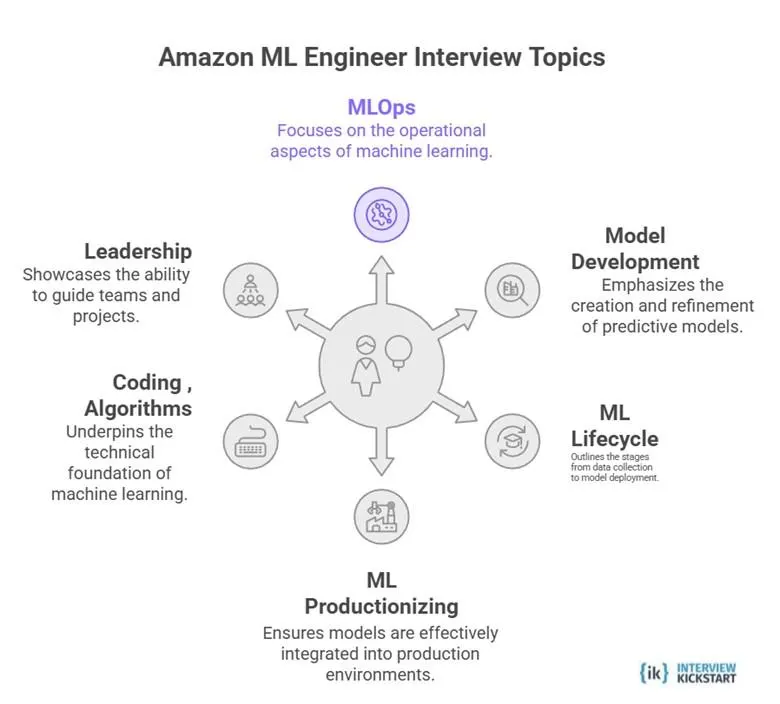
The Amazon machine learning engineer interview questions across various rounds will be on MLOps, model development, ML lifecycle, ML productionizing, coding, Algorithms, and Leadership.
Let us look at the Amazon machine learning engineer interview questions.
What Amazon Expects: Responses are evaluated for correctness, code quality, clarity, optimization, leadership, tradeoff, and edge cases. communication, and testing mindset.
Amazon MLOps Machine Learning Engineering Interview Questions
Let us look at sample coding questions and answers:
Q. How do you handle data drift in production ML systems?
A. Monitor input feature distributions and prediction outputs against training baselines. I use statistical checks, the KS test, PSI for drift detection, and SageMaker Model Monitor to automate alerts. When drift crosses a threshold, I will either retrain, make feature fixes, or make label updates
Q. How will you implement CI/CD for ML models?
A. ML models are treated as versioned artifacts. Code changes trigger unit tests and training jobs, while data changes trigger validation checks.
Q. How do you version data, models, and features?
A. I use Data, S3 versioning + immutable dataset snapshots. For features, the centralized feature store SageMaker Feature Store, and for models, Semantic versioning in Model Registry.
Sample MLOps Amazon machine learning engineer questions are:
- How is ML CI/CD different from traditional DevOps?
- What are the best practices for automating model training, testing, and deployment?
- Detail your experience with pipeline orchestrators with Airflow, Kubeflow, and managing complex workflows.
- Explain the method for reproducibility in your ML pipelines with code, data, and environment versioning.
- Describe the process of setting up effective alerts for model degradation or pipeline failures.
- Explain the model registry and how you manage model versions and lineage?
Amazon Model Development Machine Learning Engineer Interview Questions
The Amazon machine learning engineer interview guide indicates that questions on model development are a mix of foundational ML theory, practical system design, coding proficiency, and alignment with Amazon’s Leadership Principles.
What Amazon expects: Amazon wants clarity in how to build, scale, and maintain models in production.
Sample questions and answers:
Q. How will you frame a business problem as a machine learning problem?
A. Begin by defining the business objective and the decision we want to automate or support. Then I translate the results into input features available at decision time, output type classification, regression, ranking, and constraints like latency, interpretability, and cost.
Q: How will you select a model for a problem?
A. Start with a simple baseline like logistic regression or gradient boosting. Then compare the models on performance on validation data, interpretability, training/inference cost, and stability over time. I take a simpler model that is used in production than a complex model with operational risk.
Q. How do you evaluate if a model is ready for launch?
A. I define launch criteria as offline metrics beating baseline, considering stability across slices, regions, cohorts, and with acceptable latency and cost. A/B testing or shadow deployments should be done to validate real-world impact
Sample questions on model development for Amazon machine learning engineer interview questions:
- What does the area under the Curve represented in RCC- AUC indicate?
- When is accuracy not a good metric?
- When will you use Mean Absolute Error and Mean Squared Error?
- Explain the silhouette coefficient and Dunn index.
- Explain hyperparameter tuning with examples.
- How do you handle severe class imbalance?
- How do you prevent data leakage?
- Explain the differences between data drift and concept drift.
- How will you evaluate a Large Language Model?
How to prepare: Read case studies on Amazon technology implementation, perfect responses using question banks and answers, and attend mock interviews.
Also Read: Career Path to Senior Machine Learning Engineer
Amazon Behavioral/Leadership Machine Learning Engineer Interview Questions
This Amazon machine learning engineer interview guide presents several questions and answers on behavior and leadership. The questions are mapped to the 16 Leadership Principles and use past actions as indicators of future success.
What Amazon expects: Amazon wants clarity in alignment with the 16 leadership principles. Your responses should be sincere, logical, show ownership, customer obsession, and ability to dive deep, and be designed as per the STAR framework.
Sample questions and answers:
Q: Describe a situation when you had to dive deep to solve a technical problem
A: Situation: The service had random latency spikes with no clear cause.
Task: Identified the root cause to reduce customer impact.
Action: I reviewed logs, GC metrics, and deployment timelines and correlated spikes with a recent dependency upgrade.
Result: Rolling back and fixing the issue reduced p99 latency by 42%.
Q: Explain a case when delivery was under pressure.
A: Situation: The compliance deadline was moved up by four weeks.
Task: We had to deliver an acceptable solution without sacrificing system stability.
Action: I removed non-essential scope, broke work into milestones, and aligned dependencies with partner teams.
Result: We met the deadline with zero production incidents
Q: Describe how you managed to improve a low performer
A: Situation: An engineer frequently misses deadlines.
Task: Improve the performance using fair and transparent methods.
Action: I set clear expectations, provided weekly feedback, and offered support.
Result: Performance improved significantly; when it later plateaued, we mutually agreed that a role change was the best outcome.
Some sample questions are:
- Describe an incident where you went above your job description to help the company.
- Explain a situation when you made an important decision without your boss’s approval.
- Demonstrate with an example of how you delegate effectively.
- Describe an incident when your calculated risk failed, and the lessons you learned.
- Describe a complex problem that you came up with an innovative approach to.
- How do you convince engineers to adopt a new feature or idea?
- How do you carry out root cause analysis of a vexing problem?
- How will you overcome technical debt in your projects?
Preparation Framework and Study Plan for Amazon Machine Learning Engineer Interviews
This Amazon machine learning engineer interview guide suggests an 8-week preparatory plan. The plan is customized for L4 and L6 levels. You need to prepare for 5 pillars and a study plan for employed machine learning engineers.
Five Pillars of the Study Plan for an Amazon Machine Learning Engineer
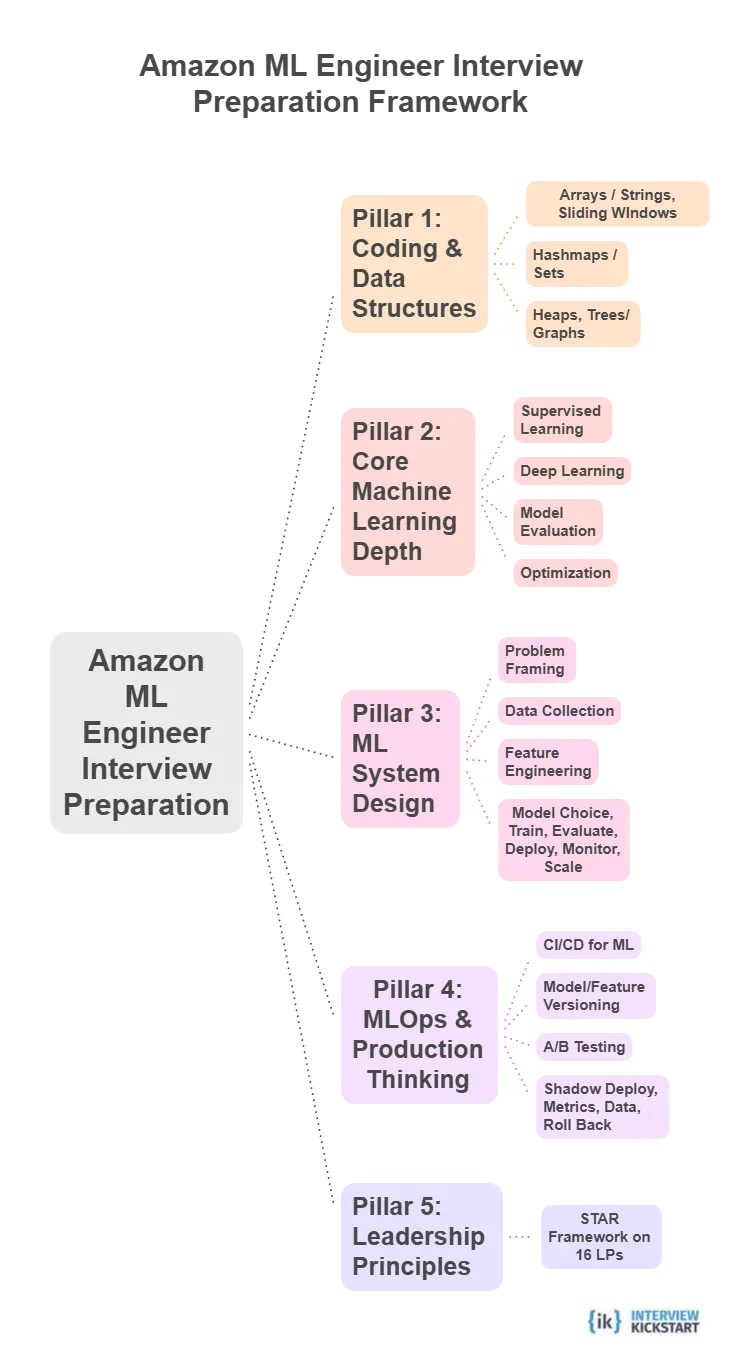
Amazon evaluates you on: Depth and did you drive the decision; Scale the team size, system impact, blast radius; judgment under pressure; learning mindset; ownership; hiring; bias for action, earn trust, delivering results. Prepare 2-3 use cases for each LP.
Technical Depth: 20%–30% of scores
Suggested Timeline
The Amazon engineering manager interview questions guide recommends a 6–8-week plan based on the 5 pillars. The suggested timelines can be adjusted as per your time and schedule.
Amazon Machine Learning Engineer Interview Tips
Some important tips for the Amazon engineering manager interview are:
- Leadership Principles: Prepare 5-7 tight STAR stories on Ownership, Hire & Develop the Best, Dive Deep, Deliver Results, Earn Trust, Have Backbone, and Disagree and Commit
- Technical Interview: Think “Judgment,” Not LeetCode. Expect questions on system design, debugging, design review, calling out risks, unknowns, and mitigations.
- People and Delivery Management: The Silent Dealbreaker: Amazon wants bar-raising teams that ship, conflict handling, missed deadlines, org debt and burnout, hiring decisions, ambiguity, starters, use data + judgement
- The Bar Raiser Interview: Amazon looks for pattern recognition, consistency, and long-term leadership.
- DO NOT: Expect sympathy, Use ‘We’ excessively, vague metrics, or dodge failure.
Prepare for Amazon Machine Learning Engineer Interview with Interview Kickstart
Interview Kickstart’s Machine Learning Engineer Interview Course is designed to help aspiring engineers and tech professionals prepare for and succeed in rigorous technical interviews. The course is designed and taught by FAANG+ engineers and industry experts to help you crack even the toughest of interviews at leading tech and tier-1 companies.
Enroll now to learn how to optimize your LinkedIn profile, build ATS-clearing resumes, personal branding, and more. Watch this Mock Interview to learn more about the different types of Amazon machine learning engineer interview questions for experienced candidates and how you can answer them to not only leave a good impression, but also to clear the interview.
Conclusion
The Amazon machine learning engineer interview guide presented a detailed process and stages of the interview. The interview is spread over 6-8 weeks and has several stages, like a recruiter screen, a technical screen, an onsite/ virtual screen, and a final interview.
The depth of technical interviews depends on the level at which you are interviewed. L4+ levels see more depth in the technical aspects of coding, MLOps, system design, and architecture. Senior L6+ levels are interviewed for their technical vision and direction.
All levels are expected to show strong alignment with the 16 Amazon leadership principles. You are evaluated for your ability to lead teams, give direction, think of the future, plan, and show exceptional leadership and mentoring skills.
However, only expertise in people management and less focus on technical competency is a big negative. The Amazon machine learning engineer interview guide has given details of the lessons and a timeline. Follow the plan to gain success.
Cracking the Amazon machine learning engineer interview questions is challenging. You need to have a strong understanding of the technical concepts and other soft skills like problem-solving, communication, collaboration, and other domains.
FAQs: Amazon Machine Learning Engineer Interview Guide
Q1. What is the Amazon machine learning engineer interview?
As detailed in the Amazon machine learning engineer interview guide, the interview process is spread across several phases with multiple rounds in each. These include the recruiter screen, technical screen, virtual onsite screen, and final round.
Q2. What is the duration of the interview process?
The Amazon machine learning engineer interview process takes 4-6 weeks from recruiter screen to final offer letter, depending on your level and Amazon’s urgency.
Q3. What type of questions are asked in the Amazon machine learning engineer interviews?
Questions focus on the 16 Amazon leadership principles and several deep technical rounds, and you are evaluated for your expertise on coding, machine learning, and data handling.
Q4. Are coding assignments given?
Yes. Rigorous coding questions will be asked. You may be asked to optimize and improve code, ensure clarity, and review for clarity and consistency.
Q5. How are candidates evaluated in the Amazon machine learning engineer interviews?
Candidates are evaluated for their technical competency, vision, problem-solving approach, and on the 16 leadership principles.
References
- Maximize business outcomes with machine learning on AWS
- Amazon Machine Learning University
- The 16 Amazon Leadership Principles
- Amazon CEO Andy Jassy explains the 16 Amazon Leadership Principles
- Amazon SDM Interview Prep
- Guide to the Amazon interview process
Recommended Reads: