The machine learning engineer interview guide for experienced professionals is designed for senior ML engineers who want to convert their hands-on experience into strong interview performance.
Teams now expect engineers who can take models from experimentation to reliable production systems. The MLOps market is projected to reach $ 2.33 billion by 2025, and more than half of developers report that AI tools help them work more efficiently.
Companies are focusing on candidates who understand deployment, monitoring, data quality, and system behavior in real environments.
In this article, we will cover the exact interview topics, system design expectations, coding requirements, behavioral themes, and preparation steps that help experienced ML engineers succeed in senior roles.
Key Takeaways
- This machine learning engineer interview guide for experienced professionals highlights how senior candidates can prepare for advanced interview loops.
- It emphasizes how to translate hands-on production experience into clear reasoning and trade-off narratives that commonly appear in a senior machine learning engineer interview.
- Candidates are expected to demonstrate advanced ML knowledge, practical modeling decisions, robust pipeline design, deployment strategies, and monitoring techniques.
- Behavioral and leadership aspects are critical, including communication, cross-team collaboration, and decision-making under constraints.
- The article highlights resources and structured approaches, including case studies, mock interviews, and expert guidance, to help senior ML engineers succeed in interviews.
How Interviews for Senior Machine Learning Engineers Work?

This section of the machine learning engineer interview guide for experienced candidates explains how senior-level interview loops are structured and evaluated.
Senior ML interviewers focus on how well you can solve problems that show up in real systems. The interview process evaluates your experience across modeling, engineering, collaboration, and production readiness.
Most senior candidates move through a sequence of rounds that cover both technical and practical judgment. You will answer each senior machine learning engineer interview question by breaking down model behavior, data assumptions, and production constraints.
Typical stages in the interview process include:
1. Technical Screen
A short round that checks your command of ML foundations. Interviewers want to see whether you can explain ideas clearly and connect them to real work. Expect questions about metrics, failure modes, data assumptions, and the reasoning behind model choices.
2. Coding Round
You write code that is clean, readable, and aligned with how engineers work in production. Hiring teams look for structured thinking, safe handling of edge cases, and an ability to express ideas clearly in code.
3. ML System Design
This is often the most important round for senior roles. You will talk through end-to-end workflows such as data ingestion, training pipelines, online inference paths, monitoring, and retraining. Strong answers focus on practical considerations like latency, cost, reliability, and how teams work together to keep systems healthy.
4. Onsite Technical Rounds
These rounds explore how you handle real situations with messy data, conflicting metrics, performance constraints, or unexpected model behavior. You will also discuss how you collaborate with product, backend, or data engineering teams.
5. Behavioral Round
Senior roles require leadership presence. Interviewers look for clarity, thoughtful decision-making, and examples where you influenced direction or helped teams ship meaningful work.
Recommended Read: Machine Learning Engineer Resume Guide: Tips, Best Formats, and Sample Included
The ML Engineering Skills and Qualities Companies Expect
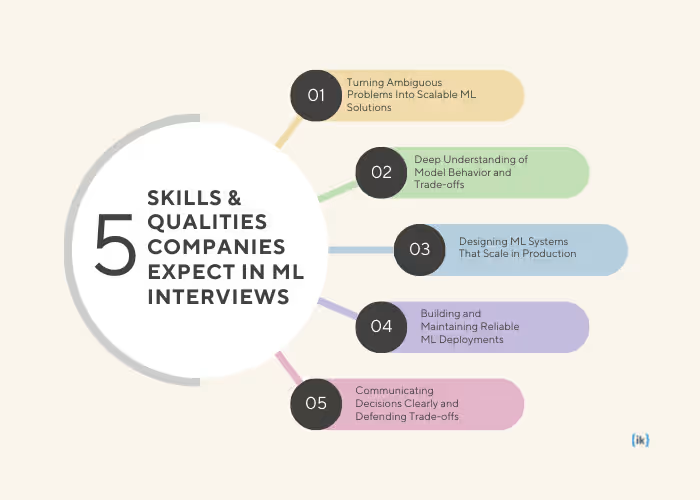
Hiring teams evaluating candidates using a machine learning engineer interview guide for experienced professionals want far more than algorithm knowledge.
At the senior level, they assess whether you can design, ship, and maintain ML systems that work reliably in production.
The goal isn’t to see if you can recall ML theory. It is to understand your judgment, your engineering intuition, and your ability to own the full lifecycle of an ML solution.
Modern interviews reflect this shift. They test how well you translate business problems into ML objectives, how you engineer datasets and pipelines, and how you make design decisions under constraints. This is where experienced ML engineers stand apart.
Below are the skills interviewers consistently evaluate in senior-level ML engineering interviews.
1. Turning Ambiguous Problems Into Scalable ML Solutions
Senior interviewers want to see whether you can take a vague product requirement and shape it into a measurable ML problem. They expect you to think like an engineer who has led initiatives before. This means demonstrating:
- How do you validate whether ML is even necessary?
- How do you define success metrics tied to business outcomes?
- How do you identify constraints around data, latency, scale, privacy, or compute?
- How do you simplify the problem into a manageable MVP before expanding it?
Strong candidates show they can take ownership of an idea and convert it into a structured ML roadmap.
2. Deep Understanding of Model Behavior and Trade-offs
Senior ML engineers are expected to diagnose model behavior with clarity. Interviewers look for reasoning such as:
- Why is the model underperforming, and where do the signals break?
- How do you separate data issues from model issues?
- How do you choose architectures based on structure and constraints?
- How do you balance accuracy with interpretability, cost, or latency?
- When does a traditional model outperform a deep model?
This is where years of practical experience matter. Interviewers want engineers who can anticipate failure modes instead of discovering them in production.
3. Designing ML Systems That Scale in Production
This is one of the most heavily weighted areas in any machine learning engineer interview for experienced professionals. Companies want engineers who understand how to get models from a notebook into a live environment. Expect to discuss:
- Feature pipelines (batch, streaming, hybrid)
- Data versioning, orchestration, and workflow management
- Distributed training setups and cost-efficient compute strategies
- Inference services optimized for latency and reliability
- Monitoring, logging, and continuous evaluation workflows
Interviewers want proof that you can design systems that scale, not just prototypes.
4. Building and Maintaining Reliable ML Deployments
Senior candidates should demonstrate strong operational thinking. Companies want engineers who understand:
- Drift detection and alerting
- Expirable features and stale data risks
- Canary testing, A/B frameworks, and staged rollouts
- Guardrails for abnormal predictions or high-risk outputs
- Automated rollback and retraining triggers
This is the part that separates ML engineers from data scientists; you’re judged on whether you can keep a model healthy after deployment.
5. Communicating Decisions Clearly and Defending Trade-offs
Clear communication is a major part of the senior bar. Interviewers test how you justify design decisions, explain constraints to non-technical teams, and handle pushback. Expect scenarios where you must defend choices such as:
- Why does one metric matter more than another?
- Why is a simpler model the right choice?
- Why is a complex pipeline worth the cost?
- How would you explain risk to leadership or compliance teams?
At this level, communication directly affects whether a project succeeds.
Core Machine Learning Topics to Master
As an experienced engineer preparing for a machine learning engineer interview, the fundamentals still matter. But interviewers now expect depth, engineering maturity, and an ability to reason about models in real production environments.
Many senior machine learning engineer interview questions center on whether you can break down complex ML problems, choose the right methods for the right constraints, and justify your decisions with clarity.
Below are the topics you must revisit with a senior-level lens.
1. Advanced Algorithms and When to Use Them
Interviewers want to know whether you understand algorithms beyond their definitions. They expect you to link models to data behavior, latency needs, and resource budgets. Expect deep dives into:
- Ensemble methods such as XGBoost and stacking
- Bayesian techniques for uncertainty-aware modeling
- Reinforcement learning scenarios and reward design
- Sequence models for prediction or anomaly detection
Strong answers explain why a specific method fits the problem. Real-world reasoning matters more than textbook descriptions.
2. Model Evaluation With a Production Mindset
Most companies evaluate whether you can diagnose and improve models across different stages of development. You should be comfortable discussing:
- Metric selection for ranking, forecasting, classification, and multi-label tasks
- Choosing the right validation strategy, including grouped splits and time-based cross-validation
- Understanding bias–variance behavior
- Explaining the difference between model lift and business impact
Senior roles require you to justify evaluation choices with respect to operational constraints, not just statistical theory.
3. Interpretability and Responsible Model Behavior
Interpretability has moved from a nice-to-know concept to a core requirement in many industries. Interviewers test whether you can communicate how your models behave and how decisions are traced. Prepare to discuss:
- SHAP and how you use it to investigate feature contributions
- LIME for local explanations
- Techniques for identifying unintended bias
- Fairness checks before model rollout
- How you approach validation when datasets evolve
These topics often appear in senior machine learning engineer interview questions, especially for roles that work closely with product and compliance teams.
4. Mathematical Foundations That Still Matter
Senior candidates are not expected to derive every equation, but they must understand the mathematics behind model behavior. Expect discussions around:
- Loss functions and how they shape optimization
- Regularization and its role in stability
- Probabilistic reasoning for noisy or sparse data
- Gradient behavior and how it affects training dynamics
Clear mathematical reasoning distinguishes mid-level candidates from those ready for senior ownership.
5. Implementing ML From First Principles
A recurring part of a machine learning engineer interview is the ability to implement algorithms from scratch. This does not mean building entire models line by line, but you should be able to:
- Recreate logistic regression or decision trees
- Implement a basic neural network training loop
- Simulate gradient descent
- Explain complexity, memory use, and edge cases
These tasks show whether you truly understand the mechanics behind the tools you use.
Coding, Data Structures, and Algorithm Skills for ML Engineers
Strong engineering fundamentals are still a core part of the machine learning engineer interview, especially at the senior level, where code quality, clarity, and performance have a direct impact on production systems.
Many senior machine learning engineer interview questions use coding as a proxy to understand how you think under constraints, how you design for scale, and how safely you write logic that powers ML pipelines and inference services.
The table below summarizes the skills evaluated in most ML engineering interviews and how they map to real production work.
Coding and DSA Expectations for Senior MLE Interviews
| Skill Area | What Interviewers Assess | Sample Senior-Level Question | Why It Matters in ML Engineering |
| Core Data Structures & Algorithms | Reasoning about complexity, clean problem-solving, predictable runtime behavior | You have a live stream of events. Design a sliding-window counter with stable performance at high throughput. | Feature pipelines, retrieval layers, and ranking systems rely on predictable DSA logic, not just ML code. |
| Model-Aware Implementations | Understanding how algorithms behave, not just how to call libraries | Implement logistic regression with gradient descent and explain how you avoid instability. | Shows whether you understand ML mechanics well enough to debug training issues in real systems. |
| Optimization Under Constraints | Ability to balance readability, speed, and safety in code | Refactor this inference code to reduce latency without changing model accuracy. | In high-traffic ML products, poorly optimized code often matters more than the model itself. |
| Production-Ready Coding | Reliability, structure, modularity, failure handling | Write an inference function with logging, input validation, and deterministic behavior. | Ensures models behave consistently across training, staging, and deployment environments. |
| System Integration Logic | How your code interacts with data stores, APIs, and infrastructure | Design a batch feature computation job and explain how you avoid data skew. | Senior ML engineers must think beyond notebooks and build components that integrate cleanly with engineering systems. |
| Edge Case & Failure Thinking | Awareness of silent failures, data anomalies, and boundary conditions | Handle missing feature values during real-time inference without degrading predictions. | Prevents production outages and reduces monitoring noise. |
How to Approach ML System Design in Machine Learning Engineer Interviews?
In any machine learning engineer interview guide for experienced professionals, ML system design is the most heavily weighted area for senior roles.
For senior roles, the machine learning engineer interview focuses heavily on whether you can design systems that run reliably in production. At this level, your ability to connect modeling, engineering, and operations is evaluated more rigorously than your ability to tune a model.
Most senior machine learning engineer interview questions in system design aim to understand how you think about architecture, data quality, system health, scalability, and long-term maintainability. A strong system design discussion shows that you can build ML workflows that survive scale, traffic spikes, changing data distributions, and real-world product needs.
1. Building Data Pipelines That Don’t Break at Scale
Robust data flow is the backbone of any ML system. Interviewers expect you to explain:
- How is raw data ingested from streams, events, or batch sources?
- How do feature computation jobs avoid skew?
- What happens when upstream schemas change?
- How do you handle late-arriving, duplicate, or corrupted records?
- When to use feature stores for consistency across training and serving?
These questions show your readiness to design pipelines that can run daily without constant manual intervention.
2. Designing Reliable Deployment Workflows
A large part of the machine learning engineer interview focuses on how you ship models in a controlled manner. Senior engineers are expected to understand deployment choices such as:
- Containerized inference services
- Batch vs. real-time serving
- GPU vs. CPU inference trade-offs
- Strategies for canary rollouts and shadow deployments
- Handling cold starts or resource spikes
These topics appear frequently in senior machine learning engineer interview questions, especially in companies with high traffic or real-time systems.
3. Managing Model Versioning and Experiment Tracking
Interviewers want to see whether you think like an engineer who manages long-term model lifecycles. Key points you may be asked to discuss include:
- Keeping training jobs reproducible
- Using a model registry to track versions, lineage, and metadata
- Preventing training-serving drift
- Maintaining feature versioning to avoid hidden inconsistencies
Engineers who understand these concepts significantly reduce the production risk.
4. Monitoring and Maintaining Production Models
Monitoring is often the single biggest gap in senior candidates. Interviewers want to know if you can:
- Detect data drift, concept drift, and feature shifts
- Track model metrics against real-world targets
- Build alerting systems that avoid noise
- Create retraining triggers based on performance degradation
- Interpret logs during failures or outages
Strong monitoring design shows that you understand what happens after a model goes live.
5. Designing for Latency, Cost, and Scalability
Every machine learning engineer interview includes trade-off discussions that test whether you can balance engineering constraints. You should be prepared to explain:
- When to prefer caching over recomputation?
- When to downsample or compress features?
- How to keep inference latency within an SLA?
- How to scale horizontally without overspending?
- Which components should be asynchronous?
These questions reveal your ability to think like an owner rather than a researcher.
6. Putting It All Together: End-to-End ML Architecture
Interviewers often ask you to walk through a complete system. For example: Design a real-time recommendation pipeline for a high-traffic product. They expect you to discuss:
- Data sources
- Feature computation
- Training workflows
- Deployment and serving
- Monitoring and retraining
The goal is to see whether your mental model of production ML is complete from data to inference to long-term maintenance.
Recommended Read: Machine Learning Engineering Interviews: What to Expect From System Design Rounds
Mock Interview Strategy and Preparation Plan for Senior ML Engineers
In a machine learning engineer interview guide for experienced candidates, this is where mock interviews become critical for translating theory into execution.
Sometimes, even the strongest candidates struggle when moving from theoretical prep to real-time execution. At the senior machine learning engineer interview level, the interviewer is evaluating not just correctness, but your speed, clarity, leadership, and engineering judgment under pressure.
That’s why a structured, high-fidelity ML interview preparation system is non-negotiable. Below is a table-driven framework designed specifically for working ML engineers, balancing depth, time, and performance expectations.
| Preparation Area | What Senior Engineers Must Demonstrate | How to Structure Mock Practice | What Interviewers Look For |
| ML System Design Interviews | Ability to design scalable, production-ready ML systems | Weekly 60–75 min sessions using real business problems and unclear requirements | Trade-off reasoning, production thinking, and capacity to handle ambiguity |
| Modeling + ML Theory | Deep understanding of algorithms, loss functions, and failure modes | Monotonicity checks, derivations, and evaluation strategy drills | Whether you understand why a method works, not just how |
| ML Coding Interview Preparation | Clean, optimized code under constraints | Timed DS/Algo + ML coding prompts (LeetCode + ML-specific problems) | Code structure, optimality, and communication of thought process |
| Data Engineering + Pipelines | Comfort with ETL, feature pipelines, and data quality | Practice with pipeline design scenarios + RCA prompts | Reliability focus, ability to debug incomplete data |
| ML Behavioral Interview | Ownership, leadership, conflict handling | STAR-driven mocks + failure scenario discussions | Whether you think like a senior engineer who owns outcomes |
How to Build a High-ROI Weekly Mock Routine?
A senior engineer doesn’t need more practice; they need the right distribution of practice.
1. Rotate Contexts, Don’t Repeat the Same Format
Practicing only coding or only system design creates false confidence.
A balanced weekly mix looks like this:
- 1 ML System Design mock
- 1 ML theory/modeling mock
- 1 coding + data structures mock (ML-focused where possible)
- 1 behavioral/leadership mock (bi-weekly)
This aligns perfectly with the senior machine learning engineer interview structure used at FAANG and top AI-first companies.
2. Simulate Production Pressure, Not Academic Problems
Your mocks should include:
- Missing requirements
- Conflicting constraints
- Noisy data
- Realistic KPIs (latency, cost, scalability)
- Non-ideal system limitations
This mirrors how real-world ML system design interview problems are judged.
3. Practice Ambiguity Handling
Interviewers expect you to:
- Identify missing information
- Ask pointed, high-leverage scoping questions
- Make assumptions explicit
- Set measurable success criteria
This is often the difference between a pass and a no-hire.
4. Prioritize Post-Mock Review More Than the Mock Itself
A 60-minute mock = 15 minutes of performance + 45 minutes of learning.
Your review should dissect:
- What slowed you down?
- Where does your reasoning lack structure?
- Whether your trade-offs superficial?
- Whether you communicate like a senior engineer?
This is where machine learning interview preparation compounds.
5. Use a Feedback Loop That Shows Improvement, Not Just Activity
Keep a weekly log for:
- System design frameworks you applied
- Modeling questions you misinterpreted
- Coding patterns you struggled with
- Behavioral patterns you need to refine
Senior engineers grow fastest by tracking patterns, not episodes.
Common Mistakes Experienced ML Engineers Make in Senior Interviews
Even strong engineers miss the bar because senior ML interviews test judgment, not just knowledge. Hiring teams already assume you understand models; what they evaluate is how you behave when requirements are ambiguous, systems break, or trade-offs matter more than theory.
These are the mistakes that repeatedly cause experienced candidates to underperform in a machine learning engineer interview.
1. Giving textbook answers instead of production-driven reasoning
Senior machine learning engineer interview questions rarely test definitions. But many candidates still answer with theory instead of framing responses through constraints, data reality, operational risk, and business impact.
What answers interviewers expect:
- Here’s the model I’d start with and why it fits the latency + data distribution.
- This metric aligns with how the product measures success.
- This is the failure mode I’d monitor based on historical patterns.
2. Ignoring data quality and pipeline fragility
A surprising number of senior candidates jump straight to model choices without discussing upstream risks, one of the biggest red flags in a machine learning engineer interview.
Signals that hurt your evaluation:
- Not asking clarifying questions about data freshness
- Overlooking the skew between training and serving
- No mention of schema enforcement, validation, or monitoring
- Treating pipelines as solved problems instead of the biggest source of outages
- Production ML is 80% data engineering. Interviewers expect you to talk like someone who knows this.
3. Over-focusing on modeling instead of ML system design
Many candidates still behave like researchers: too much energy on architectures, too little on engineering fundamentals.
What interviewers want in a senior candidate:
- End-to-end ownership
- Experience balancing accuracy vs. latency
- A clear approach to deployment and monitoring
- Awareness of trade-offs around reliability, cost, and maintainability
If you cannot talk through an ML system design interview scenario fluently, you won’t pass the senior bar.
4. Writing code that doesn’t reflect real engineering work
Even experienced ML engineers occasionally treat the coding round as a toy problem.
Common mistakes:
- Overcomplicating solutions
- Poor variable naming
- No guardrails or validation
- Notebook-style logic instead of modular functions
- Lack of attention to time/space complexity
Senior roles require code that is predictable, safe, and production-aware.
5. Weak communication and incomplete reasoning
Senior candidates often know what they’re doing, but don’t articulate why. This matters more than people expect.
Interviewers evaluate:
- If you can frame decisions logically
- If you reveal the assumptions behind your approach
- If you can handle pushback without getting defensive
- If you can simplify complex ideas without losing rigor
This directly impacts your score in behavioral interview machine learning engineer evaluations.
Interview Kickstart Masterclass for Senior ML Engineers
Preparing for a machine learning engineer interview for experienced professionals can be challenging, especially when balancing full-time work and complex system design expectations. Interview Kickstart’s Masterclass is designed to bridge this gap, providing structured guidance and real-world scenarios that senior engineers face.
Benefits of the Masterclass
- End-to-End Interview Preparation: Covers system design, coding, advanced algorithms, MLOps, and behavioral rounds.
- Mock Interviews with Expert Feedback: Simulates real interview conditions for senior ML roles.
- Hands-On Case Studies: Practical problems that mirror production ML workflows and trade-off discussions.
- Time-Efficient Learning: Designed for working professionals to integrate prep without burnout.
- Access to Senior-Level Resources: Templates, checklists, and curated problem sets aligned with senior machine learning engineer interview questions.
If you are seeking structured guidance, real-world case studies, and expert mentorship, explore the Interview Kickstart Masterclass for ML Engineers to begin your preparation and step into interviews with confidence.
Conclusion
The machine learning engineer interview guide for experienced professionals is not just a test of algorithms or coding. At the senior level, interviewers evaluate your ability to design robust systems, deploy models reliably, communicate trade-offs clearly, and take ownership of outcomes.
By approaching each round with structure and clarity, you demonstrate that you can handle real-world ML challenges. Practicing with ML mock interviews, revisiting advanced algorithms, refining coding skills, and building a library of behavioral stories will help you convert experience into interview performance.
Remember, interviews are also a mirror for self-growth. Assess gaps, reflect on trade-offs, and iteratively strengthen your skills. This proactive approach positions you to not only clear senior-level interviews but also thrive in production ML roles.
FAQs: Machine Learning Engineer Interview Guide for Experienced Candidates
Q1. What role does domain knowledge play in a senior ML engineer interview?
Domain understanding helps you pick features, set relevant metrics, and explain trade-offs clearly. It shows you not only understand the models but also the business context.
Q2. How much MLOps knowledge is expected in a senior ML interview?
You need real experience with model versioning, drift monitoring, rollout strategies, and retraining. Interviewers want to know if you can build systems that run reliably in production.
Q3. Do interviewers for senior ML roles care about research or open‑source contributions?
They do, but only when it’s relevant. In research-heavy teams, published work helps. In product teams, practical ML system experience and clear design thinking carry more weight.
Q4. How should I prepare for system‑design questions if I already work with production ML?
Practice designing full pipelines with real constraints: feature ingestion, serving, monitoring, and trade-offs like latency vs cost. Run mock interviews that simulate ambiguous business problems.
5. Is behavioral prep important for a senior ML engineer interview?
Yes. Interviewers expect leadership, team collaboration, and ownership. Prepare stories around production incidents, project decision-making, and cross-functional leadership.