
OpenAI is widely regarded as a leader in AI automation and advancement. For many machine learning engineers, having OpenAI on their profile represents a career-defining milestone. For candidates aspiring to get into OpenAI as a machine learning engineer, it is important to be prepared by knowing the interview rounds and thoroughly going through OpenAI machine learning interview questions.
According to Yahoo Finance1, OpenAI’s flagship product, ChatGPT, reached 900 million weekly active users. This unprecedented adoption has driven the company’s financial success to new heights, with annualized revenue surpassing $25 billion.
To sustain this growth and continue advancing toward Artificial General Intelligence (AGI), OpenAI needs the best ML engineers in the world. As demand for AI-driven automation rises across the industry sectors, so does the need for engineers to build and scale these systems.
However, landing a job at OpenAI is very different from landing a typical tech job; the bar is exceptionally high.
If you want to secure a role at this elite AI lab, mastering the right OpenAI machine learning engineer interview questions is essential. In this guide, we will break down the role’s responsibilities, outline the hiring process, and cover the key questions you need to prepare for.
Key Takeaways
- Understand why OpenAI machine learning engineer interview questions focus heavily on real-world AI system building, not just theoretical knowledge or coding puzzles.
- Discover how candidates must demonstrate a deep understanding of transformers, RLHF, and model optimization techniques used in large-scale AI systems.
- Learn why strong Python and PyTorch skills are essential, along with the ability to write clean, efficient, and production-ready code.
- Interviews test your ability to design and scale distributed ML systems, including GPU clusters, inference pipelines, and data workflows.
- Check why performance optimization techniques like KV caching, quantization, and efficient batching is essential.
What Does an OpenAI Machine Learning Engineer Do?
Before diving into interview preparation, it is crucial to understand what the job actually entails. In many traditional tech companies, a Machine Learning Engineer might spend their day importing pre-built models from scikit-learn or Hugging Face, training them on small CSV files, and deploying them via a basic Flask API. At OpenAI, the reality is vastly different.
You are not just using AI, you are building the foundational intelligence that the rest of the world relies on. Your day-to-day work will sit at the forefront of distributed systems, deep learning mathematics, and supercomputing.
Here are the primary responsibilities of a Machine Learning Engineer at OpenAI.
- Pre-Training Infrastructure: You will write the highly optimized code required to train Massive Large Language Models (LLMs) with hundreds of billions of parameters. This involves managing clusters of thousands of GPUs and ensuring that training runs continuously for months without failing due to hardware crashes.
- Post-Training and RLHF: A raw language model is unpredictable. You will be responsible for fine-tuning models using Reinforcement Learning from Human Feedback (RLHF) to ensure the AI follows instructions safely and accurately.
- Inference Optimization: Once a model is trained, it must be served to 900 million users. You will work on writing low-level code (often involving custom CUDA kernels) to optimize inference speed, utilizing techniques like KV caching, FlashAttention, and model quantization.
- AI Safety and Alignment: OpenAI is deeply committed to safe AI. You will build automated testing frameworks and guardrails to ensure that models do not generate harmful, biased, or dangerous content before they are released to the public.
Understanding these high-level responsibilities is the key to passing the interview, as the questions you face will directly mirror these daily challenges.
Interview Process for a Machine Learning Engineer Role at OpenAI
OpenAI moves fast, but its interview process is meticulously designed to filter out candidates who lack a deep, fundamental understanding of machine learning architectures. If you are used to standard software engineering interviews that only test LeetCode puzzles, you need to adjust your strategy.
The entire process typically takes anywhere from three to six weeks. Here is the step-by-step interview pipeline you can expect:
- Recruiter Screen (Week 1): If your resume passes the initial review, you will have a 30-minute introductory call. The recruiter wants to know your timeline, your background, and most importantly, why you are passionate about OpenAI’s specific mission of building safe AGI.
- Technical Phone Screen (Week 2): You will meet with an engineer via a video call for 60 minutes. This is usually a pair-programming session. Instead of a generic algorithm, you might be asked to implement a specific mathematical ML formula (like backpropagation for a linear layer) from scratch using Python and NumPy.
- Take-Home Assessment or Deep Dive (Week 3): Depending on the specific team, you may be given a highly practical take-home project. You might be asked to train a small model, optimize a PyTorch training loop, or write a script to distribute data across multiple mock GPUs. They care deeply about code cleanliness and performance.
- The Virtual Onsite Loop (Week 4): This is the final stage. It consists of 4 to 6 back-to-back interviews in a single day. You will face a grueling mix of advanced coding, ML system design, theoretical deep learning, and behavioral interviews with senior researchers and engineering managers.
To survive this onsite loop, you cannot just rely on surface-level knowledge. You must practice the exact concepts that the interviewers will test you on.
Top 40 OpenAI Machine Learning Engineer Interview Questions
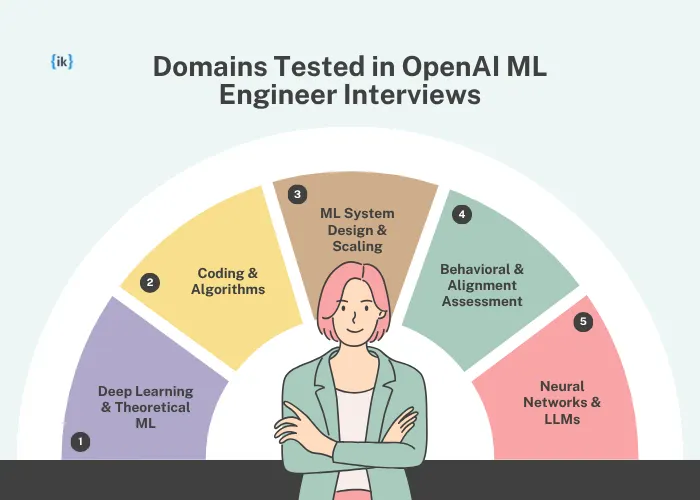
To give you a structured study plan, we have compiled the top 30 OpenAI machine learning engineer interview questions that frequently appear during the onsite loop. We have categorized these into five distinct areas to help you focus your preparation effectively.
Deep Learning and Theoretical ML
Theoretical OpenAI machine learning engineer interview questions test your fundamental understanding of the math and architecture behind modern AI. You cannot just know how to use a transformer, you must know why it works.
Q1. Can you derive the gradients for the self-attention mechanism?
OpenAI engineers need to understand the underlying calculus of their models. You should be able to write out the mathematical formulation of query, key, and value matrices and explain how backpropagation updates these weights.
Q2. Why do Transformers use Layer Normalization instead of Batch Normalization?
Explain how batch normalization struggles with the variable sequence lengths found in natural language processing, whereas layer normalization normalizes across the feature dimension independently of the batch size.
Q3. Explain the math behind Reinforcement Learning from Human Feedback (RLHF).
Discuss the reward model training phase, and how proximal policy optimization (PPO) is used to update the language model’s policy without destroying its original pre-trained knowledge.
Q4. How does the KV (Key-Value) Cache work during LLM inference?
Explain that during text generation, recalculating past tokens is computationally wasteful. The KV cache stores the key and value tensors of previously generated tokens to speed up autoregressive generation.
Q5. What is the vanishing gradient problem, and how do residual connections solve it?
Prove your understanding of deep network architectures. Explain how skip connections (ResNets) create a direct path for gradients to flow backward, bypassing problematic activation functions.
Q6. Explain the difference between PPO and TRPO in reinforcement learning.
Discuss how trust region policy optimization (TRPO) uses complex KL divergence constraints, while PPO simplifies this by clipping the objective function, making it much easier to scale on large clusters.
Q7. How would you mitigate mode collapse in a Generative Adversarial Network (GAN)?
Although OpenAI focuses heavily on diffusion models and LLMs, they still test general ML breadth. Discuss techniques like Wasserstein loss, unrolled GANs, or minibatch discrimination.
Q8. What are the trade-offs between using GeLU versus ReLU activation functions?
Explain that gaussian error linear units (GeLU) provide a smoother curve than ReLU, which helps gradient flow in deep transformer models and often leads to better convergence in NLP tasks.
Knowing the theory is excellent, but an engineer must also translate that theory into highly optimized code. This brings us to the coding round.
Coding and Algorithms
During the coding rounds, interviewers are looking for bug-free, highly efficient logic. They want to see your mastery of Python, PyTorch, and general data structures.
Q9. Implement the Multi-Head Attention mechanism from scratch in PyTorch.
You must be able to write the exact tensor operations, handle the reshaping of the query/key/value matrices into multiple heads, apply the softmax function, and handle the causal mask.
Q10. Write a function to implement Dropout during training and inference without using built-in libraries.
Show your understanding of how dropout randomly zeroes out neurons during training and scales the remaining weights, and how it behaves completely differently (identity function) during inference.
Q11. Implement a basic rate limiter for an API endpoint.
It is a classic software engineering question. Use a data structure like a sliding window log or a token bucket algorithm to ensure a user cannot spam the OpenAI inference API.
Q12. Write a custom data loader that handles out-of-memory (OOM) datasets efficiently.
Demonstrate your ability to stream massive text datasets from disk in chunks rather than loading the entire file into RAM, using Python generators and multiprocessing.
Q13. Implement the Beam Search algorithm for text generation.
Write a clean graph-search algorithm that keeps track of the top k most probable sequences at each step, demonstrating your grasp of tree traversals and probabilities.
Q14. Given an array representing server CPU loads over time, find the maximum load in every sliding window of size k.
Solve this standard algorithmic problem in O(N) time using a Deque (Double Ended Queue) data structure, proving you can optimize backend monitoring systems.
Q15. Implement a basic Tokenizer (like Byte-Pair Encoding).
Write a script that takes a corpus of text, identifies the most frequently adjacent pairs of characters, and merges them into a single token iteratively.
Q16. Write a script to parallelize matrix multiplication across multiple simulated CPU cores.
Show your understanding of Python’s multiprocessing library, chunking the matrices, and aggregating the results safely without encountering race conditions.
If you can code the micro-components, the next step is proving you can scale them. This leads us to the most critical round for senior candidates.
ML System Design and Scaling
When it comes to scaling, OpenAI machine learning engineer interview questions focus heavily on distributed computing and GPU orchestration. You must show how you would design systems capable of handling billions of parameters.
Q17. Design a system to train a 100-billion-parameter LLM from scratch.
You cannot fit this model on a single GPU. You must discuss 3D parallelism, such as data parallelism, tensor (Model) parallelism, and pipeline parallelism, using frameworks like DeepSpeed or Megatron-LM.
Q18. How do you handle checkpointing for a massive model without pausing training for hours?
Discuss asynchronous checkpointing. Explain how you would write the model’s weights to an ultra-fast in-memory cache first, and then slowly flush them to persistent cloud storage (like Amazon S3) in the background.
Q19. Design an inference API capable of serving 100 million active users.
Architect a system with global load balancers, dynamic batching of user prompts, GPU queuing mechanisms, and server-sent events (SSE) to stream text tokens back to the user’s browser in real time.
Q20. Architect a data pipeline to continuously scrape, clean, and deduplicate billions of web pages.
Discuss using distributed message queues (Kafka), massive distributed storage (HDFS), and efficient deduplication algorithms (like MinHash or SimHash) to ensure the training data is high quality.
Q21. How would you design a Retrieval-Augmented Generation (RAG) system for enterprise clients?
Explain how you would chunk client documents, use an embedding model to convert them into vectors, store them in a vector database (like Pinecone), and retrieve the top-K chunks to inject into the LLM prompt.
Q22. How do you optimize GPU utilization if your inference cluster is sitting idle 50% of the time?
Discuss implementing dynamic batching to group incoming requests together. Also, mention scaling down idle nodes or running lower-priority background batch-processing jobs on idle GPUs to maximize ROI.
Q23. Design an API abuse prevention system to stop malicious bot scraping.
Combine traditional rate limiting with ML-based anomaly detection models that analyze request patterns, IP addresses, and user-agent headers to quietly shadow-ban malicious actors.
Q24. How do you update an LLM with new daily news without retraining the entire model?
Explain that full retraining is too expensive. Suggest using a RAG pipeline connected to a live news API, or utilizing parameter-efficient fine-tuning (PEFT) methods like LoRA to update the model cheaply.
Finally, technical brilliance must be matched with ethical responsibility and teamwork.
Behavioral and Alignment
OpenAI is a mission-driven company aiming to build AGI that benefits all of humanity. Therefore, they rigorously screen candidates for cultural fit, humility, and a deep commitment to AI safety.
Q25. Why do you want to work at OpenAI instead of Google or Meta?
Avoid generic answers about salary or prestige. Focus on your alignment with their specific mission of building safe, beneficial AGI and your desire to work in an intensely fast-paced environment.
Q26. Tell me about a time you had to delay a project due to a safety or security concern.
Show that you take ownership. Describe a situation where you found a flaw, communicated the risk clearly to management, and prioritized long-term safety over short-term launch goals.
Q27. Describe a time you strongly disagreed with a senior researcher on an architectural choice.
Highlight your communication skills. Explain how you used data, benchmarks, and logical arguments to plead your case, but also show that you can “disagree and commit” if the final decision goes the other way.
Q28. Tell me about the most complex technical failure you have ever caused. What did you learn?
Be honest. Do not use a fake weakness. Take absolute accountability for the bug or outage, explain the root cause, and highlight the automated safety nets you built afterward to prevent it from happening again.
Q29. How do you prioritize your work when everything feels like an emergency?
Explain your framework for prioritization. Discuss assessing the business impact, the urgency, and the engineering effort required, and how you proactively communicate your bandwidth to your manager.
Q30. What are your personal thoughts on the ethical responsibilities of ML engineers?
Demonstrate maturity. Discuss the importance of red-teaming, mitigating dataset bias, and ensuring that highly capable AI systems do not inadvertently cause harm to marginalized communities.
Neural Networks & LLMs
To truly stand out in an OpenAI interview, you need a deep, systems-level understanding of how large neural networks and LLMs behave in real-world scenarios. These questions go beyond textbook theory and test your intuition around scaling, optimization, and architecture decisions.
Q31. How does attention complexity scale with sequence length, and how can it be optimized?
Explain that standard self-attention has O(n2) complexity due to pairwise token interactions. Discuss optimizations like sparse attention, FlashAttention, and linear attention mechanisms.
Q32. What are positional encodings, and why are they critical in Transformers?
Describe how transformers lack inherent sequence order awareness and rely on sinusoidal or learned positional embeddings to inject order information into token representations.
Q33. Explain the difference between encoder-only, decoder-only, and encoder-decoder architectures.
Compare models like BERT (encoder), GPT (decoder), and T5 (encoder-decoder), focusing on their use cases such as classification vs. generation.
Q34. What causes hallucinations in LLMs, and how can they be mitigated?
Discuss training data limitations, overgeneralization, and decoding strategies. Suggest mitigation via RAG, better alignment (RLHF), and constrained decoding.
Q35. How do temperature and top-k/top-p sampling affect text generation?
Explain how these sampling techniques control randomness vs. determinism in output generation and impact creativity versus factual accuracy.
Q36. What is fine-tuning vs. prompt engineering vs. in-context learning?
Compare these approaches in terms of cost, flexibility, and performance. Highlight when each is most appropriate in production systems.
Q37. What are embedding models, and how are they used in semantic search?
Explain how text is mapped into a high-dimensional vector space and how cosine similarity enables retrieval tasks in RAG systems.
Q38. How do you prevent overfitting in very large neural networks?
Discuss regularization techniques like dropout, weight decay, early stopping, and the role of massive datasets in implicit regularization.
Q39. What is gradient checkpointing, and why is it important for large models?
Explain how it trades compute for memory by recomputing intermediate activations during backpropagation, enabling training of larger models on limited GPUs.
Q40. How do mixture-of-experts (MoE) models improve scalability?
Describe how MoE routes tokens to specialized sub-networks, reducing compute per token while increasing total model capacity, as seen in modern large-scale architectures.
Skills You Need For an OpenAI Software Engineer Position
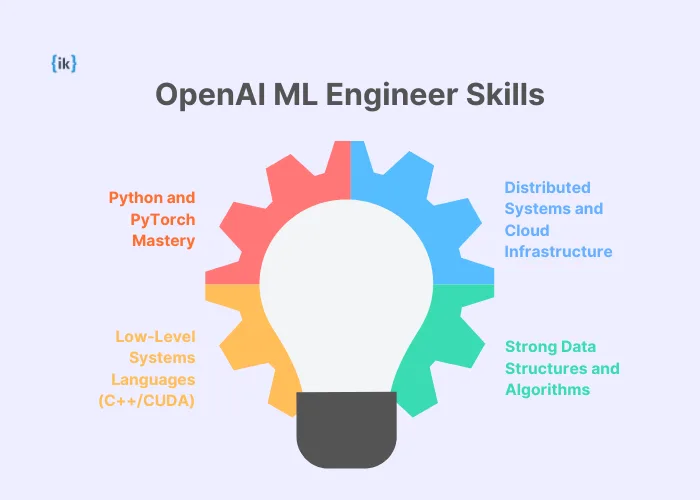
While studying OpenAI machine learning engineer interview questions is vital, you also need to ensure your resume and day-to-day skill set perfectly align with the company’s expectations. To succeed in this hybrid role, you must master the following core skills:
- Python and PyTorch Mastery: Python is the undisputed king of the AI ecosystem. You must be an absolute expert in Python and deeply familiar with PyTorch. You need to know how PyTorch handles computational graphs, memory allocation, and distributed data parallel (DDP) training.
- Low-Level Systems Languages (C++/CUDA): Python is too slow for actual hardware execution. To squeeze every ounce of performance out of expensive GPUs, OpenAI engineers often write custom kernels. A strong grasp of C++ and NVIDIA’s CUDA programming model is a massive advantage.
- Distributed Systems and Cloud Infrastructure: Training an LLM requires thousands of computers talking to each other simultaneously. You must understand Kubernetes, Docker, MPI (Message Passing Interface), and high-performance networking protocols to orchestrate these massive workloads.
- Strong Data Structures and Algorithms: Because OpenAI engineers write production code that serves hundreds of millions of users, latency matters. You must have a rock-solid foundation in traditional computer science algorithms to ensure your code runs with optimal time and space complexity.
Conclusion
Securing a position at OpenAI is one of the most challenging and rewarding achievements in the modern tech industry. The company is actively building the future of human-computer interaction, and they need brilliant, dedicated engineers who can balance raw technical coding with a profound responsibility for AI safety.
By deeply understanding the OpenAI machine learning engineer interview questions outlined in this guide, you will be vastly more prepared than the average candidate. Remember that OpenAI values practical, highly optimized code and a deep understanding of distributed scaling over abstract puzzle-solving.
Take the time to practice writing your PyTorch code on a whiteboard, conduct mock interviews to refine your system design architectures, and ensure your behavioral stories highlight your collaborative nature.
FAQs: OpenAI Machine Learning Engineer Interview Questions
Q1. Do I need a Ph.D. to be a Machine Learning Engineer at OpenAI?
No, you do not need a Ph.D. While OpenAI’s Research Scientist roles often require advanced degrees, the Machine Learning Engineer (and Software Engineer) roles focus heavily on applied engineering. If you can write highly scalable, reliable, and optimized backend code and understand the math behind the models, your actual educational background is irrelevant.
Q2. What programming language should I use during the coding interviews?
You should use the programming language you are most comfortable with. However, because the entire AI industry is built on Python, using Python is highly recommended for ML-specific questions. If you are applying for an infrastructure optimization role, demonstrating proficiency in C++ or Rust will make you highly competitive.
Q3. Does OpenAI ask LeetCode-style puzzle questions?
While you might see a few algorithmic questions, OpenAI is moving away from purely abstract, puzzle-based LeetCode questions. Instead, their technical screens heavily favor practical engineering. You are far more likely to be asked to implement an attention mechanism, build a distributed task queue, or optimize a slow piece of PyTorch code.
Q4. How long does the OpenAI hiring process usually take?
The entire process usually takes between three to six weeks. It begins with a recruiter phone screen, moves to a pair-programming technical screen or a take-home assessment, and concludes with a full-day virtual onsite loop consisting of 4 to 6 separate interviews. The timeline can be accelerated if you have competing offers.
Q5. How important is the AI safety aspect during the interview?
It is incredibly important. OpenAI is acutely aware of the global impact their technology has, so they heavily screen candidates for mission alignment and ethical responsibility. If you perform perfectly on the technical rounds but fail to show that you care about AI safety, red-teaming, and preventing bias, you will likely be rejected during the hiring committee review.
Reference
Recommended Reads:


