Article written by Nahush Gowda under the guidance of Satyabrata Mishra, former ML and Data Engineer and instructor at Interview Kickstart. Reviewed by Swaminathan Iyer, a product strategist with a decade of experience in building strategies, frameworks, and technology-driven roadmaps.
Deepseek entered the AI arena and took everyone by surprise. Its capabilities tanked the stock price of Nvidia, and the world of AI was in a frenzy over DeepSeek’s very capable R1 model that performed as well as OpenAI’s flagship models and was trained with a fraction of the cost.
Its capabilities, combined with the low cost of training, took the AI world by storm.
In 2025, the global AI race will no longer be dominated by a single player. The showdown between DeepSeek vs OpenAI has quickly become one of the most compelling rivalries in the tech world. OpenAI, the American pioneer behind GPT-4.1 and o4-mini, continues to lead with powerful multimodal tools and enterprise-level infrastructure. However, rising quickly from China is DeepSeek, a lean, open-source-focused contender that is pushing boundaries with its R1 and V3 models.
As developers and professionals look forward to infusing AI into their workflows, it is important to understand which one is better. Which platform delivers better performance? Which one is more developer-friendly, secure, and future-proof? This article takes a hard, technical look at both platforms, comparing their models, capabilities, costs, and more to help you decide which is better in 2025.
Company Backgrounds and Vision
Before diving into the detailed comparison, let’s understand both OpenAI and Deepseek and what they offer.
OpenAI
OpenAI is the one that kickstarted the era of generative AI with its image generation model and then ChatGPT in 2022. Since then, OpenAI has improved on its models and its reasoning capabilities with models like GPT-4.1 and reasoning variants like o3 and o4-mini.
OpenAI’s vision balances frontier model capabilities (e.g., GPT‑4.1’s 1 million‑token context window, advanced coding, and multimodal skills) with practical developer needs like latency, cost-effectiveness, and tool integration. This approach has made OpenAI the benchmark for commercial AI, with deep evaluations on multi‑modal reasoning, tool use, and long-context challenges built into its strategy.
DeepSeek
DeepSeek is a Hangzhou-based AI startup founded in May 2023 by Liang Wenfeng and backed by High‑Flyer, a quantitative hedge fund. It aims to challenge Western AI dominance by focusing on low-cost, open-source innovation. In stark contrast to high-cost, closed‑model development, DeepSeek leverages a lean approach, training on fewer GPUs (around 2,000 Nvidia H800s) and releasing model weights under the MIT license.
DeepSeek’s philosophy revolves around efficiency; its flagship V3 and R1 series result from smart architecture choices like MoE and multi-head latent attention, delivering top-tier reasoning at a fraction of the cost. By democratizing model access and undercutting proprietary budgets, DeepSeek positions itself as affordable, accessible, and efficient AI.
OpenAI Flagship Models
Here’s an in-depth look at OpenAI’s top-tier models driving the DeepSeek vs OpenAI comparison and why they matter in 2025.
GPT‑4.1
Released via API in April 2025 and integrated into ChatGPT by May, GPT‑4.1 is OpenAI’s latest “flat” large language model, optimized for enhanced instruction-following, nuanced output, and multimodal input (text, voice, image, video) builds upon GPT‑4.1’s versatility, aiming for speed, clarity, and contextual intelligence, particularly suited for creative workflows and general purpose tasks.
o‑Series: o3, o3‑mini, o4‑mini
While GPT‑4.1 handles broad tasks, the o‑series specializes in deep reasoning. Here’s how it breaks down:
o3
Launched April 16, 2025, the full-scale reasoning model “o3” introduces “private chain-of-thought” reasoning, deliberating step-by-step before responding. Performance highlights include:
- ARC‑AGI: 75.7% at low, up to 87.5% at high compute—surpassing human benchmark (~85%)
- SWE‑Bench Verified: 71.7% vs 48.9% for o1
- Codeforces Elo: 2,727 vs 1,891 for o1
- AIME: 96.7%; GPQA Diamond: 87.7%
It supports tool use (web search, Python, vision) and outputs structured reasoning summaries. However, this power comes with steep compute costs (~$10 input + $40 output per million tokens).
o3‑mini
Released January 31, 2025, this compact model balances reasoning power with cost and latency. Features include adjustable reasoning effort (low/medium/high) and strong STEM performance, outpacing its predecessor in coding and math.
o4‑mini
Debuted April 16, 2025, supplanting o3‑mini, it offers faster reasoning and improved efficiency.
o4-mini is built for scalable, budget-conscious deployments. Achievements include:
- AIME 2025: ~93–99% accuracy.
- Visual/multimodal tasks: Excellent performance.
- Optimized cost (≈$1.10 input, $4.40 output per million tokens)
| Model | Specialization | Compute/Cost | Key Strengths |
| GPT‑4.1 | General multimodal | Mid-tier cost | Creative tasks, balanced performance |
| o3 | Deep reasoning | High cost | Complex logic, math, coding, and tool use |
| o3‑mini | Compact reasoning | Moderate cost | STEM reasoning, lower latency |
| o4‑mini | Efficient reasoning | Low cost | Fast, accurate reasoning at scale |
DeepSeek Flagship Models
Here’s a detailed look at the flagship models of DeepSeek that can go head-to-head with the best of OpenAI’s models.
DeepSeek V3
DeepSeek V3, launched in December 2024, is a 671-billion-parameter Mixture-of-Experts (MoE) model that activates 37 billion parameters per token. It leverages Multi-Head Latent Attention and a novel load-balancing strategy without auxiliary loss, trained on 14.8 trillion tokens in just 2.788 million GPU hours, drastically lowering compute cost and operational risk. Its architecture enables efficient scaling and supports large-context inference, ideal for multilingual generation, translation, and general reasoning while maintaining affordability.
DeepSeek R1
Released in January 2025, DeepSeek R1 builds upon V3 and centers on reinforcement learning (RL) without supervised fine-tuning. This RL-first pipeline allows it to develop self-verification, reflection, and rigorous chain-of-thought reasoning, all in an open-source, MIT-licensed framework.
With a total model size of 671B and only 37B activated, R1 delivers top-tier reasoning across math, coding, and complex logic tasks on par with OpenAI’s o1, while maintaining resource efficiency.
| Model | Params/Active | Training Strategy | Key Strengths |
| V3 | 671B / 37B | Pre‑train + SFT + RL | Efficient multilingual generation, scalable inference |
| R1 | 671B / 37B | RL-first + SFT | Superior reasoning, chain-of-thought, reflection |
| R1-0528 | — | Updated R1 | Less hallucination, deeper inference depth |
| R1-Distill | 1.5–70B | Distillation from R1 | High reasoning in smaller, cost-effective variants |
Core AI Models Comparison: GPT‑4.1 vs DeepSeek‑R1
The rivalry between GPT-4.1 and DeepSeek-R1 highlights a deeper contrast in design philosophy and purpose than what first meets the eye. Both are cutting-edge models meant to handle broad reasoning, long prompts, and diverse tasks, yet how they got there and how they function under the hood tell two different stories.
Architecture & Design
OpenAI GPT-4.1
GPT‑4.1 is a heavyweight in the language model space, built using a dense transformer setup. OpenAI hasn’t shared the exact number of parameters it uses, but many experts believe it sits somewhere between 1 and 1.8 trillion, massive by any standard. It can take in and understand things like images, sound, and video, all through a setup where these inputs work closely together. That’s what people mean when they say it’s “multimodal.”
The model’s been tuned to run quickly and accurately. That tuning happens on the server side, which means it’s polished behind the scenes before you ever use it. A lot of that polish comes from human feedback, where real people guide the model on what sounds helpful and what doesn’t.
One of its core strengths is how it handles long stretches of information. Thanks to its “flat attention” system, a technical way of saying it treats every part of a long input with equal focus, it can work through huge blocks of text. In business or research setups, it’s been shown to manage up to a million tokens at a time. That’s not typical for everyday users, but the capability’s there when needed.
DeepSeek-R1
DeepSeek-R1 is a 671B parameter Mixture-of-Experts model with 37B active per token. It takes an open-source, lightweight approach by using reinforcement learning without supervised fine-tuning, prioritizing self-improvement and reflection mechanisms. Unlike GPT‑4.1, it is not inherently multimodal, but excels in reasoning within its focused domain.
Training Data & Objectives
When it comes to how they were trained, GPT‑4.1 and DeepSeek-R1 couldn’t be more different, not just in the size of their data, but in what each model was meant to learn from that data.
GPT‑4.1 had access to a massive pile of information. Think of everything from public websites and full-length books to academic journals and open-source codebases. After soaking all that up, it went through supervised fine-tuning. OpenAI also used reinforcement learning with human feedback, or RLHF, where the model learned to prefer answers that people rated as helpful or accurate. OpenAI also looked at how people use ChatGPT. The model learned from those real-life conversations, especially when tools were used mid-chat, which helped polish how it reasons through tasks step by step.
DeepSeek-R1, by contrast, had a tighter budget, about 2.7 million GPU hours, a fraction of what OpenAI spent. But it made that budget count by going a different route. It skipped the hand-holding of supervised fine-tuning and jumped straight into reinforcement learning. Its goal? To figure things out on its own. The model focuses on thinking through problems by itself, checking its work, and making sure its answers stay consistent. That makes it less about repeating what it’s been told and more about piecing things together logically.
| Feature / Model | GPT‑4.1 | DeepSeek‑R1 |
| Architecture | Dense Transformer | Sparse MoE (37B active) |
| Model Size (Total) | ~1–1.8T (est.) | 671B |
| Activation per Token | Full model | 37B |
| Context Window | Up to 1M tokens (pro users) | ~128K (configurable) |
| Training Strategy | SFT + RLHF | RL-first (no SFT in base model) |
| Multimodal Support | Yes (text, image, voice, video) | No (text-only) |
| Reasoning Style | Latent + tool-augmented | Explicit chain-of-thought + self-check |
| Licensing | Proprietary | Fully open-source (MIT) |
Reasoning & Use Case Differences
GPT-4.1 handles a wide range of tasks with ease. Whether it’s drafting stories, helping with tricky coding problems, running chatbots, or working with images and other types of media, it’s flexible enough to do it all. The results are usually clean, fast, and reliable, making it great for people who need something that works smoothly across different areas without requiring extensive fine-tuning.
DeepSeek-R1, by contrast, is much more focused. It doesn’t try to do everything. Instead, it focuses on logic-heavy tasks such as math, structured decision-making, or scientific work. What it lacks in flexibility, it makes up for in precision. That makes it especially useful in places where accuracy is more important than creativity, like education platforms that need clean, verifiable steps or research tools that require tight control and clear answers. It’s not built to “sound human” or handle fuzzy conversation. It’s built to be right.
Also read: Generative AI vs Predictive AI: What is the Key Difference?
Model Performance & Benchmarks
Evaluating DeepSeek vs OpenAI, it’s crucial to contrast their flagship models’ benchmark performances and overall efficiency.
GPT‑4.1 Benchmarks
- MMLU: 80.6% accuracy (0.806 score)
- GPQA: 50.3%
- MultiChallenge (instruction-following): improved by 10.5% over GPT‑4o with a score of 38.3%
- Long-context tools handle up to 1 million tokens, with Graphwalks at 61.7% versus GPT‑4o’s 42%
- GPT‑4.1 also averages 135 tokens/s output speed, 0.45 s first-token latency, and costs ~$2 input/$8 output per million tokens.
DeepSeek R1‑0528 Benchmarks
- MMLU: 84.9% accuracy (intelligence index 68)
- AIME (Math): 79.8% pass@1, slightly above GPT‑4o‑o1; Math‑500: 97.3%
- Codeforces Elo: ~2029
- GPQA‑Diamond: 71.5%
- Specialized benchmarks for legal and finance (Math500: 92%; ContractLaw: 62%)
- Price: ~$0.55 input/$2.19 output per million tokens, latency ~3.36 s, speed 23.7 tokens/s
| Benchmark / Metric | GPT‑4.1 | DeepSeek R1‑0528 |
| MMLU | 80.6% | 84.9% |
| GPQA‑Diamond | 50.3% | 71.5% |
| SWE‑Bench Verified | 54.6% | N/A |
| AIME / Math‑500 | N/A | 79.8% / 97.3% |
| Codeforces Elo | N/A (~2,700 for o‑series) | ~2,029 |
| Token Speed & Latency | 135 tok/s; 0.45 s | 23.7 tok/s; 3.36 s |
| Cost per 1M tokens | $2 / $8 | $0.55 / $2.19 |
| Context Window | 1 million tokens | ~128k tokens |
Interpretation
- GPT‑4.1 shines in multimodal, long-context reasoning and coding scenarios with superior speed and low latency.
- DeepSeek R1‑0528 delivers higher accuracy in academic reasoning tasks and is significantly more cost-effective, though slower and with a shorter context window.
Reasoning Capabilities
When comparing DeepSeek and OpenAI, one of the biggest dividing lines is how each model handles reasoning.
OpenAI GPT-4.1
Models like GPT-4.1 and the o‑series (especially o3 and o4‑mini) mix two kinds of reasoning: what’s going on behind the scenes (implicit) and what users can actually see through tool use (explicit). A lot of the thinking happens internally, and these models use “chain-of-thought” methods where they break problems into steps inside the model itself. But they don’t always show all those steps to the person using them.
To balance that out, OpenAI gives these models access to tools. Things like code execution (via Python), visual understanding, and live web search. This helps the models double-check their thinking, stay accurate, and handle tasks that go beyond language.
And the numbers back it up. The o3 model performs strongly across tough benchmarks:
- On ARC‑AGI, it scores between 75% and 87%. That’s a test designed to measure reasoning and general intelligence.
- It hits 96.7% on AIME, which is heavy on maths.
- And it lands 87.7% on GPQA‑Diamond, a test of grounded and structured question answering.
Strengths
- Multimodal context + tools = flexible reasoning across domains
- Very fast inference and robust production pipelines
Weaknesses
- Reasons are often hidden, and the chain of thought is not always user-visible
- Higher compute cost, particularly for intense reasoning models
DeepSeek‑R1
DeepSeek-R1 stands out because it skipped the usual fine-tuning steps at the start. Instead, it learned through reinforcement from the beginning: trial, error, correction, and self-reflection. This gave it a real advantage when it comes to reasoning out loud. Unlike other models that keep most of their thought process under wraps, R1 shows its work. Users can see each step in how it comes to a decision or answer.
This clarity doesn’t come at the cost of performance either. R1 hits strong scores on several tough academic and logic-focused benchmarks:
- 84.9% on MMLU, a broad test across many academic fields.
- 71.5% on GPQA‑Diamond, where answers have to be grounded in facts and logic.
- Around 79.8% on AIME, which focuses on advanced math.
- Codeforces Elo of about 2029, showing strong coding and problem-solving skills.
What’s even more impressive? DeepSeek has released smaller distilled versions of R1, ranging from 1.5 billion to 70 billion parameters, and they still manage to beat out many larger open-source models when it comes to pure reasoning. That’s a strong sign that its self-driven training method pays off. It’s lean, clear-thinking, and doesn’t rely on size alone to get smart results.
Strengths
- Explicit, transparent chain-of-thought reasoning
- Strong benchmark accuracy, even in compact models
- Open-source: fully inspectable and extendable
Weaknesses
- Slower inference (23.7 tok/s, ~3.36 s latency)
- Limited multimodal support; reasoning focused on text-based tasks
| Aspect | GPT‑4.1 / o‑Series | DeepSeek‑R1 |
| Reasoning Style | Latent + tool-augmented | Explicit chain-of-thought via RL |
| Benchmark Accuracy | Strong, but often proprietary metrics | SOTA-like on academic benchmarks |
| Transparency | Mainly hidden reasoning | Fully interpretable chain-of-thought |
| Speed / Latency | Fast inference, low latency | Slower, heavier reasoning steps |
| Safety / Faithfulness | Well-tested, but opaque | More faithful, but some safety quirks |
| Accessibility | Proprietary, high-cost | Open-source, inspectable, modifiable |
Code Generation & Multimodal Capabilities
In the DeepSeek vs OpenAI comparison, both platforms offer strong code generation features, but they diverge on multimodal abilities and execution performance.
OpenAI GPT-4.1 and o-series
GPT‑4.1 and the o‑series models are built to handle just about any input you can throw at them: text, code, images, audio, and even video. That makes them powerful tools for creative work, writing support, and navigating large codebases. GPT-4.1 is often considered the go-to for these kinds of tasks, but the o-series builds on that by diving deeper into complex reasoning and using tools across different types of content.
Their built-in toolset adds even more value. You can run Python code directly, search the web, generate graphs or charts, and even test scripts inside a controlled code sandbox. It’s all baked in, which means users can get hands-on, interactive results without switching platforms or writing extra prompts.
On coding benchmarks like HumanEval and Codeforces, the o-series clocks Elo ratings over 2700. First-token latency hovers around 0.45 seconds, and they pump out about 135 tokens per second. That speed is key for developers who need instant feedback, whether they’re testing ideas, debugging, or writing full applications on the fly.
DeepSeek R1 and Coder-V2
DeepSeek plays to its strengths, clean, structured, and logic-heavy tasks, especially in coding. The R1 model performs exceptionally well in algorithmic challenges and math-based programming. Internal tests even suggest it can score up to 17% higher than GPT-4 on HumanEval, and it often nails the solution on the first try, especially in Python-based tasks.
Then there’s DeepSeek-Coder-V2. It’s a specialized version built specifically for code, and it’s no slouch. This model supports a staggering 338 programming languages and handles long input, up to 128,000 tokens. That means it can tackle large files and entire projects without losing track of the logic. It’s even outpacing closed models like GPT-4 Turbo on certain math and code benchmarks, making it one of the top open options for serious development work.
However, its strength lies in reviewing and optimizing code. Users say it’s sharp when it comes to spotting bugs, cleaning up messy logic, and offering better ways to write the same thing. Whether you’re troubleshooting or improving performance, it’s a solid partner.
That said, DeepSeek has some clear limitations. It doesn’t work with images, audio, or anything outside of plain text. So if you’re trying to build a tool that blends language with vision or sound, this isn’t the right fit. And while it’s smart, it’s not the fastest. Its speed is around 23.7 tokens per second, with a delay of 3.4 seconds before the first response shows up. That might slow things down for interactive or live workflows.
| Feature | OpenAI (GPT‑4.1/o‑series) | DeepSeek (R1 & Coder‑V2) |
| Code Generation | Top-tier speed and versatility | Higher correctness and single-shot accuracy |
| Code Review & Optimization | Strong, tool-augmented | Excellent at bug detection and suggestions |
| Code Benchmarks | High Elo (~2700+), fast exec | Above GPT-4 on HumanEval/math/code tasks |
| Multimodal Input Support | Full (text, image, audio, video) | None (text-only) |
| Execution Speed & Latency | Very low latency, fast throughput | Slower (23.7 tok/s, ~3.4s latency) |
| Model Accessibility | Closed-source, API-based | Fully open-source, deployable locally |
Cost Comparison
The DeepSeek vs OpenAI comparison reveals a stark contrast in pricing, influencing adoption for budget-sensitive deployments.
OpenAI Pricing (GPT‑4.1 / o‑Series)
OpenAI’s pricing is high but justified by access to blazing-fast performance, extremely low latency (~0.45 s to first token), and seamless multimodal capabilities.
GPT‑3.1 / o3
- Input: $2.00 per 1M tokens
- Cached input: $0.50 per 1M tokens
- Output: $8.0 per 1M tokens
o4‑mini
- Input: $1.10 per 1M tokens
- Cached input: $0.275 per 1M tokens
- Output: $4.40 per 1M tokens
DeepSeek Pricing (R1 / chat models)
DeepSeek offers much lower pricing, which was one of the biggest reasons for its popularity. According to Business Insider Analysis, the discounted metrics equate to “only about 17× cheaper than OpenAI’s o1”.
DeepSeek R1
- Input: $0.55 per 1M tokens
- Cached input: $0.14 per 1M tokens
- Output: $2.19 per 1M tokens

Cost analysis
DeepSeek-R1 is about 73% cheaper than OpenAI’s o4-mini and, on average, that same 73% drop applies when stacked against GPT-4.1’s token pricing too. This adds up fast in large-scale deployments.
During off-peak times, DeepSeek’s rates can dip even lower, up to 90% cheaper than OpenAI’s top-tier models. That makes a huge difference for companies or developers running high-volume workloads around the clock. What’s more impressive is that this price drop doesn’t come with a huge performance hit. DeepSeek still holds its own in logic-heavy tasks, structured output, and code-focused benchmarks. So you get decent accuracy and strong reasoning without racking up a massive bill.
For anyone building apps that need to run constantly, like support bots, automated analysis tools, or high-frequency coding support, DeepSeek’s lower runtime costs can make it the smarter, more scalable choice.
DeepSeek vs OpenAI for Ease of Use for Developers
OpenAI
OpenAI’s developer setup is as smooth as it gets. Its REST APIs and SDKs cover all the major bases, Node.js, Python, Java, Go, so most devs can drop in without needing to rebuild anything from scratch. The endpoints are cleanly split by function – chat, image, audio, and completion, which keeps things simple when wiring it all up. Features like streaming responses, auto-retries, and async support are built right in.
Beyond the API itself, OpenAI’s tooling is stacked. You’ve got function calling, retrieval-augmented generation (RAG), and native tools for searching the web, executing code, or querying custom knowledge bases. And if you’re in the Microsoft ecosystem, you can make deep integration with Azure, LangChain, Power Platform, and VS Code, making the jump from development to deployment almost frictionless.
The community is another major strength. Tutorials, GitHub repos, and how-to threads, there’s a flood of support, both official and peer-led. OpenAI stays active too, running hackathons, sharing updates through Q&As, and keeping forums stocked with answers. For enterprise users, support scales up with SLAs, priority tickets, and onboarding that’s structured and hands-on.
On the deployment side, flexibility is solid. You can stick with the cloud, keep things siloed using Azure’s isolated environments, or go hybrid with on-premise inference. That kind of setup makes it easier to meet compliance needs while still getting fast performance and global scale.
DeepSeek
DeepSeek leans into openness and flexibility. It offers API interfaces that line up with OpenAI’s structure, so if you’ve built with GPT models before, transitioning isn’t too rough. The platform includes command-line tools for deployment, with GitHub repos that come prepped with Dockerfiles and Kubernetes YAML, great for scaling across clusters. There’s also room for real customization: plugin systems and admin tools let developers dive deep, tweak behaviors, and shape the stack exactly how they want it.
When it comes to deployment, DeepSeek doesn’t lock you into one path. You can run the models locally or in your own cloud, whichever fits your setup. That’s a win for organizations with strict data privacy rules, offline needs, or special performance requirements. However, it comes with a trade-off where you have to manage your own GPU resources. That includes provisioning, updates, and scaling, so it’s flexible, but it takes more work to keep things running smoothly.
Third-party compatibility is another area where DeepSeek holds its own. The open API makes it easy to hook into frameworks like Haystack, LangChain, and LlamaIndex. The ecosystem is still finding its legs, but there’s an active group on GitHub posting config files, setup guides, and scripts that make deployment smoother.
Documentation is decent. It gets you through the basics, from core APIs to deployment steps and dev examples, but it doesn’t quite have the polish of a commercial product. Support is community-led. That means no formal guarantees or SLAs, but you’ll often get direct access to developers and fast updates through GitHub or Slack. While the support in Chinese is strong, the English resources are improving steadily.
| Feature | OpenAI | DeepSeek |
| SDKs & API Cleanliness | Official, multi-language support | Compatible with OpenAI format |
| Framework Integrations | Extensive (LangChain, Azure, VSCode) | Emerging (Haystack, LangChain, GitHub) |
| Deployment Options | Cloud, hybrid, isolated environments | Cloud, on-premise, full sandboxing |
| Documentation Quality | Highly polished, mature | Growing but less-refined |
| Community & Support | Enterprise support & active forums | Community-first, no SLA |
Which provides better support?
OpenAI stands out for being easy to use and production-ready. Its APIs are polished, tools are built-in, and the broader ecosystem is mature and reliable. Whether you’re building a quick demo or deploying at scale, the whole pipeline is fast and smooth.
DeepSeek, by contrast, is for developers who want control. It’s open-source, transparent, and flexible, especially when you need to self-host, fine-tune, or adjust things under the hood. However, you will have to spend more time setting things up, and you’ll rely more on community forums than formal support.
Fine-tuning and Integration Tools: DeepSeek vs OpenAI
Fine-tuning and integration frameworks critically shape how DeepSeek vs OpenAI models adapt to custom use cases and embed into real-world workflows.
OpenAI
OpenAI makes it easy to fine-tune large language models without needing to manage the underlying infrastructure. With their managed API, you can upload your dataset (formatted in JSONL), adjust settings like batch size or learning rate, and let the system handle the rest. As the model trains, you get access to dashboards showing loss trends, accuracy levels, and even how it handles tricky or unusual examples.
On the integration side, OpenAI’s function-calling API transforms model outputs into clean, structured JSON, ready to plug into your backend services, automate workflows, or trigger database actions. And if you’re working with large datasets or documents, their retrieval-augmented generation (RAG) tools make it simple to connect to vector databases, enterprise search systems, or internal knowledge hubs.
The plugin ecosystem adds even more depth. You can build custom plugins that connect the model to outside APIs, perfect for adding private data sources or building tailored execution flows. Everything runs in a sandboxed environment, and plugins in the public registry are reviewed and security-checked, so you don’t need to worry about unexpected surprises in production.
If you’re operating inside Microsoft’s stack, Azure OpenAI Service lets you take that same power and lock it down inside a private network. Models can run behind firewalls, scale on Kubernetes, and tap into full Azure monitoring, logs, alerts, and all. It’s a solid fit for companies that need control, scale, and security all at once.
Enterprise customers also get dashboards for usage, real-time alerts, and logging at the token level. Policy enforcement is built in, so companies can stay aligned with data regulations like HIPAA, SOC2, and GDPR, without needing to bolt on extra systems.

DeepSeek
DeepSeek puts the power and the responsibility squarely in developers’ hands. Instead of relying on pre-packaged fine-tuning workflows, it offers a reinforcement-learning-first setup that’s built for experimentation. You can guide R1-like models using your own feedback loops. It’s still evolving, but this method allows for the development of domain-specific behaviors like self-checking and reasoning patterns that better reflect specialized needs.
For those working with smaller setups, DeepSeek’s distilled models (from 1.5B to 70B parameters) are open for tuning and distillation. Tools like Hugging Face and LoRA make it possible to tweak architectures, adjust tokenizers, or compress models for better memory performance. Because the source code is open, there’s very little that can’t be changed or extended, perfect for deep customization and optimization.
The plugin system is still growing, but it’s promising. Using the same JSON-RPC format as OpenAI, developers can switch between platforms without much rework. And because it plays well with tools like Milvus and Weaviate, setting up your own retrieval-augmented generation (RAG) system is totally doable, even without a proprietary backend.
When it comes to deployment, models can be deployed on-premises, in the cloud, or within Kubernetes clusters using Helm charts. You handle version control, scaling, and latency protection, often through tools like Prometheus and Grafana. That means total freedom, no vendor lock-in, but also more moving parts to manage.
One of DeepSeek’s strongest features is its transparency. Every part of the experimentation process, data loading, checkpointing, model loss, and reward signals, is visible and changeable. That’s a goldmine for research teams. But it comes with a tradeoff: you’re in charge of making sure everything works fairly, responsibly, and securely.
Developer Recommendations
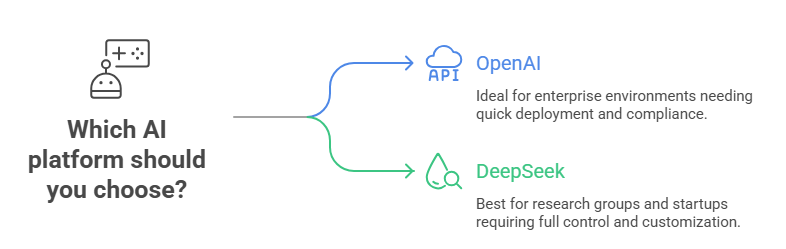
If you’re working in an enterprise environment or a regulated industry, finance, healthcare, or government, OpenAI is the smoother path. It gives you plug-and-play fine-tuning, built-in compliance support, and tight plugin integration. Everything is designed for quick deployment without the need to manage infrastructure yourself. You get speed, scale, and security without stretching your ops team thin.
 =
=
But if you’re part of a research group, an early-stage startup, or a team that handles sensitive data and needs full control? DeepSeek is built for that. It’s an open-source pipeline that lets you customize nearly everything, including how the model is trained, where it’s deployed, and what tools it connects with. You’ll need more engineering muscle to get it right, but the payoff is full-stack freedom and deep transparency.
Pros and Cons: DeepSeek vs OpenAI
Here’s a clear, comparative breakdown to help you assess DeepSeek vs OpenAI based on their strengths and trade-offs.
OpenAI
Pros
- Multimodal mastery: Handles text, code, images, voice, and video within unified models like GPT‑4.1 and o‑series.
- Speed and low latency: Fast inference (~135 tokens/s, ~0.45 s latency) crucial for real-time applications.
- Enterprise-grade ecosystem: Robust SDKs, polished APIs, integrations with Azure, LangChain, Power Platform, and VS Code.
- Secure and compliant: MIL-grade internal controls, encryption, data sovereignty, and compliance with GDPR, CCPA, HIPAA, and SOC 2.
- Managed fine-tuning: Easy-to-use API, built-in evaluation dashboards, plugin ecosystem, and support for RAG.
- Reliable support: SLA-backed enterprise service, access to training, forums, and community events.
Cons
- High cost: Token pricing is significantly higher, up to 4–8× that of DeepSeek’s models.
- Closed architecture: No access to model weights, custom architectures, or internal reasoning processes.
- Risk surface in extensibility: Custom GPTs can introduce vulnerabilities and may inadvertently leak data.
DeepSeek
Pros
- Open-source transparency: Full access to model weights, pipelines, and configurations (MIT license).
- Superior accuracy on reasoning benchmarks: Outperforms GPT‑4.1 on scholarly metrics like MMLU, GPQA, and AIME.
- Drastically lower cost: Token pricing is ~73% cheaper than OpenAI, with further discounts during off-peak hours.
- Reasoning traceability: Chain-of-thought exposure enables explainability and audit.
- Deployment flexibility: Deploy anywhere—on-premise, cloud, or hybrid—with full control over infrastructure and data.
Cons
- Slower performance: Latency (~3.4 s) and lower throughput (~24 tokens/s) may impact interactivity.
- Limited multimodality: Currently text-only; lacks vision, audio, and tool integration.
- Security and compliance concerns: Historical breach incident and flagged for mobile/data vulnerabilities.
- Less polished tooling: Requires engineering overhead for deployment, monitoring, and support is community-only.
Which One to Choose?
| Use Case | Recommended Platform |
| Enterprise apps requiring multimodal input, speed, and compliance | OpenAI |
| Budget-sensitive large-scale inference | DeepSeek |
| Research and reasoning transparency | DeepSeek |
| Prototype to production with minimal ops | OpenAI |
| Deployable on-premise with full customization | DeepSeek |
| Interactive chatbots or creative UI experiences | OpenAI |
Go with OpenAI if you’re after premium performance, polished APIs, and a model that just works across text, code, images, audio, even video. It’s built for scale, packed with features, and backed by enterprise-grade security and support. If your team wants something reliable, fast, and ready for production without getting into the weeds, OpenAI is the clear pick.
But if you’re the kind of team that wants to lift the hood, change the wiring, and tune every piece of the pipeline, DeepSeek is the better fit. It’s transparent, flexible, and significantly cheaper, especially at scale. While it won’t match OpenAI’s speed or multimodal reach, it gives developers full control and the tools to shape the model for niche, academic, or privacy-sensitive use cases.
Conclusion
Comparing DeepSeek vs OpenAI in 2025 isn’t about naming a single winner, it’s about picking what fits you. These platforms represent two very different paths in the AI world.
OpenAI is the established heavyweight. Its models like GPT‑4.1 and the o‑series are built for speed, security, and versatility. They handle text, images, code, audio, and video, all with polished tooling and strong enterprise support. If you need something that works right out of the box, integrates cleanly, and meets compliance needs, OpenAI’s the premium choice. Yes, it costs more, but you’re buying reliability, support, and serious scale.
DeepSeek, on the other hand, is the challenger with something to prove. R1 and V3 aren’t just cheap alternatives. They’re strong performers in reasoning, math, and logic. You get open weights, full visibility, and the ability to tailor the system to your needs. It’s ideal for teams that want to build, experiment, and deploy on their own terms.
Curious how DeepSeek and OpenAI actually stack up in the real world? Skip the guesswork and join our free masterclass, Exploring LLMs: DeepSeek vs OpenAI. We’ll walk through a live AI project that puts both platforms head-to-head, showing you how they behave in practical use.
You’ll hear directly from FAANG+ experts who’ve worked hands-on with these tools. They’ll break down the nuances that don’t show up in benchmark charts, things like latency under load, tool integration quirks, and the hidden costs of scaling. Plus, you’ll walk away with strategies to sharpen your AI portfolio, whether you’re just getting started or already deep in the field.
FAQs
1. Is DeepSeek better than ChatGPT?
DeepSeek is better for cost, open-source control, and reasoning transparency. ChatGPT (OpenAI) is better for speed, multimodal support, and ease of use. The best choice depends on your needs.
2. What is the main difference between DeepSeek and OpenAI in 2025?
The key difference in the DeepSeek vs OpenAI comparison lies in their approach. OpenAI offers closed, enterprise-grade AI with powerful multimodal tools, while DeepSeek delivers open-source, reasoning-first models at significantly lower cost. If your priority is compliance, speed, and multimodal deployment, OpenAI is the better fit. If you need transparency, affordability, and control over infrastructure, DeepSeek is better.
3. Which is better for code generation: DeepSeek or OpenAI?
In the DeepSeek vs OpenAI debate, both excel at code generation, but in different ways. OpenAI models like GPT-4.1 and o3 offer faster output and deeper integration with development tools. DeepSeek R1 and Coder-V2, on the other hand, often outperform OpenAI in benchmark accuracy and bug detection, especially in Python-heavy or academic code challenges.
4. Is DeepSeek more affordable than OpenAI in 2025?
Yes, DeepSeek is significantly more cost-effective than OpenAI. In this DeepSeek vs OpenAI comparison, DeepSeek R1 costs up to 4 to 8 times less per token, with even greater discounts during off-peak hours. OpenAI’s premium pricing reflects its performance and enterprise-grade support, while DeepSeek appeals to users needing scalable inference at minimal cost.