
When it comes to the tech industry, preparing for Meta phone screen interview questions is a crucial step toward landing a job at Meta (formerly Facebook), which is considered a massive milestone for any software developer. The scale at which Meta operates is simply mind-blowing. According to Meta1, it boasts an incredible 3.58 billion Daily Active People (DAP) across its family of apps, which includes Facebook, Instagram, WhatsApp, and Threads.
Because these platforms serve almost half of the global population every single day, the company requires top-tier engineering talent to keep everything running smoothly.
However, landing a role at Meta is challenging. The hiring process is rigorous, designed specifically to filter out candidates who cannot handle the immense pressure, scale, and complexity of Meta’s infrastructure.
To survive this highly competitive process, a strong preparation for the Meta phone screen interview questions is non-negotiable. In this guide, we will break down the stages of the Meta phone screen interview process, what interviewers are really looking for, and provide you with a master list of the most common questions you need to prepare.
Key Takeaways
- Understand that Meta phone screen interview questions are designed to test fundamentals first, not advanced system design. Your strength in arrays, strings, hash maps, and trees matters most at this stage.
- Recognize that the 45-60 minute format is fast-paced and structured, typically including 1-2 coding problems, making time management and quick pattern recognition critical for success.
- Learn that communication is just as important as coding ability. You must clearly explain your thought process, approach, and trade-offs while solving problems in real time.
- Focus on writing clean, bug-free, and optimized code, as interviewers evaluate readability, edge-case handling, and efficiency.
- Be aware that Meta uses a standardized evaluation rubric, assessing you on problem-solving, coding execution, communication, and testing methodology during the interview.
What is a Meta Phone Screen Interview?
A Meta phone screen interview is the first serious technical evaluation in the hiring process at Meta, following the initial recruiter conversation. While the recruiter call is largely informational, covering your background, experience, and expectations, the phone screen is designed to rigorously assess your core software engineering skills.
This interview is typically conducted by a current Meta software engineer and lasts around 45 to 60 minutes. It is conducted remotely, often via a coding platform where you are expected to write and execute code in real time. The focus at this stage is not on advanced system design or deep architectural knowledge, but on evaluating whether you possess strong fundamental problem-solving abilities, clean coding practices, and the right technical mindset.
During the interview, you are usually given one or two algorithmic coding problems. You are expected to:
- Clearly understand and clarify the problem
- Explain your approach and reasoning out loud
- Write efficient, bug-free code
- Optimize your solution where possible
- Handle edge cases and discuss trade-offs
Communication plays a critical role here. Interviewers are not just evaluating the final solution, but also how effectively you articulate your thought process, respond to hints, and adapt under time constraints.
The primary objective of the phone screen is to determine whether you are ready to move on to the more intensive onsite (or virtual onsite) interview loop. From a hiring efficiency perspective, Meta uses this stage to filter candidates before committing multiple senior engineers’ time to a full-day evaluation.
What to Expect in Meta’s Initial Phone Screens?
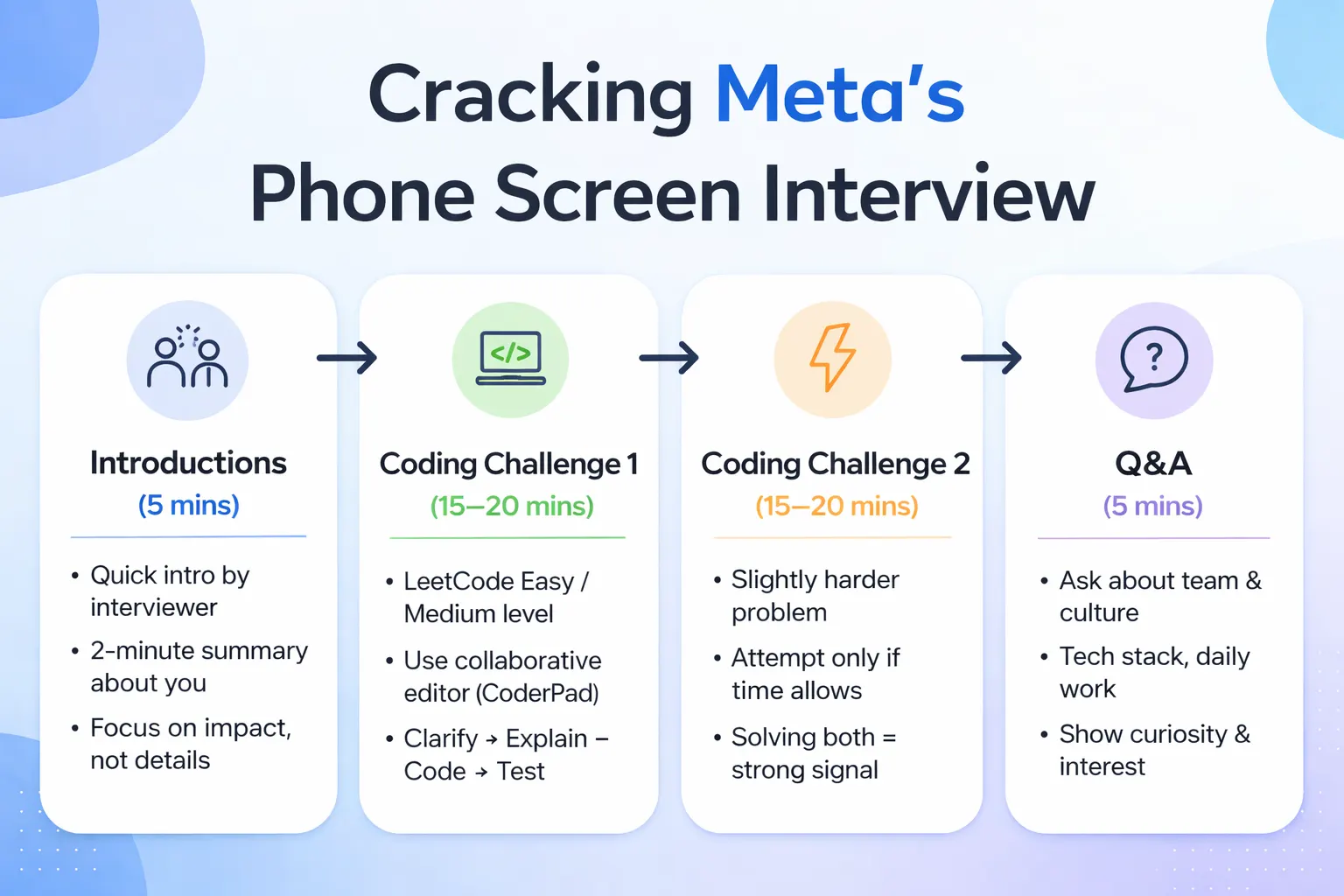
The technical phone screen at Meta follows a very predictable and tightly timed format. Knowing this format well can help you manage your anxiety and pace yourself correctly. Before you dive into practicing Meta phone screen interview questions, you should know how the 45 minutes will be divided. Here is a breakdown of the standard timeline you will experience during the call.
- Introduction (5 Minutes): The interviewer will briefly introduce themselves, explain what team they work on, and ask you to give a quick 2-minute summary of your background. Keep this short and impactful.
- Behavioural Question 1 (15-20 Minutes): You will be given a link to a collaborative code editor (like CoderPad). The interviewer will paste the first algorithmic question. This is usually a LeetCode “easy” or straightforward “medium” question. You are expected to ask clarifying questions, explain your approach, and write working code quickly.
- Coding Question 2 (15-20 Minutes): If you finish the first question fast enough, you will be given a second, slightly harder question. Completing two questions optimally is generally the unspoken benchmark for a “strong hire” recommendation at Meta.
- Q&A (5 Minutes): At the end, you will have a few minutes to ask the interviewee questions about Meta’s culture, their daily routine, or the specific technologies they use.
The pace is intentionally fast. Meta values execution speed highly. They do not just want to see if you can solve the problem eventually; they want to see if you can recognize the optimal pattern instantly. Staying quiet for a longer time gives a negative signal to the interviewer.
Top 30 Meta Phone Screen Interview Questions
To ensure you are fully prepared, we have compiled a list of the 30 most common questions asked during Meta phone screen interview. The interview is divided into two distinct categories: behavioral and coding. While the phone screen is primarily technical, behavioral checks happen naturally throughout the conversation. Let’s discuss few common behavioral questions that one may come across during the interview.
Top Behavioural Meta Phone Screen Interview Questions
Even though this is a technical round, the interviewer is still judging whether they would actually enjoy working with you. While technical skills are vital, the behavioral Meta phone screen interview questions are designed to test your communication, your ability to handle feedback, and your alignment with Meta’s core values (like “Move Fast” and “Focus on Impact”).
Here are the top 15 behavioral questions you should be ready to answer quickly and confidently:
1. Tell me about yourself. Keep it strictly professional. Highlight your current role, your biggest technical achievement, and why you are currently looking to transition to Meta.
2. Why do you want to work at Meta? Do not mention the salary. Talk about the massive scale of their systems, your passion for connecting people, or a specific open-source technology they built (like React or PyTorch) that you admire.
3. Describe a time you had a disagreement with a teammate. Focus on how you resolved the conflict using data and logic rather than emotion. Show that you can “disagree and commit” if the team decides to go in a different direction.
4. Tell me about the most complex technical challenge you have faced. Explain the problem clearly to someone who doesn’t know your company’s architecture. Highlight exactly what you did to solve it and the positive business impact it had.
5. How do you handle missing a deadline? Meta values transparency. Explain how you would communicate the delay as early as possible, propose a mitigation plan, and learn from the poorest estimation.
6. Tell me about a time you received constructive feedback. Show that you are coachable. Give a real example of feedback you received and detail the exact steps you took to improve yourself based on it.
7. Describe a situation where you had to learn a new technology quickly. Meta engineers frequently switch stacks. Talk about a time you read the documentation, built a quick prototype, and successfully shipped a feature using a totally unfamiliar language.
8. Tell me about a time you took initiative outside of your expected duties. It tests the “Focus on Impact” value. Talk about a time you refactored messy legacy code, improved the CI/CD pipeline, or mentored a struggling junior developer without being asked.
9. How do you prioritize tasks when you have multiple urgent deadlines? Explain your framework for prioritizing based on business impact and unblocking other teammates.
10. Describe a time you made a critical mistake in production. Own up to the failure. Meta loves a blameless post-mortem culture. Explain the bug, how you hot-fixed it, and the automated tests you added to prevent it from ever happening again.
11. Tell me about a project that failed. Focus on the lessons learned. A failed project is fine as long as you extracted valuable data from the failure that helped the company make better decisions later.
12. How do you ensure your code is maintainable? Discuss your approach to writing clean code, proper variable naming, modular design, and writing comprehensive unit tests before pushing to production.
13. Tell me about a time you had to work with a vague or unclear requirement. Explain how you proactively reached out to product managers or designers to define the scope and build a minimum viable product (MVP) to get early feedback.
14. What is your favorite technology stack and why? Be honest but objective. Discuss the pros and cons of your favorite language, showing that you understand trade-offs in software engineering.
15. Where do you see your engineering career in five years? Show ambition. Whether you want to be a deep technical expert (staff engineer) or transition into engineering management, Meta wants people who are driven to grow.
Top Coding Meta Phone Screen Interview Questions
Once you pass the behavioral questions round, the Meta interviewer moves on to the coding round. It tests your grasp of core data structures and algorithms. At this stage, you can expect questions related to fundamental concepts like arrays, strings, hash maps, stacks, and trees to solve problems under time pressure.
Here are the top 15 coding questions you must master, along with the optimal approach for each:
16. Two Sum (Variant): Given an array of integers and a target sum, return the indices of the two numbers that add up to the target. The Approach: Do not use a nested loop. Use a HashMap to store the numbers you have seen so far and their indices. This brings the time complexity down to O(N).
17. Valid Palindrome (With Alphanumeric Filter): Given a string, determine if it is a palindrome, considering only alphanumeric characters and ignoring cases. The Approach: Use the two-pointer technique. Start one pointer at the beginning and one at the end, skipping spaces and punctuation, and compare the characters as they move toward the middle.
18. Merge Intervals: Given an array of intervals, merge all overlapping intervals. The Approach: Sort the array based on the start times first. Then, iterate through the list, comparing the end time of the current merged interval with the start time of the next interval.
19. Move Zeroes: Given an integer array, move all 0s to the end of it while maintaining the relative order of the non-zero elements. The Approach: Use a two-pointer approach where one pointer keeps track of the position for the next non-zero element. Swap elements in place to achieve O(1) space complexity.
20. Product of Array Except Self: Return an array such that each index i is equal to the product of all the elements of the original array except nums[i], without using division. The Approach: Create two passes. First, calculate the prefix products for each index. Then, do a reverse pass to multiply by the suffix products.
21. Minimum Remove to Make Valid Parentheses: Given a string containing letters and parentheses, remove the minimum number of invalid parentheses to make the string valid. The Approach: Use a Stack to keep track of the indices of open parentheses. If you find a closing parenthesis without a matching open one, mark it for deletion. Finally, remove any remaining unmatched open parentheses from the stack.
22. Binary Tree Right Side View: Given the root of a binary tree, imagine yourself standing on the right side of it, return the values of the nodes you can see ordered from top to bottom. The Approach: Use Breadth-First Search (BFS) with a queue. For each level of the tree, append the very last node processed in that level to your result array.
23. Kth Largest Element in an Array: Find the kth largest element in an unsorted array. The Approach: Do not sort the entire array (which is O(N log N)). Instead, use a Min-Heap of size K. Iterate through the array, pushing elements into the heap, and pop the smallest if the heap size exceeds K. The root will be your answer in O(N log K) time.
24. Lowest Common Ancestor of a Binary Tree: Given a binary tree, find the Lowest Common Ancestor (LCA) of two given nodes in the tree. The Approach: Use Depth-First Search (DFS) recursively. If the current node is either of the targets, return it. If the left and right recursive calls both return a node, the current node is the LCA.
25. Valid Anagram: Given two strings s and t, return true if t is an anagram of s, and false otherwise. The Approach: Use a fixed-size integer array of length 26 to count character frequencies. Increment counts for string s and decrement for string t. If all counts end at zero, it is an anagram.
26. Add Strings: Given two non-negative integers represented as strings, return the sum of the two numbers also as a string, without using built-in BigInteger libraries. The Approach: Simulate Elementary Math. Use two pointers starting at the end of each string, add the digits together along with any carry-over, and build the result string backward.
27. Subarray Sum Equals K: Given an array of integers and an integer k, return the total number of continuous subarrays whose sum equals k. The Approach: Use a hash map to store the cumulative sum frequencies. As you iterate, check if current_sum – k exists in the hash map to find valid subarrays in O(N) time.
28. Clone Graph: Return a deep copy (clone) of a connected undirected graph. The Approach: Use DFS or BFS to traverse the graph. Keep a hash map where the key is the original node and the value is the cloned node to ensure you do not get stuck in infinite loops caused by cycles.
29. First Bad Version: You are a product manager and currently leading a team to develop a new product. You have n versions [1, 2, …, n] and you want to find out the first bad one, which causes all the following ones to be bad. The Approach: This is a disguised binary search problem. Find the midpoint, check if it is bad using the provided API, and narrow your search window accordingly to find the exact boundary in O(log N) time.
30. Validate Binary Search Tree: Given the root of a binary tree, determine if it is a valid binary search tree (BST). The Approach: Perform a recursive DFS traversal, passing down a strict minimum and maximum boundary that each node must adhere to. If a node breaks the boundary, return false.
Knowing the correct code is essential, but it is equally important to understand how the interviewer is judging your performance during those tense 45 minutes.
How Meta Scores Your Phone Screen Interview Answers?

The Meta interview process is highly standardized to prevent bias. When you answer these Meta phone screen interview questions, the interviewer is filling out a rubric with specific criteria. They do not just give a simple “pass” or “fail” based on whether your code compiled. Instead, they evaluate you on several distinct pillars of software engineering.
To ensure you hit all the right notes, you must understand the exact metrics they use to score your performance:
- Communication: Did you start coding immediately in silence, or did you explain your approach first? Meta requires you to talk through your thought process. You should consistently explain why you are choosing a specific data structure. If you get stuck, your ability to communicate your confusion clearly is heavily graded.
- Problem Solving: The problem-solving metric evaluates your logic. Did you recognize the correct algorithmic pattern (like sliding window or BFS)? Did you proactively identify edge cases, such as empty arrays or negative numbers, before the interviewer had to point them out to you?
- Coding Execution: It is about syntax and speed. Are you writing clean, modular code? Are your variable names descriptive? Meta engineers do not like seeing variables named x or temp. They want to see production-ready code written at a brisk, confident pace.
- Verification and Testing: After writing your code, did you manually dry-run it with a test case? A massive red flag at Meta is writing code and immediately saying, “I’m done.” You must trace through your logic line-by-line with a sample input to prove that it works, tracking the variable state out loud.
Conclusion
Passing the initial technical screen at a massive tech giant is an incredible achievement. The competition is hard, the scale of the company is intimidating, and the time constraints are incredibly tight.
However, by understanding the format and meticulously preparing, you can turn a stressful phone call into an opportunity to showcase your brilliance.
Mastering the Meta phone screen interview questions is just the first step of the journey. Remember that Meta is looking for engineers who are not only smart but also communicative, fast, and highly methodical in their problem-solving approach.
FAQs: Meta Phone Screen Interview Questions
Q1. How many coding questions will I be asked during the Meta phone screen?
Typically, you will be asked to solve two coding questions within the 45-minute technical window. The first is usually a warm-up question (LeetCode Easy or lower Medium), and the second is a slightly more complex problem (solid LeetCode Medium). Finishing both optimally is the best way to secure an on-site invitation.
Q2. Can I use any programming language for the Meta phone screen?
Yes, Meta is largely language-agnostic during the interview process. You are highly encouraged to use the programming language you are most comfortable with. Python, Java, C++, and JavaScript are the most popular choices. Pick the one where you can write syntax the fastest without relying heavily on an IDE.
Q3. Do I need to run my code during the interview?
In most cases, yes. Meta uses platforms like CoderPad, which allows the interviewer to execute your code. However, before you hit the “Run” button, the interviewer will expect you to manually trace through your code with a sample input to find bugs yourself. Relying on the compiler to find your errors will result in a lower score.
Q4. What happens if I get stuck on a question?
Getting stuck is normal. The key is how you handle it. Do not sit in silence. Explain exactly what you are confused about or which part of your logic is failing. The interviewer is there to help and will often give you a subtle hint. Taking a hint gracefully and using it to unblock yourself is viewed positively.
Q5. How long does it take to hear back after the Meta phone screen?
Meta recruiters generally move very fast. You can expect to hear back with your results within 3 to 5 business days. If you passed, the recruiter will schedule a prep call to discuss the logistics and format of your upcoming full-day onsite interview loop.
References
Recommended Reads:


