
Securing a position at a tech giant like Apple is a milestone for any software professional. Apple is globally famous for its obsessive focus on perfection, seamless user experiences, and premium product quality. Because their products are used by billions, a single software glitch can make global news. To prevent this, Apple relies heavily on its world-class Quality Assurance (QA) teams.
Testing at Apple involves building complex automation frameworks, diving deep into embedded systems, and ensuring that software and hardware communicate flawlessly. According to Apple Insider1, Apple’s active install base has reached over 2.5 billion active devices around the world, which means every software release must meet exceptionally high reliability standards.
If you want to get into the Apple QA engineer role, we are here to help you succeed. We have compiled the ultimate list of Apple QA engineer interview questions to guide your preparation.
Before we jump into the specific questions, let us first understand what this role actually entails and why it is so critical to the company.
Key Takeaways
- Understand that Apple QA Engineer interview questions evaluate both technical testing expertise and strong software engineering fundamentals, including coding, automation, and system-level debugging.
- Learn how QA engineers at Apple Inc go beyond manual testing by building automation frameworks, validating APIs, analyzing logs, and ensuring seamless interaction between software and hardware.
- Recognize the importance of mastering core technical areas such as scripting, data structures, SQL queries, CI/CD pipelines, and automation architecture to perform well during coding and automation interview rounds.
- Discover how Apple’s interview process assesses multiple dimensions including behavioral communication, testing strategy, debugging skills, and ecosystem awareness across devices like iPhone, Apple Watch, and Mac.
Who is an Apple QA Engineer?
An Apple QA Engineer is a software engineer responsible for ensuring that Apple’s products meet strict quality and reliability standards before they are released to the users. Unlike traditional testers, Apple QA Engineers write automation code, build testing frameworks, and design systems that verify whether software and hardware features work correctly under real-world conditions.
Depending on the team, their work may involve automating user interface tests for iOS, validating operating system components in CoreOS, or testing hardware-level behaviors such as battery performance and device stability. Their goal is to detect defects early and prevent issues from reaching customers.
Top 25 Apple QA Engineer Interview Questions
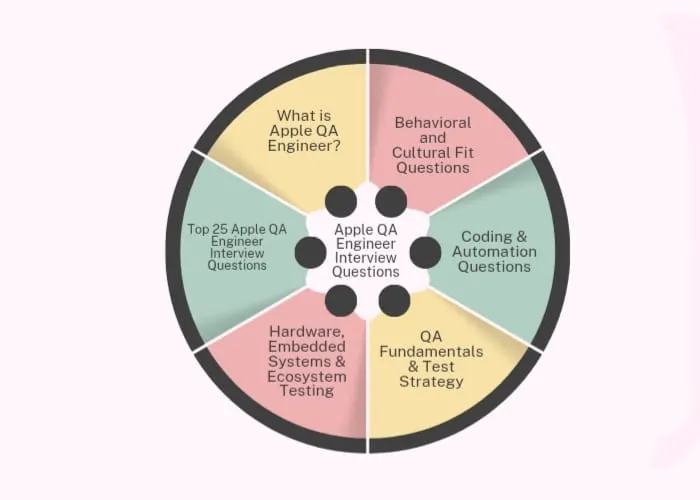
Reviewing the top Apple QA engineer interview questions is the best way to prepare for rigorous hiring processes. Apple’s interview panels are known to be highly conversational but deeply probing. They will ask you a question, and then constantly ask “why” to understand your engineering decisions.
To organize your study sessions, let us break down these Apple QA engineer interview questions into specific categories so you can study more effectively.
Behavioral and Cultural Fit Questions
Apple places a strong emphasis on organizational culture and teamwork. They want to know how smartly one can handle pressure, feedback, and conflicts. Here are the top behavioral questions you should expect:
Q1. Why do you want to work at Apple?
Do not just say you like iPhones. Focus on Apple’s commitment to privacy, the seamless integration of their ecosystem, and your passion for delivering pixel-perfect user experiences.
Q2. Tell me about a time you missed a bug that made it to production.
Interviewers want honesty here. Explain the mistake, take accountability, and most importantly, detail the automated safety nets you built afterward to ensure it never happened again.
Q3. How do you handle a conflict with a developer who refuses to fix a bug?
Focus on communication and data. Explain how you would gather reproducible steps, user impact data, and system logs to logically prove why the bug needs fixing, rather than arguing emotionally.
Q4. Describe a time you had to deliver bad news about a release schedule.
QA is often the bearer of bad news. Explain how you communicated the risk early, provided a clear status report, and worked with the team to find a safe resolution.
Q5. Tell me about a time you received negative feedback.
Show that you are coachable. Describe a valid critique you received from a manager or peer, and explain the exact steps you took to improve your performance based on that feedback.
Behavioral questions show your personality, but you also need to prove you can write clean code. It brings us to the technical scripting phase.
Coding & Automation Questions
Apple expects QA Engineers to be highly proficient in programming languages like Python, Swift, or Java. You will likely face live coding challenges on a whiteboard or a shared screen.
Q6. Write a script to reverse a string or find a palindrome.
This is a classic warm-up question. Interviewers are looking at your syntax, your ability to handle edge cases (like empty strings), and how quickly you can solve basic algorithmic problems.
Q7. How would you design an automation framework from scratch?
Walk them through your architecture. Mention the Page Object Model (POM), how you handle reporting, how you manage test data, and how the framework integrates with a CI/CD pipeline.
Q8. Write a function to parse a large log file and extract specific error codes.
Log parsing is a daily task for QA engineers. Show your proficiency with regular expressions (Regex) and efficient file-reading techniques in Python or Shell scripting.
Q9. Explain the difference between an array and a linked list.
You need basic Data Structures and Algorithms (DSA) knowledge. Explain how arrays have fast lookups but slow insertions, while linked lists have fast insertions but slow lookups.
Q10. How do you handle flaky automated tests in your CI/CD pipeline?
Never say you just delete them. Explain how you isolate the flaky test, check for network latency issues, implement dynamic wait times instead of hard sleeps, and run the test in a sandbox environment.
Q11. Write a SQL query to find the second-highest salary in an employee table.
Backend QA roles require database validation. Be prepared to write JOIN, GROUP BY, and sub-queries to prove you can validate data integrity accurately.
Knowing how to code is vital, but coding without a solid testing strategy is useless. Let us move to core QA methodologies.
QA Fundamentals & Test Strategy
Apple wants to see your “tester’s mindset.” They will often give you open-ended scenarios to see how you plan, prioritize, and execute your testing strategies.
Q12. You are handed a pair of Apple AirPods for the first time. Write a test plan.
Break this down logically. Start with functional testing (pairing, playing audio), move to hardware (dropping them, battery life), and finish with edge cases (connecting to Android, low battery behavior).
Q13. What is the difference between regression testing and sanity testing?
Explain that regression testing is a comprehensive suite run to ensure that new code doesn’t break old features. Sanity testing is a quick, unscripted check of a specific module to ensure it is stable enough for deeper testing.
Q14. How do you prioritize which bugs to fix first before a major release?
Base your answer on severity and business impact. A minor UI glitch on the settings page can wait, but a crash on the payment checkout screen is a showstopper that must be fixed immediately.
Q15. Explain your approach to testing a vague or open-ended feature.
Explain how you would proactively schedule meetings with product managers and developers to clarify requirements and write acceptance criteria before writing a single test case.
Q16. What is the bug lifecycle in your current organization?
Walk them through the journey: New, Assigned, In Progress, Fixed, Ready for QA, Verified, and Closed. Mention how you handle bugs that are marked “Cannot Reproduce.”
Q17. How do you perform API testing without a user interface?
Discuss using tools like Postman or writing Python request scripts. Explain how you validate status codes, response times, JSON payload structures, and authorization headers.
Q18. What is a defect escape rate, and how do you reduce it?
Defect escape rate is the percentage of bugs found by users versus bugs found by QA. Explain that you reduce it by increasing automation coverage, shifting testing left, and conducting better root-cause analysis.
Finally, because Apple is a hardware company, you must understand how software interacts with physical devices.
Hardware, Embedded Systems & Ecosystem Testing
Apple’s magic lies in its ecosystem. A feature on an iPhone must work seamlessly with an Apple Watch and a MacBook. These questions test your ecosystem awareness.
Q19. How would you test a hardware button on an iPhone that acts as a camera shutter?
Discuss testing the physical tactile feel, the software response time, how it behaves when the phone is locked, and what happens if the user holds the button down continuously.
Q20. What factors would you consider when testing the battery drain of a new iOS app?
Mention testing background location tracking, heavy network calls, CPU usage during animations, and how the app behaves when the iPhone is in “Low Power Mode.”
Q21. How do you test software across a fragmented network environment?
Explain how you would test the app while walking out of Wi-Fi range and switching to 5G, testing in airplane mode, and simulating high-latency networks using network conditioning tools.
Q22. Explain how you would test the synchronization between an Apple Watch and an iPhone.
Focus on Bluetooth connectivity drops, data sync delays (like reading a message on the watch and seeing it clear on the phone), and how the devices sync after being disconnected for hours.
Q23. What are pull-ups and pull-downs in basic circuit logic?
If you are applying for an embedded QA role, expect hardware questions. Explain how these resistors ensure a known state (high or low) for digital inputs to prevent floating signals.
Q24. How would you test an AI-based feature like Siri processing voice commands?
Discuss testing different accents, background noise environments, offline processing capabilities, and how Siri handles vague or contradictory user commands gracefully.
Q25. How do you securely test software that processes sensitive user data, like Apple Pay?
Highlight security testing. Mention data masking in test environments, validating encryption over the network, and ensuring no credit card data is ever accidentally printed in console logs.
Knowing the questions is only half the battle. You must also understand how to deliver your answers in a way that impresses the hiring manager.
What Interviewers Expect From a Candidate?
Apple interviewers are not just checking boxes on a grading sheet; they are looking for future contributors whom they can trust with billion-dollar products. They expect a blend of technical mastery, curiosity, and excellent communication skills.
When you practice these Apple QA engineer interview questions, always remember to articulate your thought process out loud. Here is a detailed breakdown of the exact traits interviewers are looking for during your interview loop:
- Technical Proficiency: You must be comfortable writing clean, efficient code. If you are asked to automate a task, your code should be modular, readable, and highly scalable.
- End-to-End Understanding: Apple wants engineers who understand the entire tech stack. If you find a bug on the front-end UI, they expect you to know how to check the backend database and API logs to find the root cause.
- Empathy for the User: Apple is deeply customer-centric. Your answers should always highlight how a bug or a feature impacts the end user’s experience.
- Cross-Functional Collaboration: You must prove that you can work peacefully and effectively with stubborn developers, busy product managers, and external hardware teams.
The testing industry is growing incredibly fast. According to TestGrid2, the global software testing industry size is estimated at $57.73 billion in 2026, and companies like Apple are investing heavier than ever in top-tier talent. They want strategic engineers, not just manual testers.
Conclusion
Interviewing at Apple is a challenging but incredibly rewarding experience. The process is designed to push your limits and see how you solve ambiguous, complex problems under pressure. Do not let the difficulty intimidate you. Instead, use it as motivation to sharpen your coding abilities, refine your testing strategies, and study the Apple ecosystem deeply.
In conclusion, thoroughly mastering these Apple QA engineer interview questions will give you a massive advantage over other applicants. Take the time to practice your coding on a whiteboard, do mock interviews with friends, and always focus on the “why” behind your testing methods. Good luck, and happy testing!
FAQs: Apple QA Engineer Interview Questions
Q1. How technical is the Apple QA interview?
Yes, it is highly technical. Many apple QA engineer interview questions involve live coding sessions where you must write scripts, manipulate data structures, or design automation frameworks from scratch. You are expected to code just as well as a junior software developer.
Q2. What programming language should I use for the interview?
Apple generally allows you to code in the language you are most comfortable with. Python is the most popular choice due to its readability and rich automation libraries. However, if you are applying for an iOS-specific role, knowing Swift will give you a major advantage.
Q3. Does Apple ask LeetCode-style questions for QA roles?
Absolutely. Some Apple QA engineer interview questions are very similar to medium-level LeetCode problems. You should be prepared to solve algorithms related to strings, arrays, hash maps, and linked lists, as these test your logical problem-solving speed.
Q4. How long does the Apple hiring process take?
The hiring process typically takes anywhere from 4 to 6 weeks. It generally starts with a recruiter phone screen, followed by a technical phone interview, and concludes with a full day of “onsite” (often virtual) interviews consisting of 4 to 5 different panels.
Q5. How important are behavioral questions compared to technical ones?
Extremely important. Even if you perfectly answer all the technical Apple QA engineer interview questions, failing to show cultural fit will result in a rejection. Apple strictly avoids hiring brilliant but toxic individuals, so demonstrating teamwork, humility, and clear communication is mandatory.
Reference
Recommended Reads:


