
Netflix senior software engineer interview questions reflect the level of technical depth and ownership expected from software engineers. At Netflix, software systems are designed to deliver seamless, high-definition streaming to hundreds of millions of users, which demands highly resilient distributed architectures and continuous performance optimization.
According to Yahoo Finance1, Netflix reached 300 million global subscribers and a significant share of internet traffic flows through its platform. Netflix operates at a scale where even minor inefficiencies can have a widespread impact.
Therefore, maintaining this level of performance requires software engineers who can design fault-tolerant systems, optimize data flow, and handle real-time user demand without compromise.
As a result, the hiring bar is exceptionally high. Going forward, we will cover the software engineer role expectations at Netflix, the interview structure, and the most relevant questions you need to master to succeed in the Netflix senior software engineer hiring process.
Key Takeaways
- Understand how Netflix senior software engineer interview questions evaluate advanced problem-solving ability, system design expertise, and the capacity to handle large-scale distributed systems under real-world constraints.
- Learn how senior engineers at Netflix are expected to operate with full ownership, designing architectures, optimizing performance, and deploying scalable solutions without close supervision.
- Recognize the importance of mastering both data structures and algorithms and system design, as Netflix interviews place equal emphasis on writing efficient code and architecting high-availability systems.
- Discover how concepts like microservices, cloud computing (AWS), concurrency, and chaos engineering are critical to building resilient systems that can handle millions of concurrent users globally.
- Gain insight into Netflix’s unique culture, where candidates are evaluated on independence, candid communication, accountability, and alignment with the “Freedom and Responsibility” philosophy.
What Does a Senior Software Engineer at Netflix Do?
Senior Software Engineers at Netflix operate with a high degree of ownership, focusing on designing, scaling, and maintaining systems that serve millions of users globally. Their role extends beyond writing code to making architectural decisions that directly impact performance, reliability, and user experience.
Below are the core responsibilities typically expected from engineers in this role:
- Microservices Architecture Design: Building and maintaining loosely coupled microservices that communicate efficiently across distributed systems, ensuring scalability and fault isolation.
- Streaming Performance Optimization: Continuously improving video delivery pipelines by optimizing encoding, buffering strategies, and adaptive bitrate algorithms to deliver seamless playback.
- Cloud Infrastructure Management: Leveraging cloud platforms (primarily AWS) to deploy, monitor, and scale applications dynamically based on traffic patterns and user demand.
- Chaos Engineering Implementation: Designing resilient systems by simulating failures using tools like Chaos Monkey to test fault tolerance and recovery mechanisms.
- Distributed System Reliability: Ensuring high availability through redundancy, failover strategies, and efficient load balancing across global regions.
- Data Pipeline Engineering: Building and optimizing large-scale data pipelines for analytics, personalization, and recommendation systems.
- Cross-Functional Collaboration: Working closely with product managers, data scientists, and design teams to deliver features that improve engagement and retention.
- Production Monitoring and Debugging: Analyzing logs, metrics, and alerts to quickly identify and resolve production issues in real time.
Netflix Senior Software Engineer Interview Process

The interview process at Netflix is thorough, but it moves relatively fast if you perform well. The company prioritizes candidates who not only have deep, specialized technical expertise but also align perfectly with their unique corporate values.
Knowing what happens at each stage can significantly lower your interview anxiety. Here is the standard process you will experience:
Step 1: Recruiter Call
The process begins with an initial recruiter conversation. This round focuses on understanding your background, experience, and alignment with Netflix’s culture. It also gives you an overview of the role, expectations, and the hiring process.
Step 2: Hiring Manager Screen
Hiring manager screening is typically a 30-minute discussion with the hiring manager. Compared to later stages, this round is relatively relaxed and conversational. It includes high-level, two-way discussions about your experience, projects, and expectations.
In addition, the hiring manager actively “sells” the opportunity, highlighting the team’s work, impact, and culture. This is particularly important at Netflix, as the later stages, especially onsite interviews, are more intensive and require a significant time commitment from candidates.
Step 3: Technical Phone Screen
The technical phone screen lasts around 45–60 minutes and primarily focuses on coding. The exact format, difficulty, and tools used can vary significantly across teams. Candidates are expected to demonstrate strong problem-solving skills, clean coding practices, and the ability to communicate their thought process clearly.
Step 4: Onsite Interviews
The onsite stage is the most rigorous part of the process and typically consists of around 6–8 interviews. These interviews heavily emphasize:
- System design (a major focus area)
- Behavioral and cultural fit
- Coding and problem-solving
Given the intensity, candidates are often given the option to split the onsite into two days, something that is strongly recommended to maintain performance and focus.
A distinctive aspect of Netflix’s onsite loop is the inclusion of 1–2 directors in the interview panel. Usually, one director comes from the hiring team, while another may be from a partner organization. This helps reduce bias and ensures a well-rounded evaluation. These director-level interviews often cover system design and behavioral aspects in greater depth.
Also Read: How to Get a Software Engineering and Developer Jobs at Netflix
Top 30 Netflix Senior Software Engineer Interview Questions
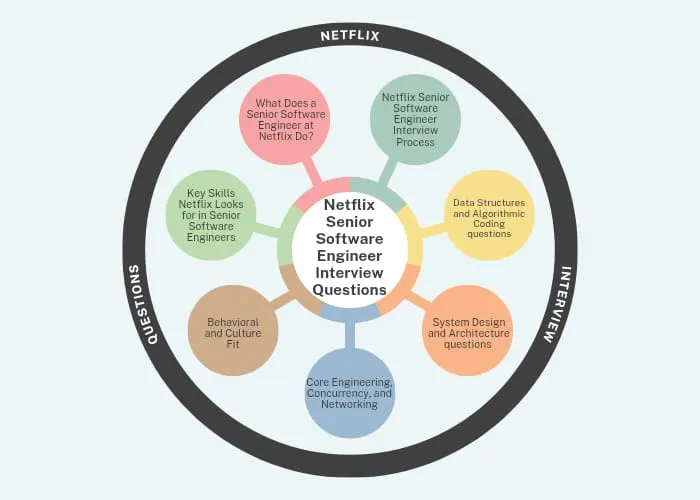
At the senior level, Netflix interviewers want to see how you handle ambiguity, massive scale, and system failures. We have categorized these Netflix senior software engineer interview questions into four distinct areas to help you focus your study sessions effectively.
Data Structures and Algorithmic Coding
At Netflix, your coding is evaluated through problems that reflect real system challenges like caching, data aggregation, and graph traversal. Candidates are expected to apply core data structures with optimal complexity while handling edge cases efficiently. These questions test how well you translate theoretical knowledge into scalable, production-level solutions.
Q1. Design and implement a data structure for a Least Recently Used (LRU) cache.
Q2. Given an array of intervals, merge all overlapping intervals and return an array of the non-overlapping intervals.
Q3. Given an integer array, return the k most frequent elements.
Q4. Find the length of the shortest transformation sequence from a begin word to an end word using a given dictionary.
Q5. Given an array of integers and a window size k, return the maximum sliding window.
Q6. A message containing letters from A–Z is being encoded to numbers. Determine the total number of ways to decode it.
Q7. Given a sorted dictionary of an alien language, find the correct order of characters in the language.
Q8. Find the median of two sorted arrays with an optimal O(log(m+n)) runtime complexity.
System Design and Architecture
System design and architecture is the most critical technical phase for a senior role. Because Netflix runs entirely on the cloud (AWS), you must demonstrate a deep understanding of distributed systems. Some of the main system design and architecture questions are as follows:
Q9. Explain how you would architect the Netflix video streaming platform from the ground up.
Q10. How would you efficiently cache and serve heavy video files to users in remote parts of the world?
Q11. How do you calculate and display the most-watched shows in real-time for millions of concurrent users?
Q12. Build a system to prevent abuse of Netflix’s backend APIs by limiting the number of requests a user can make.
Q13. How would you ingest massive amounts of user viewing history to serve personalized movie recommendations?
Q14. How would you allow users to search for movie titles, actors, and genres with instant autocomplete features?
Q15. Explain how your architecture would gracefully failover and keep the app running if an entire AWS data center goes offline.
Q16. How do you reliably store and retrieve the exact timestamp a user paused a movie on their TV, so they can resume it on their phone?
Designing a massive system on a whiteboard is only part of the battle. You must also prove that you understand the underlying engineering principles that keep those systems running securely.
Core Engineering, Concurrency, and Networking
Core engineering and networking questions focus on how well you understand low-level system behavior, handling parallel workloads, optimizing network communication, and managing resources under heavy traffic. Below are some commonly asked questions in this area.
Q17. Which protocol does video streaming primarily use, and why? Explain the trade-offs of each.
Q18. Explain how you would safely handle concurrent requests writing to the same database row without causing a race condition.
Q19. How do you profile and identify a memory leak in a highly trafficked production microservice?
Q20. Explain how garbage collection works under the hood in your preferred programming language.
Q21. When scaling a relational database, what strategies would you use to partition the data evenly across multiple servers?
Q22. Explain the CAP theorem. For a video streaming service, would you prioritize Availability or Consistency?
Q23. Why might a company like Netflix choose gRPC over traditional REST APIs for internal microservice communication?
After validating your technical mastery, the final and most rigorous hurdle is proving that you fit seamlessly into Netflix’s culture.
Also Read: How to Crack a Netflix Software Engineer Interview
Behavioral and Culture Fit
Hiring decisions heavily factor in how well you align with their high-performance culture, not just your technical ability. The following questions are designed to assess ownership, candor, and how you handle ambiguity, failure, and disagreement in real-world scenarios.
Q24. If you told your manager you were leaving for a competitor, would they fight to keep you? Tell me about a time you made yourself indispensable.
Q25. Tell me about a time you gave difficult, constructive feedback to a peer or a senior manager. How did they react?
Q26. Describe a time when a piece of code you wrote brought down a production system. What did you learn from it?
Q27. Tell me about a technical decision where you completely disagreed with your team, but you still had to support the final choice.
Q28. Describe a project where the requirements were extremely vague. How did you define the scope and deliver the final product?
Q29. How do you handle a situation where the product team wants to launch a feature immediately, but you know the code is not scalable yet?
Q30. Beyond the compensation, what specifically about the Netflix culture makes you want to work here instead of Google or Amazon?
Key Skills Netflix Looks for in Senior Software Engineers
When evaluating your answers to Netflix senior software engineer interview questions, interviewers are quietly looking for specific behavioral and technical signals. They do not just want a smart coder, they want a mature, product-focused engineer who can thrive without supervision.
To ensure you get a strong “hire” recommendation, make sure you highlight these key skills during your conversations:
- Designing Production-Grade Microservices: You should be comfortable building loosely coupled services using REST/gRPC APIs, handling service discovery, and managing inter-service communication. Experience with frameworks like Spring Boot, Micronaut, or Node.js-based services is highly relevant.
- Building and Operating Data Pipelines: Netflix relies heavily on real-time and batch data pipelines. You are expected to work with systems like Kafka for streaming, and design pipelines that process large-scale event data reliably with proper schema management, replay capability, and fault tolerance.
- Defining SLIs, SLOs, and Error Budgets: You must know how to define Service Level Indicators (SLIs) like latency, availability, and error rate, set realistic Service Level Objectives (SLOs), and manage error budgets to balance reliability with fast feature delivery.
- Implementing Observability (Logs, Metrics, Tracing): You should design systems with strong observability using structured logs, real-time metrics, and distributed tracing to enable quick detection, debugging, and resolution of production issues across microservices.
- Designing Scalable APIs: You should build APIs that are backward-compatible, versioned properly, and resilient to failures. This includes handling schema evolution, rate limiting, and ensuring smooth integration across multiple services and clients.
- Working with Event-Driven Architectures: Experience in designing systems using event streams (e.g., Kafka) is essential. You should understand producers, consumers, idempotency, message ordering, and failure handling in asynchronous systems.
- Handling Distributed Systems Complexity: You should understand concepts like replication, partitioning, consistency models, and network failures. The ability to design systems that handle partial failures gracefully is critical.
- Working with Cloud-Native Infrastructure: Strong experience with cloud platforms (especially AWS) is expected, including compute, storage, networking, and auto-scaling strategies for handling unpredictable traffic loads.
- Managing CI/CD and Safe Deployments: You should be comfortable with automated pipelines, canary releases, blue-green deployments, and rollback mechanisms to ensure safe and continuous delivery to production.
- Designing and Managing Distributed Datastores: You should understand NoSQL databases like Cassandra, including data modeling, indexing strategies, replication, and handling large-scale read/write workloads.
Also Read: What Does a Netflix Software Development Engineer Do?
Turn Your Technical Skills Into Software Engineering Job Offers
The gap between “I know this” and “I can clear the interview” is where most engineers struggle. The Software Engineering Interview Prep program by Interview Kickstart is built to close that gap with structured, in-depth training and personalized support. You’ll learn not just the technical concepts, but how to apply them in interviews through 1:1 coaching, guided practice, and insights from FAANG+ instructors who understand exactly what top companies look for.
With a mix of live sessions, self-paced learning, and realistic mock interviews, you’ll practice in environments that mirror actual hiring processes. Alongside technical prep, you’ll get actionable feedback, career guidance, and support with resume building and personal branding. If you’re serious about turning your skills into actual job offers, this is where preparation starts to pay off.
Conclusion
Netflix senior software engineer interview questions require far more than strong coding skills; they demand a deep understanding of distributed systems, scalability, and real-world engineering trade-offs. At Netflix, engineers are expected to take full ownership, design resilient architectures, and make decisions that directly impact millions of users.
To stand out, focus on mastering system design, refining your ability to handle ambiguity, and clearly communicating your thought process. Strong candidates do not just solve problems; they justify decisions, consider edge cases, and design for failure from the start.
Consistent practice, mock interviews, and a clear grasp of Netflix’s culture will significantly improve your chances. Approach preparation strategically, and you can position yourself as a high-impact engineer ready to thrive in one of the most demanding and rewarding environments in tech.
FAQs: Netflix Senior Software Engineer Interview Questions
Q1. How hard is the Netflix engineering interview?
It is widely considered one of the hardest interviews in the tech industry. Because Netflix hires almost exclusively at the senior level, the technical bar is extremely high, and the behavioral rounds are intensely scrutinized to ensure absolute cultural alignment.
Q2. Does Netflix still fire people using the Keeper Test?
Yes, the Keeper Test is still a core part of Netflix’s philosophy. Managers regularly ask themselves: “If this employee wanted to leave, would I fight hard to keep them?” If the answer is no, the employee is given a generous severance package. This ensures the team remains packed with high performers.
Q3. What programming language should I use for the technical rounds?
Netflix is generally language-agnostic during the interview process. You should use the language you are most comfortable with typically Java, Python, C++, or Go. The interviewers care much more about your logic, problem-solving speed, and clean code structure than the specific syntax of a language.
Q3. How much time should I spend preparing for the system design round?
For a senior role, you should dedicate at least 50% of your total study time to system design. While coding algorithms are important, your performance in the system design rounds is what primarily dictates your final leveling and your compensation package.
Q4. Where can I practice Netflix senior software engineer interview questions?
You can practice the coding portions on platforms like LeetCode and HackerRank by filtering for company-specific tags. For the system design and behavioral portions, using peer-to-peer mock interview platforms like Pramp or interviewing.io is highly recommended to simulate the pressure of a real Netflix interview.
References
Recommended Reads:


