
Machine learning engineers are core to Netflix, a well-known streaming technology innovator. The company has created a data-driven approach to performance, where using machine learning as a core technology platform allows Netflix to build and optimize intelligent systems. The machine learning engineers’ interview questions at Netflix focus on building scalable systems, creating and maintaining advanced personalized recommendations, content performance, and improving streaming quality for users across the globe.
The responsibilities of machine learning engineers at Netflix include handling large amounts of data and creating relevant features, making predictions in real time, and testing continuously. The key focus of this team is to design and build highly available, resilient solutions that run on distributed infrastructure with strict performance and latency requirements.
The goal of this blog is to give an overview of the Netflix machine learning engineer interview process, along with the level of technical, systems design, and product-thinking abilities required to successfully clear the interview.
Key Takeaways
- The Netflix machine learning interview questions focus on using machine learning knowledge to solve practical problems rather than theoretical questions.
- Candidates will need to be able to create and execute full end-to-end machine learning systems, including creating data pipelines, training models, deploying models, and monitoring models continuously.
- A deep understanding of advanced knowledge of recommendation systems, methods employed to personalize a user’s experience, and ranking at scale.
- Understanding MLOps is crucial to the interview process regarding the creation of strong CI/CD pipelines, managing model life cycles, and assuring the models are deployed correctly into the production system.
- Knowledge of all experimental methodologies, such as A/B testing, performance measurement.
Netflix Machine Learning Interview Questions
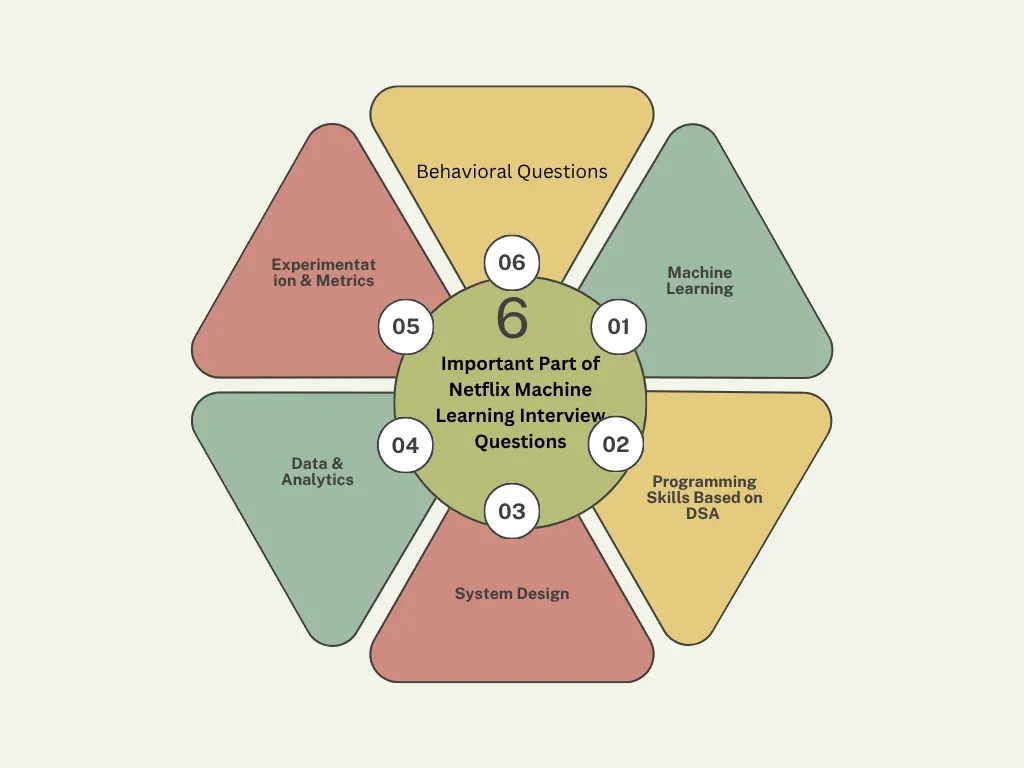
Netflix machine learning interview questions are designed to check a candidate’s ability. It is divided into six major parts, such as basic machine learning questions, DSA based, system design-oriented, standard data analytics, probabilities & statistics, and behavioural questions.
Machine Learning
Aspirants preparing for machine learning engineer role at Netflix must have in-depth knowledge of both supervised and unsupervised learning techniques in order to choose suitable models for various types of problems. In addition to understanding the bias-variance trade-off, experience with feature engineering and pre-processing will help to ensure the creation of a strong model development. Engineers should also have an ability to assess performance models well with appropriate metrics, and also know how to implement machine learning techniques on real-world scenarios.
Q1. What is the difference between generative models and discriminative models?
Q2. Best approaches for optimizing hyperparameters in ML models
Q3. Evaluate how to choose the right evaluation metric for a given ML problem
Q4. Explain regularization L1 & L2 and their effect on the model
Q5. How to detect and handle data drift with machine learning models
Q6. Create an implementation of an LRU cache with usage within machine learning systems
Q7. Build a code that merges and processes many massive datasets in order
Q8. Design a thread safe queue for concurrent ML workload management
Q9. What are the differences between generative and discriminative models?
Q10. How do you tune hyperparameters effectively in machine learning models?
Q11. What is the curse of dimensionality, and how does it affect model performance?
Programming Skills Based on DSA
The development of dependable machine learning systems depends on developers who possess advanced Python and Java programming skills. Developers need to demonstrate their ability to create production standards through their work which requires them to produce efficient code that exceeds basic syntax extension.
The following areas should be mastered:
- Data Structures & Algorithm Design: This area is crucial in developing systems that can efficiently process data while delivering optimal results in machine learning systems.
- Machine Learning Frameworks: Professionals should master frameworks like PyTorch and TensorFlow tools in order to develop systems that can cope with increasing demands.
- System Reliability: Developers should create systems which maintain operational capability throughout extensive production environments.
The following practice questions will help you study for Netflix, which prioritizes real-world skills and decision-making abilities.
Arrays & Data Processing
Q12. Find top K most frequent elements in a large dataset
Q13. Sliding window maximum for real-time analytics
Q14. Merge overlapping intervals (e.g., user watch sessions)
Q15. Find duplicate entries in large-scale logs
Q16. Rotate array efficiently (stream processing context)
Hashing & Caching
Q17. Design and implement an LRU Cache
Q18. Design LFU Cache for model serving optimization
Q19. Group anagrams (used in clustering/content grouping)
Q20. Two-sum / k-sum (basic but foundational)
Q21. Detect duplicates within k distance (streaming data)
Heaps & Ranking Systems
Q22. Find median from data stream
Q23. Top K frequent elements using heap
Q24. Merge K sorted lists (data pipeline merging)
Q25. Kth largest element in a stream
Trees & Graphs (Important for Recommendations)
Q26. BFS/DFS traversal for graph-based recommendations
Q27. Detect cycles in a graph (dependency systems)
Q28. Shortest path (user-content relationship graph)
Q29. Connected components (user segmentation)
Strings & Pattern Matching
Q30. Longest substring without repeating characters
Q31. Implement autocomplete system
System Design
The ability to design end-to-end machine learning systems is essential for Netflix machine learning engineers’ roles because it delivers complete and production-ready solutions. Scalable and considerate systems can only be achieved through engineers who comprehensively understand distributed and scalable architectures, as well as batch and real-time processing systems. Engineers also need to maintain latency, performance and reliability to ensure system stability. Furthermore, engineers must design data pipelines and make sound trade-off decisions among system components for optimal, high-performing machine learning systems.
Q32. Design a large-scale data ingestion and processing pipeline
Q33. Batch vs real-time streaming pipeline — how would you choose?
Q34. Design a feature store for ML systems and a pipeline.
Q35. How would you handle millions of users concurrently?
Q36. How would you ensure high availability in model serving?
Q37. Design a system to monitor model performance in production
Q38. How would you improve Netflix recommendations?
Q39. Design a system to reduce streaming latency
Q40. Design a real-time personalization system
Q41. Design a content ranking pipeline
Q42. Design a system to detect user churn using ML
Data Analytics
Good knowledge of SQL is also significant in effective data extraction and analysis, especially in dealing with huge amounts of data. The ability to effectively clean, transform, and preprocess data, along with good knowledge of data pipelines and workflows, guarantees effective data operations. Moreover, data quality is also significant in ensuring effective data operations. Additionally, engineers should create pipelines for data, and decide on the best tradeoffs among the components of the system that provide high performance for machine learning solutions.
Q43. Get the five most watched shows based on watch time
Q44. Get a list of users who watch more than three different types of content in one day
Q45. Find the average watch time per user across a day.
Q46. Create a query to find the users who viewed nothing for thirty days.
Q47. Find the ranked TV shows by their views using window functions.
Q48. Create a query to find duplicate activity records for all users in the user_activity table.
Q49. Create a query to find retention for all users from week-to-week.
Q50. Use a query to find the second most watched show in each region.
Q51. Use cumulative view time calculation per user in a given time period by using windowing functions.
Experimentation & Metrics
To conduct high quality A/B tests, understanding A/B test fundamentals is crucial both in formulating your experiment as well as assessing resulting outcomes. Defining key success metrics, statistical significance and hypothesis testing knowledge are the main tools used when reading test results correctly. To foster credibility of A/B testing, experience in examining tested A/B test and awareness of chances of having bias/errors helps provide a sufficient level of confidence in the outcomes.
Q52. Creating a new recommendation feature based on A/B test design
Q53. How can you measure Netflix user engagement?
Q54. Establishing success criteria when conducting an experiment
Q55. Understanding p-values and their interpretation in the context of A/B testing
Q56. How to calculate sample size for an experiment
Q57. The definition of type I & type II errors in an experiment
Q58. Managing noise or ambiguity in experimental results
Q59. Understanding difference between online and offline evaluation metrics
Q60. How can you detect bias in A/B testing
Q61. The definition and importance of guardrail metrics
Q62. Analyzing a decline in user engagement following the launch of a new feature
Q63. Understanding the concept of statistical significance and its importance
Q64. Dealing with multiple experiments that are ongoing at the same time
Q65. Distinguishing between correlation and causation in experiments.
Probabilities and Statistics Based
Q66. Explain Bayes’ theorem and its importance in machine learning.
Q67. What is the difference between a discrete and a continuous random variable?
Q68. Explain the central limit theorem and tell about its significance.
Behavioral Questions
Behavioral interview questions in a Netflix machine learning engineer role are designed to assess ownership, decision-making, and real-world impact beyond technical skills. This section is equally important to technical questions and deserve equal attention while preparing for the interview.
Q69. Share your thoughts of a project where you had complete control
Q70. Give an example of your decision-making based on partial, vague and insufficient information.
Q71. Provide examples of how you have prioritized several very impactful initiatives.
Q72. Describe a recent challenging experience you had within a cross-functional team that involved cross-group support.
Netflix Interview Process
Netflix’s hiring process evaluates candidates on their problem-solving ability and system design techniques. Candidates are assessed on three core areas, the technical depth, the business impact of the candidate, and whether they fit within a strong ownership culture where the value of performance matters.
1. Initial Recruiter Screens
The initial round with Netflix is conducted by recruiters who focus on understanding candidates’ backgrounds, qualifications, and alignment with available roles. This stage is the exploratory phase, where the recruiter explains to the candidate the interview process and introduces them to Netflix’s culture and expectations.
The conversation should be open and transparent, which evaluates the candidate on cultural compatibility before progressing to the hiring manager round. The hiring manager will evaluate the candidate on technical depth, leadership experience, problem-solving approach, and how well the candidate fits with Netflix’s management style and culture.
2. Technical Screen
Technical screening can differ depending on the applied role. The interview session can take place over the phone or through an online assessment, both include skills and knowledge of coding and machine learning concepts, as well as application of those concepts to real-world situations. The candidate will be expected to have a vast knowledge of machine learning systems and bias-variance trade-offs. Assessment tools often focus more on how you solve problems in a practical way than their technical ability. In general, Netflix’s interview questions closely align with actual team dynamics, and it would evaluate substantive discussions around practical experience and decision-making skills.
Assessment tools often focus more on how you solve problems in a practical way than on your technical ability. In general, all of Netflix’s interviewing problems closely align to actual team dynamics and what it would take to have substantive discussions around practical experience and decision-making.
3. Onsite Interviews
Round 1 onsite
Round 1 focuses on evaluating technical leadership and problem-solving skills based on a combination of actual system design, scalability, and behavior-based experience. In the selection process, interviewers evaluate the candidates based on their responses to the technical questions, the skills used to resolve team conflicts, and how candidates reached their decisions in real-world business-driven situations.
Round 2 onsite
Round two is based on cross-functional collaboration, leadership quality, and effective team management in a decentralized environment. The interviewers will also ask situational-based tricky narratives, which assess the candidate’s ability to communicate, build trust with others, and navigate ambiguity.
Overall, both rounds reflect Netflix’s culture of autonomy, accountability, and ownership, as well as a strong technical judgment.
4. Decision and Offer
In the final round, the interview panel collects feedback from all the stages in order to make a hiring decision. The candidates who did not receive an offer letter are provided feedback by Netflix.
Core Skills Required for a Netflix Machine Learning Engineer
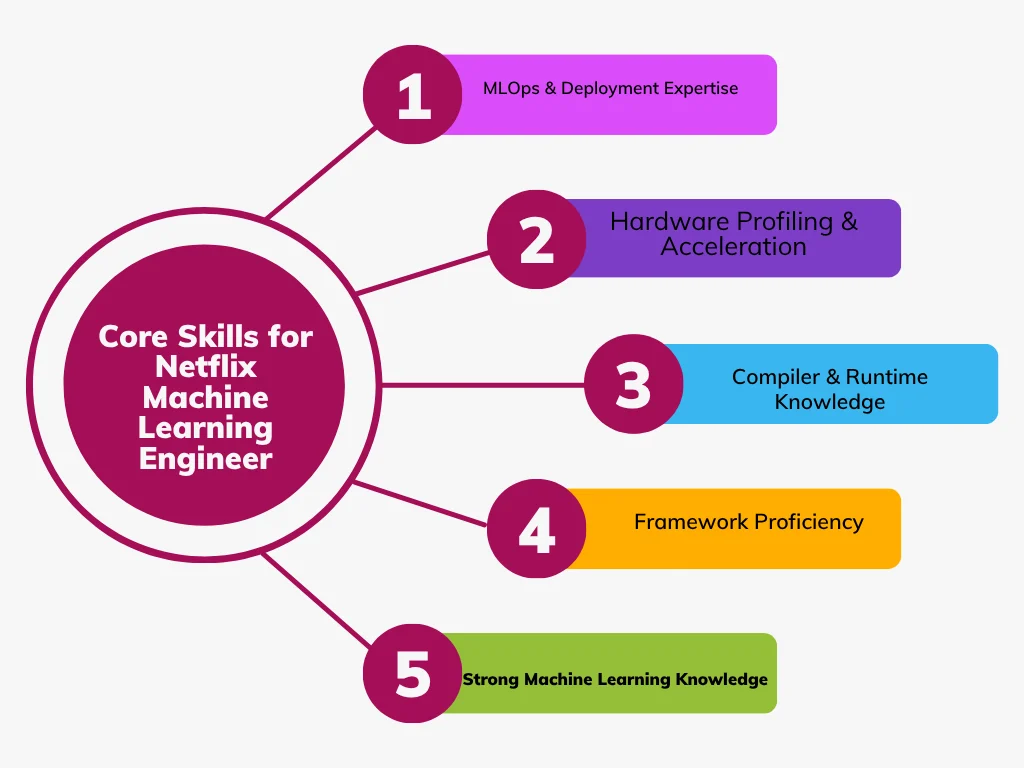
The machine learning engineer’s job at Netflix requires advanced technical skills and hands-on experience solving real problems. Let’s discuss the primary skill sets required to build scalable systems, analyzing and extracting data to provide useful insights, and deploying high-quality, robust machine learning applications.
1. MLOps & Deployment Expertise
Candidates interested in becoming a Machine Learning (ML) Engineer at Netflix will need to demonstrate experience with all facets of building and operating an end-to-end Machine Learning Operations (MLOps) pipeline, including model registry, containerization, and continuous integration/continuous deployment (CI/CD) workflow for ML systems.
Candidates who have a deep knowledge of deploying ML models into production in cloud platforms such as AWS and SageMaker, including their focus on scalability, reliability, monitoring, and collaboration with platform and infrastructure teams, will have an advantage in the recruitment process.
2. Hardware Profiling & Acceleration
This position requires applicants with a strong background in evaluating, assessing, and maximizing GPU performance of machine learning inference, including familiarity with tools such as Nsight, cuDNN, and the ONNX Runtime for determining performance and identifying bottlenecks.
3. Compiler & Runtime Knowledge
Candidates are expected to know graph-level optimizations and compiler frameworks like MLIR and LLVM to enhance execution efficiency and model performance across different environments.
4. Framework Proficiency
Candidates having knowledge or experience in building, training, and deploying machine learning models utilizing deep learning frameworks such as PyTorch, TensorFlow, and JAX always have a competitive edge. Candidates who possess these skills will have the ability to create machine-learning models as well as strong foundation to create future machine-learning models.
5. Strong Machine Learning Knowledge
To build a career as an ML engineer at Netflix, candidate must possess strong software engineering skills with the ability to integrate multiple complex ML algorithms into a robust production environment while developing, training, and deploying these algorithms.
Bonus Skills
Experience in implementing ML models like android, iOS, optimizes the limitations of the hardware. Experience with Unity & Unreal game engines, compression methods like distillation, pruning & methods of using resources efficiently.
| Skill | Subdomains |
|---|---|
| MLOps & Deployment | End-to-end MLOps pipelines, model registries, containerization, CI/CD workflows, cloud deployment (AWS, SageMaker), scalability, monitoring. |
| Hardware Profiling & Acceleration | GPU profiling, benchmarking, inference optimization, CUDA tools (Nsight, cuDNN, TensorRT, ONNX Runtime), bottleneck identification, performance runtime. |
| Compiler & Runtime Knowledge | Graph-level optimization, MLIR, LLVM, efficient model execution across environments. |
| Framework Proficiency | PyTorch, TensorFlow, JAX, model development, training, production deployment. |
| Machine Learning Engineering | Scalable code, clean architecture, and integrating ML algorithms into production systems. |
| Bonus Skills | Edge deployment (iOS/Android), hardware-aware optimization, Unity/Unreal, model compression (distillation, pruning). |
What do Netflix Machine Learning Engineers do?
Netflix Machine Learning Engineers build and scale machine learning systems which is capable of producing real-world outputs. Below is an overview of the responsibilities of an engineer in this position at Netflix.
- Create and maintain CI/CD MLOps pipelines, model registries, and auto deployment systems.
- Develop production-ready ML models to bridge the gap between Research and production.
- Using profiling tools to optimize model performance as well as benchmarking across cloud GPUs and Edge devices.
- Design and implement low latency, scalable deployment methods through both Cloud and Edge environments.
- Improve model efficiency through quantization techniques, tuning of precisions, and resource maximization.
- Process large amounts of data, while ensuring efficient ML model data pipeline management.
- Develop integrations to integrate ML models into production systems with other engineers, designers, and teams.
Conclusion
The Netflix machine learning engineer interview is a mix of technical skills, practical skills, and real-world results. The candidate is expected to show an understanding of systems of thinking, data-based decision making, and how to interface with large-scale systems. Netflix also values candidates who fit in the environment and has leadership quality. Overall, to get placed at Netflix a candidate should have technical knowledge, team work dependencies as well as cultural fit.
FAQs: Netflix Machine Learning Engineer Interview Questions
Q1. What is the main focus of ML engineer interviews at Netflix?
Netflix emphasizes the resolution of real-world problems, creating reliable systems, and the ability to deliver scalable, deployable ML systems. Candidates need to demonstrate an impact-driven solution rather than an algorithm.
Q2. What role does a Netflix machine learning engineer perform?
Netflix’s machine learning engineers develop, deploy, and maintain a scalable production-ML system that is performant in the real world.
Q3. What qualifications do candidates need?
Machine Learning Engineer candidates typically have experience with machine learning, systems architecture, ML DevOps data engineering, programming, and building and operating at scale.
Q4. What is the salary of Netflix machine learning engineer?
The salary of soft engineer at Netflix can vary on their experience, performance and skills. It may ranges from $200K to $1M per year. This can be depend on the level of working such as L2, L3, L4. Additionally they don’t pay for extra performance bonus but they add a RSU of 4 years which can be a increment of the salary.
References
Recommended Reads:


