
The expectation of a full-stack engineer at Google is much higher than the basic requirement of simply programming. The company chooses an ideal candidate who has strong problem-solving skills, is able to write scalable, optimized code, and has some understanding of how to develop large-scale applications. According to Forbes, Google seeks engineers who can think critically, take risks, optimize performance, and build products that serve billions of users worldwide.
The Google fullstack engineer interview questions span multiple domains, including data structures and algorithms, frontend development, backend engineering, system design, and behavioral assessment. Each category is structured to assess a specific dimension of a candidate’s capability. Overall, the Google full-stack engineer interview questions aim to identify candidates who possess not only strong technical knowledge but also the practical skills and mindset required to build efficient, scalable, and impactful solutions in a dynamic engineering environment.
Key Takeaways
- To successfully pass an interview for a Google full-stack engineer, one needs to be competent at both development and solving problems, not only in a theoretical sense but also in a practical manner.
- Preferency in writing data structures & algorithms, along with frontend and back-end development, is the key to preparing for the full-stack development role. Google prioritizes developers with both frontend and backend experience.
- Understanding system design, scalability, performance, and architecture as they apply to real-world applications is vital.
- Effective communication skills, structured thinking, and writing code are non-negotiable skills that contribute to a candidate’s success in an interview.
- Practicing procedures, mock interviews, and creating as many live applications will greatly increase a candidate’s ability to leverage their experience into obtaining jobs at Google.
Who is a Full Stack Engineer?
Full-stack engineers develop both the frontend and backend of a web application, including the UX/UI and server-side logic and database. For a successful full-stack engineer, it is necessary to understand how to integrate multiple types of technologies together to produce an effective complete product.
This position is focused on developing the client-side using many different technologies – HTML, CSS, JavaScript, and server-side languages such as Node.js, Python, Java, and APIs, and also requires strong database skills, including MongoDB and Cassandra.
Role of a Google Full Stack Engineer
A Google Full Stack Engineer is responsible for developing and maintaining both frontend and backend components of large-scale web applications. The role requires designing scalable, efficient systems while ensuring high performance, reliability, and seamless user experience.
- Advanced Frontend Engineering: Developing responsive, fast, and easy-to-use user interface development that maximizes performance and accessibility while providing an excellent user experience for billions of users.
- Robust Backend Systems: A Google full-stack engineer designs and manages secure, scalable backend systems, APIs, and databases, and ensures reliability, fault tolerance, and efficient data processing.
- Scalable System Design: Design systems to support large amounts of traffic and real-time data. Use techniques of distributed systems thinking and load balancing.
- Code Excellence & Engineering Standards: Write clean, efficient, and production-ready code. Follow best practices and have code reviews with an emphasis on maintaining high standards of engineering.
- Innovation & Problem Solving: Engineers often solve complex real-world problems with solutions that meet both business and technical requirements and are optimized and efficient.
Google Full Stack Engineer Interview Questions
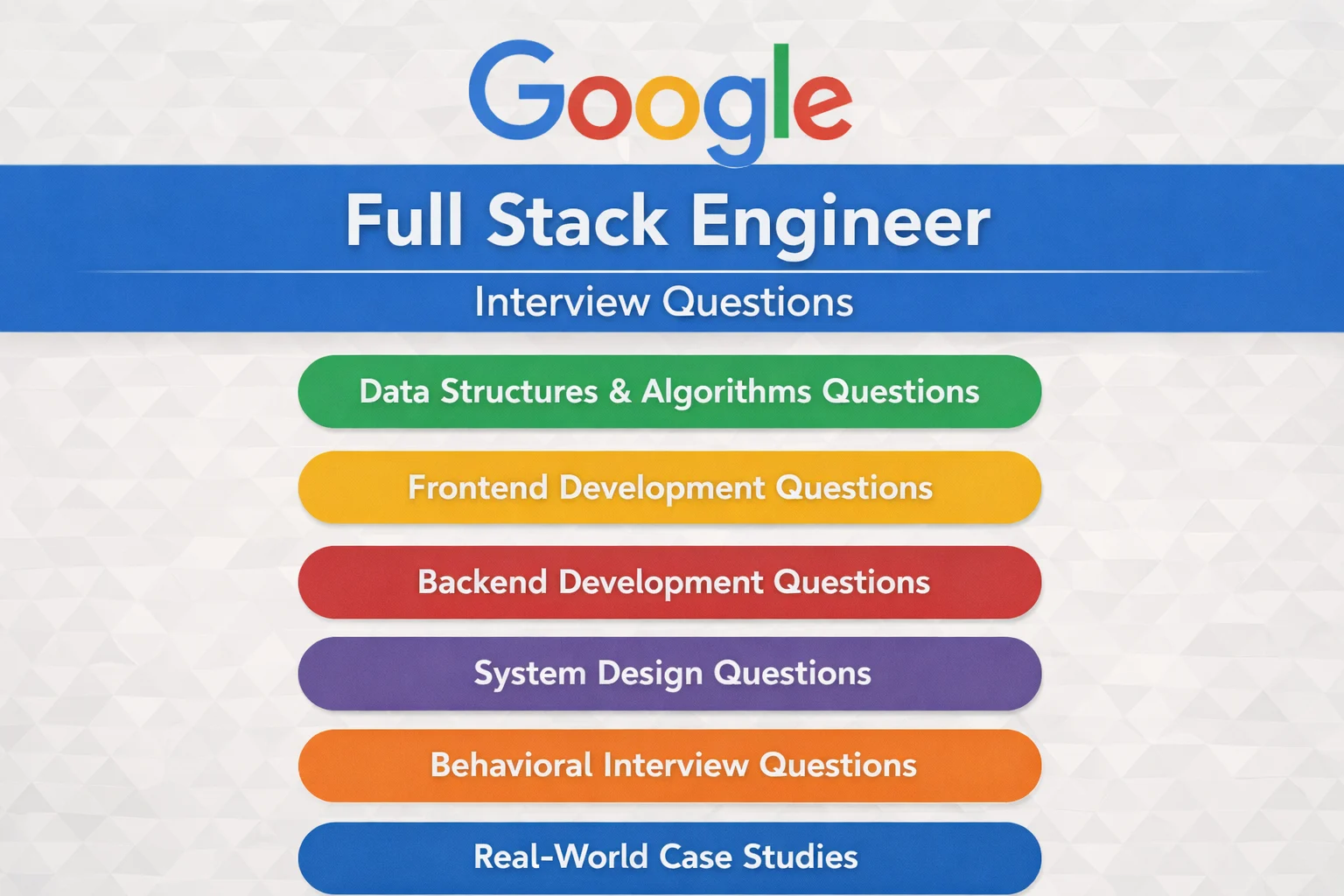
The Google full-stack engineer interview includes questions related to data structures and algorithms for evaluating problem-solving and coding skills, as well as frontend and backend development questions for assessing practical knowledge of web technologies, APIs, and system functions. There are also questions concerning system design, which evaluate if a candidate can construct an architecture, database designs, and APIs, and behavioral questions assessing how well a candidate communicates and collaborates with teams, and solves real-world problems.
Data Structures & Algorithms Questions
Data structures & algorithms questions are a fundamental part of Google’s full-stack engineer interview questions. These questions assess problem-solving ability and logical thinking. They also test a candidate’s understanding of time and space complexity, handling of edge cases, and ability to approach problems in a clear and structured manner.
Arrays & Strings
Q1. Two Sum problem
Q2. Find the missing number in a sorted array.
Q3. Reverse a given string in-place.
Q4. Longest Substring Without Repeating Characters
A5. Maximum Subarray
Linked Lists
Q6. Reverse a Linked List
Q7. Merge two sorted linked lists into a single sorted list.
Q8. Detect Cycle in a Linked List (Floyd’s Algorithm)
Stacks & Queues
Q9. Valid Parentheses
Q10. Implement Stack using Queues / Queue using Stacks
Trees & Graphs
Q11. Binary Tree Level Order Traversal
Q12. Lowest Common Ancestor of a Binary Tree
Q13. Implement a Depth-First Search (DFS) traversal on a graph.
Q14. Find the shortest path between two nodes in a graph.
Searching & Sorting
Q15. Explain the time and space complexity of Merge Sort.
Q16. Implement a binary search algorithm.
Dynamic Programming
Q17. Climbing Stairs
Q18. Longest Increasing Subsequence
Q19. 0/1 Knapsack Problem
Greedy Algorithms
Q20. Given a list of activities with start and end times, find the maximum number of activities that can be done without conflict.
Frontend Development Questions
Frontend development questions in Google’s full stack engineer interview questions focus on evaluating the ability to build responsive and user-friendly interfaces. These questions assess knowledge of core technologies such as HTML, CSS, and JavaScript, along with modern frameworks. They also test understanding of performance optimization, UI/UX principles, and efficient rendering of web applications.
HTML Basics & Semantic Tags
Q21. What are semantic HTML tags? Why are they important?
Q22. Difference between <div> and <span>
Q23. What is the difference between <b> and <strong> tags in HTML?
Q24. What is the purpose of the <iframe> tag?
Q25. What is the purpose of <meta> tags?
Q26. Explain the structure of a basic HTML document
CSS (Flexbox, Grid, Responsive Design)
Q27. What is CSS? Explain selectors in CSS?
Q28. What is the difference between visibility: hidden and display: none properties in CSS?
Q29. Difference between Flexbox and CSS Grid
Q30. What is the CSS preprocessor?
Q31. What are pseudo classes and pseudo elements in CSS?
Q32. What is a responsive design? How to implement it?
Q33. Explain media queries with examples
JavaScript Fundamentals
Q34. Difference between var, let, and const
Q35. What is closure in JavaScript?
Q36. Difference between null and undefined in JS.
Q37. Difference between Implicit and Explicit Conversion in JavaScript?
Q38. Explain the event loop and asynchronous programming.
Q39. Difference between == and ===
Vue Instance
Q40. What is a Vue instance? How can we create a Vue instance?
Q41. What is the watcher in VueJS?
Q42. Explain Virtual Dom in VueJS?
Q43. Explain Hooks in VueJS?
Q44. What is Vue-loader?
Q45. Discuss the v-cloak directive in VueJS?
Q46. Name some websites that use VueJS?
DOM Manipulation
Q47. What is the DOM?
Q48. How to select elements in JavaScript?
Q49. What is event delegation?
Frameworks (React/Angular Basics)
Q50. What is React? How does it work?
Q51. What are Hooks in React?
Q52. Difference between state and props
Q53. What is Angular?
Q54. What is a directive in Angular?
Backend Development Questions
Backend development questions in Google’s full-stack engineer interview questions focus on evaluating the ability to build robust, secure, and scalable server-side systems. These questions assess knowledge of APIs, databases, authentication, and server logic. They also test understanding of performance optimization, data handling, and designing efficient backend architectures.
Server-side Programming Concepts
Q55. What is server-side programming?
Q56. Difference between synchronous and asynchronous processing
Q57. What is multithreading, and how is it used?
APIs (REST & GraphQL)
Q58. What is a REST API?
Q59. What is a URI?
Q60. Difference between REST and GraphQL
Q61. What are HTTP methods (GET, POST, PUT, DELETE)?
Q62. What are HTTP Status Codes?
Authentication & Authorization
Q63. Difference between authentication and authorization
Q64. What is JWT (JSON Web Token)?
Q65. How does OAuth work?
Databases (SQL vs NoSQL)
Q66. Difference between SQL and NoSQL databases
Q67. How does SQL Server execute a statement with nested subqueries?
Q68. What is normalization?
Q69. When to use NoSQL over SQL?
Caching & Scalability
Q70. What is caching, and why is it used?
Q71. What is load balancing?
Q72. How to scale a backend system?
Error Handling
Q73. What is exception handling?
Q74. How to handle errors in APIs?
Q75. Difference between client-side and server-side errors
Performance Optimization
Q76. How to optimize website loading speed?
Q77. What is lazy loading?
Q78. Explain code splitting
Q79. How to reduce render time in web applications?
System Design Questions
System design questions in Google’s full-stack engineer interview questions focus on evaluating the ability to design scalable, reliable, and efficient systems. These questions assess understanding of architecture, databases, APIs, and handling large-scale traffic in real-time scenarios.
Designing Scalable Web Applications
Q80. Design a social media feed system
Q81. What is the difference between horizontal and vertical scaling?
Q82. How to design a scalable web application for millions of users?
Microservices vs Monolith
Q83. Difference between microservices and monolithic architecture
Q84. When to choose microservices over monoliths?
Q85. What are the challenges of microservices architecture?
Load Balancing
Q86. What is load balancing, and why is it important?
Q87. How does a load balancer distribute traffic?
Q88. What are the different types of load-balancing techniques?
Database Design
Q89. Design a database schema for an e-commerce system
Q90. How to design a database for a messaging application?
Q91. How to handle large-scale data efficiently?
API Design Best Practices
Q92. How to design a RESTful API?
Q93. What are the best practices for API versioning?
Q94. How to ensure API security and performance?
Real-world Case Studies
Q95. Design a system like WhatsApp
Q96. Design an online video streaming platform (like YouTube)
Q97. Design a ride-sharing system (like Uber)
Q98. Design a recommendation system like Netflix’s?
Q99. Design a social media platform like Facebook?
Behavioral Interview Questions
Behavioral questions in Google’s full-stack engineer interview assess communication skills, team management, and leadership qualities. It tests how a candidate handles real-world challenges and makes decisions in a structured way.
Q100. Discuss a challenging project and how it was handled.
Q101. Describe a situation involving teamwork and conflict resolution.
Q102. Explain a time when a mistake was made and how it was handled.
Q103. Share the experience of leading a team or taking initiative.
Q104. Describe how tight deadlines and pressure are managed.
Google Interview Process Overview
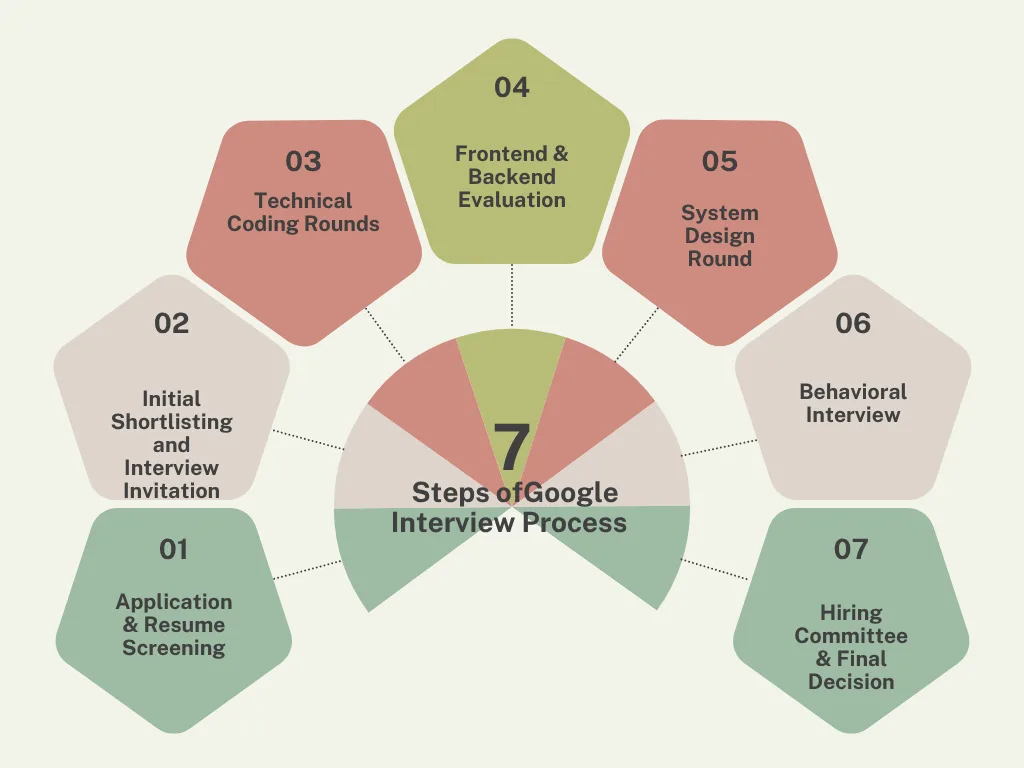
The Google interview process is a structured and multi-stage evaluation designed to assess technical expertise, problem-solving ability, and overall candidate suitability. It systematically examines coding skills, system design knowledge, and behavioral competencies to ensure alignment with the company’s engineering standards.
- 1. Application & Resume Screening: The first step of Google’s recruitment process is the resume screening. Here, after a candidate has submitted an application through Google’s jobs portal or been contacted directly via email or LinkedIn, recruiters will evaluate the resume to see if the candidate’s experience aligns with the position.
- 2. Initial Shortlisting and Interview Invitation: Shortlisted candidates are invited to attend offline interviews at a Google office or a designated location. Details regarding the interview schedule and rounds are shared in advance.
- 3. Technical Coding Rounds: Candidates are primarily interviewed on data structures and algorithm skills. Candidates will be presented with coding problems, and they are required to solve DSA problems with an efficient solution and clearly articulate the thought process behind the chosen approach.
- 4. Frontend & Backend Evaluation: This interview round evaluates the candidate’s knowledge of web development technologies, which include HTML, CSS, JavaScript, APIs, database design, and server design.
- 5. System Design Round: Candidates may be asked to design scalable systems. This evaluates knowledge of architecture, databases, APIs, and performance optimization in real-world scenarios.
- 6. Behavioral Interview: In this round, the interview assesses the candidate’s primary focus on communication style and collaboration with teams, and structured responses.
- 7. Hiring Committee & Final Decision: The Googlers reviews interviews, resumes, feedback, and skills; they will make the final decision in one to two weeks. Based on the results candidate can move forward to the offer stage.
Core Skills Required to Crack the Interview
Having a good understanding of data structures and algorithms will aid in passing the technical section of a Google full-stack engineer interview. Additionally, the candidate must have strong frontend development skills along with knowledge of frameworks. Equally important is to have robust experience in backend development to build and manage scalable systems effectively, handling millions of requests at the same time.
Furthermore, an in-depth understanding of system design, which includes core concepts like performance, scalability, database scaling, load balancing and architecture. Problem-solving, writing clean and maintainable code, and optimizing coding problems are very important during the interview process. Let’s discuss the core skills required to crack the Google full-stack engineer interview.
- Problem-Solving Ability: Strong problem-solving skills are the basis for logical processes to tackle complicated problems. It involves breaking problems into smaller factors and finding efficient solutions under time constraints.
- Data Structures & Algorithms: Having a good understanding of data structures and algorithms is critical in coding rounds and will assist you in writing optimal code while having better time and space complexity.
- System Design Thinking: System design relates to building scalable and efficient applications. When designing a system, candidates must understand the areas of architecture, database, and deployment of large-scale systems.
- Frontend Development Skills: Frontend development skills include knowledge of the technologies associated with frontend, such as HTML, CSS, and JavaScript. Additionally, knowledge of UI/UX and responsiveness is important to crack the interview.
- Backend Development Skills: Backend development involves working with various components of the server, such as databases and API. Candidates must know authentication, handling data, and scalability.
Common Mistakes to Avoid
- Ignoring problem constraints may result in either an incorrect or inefficient solution.
- Poor communication of candidates makes it difficult for Google interviewers to understand the approach.
- Failing to maintain a structured thought process will lead to disorganized and/or confusing answers.
- Not testing code properly is a non-negotiable mistake, as it leads to missed edge cases and potential errors.
Resources for Preparation
- Coding Platforms: The use of a coding platform such as LeetCode, HackerRank, Codeforces, and Codechef is very important because they are the only way to gain experience in solving DSA problems quickly and accurately.
- Online Courses: Online courses from Coursera, InterviewKickstarter, Udemy, and edX offer courses that can help to learn DSA, system design, and full-stack development in a structured way.
- Mock Interview: Mock interviews help simulate real Google Full Stack Engineer interview conditions and improve problem-solving under pressure. They enhance communication skills and build confidence by practicing structured and clear explanations.
Final Tips for Cracking a Google Interview
- Learn the fundamentals and mathematics behind data structures, algorithms, and core programming concepts so that you have a great foundation.
- Practicing using real-world mock interviews will help to develop the skills needed for solving problems under pressure.
- Provide yourself with coding speed and accuracy through practice using coding platforms.
- Develop creative real-world projects for practical knowledge and experience.
- The ability to confidently articulate and explain your proposed solutions will create a positive impression.
Conclusion
The Google full-stack engineer Interview isn’t simply a test of your coding skills, but rather it’s about proving that you have all the knowledge necessary to create real-world applications, including data structures, algorithms, frontend, backend, and systems design. Each portion of the interview process allows hiring managers to assess your unique technical and problem-solving skills in a different way, by evaluating how well you approach each challenge, how effectively you express your solutions, and how easily you grasp scalable systems.
FAQs: Google Full-Stack Engineer Interview Questions
Q1. What skills are essential for a Google Full Stack Engineer interview?
A strong foundation in data structures, algorithms, system design, and full-stack development is essential for the Google full-stack engineer jobs. It tests the candidates’ effective problem-solving and communication skills.
Q2. What types of questions are asked in a Google Full Stack Engineer interview?
The Google full-stack engineer interview includes questions on data structures, frontend development, backend development, system design, and behavioral aspects. These questions test both theoretical knowledge and practical application.
Q3. What is the interview process for a Google Full Stack Engineer role?
The process includes resume screening, technical interviews, and behavioral rounds. The final selection involves a review by the hiring committee and team matching.
Q4. How to prepare for a Google Full Stack Engineer interview effectively?
Preparation for a Google full-stack engineer interview requires consistent coding practice along with building real-world projects. Mock interviews and regular revision of core concepts help improve performance.
Q5. Are frontend and backend skills equally important in a Google Full Stack Engineer interview?
Yes, a balanced knowledge of both frontend and backend is important for this role. The interview evaluates the ability to work across the full stack.
Recommended Reads:


