Preparing for a Technical Program Manager role requires a strong blend of technical expertise and program management skills, as the role bridges engineering execution and business strategy. Interviewers use technical program manager interview questions to assess your ability to understand system design, lead cross-functional teams, and deliver complex programs on time.
Interviewers evaluate whether you can contribute to architectural discussions involving distributed systems, APIs, and infrastructure trade-offs while ensuring alignment and accountability across stakeholders. In addition, they look for structured thinking, prioritization under constraints, and decision-making in ambiguous situations.
You are also expected to demonstrate experience with Agile, DevOps, and risk management, along with the ability to translate technical complexity into measurable business outcomes.
Key Takeaways
- Develop a strong understanding of technical program manager interview question types, especially how they assess your technical knowledge, leadership strengths, and ability to execute programs effectively.
- Gain expertise in fundamental frameworks like STAR and systematic systems design methodology, which are necessary in responding to technical program manager interview questions and answers.
- Recognize that TPM interview questions focus mainly on determining whether you can manage complex program execution, lead multiple teams, and make good technical decisions in large systems.
- Learn about program thinking through dependency management, risk management, stakeholder management, and balancing speed, scalability, and technical difficulty.
- Look at how the expectations for each company differ between Amazon, Meta (Facebook), and Google. Pay close attention to the leadership principles, system design depth, and execution excellence needed to succeed.
Types of Technical Program Manager Interview Questions
Most companies evaluate candidates across four core categories- behavioral, system design, program management, and technical architecture.
- Behavioral questions focus on experience and leadership skills. Interviewers assess how you handle ambiguity, resolve conflicts, and drive outcomes using approaches like STAR.
- System design questions evaluate your ability to think in terms of scalable, distributed systems. Unlike SDE interviews, TPMs are expected to focus more on high-level architecture, tradeoffs, and cross-team implications.
- Program management questions test how you plan, execute, and deliver large programs. It includes dependency management, risk mitigation, and stakeholder communication.
- Technical architecture questions assess the ability to make informed technical decisions. You are expected to evaluate tradeoffs, balance technical debt, and align engineering choices with business goals.
Question Categories Overview
| Question Type |
What It Tests |
Example Question |
| Behavioral |
Leadership, conflict resolution, and decision-making |
Tell me about a time you managed a complex cross-team program. |
| System Design |
Scalability, distributed systems thinking, tradeoffs |
Design a notification system for 100 million users. |
| Program Management |
Planning, execution, risk management, stakeholder alignment |
How do you manage a large-scale program with multiple dependent teams? |
| Technical Architecture |
Technical decision-making, system tradeoffs, long-term impact |
How do you evaluate and choose between two competing technical approaches? |
Roles and Responsibilities of a Technical Program Manager
The technical program manager handles multiple tasks across areas such as engineering, products, and business. Their responsibilities generally include:
- Cross-team Coordination: TPM is responsible for bringing together the engineering, product, design, and operations teams to ensure a complex project is completed on time. The TPM also ensures dependency management and facilitates effective communication among teams.
- Program Execution: Technical program managers are responsible for converting plans into delivery, defining scope and milestones, dividing work into actionable tasks, tracking progress over time, detecting risks early, and ensuring that projects are on schedule.
- Technical Decision Support: TPM works closely with software engineers to help teams understand system design and trade-offs like cost, performance, and scalability. It helps teams make smart choices.
Top Technical Program Manager Interview Questions and Answers
Most technical program manager interview questions and answers are designed to evaluate how you think, communicate, and execute across ambiguity. Interviewers assess your structured thinking, stakeholder management, and technical judgment.
The questions below are grouped by category to reflect how real TPM interviews are conducted, helping you prepare with clarity and intent.
Behavioral Interview Questions
Behavioral TPM interview questions focus on past experiences and leadership patterns. Answers should follow the STAR (Situation, Task, Action, Result) framework to ensure clarity and impact.
Tip: Prepare 5-8 strong project stories in advance. Most behavioral questions can be answered by reframing same experiences with a different emphasis.
Q1. Tell me about a complex program you managed from start to finish
Why do interviewers ask this? To evaluate your end-to-end ownership, ability to manage complexity, and impact at scale.
Use the STAR framework to structure your response. Begin with the situation, such as a platform struggling to handle peak holiday traffic. Clearly define your task, for example leading a migration to a microservices architecture within a fixed timeline.
Describe your actions in a structured way. Explain how you organized multiple engineering teams, coordinated dependencies across pods, and established sprint planning and tracking mechanisms. Highlight how you managed risks and ensured alignment across stakeholders.
Conclude with measurable results, such as delivering ahead of schedule, achieving zero downtime during migration, and reducing system latency significantly during peak traffic periods.
Q2. Describe a time you had to manage conflicting priorities across multiple teams
Why do interviewers ask this? To assess stakeholder management, prioritization skills, and decision-making under pressure.
Provide a scenario where two teams had competing priorities, such as one team focusing on a client feature while another prioritized security compliance work. Explain how you facilitated alignment by bringing stakeholders together for a structured discussion. Describe how you evaluated both priorities against business objectives and organizational OKRs.
Highlight how you drove a balanced resolution by proposing a phased delivery approach that allowed compliance requirements to proceed while still supporting the client timeline.
3. Tell me about a time a project missed a critical milestone. What did you do?
Why do interviewers ask this? To evaluate accountability, transparency, and problem-solving under pressure.
Select a real example where a milestone was missed. Clearly explain the root cause, such as underestimating the complexity of a third-party integration. Describe your immediate response, focusing on transparent communication with stakeholders and ownership of the issue. Avoid blame and focus on facts.
Then explain the corrective actions you implemented, such as revising the project scope, updating timelines, and introducing stricter vendor coordination and tracking processes to prevent similar issues in the future.
Q4. How do you handle a situation where two senior stakeholders disagree on direction?
Why do interviewers ask this? To assess conflict resolution and influence without authority.
Explain your structured approach to resolving disagreements. Start with how you shift discussions away from opinion-based arguments toward objective evaluation. Describe how you introduce a decision framework that compares options based on engineering effort, risk, customer impact, and business value.
Highlight how this structured approach helps stakeholders align on a data-driven decision rather than personal preference.
Q5. Describe a time you had to push back on scope creep
Why do interviewers ask this? To assess your ability to protect delivery timelines while managing stakeholder expectations.
Provide an example where additional requirements were introduced late in the development cycle. Explain how you evaluated the impact of the change in terms of timeline, engineering effort, and testing requirements.
Describe how you communicated the trade-offs clearly to stakeholders and presented alternatives such as deferring the feature to a later release. Conclude by emphasizing how you maintained delivery commitments while ensuring strong stakeholder alignment.
System Design Interview Questions
System design technical program manager interview questions evaluate your ability to think in terms of scalable, distributed systems. Unlike SDE interviews, TPMs are expected to focus on high-level architecture, tradeoffs, and cross-team implications.
To approach these questions effectively, use a structured framework:
- Clarify requirements and constraints
- Define high-level architecture
- Break down components and data flow
- Address scalability, reliability, and tradeoffs
Warning: TPM system design is broader than SDE interviews. Focus on distributed systems, dependencies, and tradeoffs, not low-level code.
Q9. Explain how the internet works.
Why do interviewers ask this? It is the most common technical explanation question, testing your ability to explain complex networking concepts simply and accurately.
Use the 3-step framework. First, clarify the scope by asking if they want a focus on DNS, routing, or the hardware layer. Second, explain step-by-step: describe a user typing a URL, the DNS resolution translating the domain to an IP address, the HTTP request travelling via TCP/IP packets through routers, reaching the server, and the server sending the HTML response back. Third, conclude by inviting discussion on specific layers like load balancers or CDN caching.
Q10. Design a notification system for 100 million users.
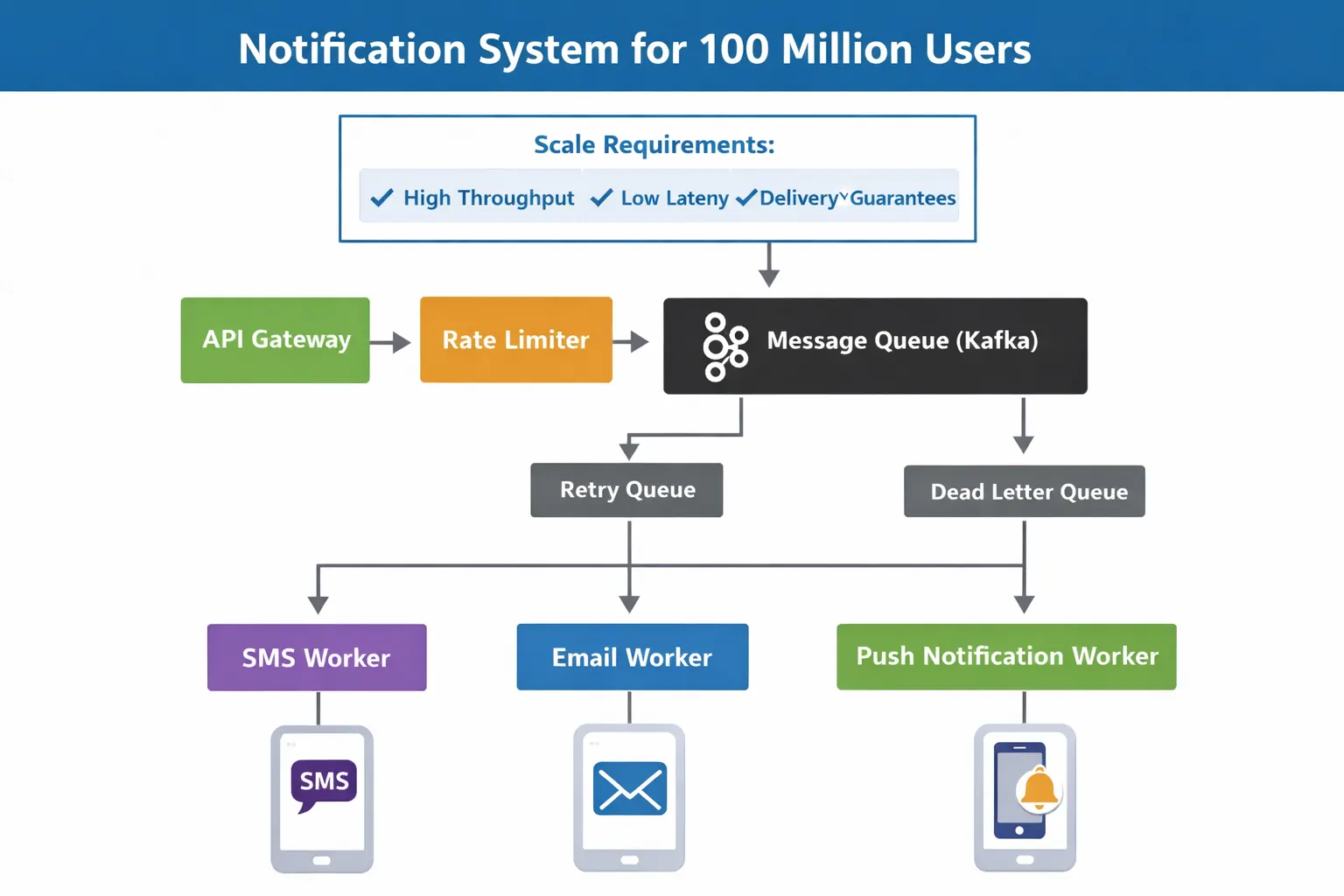
Why do interviewers ask this? A classic distributed systems design question testing your grasp of massive scale, asynchronous message processing, and system reliability.
Begin by defining scale requirements (e.g., latency expectations, delivery guarantees). Break down the components: a rate limiter, an API gateway, a message queue (like Kafka) to handle async processing, and worker services dedicated to different delivery channels (SMS, Email, Push). Discuss failure handling mechanisms like retry queues and dead-letter exchanges.
Q11. How would you design the backend for a ride-sharing app?
Why do interviewers ask this? Frequently cited in real interviews, it tests your ability to handle continuous real-time data, high-concurrency matching, and robust fault tolerance.
Address the real-time matching engine, which requires incredibly low latency. Explain how you would ingest constant location data using WebSockets and store it in an in-memory datastore like Redis for fast geospatial querying.
Discuss scalability trade-offs, such as partitioning the map into geographic grids (e.g., using S2 geometry or Geohashes) so the system can match riders and drivers efficiently without scanning the entire global database.
Q12. What is the difference between SQL and NoSQL databases, and when would you choose each?
Why do interviewers ask this? Tests your technical depth and reasoning in foundational data architecture decisions.
Show a deep understanding of structural trade-offs, not just dictionary definitions. Explain that SQL databases provide strict schemas and complete ACID (Atomicity, Consistency, Isolation, Durability) compliance, making them the only acceptable choice for financial transactions or heavily relational inventory systems where data integrity is paramount.
Explain that NoSQL databases (like MongoDB or Cassandra) offer highly flexible schemas and massive horizontal scalability, making them perfect for rapidly changing data models, vast unstructured document stores, or high-velocity social media feeds where eventual consistency is acceptable.
SQL and NoSQL databases differ in structure, scalability, and consistency models. SQL systems emphasize structured schemas and strong consistency, while NoSQL systems prioritize flexibility and horizontal scaling. The table below highlights key differences to help determine the right choice based on system requirements.
| Aspect |
SQL Databases |
NoSQL Databases |
| Data Model |
Structured tables with schema |
Flexible (key-value, document, graph) |
| Scalability |
Vertical scaling |
Horizontal scaling |
| Consistency |
Strong consistency (ACID) |
Eventual consistency (BASE) |
| Best Use Case |
Transactions, relational data |
Large-scale, distributed, unstructured data |
Program Management Interview Questions
Program management technical program manager interview questions and answers focus on how you structure execution, manage dependencies, and drive programs to completion under real-world constraints.
Interviewers are looking for clear thinking, your response should show how you break down ambiguity into a plan, manage risks proactively, and keep multiple teams aligned.
Tip: Use structured frameworks when answering program sense questions. Approaches like defining scope, mapping dependencies, setting milestones, and tracking risks help demonstrate clarity and repeatability in execution.
Q13. How do you manage a large-scale program with multiple dependent teams?
Why do interviewers ask this? It is the core program management question, testing your dependency mapping and cross-team coordination skills.
Walk through a highly structured approach from initial kickoff to final delivery. Explain how you establish a central program charter to strictly align overarching business goals. Detail your process for meticulously mapping dependencies during the planning phase using Gantt charts or Jira Advanced Roadmaps to identify the critical path.
Emphasize establishing regular “Scrum of Scrums” meetings to track cross-team technical blockers, ensuring that all dependent engineering pods are marching concurrently toward the exact same milestone dates.
Q14. How do you handle a situation where a critical dependency slips and threatens the launch date?
Why do interviewers ask this? Tests risk management, escalation judgment, and crisis communication skills.
Show how you identify the risk early through established velocity tracking metrics. Once identified, communicate the risk immediately to stakeholders with a fully proposed mitigation plan, never just present an unsolvable problem.
Evaluate the available trade-offs: explain how you would analyze if you can crash the schedule by safely adding engineering resources, decouple the dependency by having the frontend team mock the API, or ultimately negotiate descoping a non-critical feature to aggressively protect the primary launch date.
Q15. Walk me through how you would build a program roadmap from scratch.
Why do interviewers ask this? Tests end-to-end program planning skills, strategic foresight, and organizational capability.
Cover the entire lifecycle comprehensively. Start with deep stakeholder alignment to definitively capture the program’s vision and strict success metrics (KPIs). Work backward from the target launch date to establish major quarterly and monthly milestones.
Collaborate heavily with engineering leads to break these milestones down into actionable epics, map the necessary cross-team architectural dependencies, and explicitly document the critical delivery path. Finally, embed calculated risk identification buffers into the roadmap to account for unknown technical hurdles.
Q16. How do you track and report program health to different audiences?
Why do interviewers ask this? Tests your adaptability in communication and metrics-driven thinking.
Explain that different organizational audiences require vastly different levels of data granularity. For engineering teams, you track daily sprint burndown charts, PR velocity, and open bug ticket counts. For program leads, you provide weekly status reports highlighting RAG (Red/Amber/Green) status on major milestones and active technical blockers.
For C-level executives, you present high-level dashboard summaries focusing exclusively on budget burn, overarching launch timelines, and immediate business impact, entirely omitting the granular technical weeds.
Technical Architecture Questions
Technical architecture questions require you to step fully into the shoes of an engineering leader. You must strike a perfect balance between pure technical best practices and harsh business realities, maintenance costs, and operational readiness requirements. Below are the most common technical architecture questions a candidate should prepare for:
Q17. How do you evaluate and choose between two competing technical approaches for a program?
Why do interviewers ask this? Tests structured decision-making and your ability to mediate fierce technical debates among senior engineers.
Demonstrate a structured evaluation framework. First, gather all strict business requirements and expected scale metrics. Next, evaluate the technical trade-offs of both approaches concerning system scalability, required development time, and long-term maintenance costs. Solicit input through a formal architecture review board.
Crucially, consider the reversibility of the decision (framing it as a “two-way door” versus a “one-way door” decision) to determine exactly how fast the team should move before permanently committing to the final architecture.
Q18. How do you balance technical debt against delivery speed?
Why do interviewers ask this? Extremely common at the senior level, testing your pragmatism and business acumen.
Explain exactly how you quantify the actual cost of technical debt. Taking on technical debt is completely acceptable if it allows the company to hit a critical, time-sensitive market window, provided the debt is actively documented.
Show how you communicate this risk to non-technical stakeholders by translating “bad, rushed code” into “future engineering hours lost.” Explain your firm’s strategy for paying it down, such as permanently dedicating 20% of every future sprint to refactoring the exact debt you incurred to launch quickly.
Q19. How do you ensure technical quality is maintained across a large distributed team?
Why do interviewers ask this? Tests your quality governance thinking and your ability to influence standards without micromanaging code.
Address systemic engineering processes rather than individual supervision. Cover the firm enforcement of rigorous code review standards and the mandatory implementation of automated CI/CD pipelines that instantly reject builds failing unit tests.
Explain how you, as a TPM, actively foster a culture of quality by establishing regular cross-team architecture review boards and ensuring that quality metrics (such as test coverage percentages and defect escape rates) are highly visible on dashboards to all distributed teams.
Q20. How would you approach migrating a legacy system to a modern architecture without disrupting live services?
Why do interviewers ask this? Tests migration planning, severe risk management, and handling of complex real-world legacy scenarios.
Highlight the absolute necessity of a phased rollout strategy. Detail a strategy like the Strangler Fig pattern, where backend functionality is migrated microservice by microservice over several months. Discuss running the old and new systems in parallel to continuously verify data integrity (shadow testing or dark launching).
Emphasize the absolute necessity of rigorous rollback planning, feature flags, and continuous stakeholder communication throughout the entire multi-month migration window.
Q21. What questions do you ask an engineering team to assess whether a system is production-ready?
Why do interviewers ask this? Tests your technical depth and launch readiness thinking strictly from a TPM perspective.
Focus intensely on operational excellence and system resilience. Ask about monitoring: “Do we have real-time dashboards tracking p99 latency and system error rates?” Ask about alerting: “Are automated CPU thresholds set, and is the on-call pager rotation finalized?” Inquire about load testing: “Has the system been successfully tested at 2x our expected peak holiday traffic?”
Finally, ensure incident runbooks are fully documented so the Tier 1 support team knows exactly what to execute if a critical failure occurs post-launch.
Want to master TPM-level system thinking and interview strategies? Explore our TPM Interview Masterclass for in-depth frameworks & real-world preparation techniques.
Amazon Interview Questions for Technical Program Manager
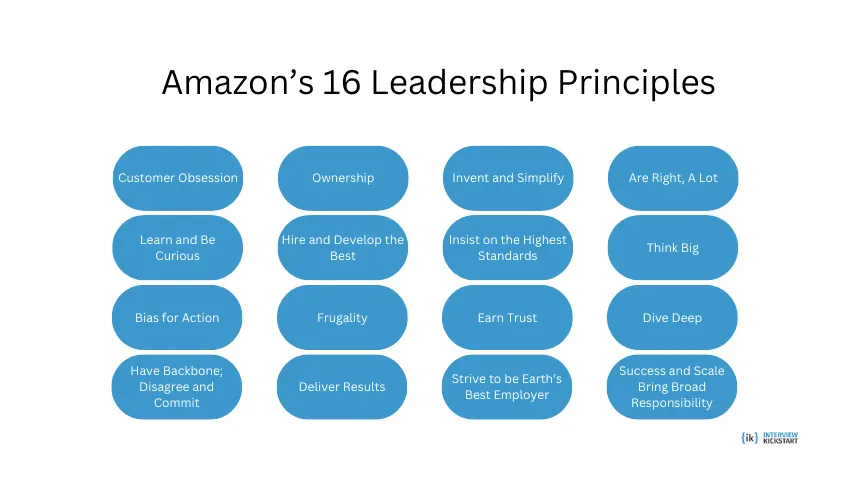
The TPM interview questions at Amazon evaluate candidates through a notoriously rigorous, highly structured process. A standard onsite loop consists of five 55-minute interviews deeply covering system design, program management, and intense behavioral assessments.
Crucially, Amazon’s Leadership Principles (LPs) are assessed in every single round, including the technical ones. You must deeply intertwine your technical competence with these specific principles to pass the final Bar Raiser round successfully.
Q22. Tell me about a time you delivered a program despite significant obstacles. (Ownership)
Why do interviewers ask this? To see if you take extreme ownership and drive results when a program inevitably goes off the rails.
Utilize the STAR format rigorously. Detail the severe, unexpected obstacles you faced (e.g., losing a lead backend engineer mid-project or dealing with a massive third-party outage). Emphasize how you personally took ownership of the problem rather than blaming external factors or management.
Amazon expects heavy data usage, so quantify the outcome wherever possible, for example, “Despite a critical two-week vendor delay, I completely reorganised the sprint schedule, parallelised the QA phase, and successfully delivered the launch, securing $2M in projected Q3 revenue.”
Q23. How do you decide which programs to prioritize when resources are constrained? (Think Big)
Why do interviewers ask this? To evaluate your strategic business judgment and your ability to say no to good ideas in favor of great ones.
Show a highly structured prioritization framework strictly tied to long-term business impact. Explain how you meticulously calculate Return on Investment (ROI) and deeply evaluate the opportunity cost of delay.
Discuss how you consult customer data metrics and utilize strong judgment to bravely pause low-impact, comfortable projects in favor of highly complex, ambiguous initiatives that align perfectly with the company’s long-term strategic vision.
Facebook Technical Program Manager Interview Questions
TPM interview questions at Facebook (Meta) lean heavily toward deep technical execution and infrastructure knowledge. Meta expects its TPMs to be highly proficient in the architecture of massive distributed systems.
Real interview reports consistently feature massive-scale challenges, asking candidates to architect platforms like “Design Instagram” or “Design WhatsApp,” ensuring they have an intimate understanding of the unique database and latency bottlenecks of global social media systems.
Q24. Design Instagram’s feed ranking system.
Why do interviewers ask this? Tests your understanding of machine learning pipelines, data ingestion at Facebook-scale, and system latency constraints.
Cover the vast data inputs required, such as tracking billions of daily user interactions, view times, and post metadata. Discuss the complex ranking signals and how a heavy machine learning model would mathematically score the relevance of thousands of posts per user.
Address the extreme scale by explaining how to pre-compute feeds asynchronously and cache them globally using distributed Redis clusters to ensure sub-millisecond load times.
Finally, explain how you would safely A/B test and iterate on the ranking algorithm without negatively impacting the live user experience.
Google Technical Program Manager Interview Questions
Google TPM interview questions are highly comprehensive, focusing tightly on three core areas- flawless system design knowledge, precise program execution capability, and seamless cross-team coordination.
A standard Google onsite loop includes rounds dedicated entirely to program management, technical depth (covering scalable architecture), and a specialized “Googleyness” and Leadership behavioral round to ensure deep cultural alignment and ethical decision-making.
Q25. What was the most complex design project you have worked on?
Why do interviewers ask this? It is the most asked question in Google TPM on sites, testing your true technical decision-making depth and project scope.
Be incredibly specific and highly technical. Detail the overarching architecture of the system, highlighting the specific data bottlenecks and latency issues you faced.
Demonstrate your technical decision-making by explaining exactly why you chose a specific NoSQL database or an Apache Kafka messaging queue over an alternative solution.
Critically, explain the operational side by detailing how you aligned multiple disagreeing engineering teams around this complex design to execute the vision flawlessly on time.
Sample Technical Program Manager Interview Questions for Practice
To get the most value from these technical program manager interview questions, practice answering behavioral prompts using the STAR framework and approach system design problems with a clear, step-by-step structure. The goal here is not just to think through answers, but to simulate real interview conditions by articulating your reasoning clearly and concisely.
Tip: Record yourself answering out loud. Verbal practice consistently outperforms silent reading and helps you refine clarity, pacing, and confidence.
Behavioral Practice Questions
The following behavioral questions are designed to help you refine your leadership stories and improve how you structure responses under pressure. Focus on clarity, impact, and measurable outcomes.
- Describe a time you had to decide with incomplete information.
- Tell me about a time you managed a stakeholder who was difficult to work with.
- How have you handled a situation where your team was behind schedule and morale was low?
- Describe a time you changed a process that improved your team’s efficiency.
- Tell me about a program you are most proud of and why.
System Design Practice Questions
These system design questions help you practise structuring complex problems, defining architectures, and discussing tradeoffs. Use the same step-by-step framework covered earlier to guide your answers.
- Design a URL shortener service like bit.ly.
- How would you design a distributed logging system for a large engineering org?
- Design a real-time leaderboard for a gaming platform with 50 million users.
- How would you architect a multi-region deployment for a customer-facing application?
Technical Program Manager Interview Process

The Technical Program Manager interview process follows a structured, multi-stage pipeline designed to evaluate both technical depth and program execution capabilities. While formats vary slightly across companies, the flow remains consistent, helping candidates understand what to expect at each stage.
- Recruiter Screen (30 minutes): Initial discussion covering background, role expectations, and basic fit.
- Technical Phone Screen (45–60 minutes): Deep dive into past program execution with one high-level system design discussion.
- On-site Loop (4–5 rounds): Series of interviews, each ~45 minutes, assessing multiple dimensions.
- System Design Rounds: Focus on scalability, architecture tradeoffs, and distributed systems thinking.
- Behavioral & Leadership Rounds: Evaluate stakeholder management, conflict resolution, and ownership.
- Hiring Decision: Interviewers submit feedback, reviewed by a hiring committee for the outcome.
Company-specific variations include Amazon (5 rounds with Bar Raiser), Google (“Googleyness” round), and Meta (strong emphasis on technical depth).
Technical Program Manager Mock Interview: Key Insights and Preparation Tips
Mock interviews are the absolute closest simulation to the real event. Based on thousands of successful mock sessions, here are the most concrete strategies to elevate your performance and secure an offer on interview day.
- Practice System Design Discussions Aloud: Do not just draw architectural boxes in silence. For system design practice, work through specific, high-scale prompts like: “Design Twitter,” “Design Instagram,” or “Design a parking reservation system.” Explain your technical trade-offs verbally as you draw, simulating a real engineering whiteboard session.
- Prepare STAR Leadership Examples Rigorously: Map out your top 5 career achievements in deep detail. Write them down using the exact Situation, Task, Action, Result framework. Highlight the specific metrics you achieved and the specific technical conflicts you personally resolved.
- Understand the Program Lifecycle End-to-End: Interviewers will intensely test if you can handle ambiguity. Practice whiteboarding a complete program launch plan from scratch, from initial kickoff and strict stakeholder alignment, through development, to post-mortem analysis and operational handoff.
Warning: System design prep for TPMs differs drastically from standard SDE prep. Do not waste precious time memorizing low-level algorithm code. Focus intensely on distributed systems architecture, API design, database trade-offs, and program-level risk mitigation.
Get Ready to Crack Your Next Technical Program Manager Interview
A TPM offer at a top tech company requires significantly more than just reading guides; it demands structured, expert-led preparation that mirrors the real interview environment.
If you want to transform your experience into an undeniable interview performance, explore Interview Kickstart’s Technical Program Manager Interview Masterclass today.
Let our seasoned experts help you master your delivery and secure your dream role.
Conclusion
Mastering technical program manager interview questions requires a highly strategic blend of deep architectural knowledge and razor-sharp leadership acumen. This guide has equipped you with the fundamental behavioral structures, scalable system design frameworks, rigorous program management methodologies, and company-specific insights needed to excel in any top-tier interview loop.
However, simply reading these scenarios is not enough to secure a top-tier offer. You must actively practice consistently by speaking your answers aloud, whiteboarding complex distributed systems, and engaging in rigorous mock interviews to drastically refine your delivery under intense pressure.
FAQs: Technical Program Manager Interview Questions
Q1. What is the role of a Technical Program Manager?
A TPM acts as the strategic bridge between engineering, product, and business teams. They are strictly responsible for cross-team coordination, driving end-to-end program execution flawlessly, and providing critical technical decision support to architecture teams.
Q2. How is a TPM different from a Product Manager?
The distinction is highly practical regarding daily duties: a TPM fully owns the execution and delivery of the program, figuring out “how” the system is built and “when” it gets delivered. A Product Manager fully owns the product direction and roadmap, determining exactly “what” gets built and “why” the customer needs it.
Q3. What technical skills does a TPM need?
A Technical Program Manager needs strong technical depth across multiple areas to effectively drive complex programs. It includes a solid understanding of system design, distributed architectures, and data pipelines to make informed architectural decisions. In addition, a TPM should be well-versed in software engineering processes such as CI/CD, DevOps, and Agile methodologies to align with engineering teams and ensure smooth execution.
Q4. How should I prepare for technical program manager interview questions and answers?
You should systematically build 5 to 8 versatile STAR stories for your behavioral rounds, practice drawing out highly scalable system designs on a whiteboard, thoroughly research the target company’s specific products, and conduct numerous verbal mock interviews to refine your delivery speed.
Q5. What types of questions are asked in a TPM interview?
Evaluators generally ask four primary types of TPM interview questions: behavioral questions assessing your leadership style, system design questions testing your architectural knowledge, program management questions evaluating your execution methodology, and technical architecture questions testing your ability to make strict trade-off decisions.
References
Recommended Reads: