A phone screening interview is typically the litmus test in the hiring process. Although a brief conversation, it is extremely important since recruiters rely on their conclusions from it to make a decision about moving forward.
Employers use it to filter potential candidates by selecting those whose resumes and personalities seem to fit the job description.
Apart from listening for accurate answers, the interviewer evaluates the candidate’s communication skills, his/her suitability and relevance for the position in question, as well as their enthusiasm about the offer itself.
In this article, we’ll share some common phone interview questions and answers with a list of helpful preparation tips and follow-up techniques.
Key Takeaways
- A phone interview is a 15 to 30-minute screening designed to verify your resume, assess your communication skills, and ensure you are a practical fit before moving to more intensive technical rounds.
- Use the Situation, Task, Action, and Result (STAR) framework to provide structured, evidence-based answers to behavioral questions about challenges, teamwork, and mistakes.
- When discussing achievements, move beyond vague descriptions and use measurable metrics, such as percentages or specific revenue figures, to prove your professional impact.
- Success depends on minimizing external distractions, speaking clearly at a deliberate pace, and having your resume and key notes accessible as a quick reference guide.
- Always have thoughtful questions ready for the interviewer regarding role success and team challenges, and follow up within 24 hours with a personalized thank-you email to reinforce your interest.
What is a Phone Interview?
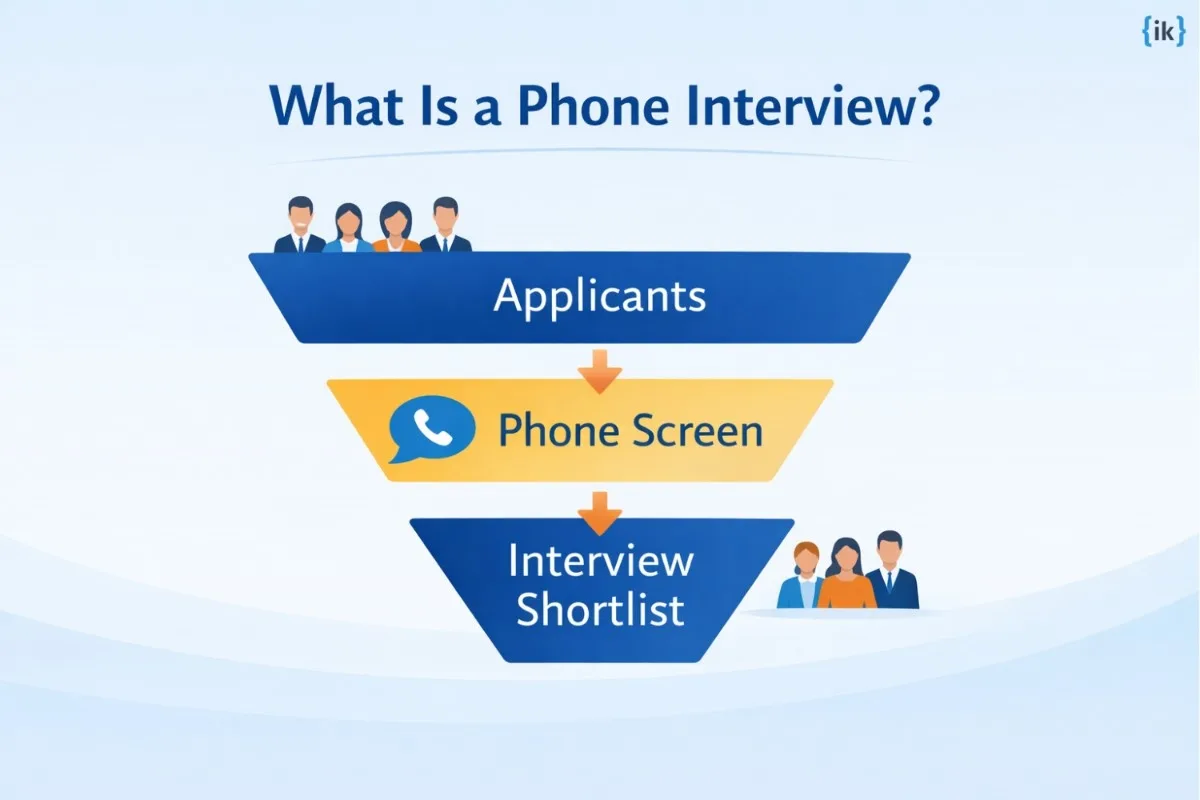
A phone interview is usually a short screening call with a recruiter or hiring manager. It often lasts 15 to 30 minutes and helps the company quickly decide which candidates should move ahead in the hiring process. During this call, the interviewer checks basic qualifications, communication skills, role fit, and interest in the position.
Why Employers Conduct Phone Interviews
Employers use phone interviews to quickly screen candidates before spending time on longer interview rounds. This step helps recruiters confirm that the resume matches the candidate’s actual background, assess how clearly a candidate communicates, and determine whether the role is a practical fit. It also gives hiring teams a fast way to compare applicants and move forward with the strongest matches.
| Purpose |
What Recruiters Evaluate |
| Verify resume details |
Work history, job titles, responsibilities, and overall accuracy |
| Assess communication skills |
Clarity, confidence, listening skills, and how well ideas are explained |
| Evaluate role fit |
Relevant experience, interest in the position, and alignment with the job requirements |
How to Prepare for a Phone Interview
Good preparation makes a phone interview feel a lot less random. Start by researching the company so you understand its products, values, and recent work. Review your resume carefully and be ready to walk through your experience without hesitating. It also helps to prepare answers to common questions in advance so you can speak clearly and stay focused. Finally, choose a quiet space with a strong phone signal and no distractions so the call stays professional from start to finish.
| Step |
Why It Matters |
| Research the company |
Helps you answer with context and show real interest |
| Review your resume |
Makes it easier to explain your background clearly and confidently |
| Prepare answers |
Reduces hesitation when common questions come up |
| Find a quiet space |
Keeps the conversation professional and avoids interruptions |
After the phone screen, many candidates move into more technical rounds. For software roles, our guide on coding interview questions is a useful next step for preparing for that stage.
Common Phone Interview Questions and Answers
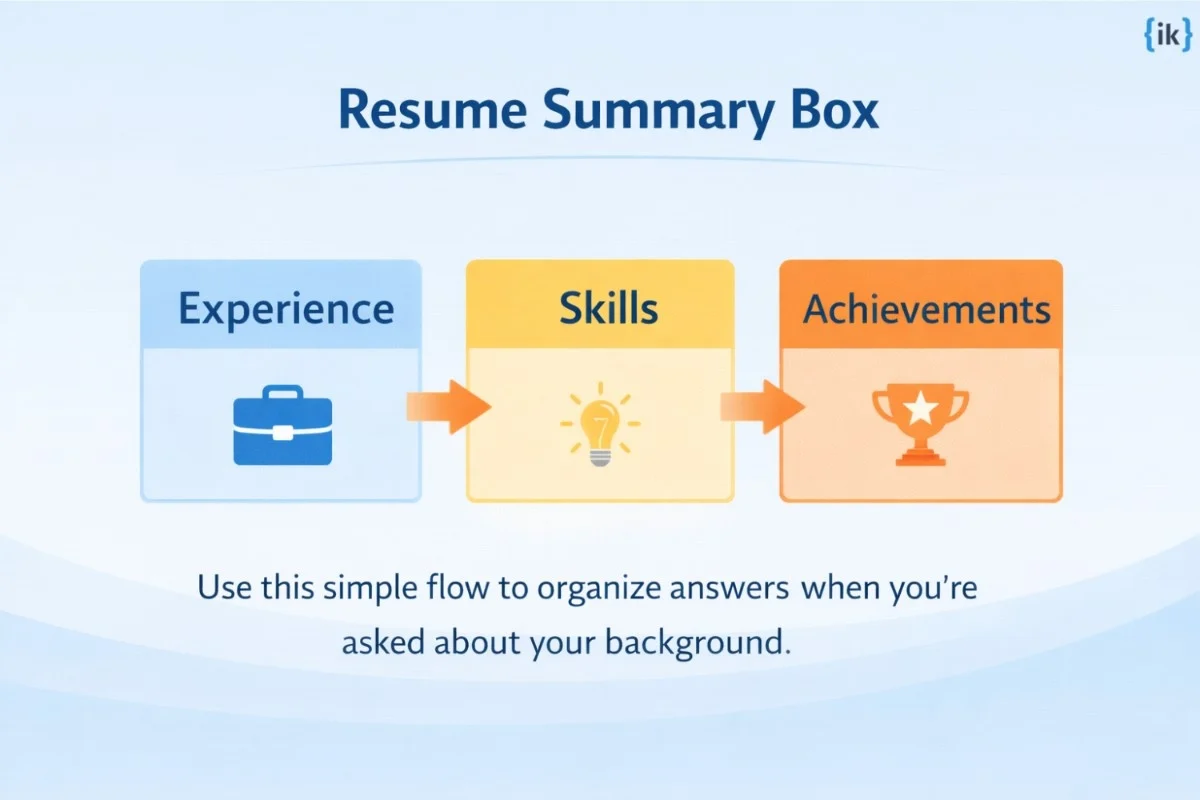
Most phone screenings cover a familiar set of questions. Recruiters use them to check your background, communication style, interest in the role, and overall fit before they decide whether to move you forward. A clear, organized answer goes a long way in this round.
Q.1 Tell Me About Yourself
Start with your current role, add a quick summary of your background, and end with what you are looking for next. Keep it focused on work experience, not your life story.
Example answer: I am a product analyst with four years of experience in data analysis, reporting, and cross-functional work. In my current role, I have helped improve reporting workflows and supported decisions with clear insights. I am now looking for a role where I can take on bigger business problems and work more closely with product and engineering teams.
Q.2 Why Do You Want to Work Here?
Interviewers ask the infamous ‘Why do you want to work here’ question to check whether you understand the company and have a real reason for applying. The best answers connect your goals to the company’s work, mission, or team structure.
A strong response should mention something specific about the role, team, or company. Show that you researched the organization and explain why the opportunity feels like a good match for your skills and interests.
This is one of the most common phone interview questions that recruiters expect to hear answered in a thoughtful, personalized way.
Q.3 Walk Me Through Your Resume
This question is your chance to tell a clean career story. Do not repeat every line on the page. Instead, move through your experience in order and highlight the parts that matter most for the role.
For a strong structure, use this flow: current role, earlier experience, and the results you have delivered.
Example response: I started my career in support and operations, where I learned how to work with customers and handle detail-heavy tasks. I later moved into analytics, where I built dashboards, tracked product metrics, and worked with teams to improve reporting. Most recently, I have been focused on turning data into decisions that help teams move faster.
Also Read: How to Write a Professional Resume – A Guide
Q.4 What Are Your Strengths?
Pick strengths that match the job description and back them up with a quick example. A recruiter wants to hear more than a list of traits.
If the role needs collaboration, mention teamwork. If it needs problem-solving, talk about how you approach challenges. The key is to connect the strength to actual results. This is one of the answers for phone interview questions that works best when it sounds specific and credible.
Q.5 What Are Your Weaknesses?
Choose a real but manageable weakness, then explain how you are working on it. The goal is to show self-awareness and growth, not perfection.
A good answer sounds honest without hurting your candidacy. For example, you might mention that you used to spend too much time perfecting small details, but now you manage time better by setting clearer priorities.
Q.6 Why Are You Leaving Your Current Job?
Keep the answer positive and professional. Focus on what you want next instead of what you dislike about your current job. You can talk about growth, new challenges, or the type of work you want to do more of. Avoid negative comments about your manager, team, or company.
Q.7 What Are Your Salary Expectations?
This question is usually about alignment, not pressure. If possible, give a thoughtful range based on research, your experience, and the job level.
A smart response leaves room for discussion. You can say that you are open to a fair market rate for the role and would like to learn more about the full scope before giving a final number.
Q.8 What Are Your Career Goals?
Interviewers ask this to see whether your direction aligns with the role and company. Your answer should show ambition, but it should also feel realistic.
Connect your goals to skills you want to build, responsibilities you want to take on, and the kind of impact you want to make. That helps the interviewer see that you are thinking long-term.
Behavioral Phone Interview Questions and Answers
Behavioral questions are the bread and butter of modern hiring. Companies use them to look past your resume and see how you actually function in a professional environment. Instead of asking what you would do, recruiters ask what you have done.
They want to see patterns in your decision-making, emotional intelligence, and ability to handle pressure. On a phone screen, these questions help the interviewer gauge if your soft skills match the technical expertise listed on your profile.
Q.9 Tell Me About a Challenge You Faced at Work
When an interviewer asks about a challenge, they are checking your resilience and problem-solving logic. The most effective way to keep your answer structured over the phone is the STAR method. This framework ensures you don’t ramble and that the most important part of your story, the outcome, gets enough airtime.
| Step |
What to Explain |
| Situation |
Set the scene. Briefly explain the context of the problem. |
| Task |
Define the goal. What exactly needed to be fixed or achieved? |
| Action |
This is the meat of your answer. Detail the specific steps you took. |
| Result |
Share the outcome. Use numbers or concrete feedback if possible. |
Q.10 Describe a Time You Worked in a Team
Phone interviewers ask about teamwork to see if you are a culture add or a potential bottleneck. When answering, avoid taking all the credit, but don’t hide your specific contributions either. A great example might involve a time you filled a gap for a teammate or how you helped the group stay on schedule when a project scope changed.
Focus on how you communicated. Did you set up a new channel to streamline updates? Did you volunteer for the less glamorous tasks to ensure the deadline was met? Showing that you prioritize the group’s success over your own ego is key here.
Q.11 Tell Me About a Mistake You Made
This is often the most dreaded question, but it’s actually a chance to show high levels of self-awareness. The worst thing you can do is say you’ve never made a mistake or provide a fake mistake like being a perfectionist.
Instead, pick a genuine, work-related oversight. Explain what happened clearly, take full ownership without blaming others, and most importantly, talk about the fix.
- What did you learn?
- What systems did you put in place to make sure it never happened again?
Employers value people who can pivot and grow from a stumble.
Q.12 Describe a Time You Handled Conflict
Conflict is inevitable in any office, and recruiters want to know you can handle it professionally rather than emotionally. Your answer should show that you are a listener and a bridge-builder.
For example, describe a time you had a different opinion on a project direction than a colleague. Instead of focusing on who was right, explain how you sat down with them to understand their perspective and found a middle ground that benefited the project. Avoid making the other person look like a villain. Focus on the professional disagreement and the resolution.
If you are aiming for a senior role, these scenarios often overlap with leadership interview questions, where managing personalities is just as important as managing tasks.
Phone Interview Questions About Experience
The initial phone screening is a gatekeeper round designed to verify that your resume matches reality. Recruiters use these questions to peel back the layers of your professional history and see if you actually have the required experience you claimed in your application.
It is less about a deep dive into every project and more about confirming you have the foundational background needed to survive the more intense technical rounds.
Q.13 Can You Describe Your Current Role?
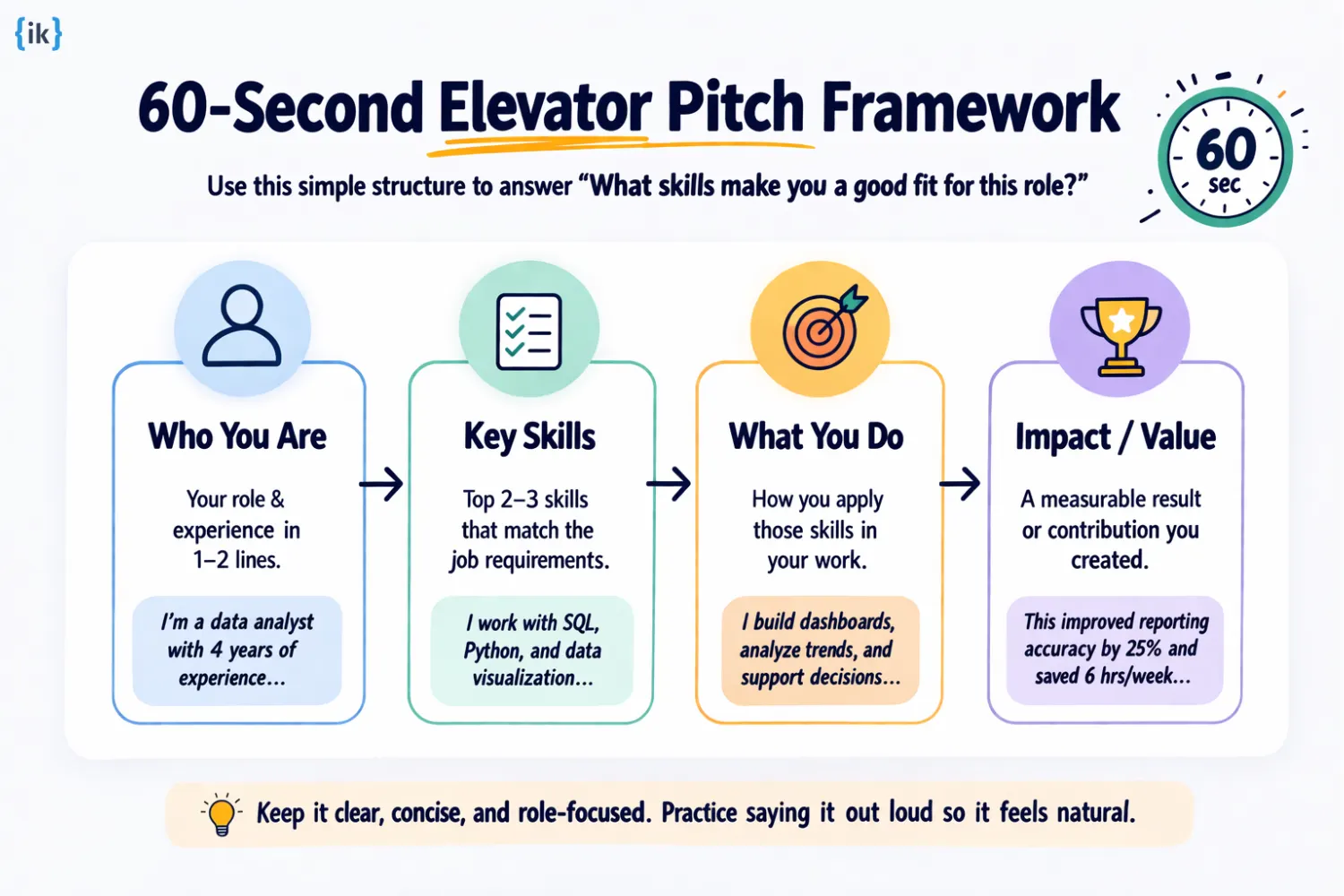
When an interviewer asks this, they are not looking for a laundry list of your daily chores. They want a high-level summary that connects your current responsibilities to the job they are trying to fill.
A concise answer follows a simple past-present-future structure. Start with your job title and the main mission of your team. Then mention two or three core responsibilities you handle daily. Finish by briefly stating why you are ready to transition those skills into this new opportunity. Keeping this under two minutes shows you can communicate complex career paths with clarity.
Q.14 What Achievements Are You Most Proud Of?
Vague statements like “I am a hard worker” or “I helped my team” do not carry weight in a phone interview. Employers want measurable results. They want to hear about the time you saved the company money, increased revenue, or streamlined a process that was previously broken.
When you prepare this answer, think in terms of numbers, percentages, and timeframes.
- Did you reduce server downtime by 15%?
- Did you onboard ten new clients in a single quarter?
If your role is not directly tied to revenue, talk about the scale of your work, such as managing a budget of $50,000 or leading a cross-functional team of twelve people. Hard data proves your impact.
Q.15 What Skills Make You a Good Fit for This Role?
This is where you show you have done your homework. Many candidates make the mistake of listing skills they like using, rather than the skills the company actually needs. To nail this, you must link your personal toolkit directly to the requirements listed in the job description.
Pick three specific skills, ideally a mix of technical ability and soft skills like project management, and provide a brief proof point for each. If the job requires expertise in Python, mention a specific automation script you built. If they need a leader, mention a time you mentored a junior staff member. By mirroring the language of the job posting, you make it incredibly easy for the recruiter to check all the boxes on their scorecard.
Questions You Should Ask the Interviewer
The end of a phone interview is not just a formality. When the recruiter asks if you have any questions, saying no is a missed opportunity. Asking thoughtful questions proves you are genuinely interested in the position and that you are evaluating the company just as much as they are evaluating you.
It transforms the conversation from an interrogation into a professional dialogue. Beyond showing enthusiasm, your questions help you gather the information needed to decide if this workplace is actually a good fit for your career goals.
Q.16 What Does Success Look Like in This Role?
This is perhaps the most important question you can ask. It forces the interviewer to move past the generic job description and give you the real expectations.
- Are they looking for someone to hit a specific sales target within six months?
- Do they need someone to clean up a messy codebase?
Understanding the definition of success helps you tailor your future interview answers to show you can meet those specific markers. It also protects you from taking a job where the expectations are vague or unrealistic.
Q.17 What Are the Next Steps in the Hiring Process?
Never hang up the phone without knowing the timeline. Asking about next steps shows that you are organized and respectful of the process. It also saves you from unnecessary anxiety while waiting if the recruiter knows they will not be making decisions until the following week. This question clarifies whether there are more technical rounds, a take-home assignment, or a final interview with the department head.
Q.18 What Challenges Is the Team Currently Facing?
Every team has hurdles, whether it is a tight budget, a lack of documentation, or rapid growth that is hard to manage. By asking this, you show that you are a problem solver who wants to walk in with eyes wide open. Their answer gives you a sneak peek into the daily reality of the office. If they mention a specific technical bottleneck, you can use that information in your next interview to explain exactly how your previous experience makes you the perfect person to fix it.
Selecting Your Questions
Use the table below to determine which questions align best with what you still need to learn about the opportunity.
| Question |
Purpose |
| What does success look like? |
To understand the KPIs and real goals of the manager |
| What are the next steps? |
To manage your own timeline and show professional follow-up |
| What challenges exist? |
To identify pain points where you can provide immediate value |
| How would you describe the culture? |
To see if the environment matches your preferred work style |
| Why is this position open? |
To find out if it is a new growth role or replacing someone who has left |
Phone Interview Tips for Success
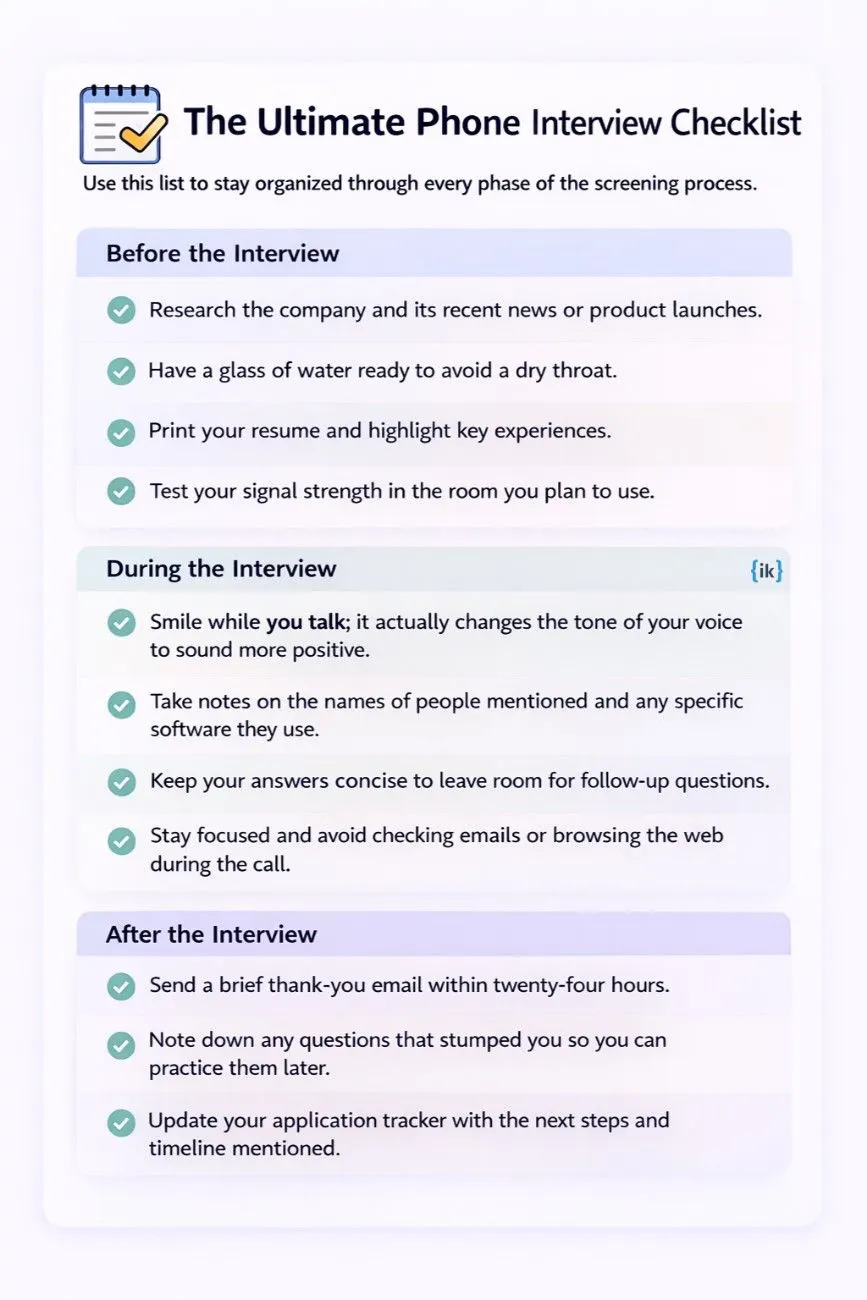
A phone interview might feel less formal than a face-to-face meeting, but it is just as critical for moving forward. Without the benefit of body language or eye contact, your voice and your preparation have to do all the heavy lifting.
The best way to stay composed is to create the right setup, keep your notes nearby, and practice answering phone interview questions in a way that sounds natural rather than rehearsed. Here is some practical advice to ensure you sound like the professional they are looking to hire.
1. Keep Your Notes Nearby
One of the biggest advantages of a phone call is that it is essentially an open-book test. You should have a printed copy of your resume, the job description, and a few bullet points of your best stories right in front of you. Do not rely on your memory alone when you are nervous. However, avoid reading from a script. If you sound like you are reciting a poem, you will lose the conversational flow. Use your notes as a quick reference to make sure you do not forget a specific metric or a key skill the recruiter mentioned.
2. Speak Clearly and Listen
On a digital connection, it is easy for words to get clipped or for a fast talker to become unintelligible. Make a conscious effort to slow down. Enunciate your words and take a breath between sentences. This not only makes you easier to understand but also makes you sound more composed. Also, be careful not to interrupt. Because of potential lag on the line, wait an extra second after the interviewer finishes speaking before you start your response. This ensures you have heard the full question and prevents awkward overlapping talk.
3. Minimize All Distractions
Treat the call with the same respect as an in-person meeting. Find a quiet, private space where you will not be interrupted by pets, roommates, or street noise. If you are at home, turn off the television and close the windows. Make sure your phone is fully charged and that you have a strong signal. Using a headset can be a lifesaver because it keeps your hands free to take notes and prevents the muffled sound that often happens when you hold a phone against your face for thirty minutes.
Common Phone Interview Mistakes to Avoid
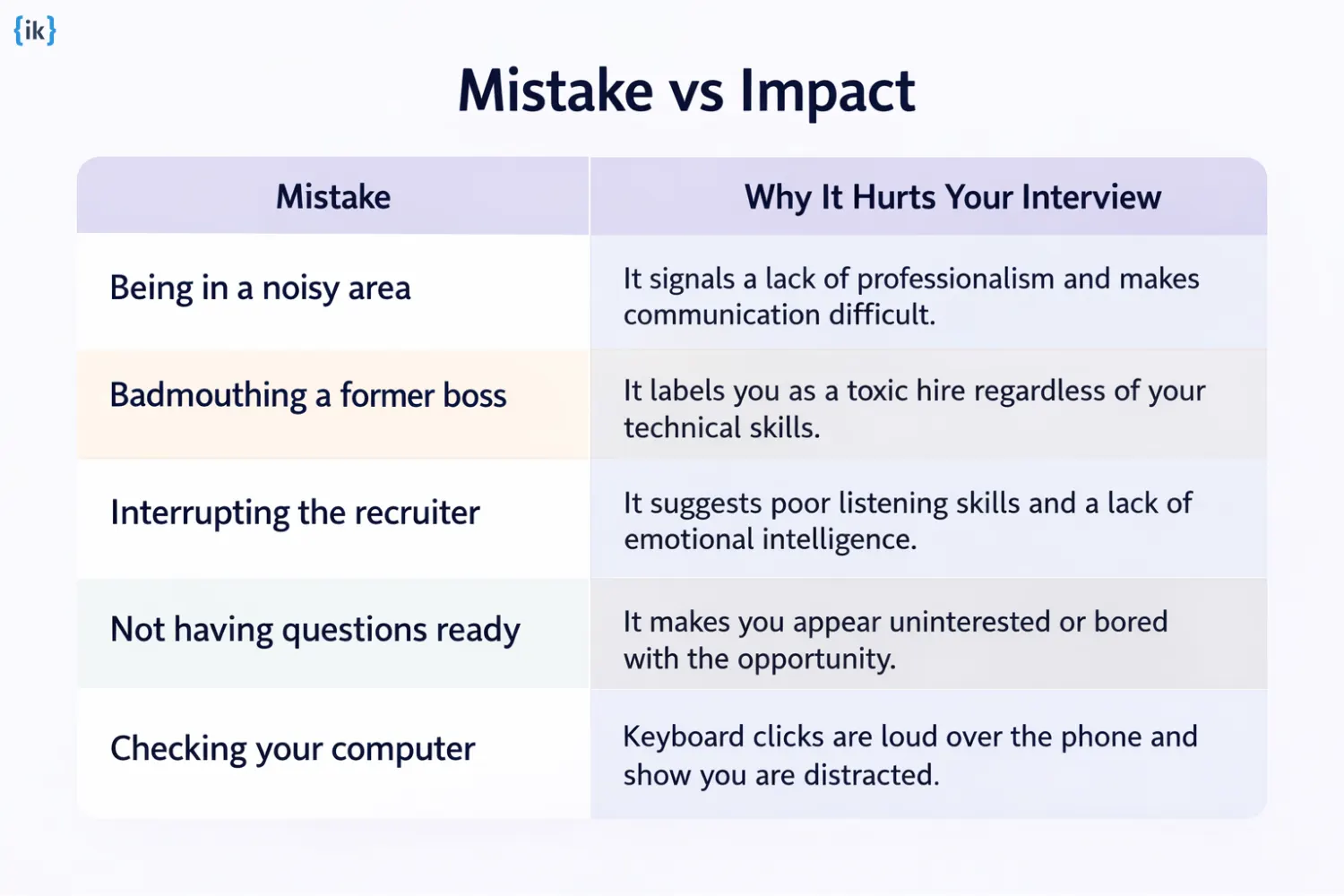
Even the most qualified candidates can trip up during a phone screen if they treat it too casually. Since the recruiter cannot see your professional attire or your friendly smile, every verbal slip-up is magnified. Avoiding these common pitfalls is often the difference between getting an invite to the next round and receiving a generic rejection email.
1. Speaking Too Fast
Nerves naturally make people talk faster. On a phone line, this can turn into a disaster where your words blur together, making it impossible for the interviewer to take accurate notes. If you rush through your background, you come across as anxious or unprepared. It is better to take a deliberate breath before each answer to steady your pace. Slowing down shows that you are confident in your expertise and that you respect the time it takes for the interviewer to process what you are saying.
2. Giving Long Answers
Without visual cues like a nod or a change in posture, it is hard to tell when an interviewer has heard enough. Many candidates fall into the trap of rambling, filling the silence with unnecessary fluff. If your answer to a single question goes over three minutes, you risk losing the listener entirely. Aim for a sweet spot of ninety seconds to two minutes per response. If you are worried you have been talking too long, you can simply ask if they would like you to go into more detail on a specific point.
3. Not Researching the Company
A recruiter can tell within the first five minutes if you have actually looked at their website. Asking basic questions that are easily found on their homepage makes you look lazy. Even worse, if you cannot explain why you want to work for their specific organization, they will assume you are just sending applications everywhere. Spend at least thirty minutes reading about their recent projects, their mission statement, and any recent news articles. Showing that you understand their place in the market proves you are a serious contender.
How to Follow Up After a Phone Interview
The work does not end once you hang up the phone. A prompt and professional follow-up is a vital step that many candidates simply skip, which is exactly why you should do it. Sending a thank you email within 24 hours reinforces your interest and keeps your name at the top of the recruiter’s mind. It is also a final chance to touch on a specific point you discussed or clarify an answer you felt was a bit weak. This small gesture proves you have strong professional etiquette and a genuine desire to join the team.
The Power of the Thank You Note
In a competitive job market, recruiters often talk to dozens of people for a single role. A well-timed email helps you transition from a voice on the phone to a memorable person. Keep it short and focused. Mention a specific detail from the conversation to show you were paying attention. For example, if the interviewer mentioned a new software rollout or a specific team goal, reference that. It shows you are already thinking about how you can contribute to their success.
Follow-Up Email Template
Use the structure below to craft a message that is professional and direct.
| Subject Line: Thank you – [Your Name] – [Job Title] Interview
Message:
Hi [Interviewer Name],
Thank you for taking the time to speak with me earlier today about the [Job Title] position. I really enjoyed learning more about the team’s current focus on [Specific Project or Goal discussed].
Our conversation confirmed my excitement about this opportunity. I am confident that my background in [Mention a Key Skill] would allow me to hit the ground running and help the team achieve its goals for the upcoming quarter.
I look forward to hearing from you regarding the next steps in the process. Please let me know if you need any additional information from my side.
Best regards,
[Your Name]
[Your Phone Number]
[Your LinkedIn Profile Link] |
💡 Pro Tip: If you spoke to multiple people during a conference call, try to get the individual email addresses for each person. Sending a personalized note to every participant shows a high level of detail and respect for everyone’s time. Even a slight variation in each message can make a massive impact on how the group perceives your social awareness.
Build Confidence Before Your Phone Interview
For readers who want real practice before a screening call, Interview Kickstart’s Tech Mock Interviews course is a strong fit. It helps you rehearse interview-style questions in a realistic setting, so your answers feel smoother and more natural when the real call comes.
- Live mock interviews with current hiring managers from leading tech companies.
- Personalized feedback on communication, clarity, and response quality.
- Practice across technical and role-specific interview formats for better overall preparation.
This is especially useful if you want to sharpen how you handle common phone interview questions, explain your background, and stay calm under pressure.
Explore our Tech Mock Interviews and practice your next interview with real interviewers before the actual call.
Conclusion
The phone interview is less about impressing with long answers and more about proving that you can think clearly, communicate with purpose, and connect your experience to the role in front of you.
That means every response should do three things well. It should answer the question directly, show relevant experience, and give the recruiter a reason to keep the conversation going. This is why preparation matters so much. The strongest candidates do not sound memorized. They sound organized, calm, and familiar with their own story.
If you are preparing for phone interview questions and answers, focus on the basics that actually move the needle. Know your resume well enough to walk through it without hesitation. Practice short examples for common questions. Use the STAR method for behavioral prompts. Keep your reasons for applying specific. And before the call ends, ask questions that show you understand the role and the team. That combination is what turns a screening call into a real opportunity.
FAQs: Phone Interview Questions and Answers
These common phone interview questions show up in most screening calls, especially when recruiters want to check fit before moving candidates forward.
Q1. How long do phone interviews last?
Most phone interviews last about 15 to 40 minutes, though some recruiter screens are closer to 10 to 15 minutes, depending on the company and role.
Q2. Are phone interviews difficult?
They are usually less intense than final-round interviews, but they still matter because recruiters use them to screen for communication, background, interest, and role fit. Keep your answers clear, short, and focused.
Q3. Can you fail a phone interview?
Yes. A phone interview is a real screening round, and recruiters use it to decide who moves ahead. Weak answers, unclear communication, or a poor fit for the role can end the process there.
Q4. How should you answer salary questions?
Give a thoughtful response based on market research. You can share a salary range, ask about the company’s range, or delay giving a number until you know more about the role.
Q5. What is the best way to handle telephone interview questions and answers?
Keep your responses structured, specific, and calm. The best telephone interview questions and answers sound natural, show real experience, and connect your background to the role.
Recommended Reads