An elevator pitch is a short introduction that clearly explains who you are, what you do, and the value you bring. If you are wondering what is an elevator pitch, it is typically a 30 to 60-second summary you can deliver confidently.
Many people wonder what an elevator pitch actually is and how to use it in a way that feels natural and effective. The idea is simple. You should be able to talk about yourself and your strengths with clarity and confidence. A good pitch helps you make a strong first impression in job interviews, networking events, and even casual professional conversations.
In this article, we will explain what an elevator pitch is, why it matters, and how to create one. You will also find examples and a practical template to help you build your own elevator pitch with ease.
Key Takeaways
- An elevator pitch is a short, focused self-introduction that explains who you are, what you do, and what you want.
- It matters because it helps you make a strong first impression in interviews, networking conversations, and career fairs.
- The best pitches follow a simple structure: introduction, summary, unique value, goal, and call to action.
- Delivery matters just as much as wording, so pacing, eye contact, and body language should feel calm and natural.
- The same core pitch can be adapted for interviews, LinkedIn, resumes, cover letters, and different audiences.
What Is an Elevator Pitch?
An elevator pitch is a 30–60 second professional self-introduction you can use in interviews, networking events, and career fairs to quickly explain who you are, what you do, and what you are looking for.
The term comes from the idea of having just enough time to make your point during a short elevator ride. In practice, it is a compact way to present your background and value without rambling.
A strong elevator pitch is not limited to live conversations either. You can also adapt it for resume summaries, LinkedIn summaries, and cover letter openers so your personal brand stays consistent across every touchpoint.
💡 Pro Tip: An elevator pitch isn’t just for elevators; it’s the answer to ‘tell me about yourself’ in every professional setting.
Why Is an Elevator Pitch Important?
- First impressions happen fast. You often get only a few moments to sound clear and confident.
- Recruiters make quick judgments. A focused pitch helps you stand out early.
- It prepares you for surprise opportunities. You will be ready when someone asks, ‘So, what do you do?’
In a world of shrinking attention spans, a rambling introduction is a missed opportunity. Having a polished elevator pitch ensures you are always prepared for:
Cold Calls or Emails: Getting straight to the value proposition.
Chance Encounters: Turning a brief chat at a coffee shop into a professional connection.
How Long Should an Elevator Pitch Be?
A successful pitch isn’t just a list of facts; it’s a narrative arc. To make it effective, you need to hit these four marks:
| Component |
Goal |
| The Hook |
Grab their attention immediately with a problem or a bold statement. |
| The Value |
Explain exactly how you (or your product) solve that problem. |
| The Proof |
Mention a specific achievement or ‘win’ to build credibility. |
| The Ask |
End with a clear call to action (a meeting, a business card, or a referral). |
In most cases, aim for 75–150 words so your pitch feels natural, not rushed.
💡 Pro Tip: Your pitch shouldn’t sound like a memorized script. The goal is to sound like a human being, not a brochure. Aim for a conversational tone that invites the other person to ask questions.
When Should You Use an Elevator Pitch?
Understanding what is an elevator pitch and why it is important starts with recognizing the moments that define your career. For job seekers, a pitch isn’t just for chance encounters; it is a strategic tool used to navigate the competitive hiring market.
Key Professional Scenarios
| Situation |
What to Emphasize |
| Job Interviews |
When answering ‘Tell me about yourself’, use your pitch to bridge your past experiences with the specific needs of the role. This is often the first impression you make, so focus on your most relevant win. |
| Career Fairs & Networking |
These fast-paced environments require a high-energy hook. Highlight your unique skills or academic background to stand out among hundreds of other candidates. |
| LinkedIn & Cold Outreach |
In a digital elevator pitch sample for job seekers, lead with a specific reason for reaching out. Connect your expertise to a challenge the recipient’s company is currently facing. |
| Resumes & Cover Letters |
Transform your pitch into a punchy professional summary. This serves as the hook that encourages a hiring manager to read the rest of your application. |
| Chance Encounters |
If you bump into an industry leader, keep it conversational but professional. Briefly mention what you do and offer a clear ask, such as requesting a business card or a brief follow-up. |
💡 Pro Tip: Knowing what is an elevator pitch in interview settings is crucial because it sets the tone for the entire conversation. Practice your delivery until it feels like a natural dialogue rather than a rehearsed script.
What to Include in an Elevator Pitch?
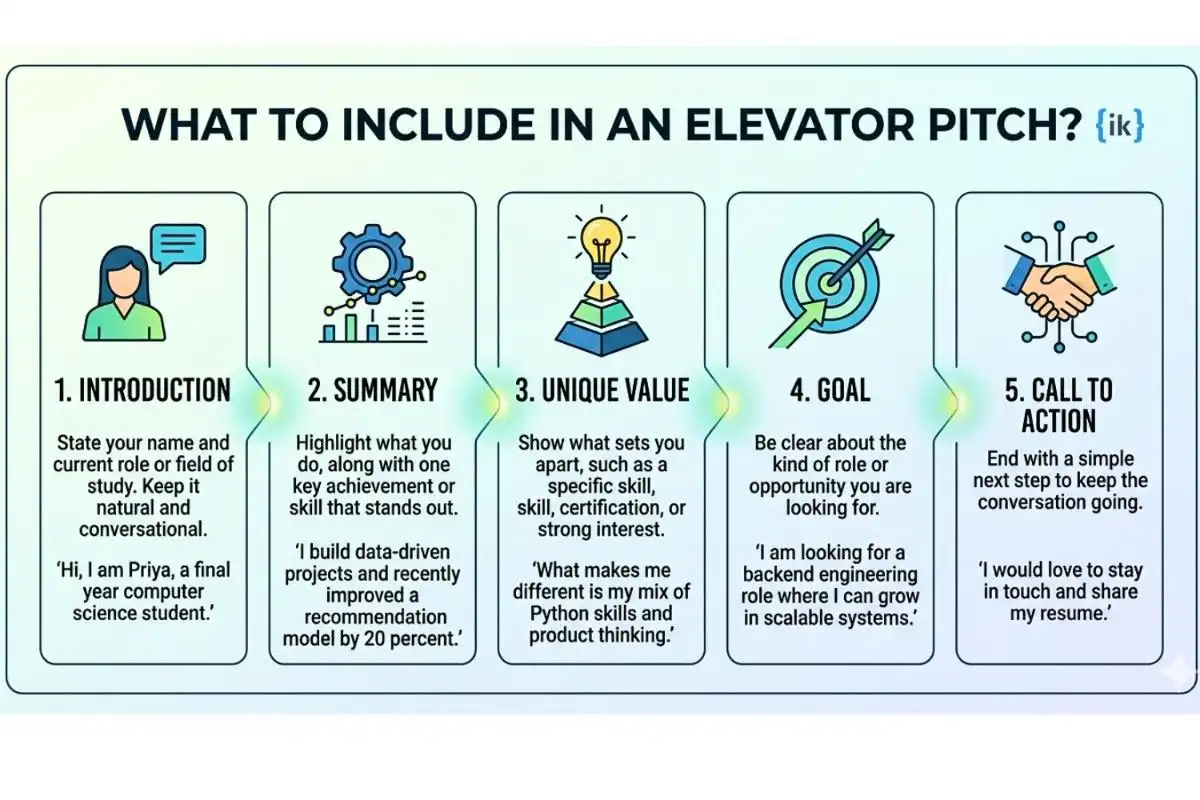
If you are wondering what is an elevator pitch and how to actually build one, the answer lies in a simple structure you can follow every time. A strong elevator pitch template includes five key parts that help you communicate clearly and confidently in interviews, networking events, and beyond.
1. Introduction
Start with your name and current role or field of study. Keep it natural and conversational.
Example: ‘Hi, I am Priya, a final year computer science student.’
2. Summary
Highlight what you do, along with one key achievement or skill that stands out.
Example: ‘I build data-driven projects and recently improved a recommendation model by 20 percent.’
3. Unique Value
Show what sets you apart, such as a specific skill, certification, or strong interest.
Example: ‘What makes me different is my mix of Python skills and product thinking.’
4. Goal
Be clear about the kind of role or opportunity you are looking for.
Example: ‘I am looking for a backend engineering role where I can grow in scalable systems.’
5. Call to Action: What happens next?
End with a simple next step to keep the conversation going.
Example: ‘I would love to stay in touch and share my resume.’
This structure works well for anyone trying to understand what an elevator pitch is in interview settings and why it is important, while also providing a practical elevator pitch sample for job seekers.
Also Read: How to Create An Elevator Pitch (Examples and Samples Included!)
What NOT to Say in Your Elevator Pitch?
Even the best elevator pitch template can fail if it feels forced or cluttered. To ensure your message lands effectively, avoid these common pitfalls that often trip up job seekers during high-stakes moments.
| Avoid This |
Instead, Try This |
| Industry Jargon |
Use clear, accessible language. If a recruiter from a different department cannot understand your role, you have lost the connection. |
| The Life Story |
Focus only on the last few years or your most relevant wins. A detailed history is for the interview, not the initial pitch. |
| Mechanical Recitation |
Aim for a conversational flow. Knowing what is an elevator pitch involves understanding that it is a dialogue, not a monologue. |
| Vague Requests |
Be specific about your goal. Saying ‘I am looking for anything’ makes it difficult for a contact to actually help you. |
Remember that an elevator pitch in interview settings is often a test of your communication skills. Keeping your delivery concise and jargon-free shows you are a self-aware professional. This approach is much more effective than providing an elevator pitch sample for job seekers that feels like a scripted robot.
How to Write an Elevator Pitch (Step-by-Step)?
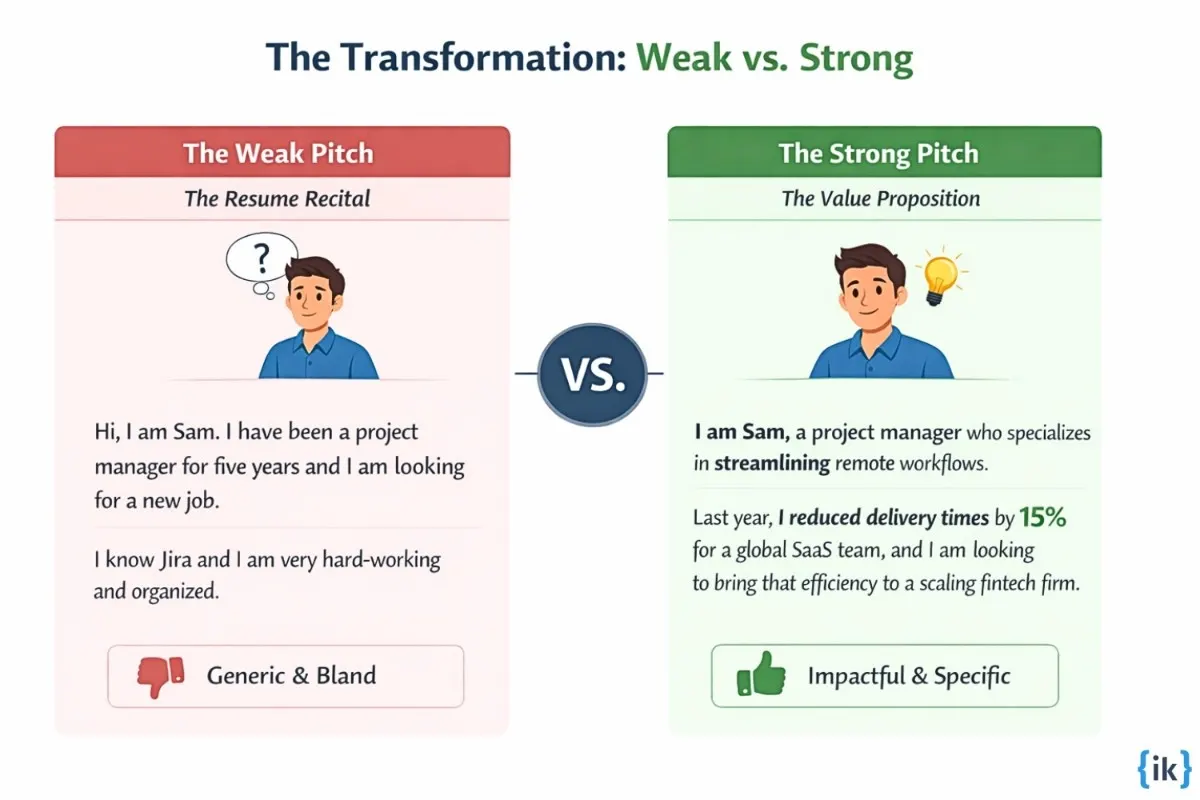
Writing a compelling pitch is a process of distillation. To understand what is an elevator pitch and why is it important, you must move beyond a simple list of facts and create a narrative that flows.
Follow this workflow to transform a cluttered professional history into a punchy, 30-second introduction.
1. The Brain Dump
Start by writing down everything you want a recruiter to know. Do not worry about word counts or grammar yet. List your current role, your biggest win from the last year, and the specific technical skills you use daily. This raw material is the foundation of your elevator pitch template.
2. Identify the Hook
Review your notes and circle the one thing that makes people stop and listen. This might be a massive revenue increase, a unique certification, or a problem you solved for a high-profile client.
If you are preparing for a high-stakes environment, learning how to pitch yourself as a must-hire at a FAANG interview can help you identify which hooks resonate with top-tier tech recruiters.
3. Draft the Narrative
Connect your identity to your hook using a simple ‘I do X for Y by doing Z’ formula. Ensure you address what is an elevator pitch in interview contexts by tailoring this draft to the specific company’s values or current challenges.
4. Trim the Fat
Read your draft out loud and use a stopwatch. If it takes longer than 45 seconds, it is too long. Remove industry jargon, filler words like ‘basically’ or ‘actually,’ and any biographical details that do not directly support your current career goal.
5. The Practice Loop
Record yourself on your phone. Listen for awkward pauses or sections where you sound scripted. A great elevator pitch sample for job seekers should sound like a natural part of a conversation, not a memorized speech.
How to Deliver Your Elevator Pitch With Confidence?
Knowing what is an elevator pitch is only half the job. The way you deliver it decides whether people remember you or forget you in seconds. Even a well-written pitch can fall flat if it sounds rushed, robotic, or unsure. In interview and networking settings, your tone, body language, and timing work together to show confidence and clarity.
1. Use Confident Body Language
Stand upright, relax your shoulders, and avoid fidgeting. A calm posture signals confidence before you even speak.
2. Control Your Pace
Speak slowly enough to be understood, but not so slow that it feels forced. This is especially important for what is an elevator pitch in interview situations.
3. Maintain Natural Eye Contact
Look at the listener while speaking, but do not stare. This helps build trust and keeps the interaction comfortable.
4. Use Pauses Effectively
Pause briefly between key points so your message feels clear and not rushed.
5. End With a Smooth Transition
After your pitch, invite a response by asking a simple question or offering to continue the conversation.
A strong delivery makes your pitch feel genuine, not memorized, which is what leaves a lasting impression.
Elevator Pitch Examples for Different Situations
If you are still asking what is an elevator pitch, the best way to learn it is to see how it sounds in real situations. The examples below work as a practical elevator pitch sample for job seekers, students, career changers, and founders, so you can adapt the version that fits your goal.
1. For a Job Interview, Experienced Professional
Hi, I am [Your Name], a [Current Role] with [X] years of experience in [Industry]. I have focused on [Key Skill or Specialty], and recently I [Specific Achievement with Result]. I am now looking for a role where I can bring that experience to a team that values [Relevant Strength or Goal].
Why it works: It is specific, confident, and shows both experience and impact without sounding scripted.
2. For a Career Fair, Student
Hi, I am [Your Name], a [Year] student at [University Name] studying [Field]. Through coursework, volunteering, and internships, I have developed skills in [Skill 1] and [Skill 2]. I am especially interested in opportunities where I can keep learning and contribute from day one. This works well because it highlights potential, not just limited experience.
3. For a Networking Event, Career Changer
Hi, I am [Your Name], and I am transitioning into [New Field]. In my previous role, I built strengths in [Transferable Skill] and [Transferable Skill], which now help me approach this new path with a strong foundation. I am excited to connect with people in this space and learn how I can add value.
This keeps the transition positive and focused on what you bring forward.
4. For a Small Business or Startup
[Problem] [Solution] [Unique Angle] [Ask]
Example: Small teams lose time managing client follow-ups manually. We built [Company Name] to automate that workflow in one simple dashboard. Unlike generic tools, our platform is designed specifically for early-stage service businesses. We are looking for partners who want to pilot the product and shape its next version.
This structure works well for investors or potential partners because it is direct and outcome-driven.
5. Elevator Pitch Template, Fill in Format
Hi, I am [Your Name], and I am a [Role or Field] with experience in [Skill or Area]. I have worked on [Project, Achievement, or Strength], which helped me [Result]. Right now, I am looking for [Type of Role, Opportunity, or Collaboration] where I can contribute my strengths in [Key Value].
It is easy to customize and works well as a flexible elevator pitch template for different settings.
Also Read: Best Ways to Introduce Yourself in an Interview
Take Your Elevator Pitch Further With Structured Interview Prep
A strong elevator pitch can open doors, but converting that first impression into an offer requires structured preparation. The Fast-Track Your Interview Prep program by Interview Kickstart is designed to help you build on your pitch and perform confidently across every stage of the interview process. It bridges the gap between knowing what to say and delivering it effectively under pressure.
- Designed by FAANG+ experts with core interview coverage
- Live mock interviews with Silicon Valley engineers
- 1:1 mentoring and personalized feedback
- Resume, LinkedIn, and personal branding support
- Six months of support to keep improving after the pitch is ready
Build a sharper pitch and turn it into real interview success with Fast-Track Your Interview Prep.
Conclusion
An elevator pitch is a short, professional introduction that helps you explain who you are, what you do, and what you want clearly and memorably. The strongest pitches follow a simple structure, highlight your value, and stay focused on the audience in front of you.
Just as important, they improve with practice. The more you tailor your pitch to interviews, networking events, or career fairs, the more natural and effective it becomes. Keep it clear, keep it relevant, and keep it human. With the right structure and a little practice, you are ready to write an elevator pitch that sounds confident and feels true to you.
FAQ: What is an Elevator Pitch
Q1. What is the ideal length of an elevator pitch?
The ideal length is usually 30 to 60 seconds, which is about 75 to 150 words for most people. In some situations, such as a longer networking conversation, it can stretch closer to two minutes, but it should still feel concise and focused.
Q2. How do I start an elevator pitch?
Start with your name, your role or field of study, and a simple line about what you do or specialize in. Career centers commonly recommend leading with a quick introduction and then moving into your strengths or experience so the listener immediately understands who you are.
Q3. What is an elevator pitch in an interview?
In an interview, an elevator pitch is a short professional introduction that helps you answer tell me about yourself in a clear, confident way. It should quickly show your background, value, and career direction so the interviewer can see why you are a fit.
Q4. Can an elevator pitch be written?
Yes, and writing it first is often the best way to make it clear and memorable. Many career resources also suggest using that same pitch in resume summaries, cover letters, LinkedIn profiles, and networking introductions.
Q5. How do I end an elevator pitch?
End with a natural next step, such as asking for a conversation, sharing contact details, or inviting a follow-up. The goal is to keep the interaction moving instead of letting it stop after the introduction.
Q6. What should you NOT include in an elevator pitch?
Do not overload it with jargon, too many details, or information that does not help the listener understand your value. Career guidance sources also advise keeping the pitch simple, conversational, and focused on the most relevant skills and achievements.
Related Articles: