Large Language Models (LLMs) have rapidly transformed the way we interact with technology. They can generate fluent text, answer complex queries, and even assist in creative tasks. But despite their impressive capabilities, LLMs come with critical limitations. Their knowledge is frozen at the time of training, meaning they can’t automatically stay current with real-world updates. They also struggle when tasked with providing highly domain-specific or context-dependent answers.
This is where Retrieval-Augmented Generation (RAG) enters the picture. By combining the strengths of retrieval systems with the generative power of LLMs, RAG ensures responses are not only coherent but also grounded in the most relevant and up-to-date information. In essence, RAG turns a general-purpose model into a knowledge-enhanced system capable of addressing specialized tasks with greater accuracy.
Key Takeaways
- RAG blends retrieval and generation for accurate, context-aware AI outputs.
- Essential for future-ready AI adoption across industries and roles.
- It reduces hallucinations and enhances trust in AI applications.
- Use cases span chatbots, legal, healthcare, and enterprise workflows.
What Is Retrieval-Augmented Generation (RAG)?
Retrieval-Augmented Generation is a hybrid AI architecture designed to extend the usefulness of language models. Instead of relying solely on what the LLM has memorized from its training data, RAG connects it to an external knowledge source, which is usually a vector database containing documents, articles, or domain-specific records.
The workflow is simple yet powerful:
- A user asks a question.
- The system retrieves relevant documents from the knowledge base using semantic search techniques.
- These documents are provided as context for the LLM.
- The LLM generates an answer that draws on both its pre-trained knowledge and the freshly retrieved content.
This process allows the model to “stay current” without needing to be retrained on every new piece of data. Think of it like a student preparing for an exam: instead of relying only on memory, they can open a textbook and reference the exact material needed before answering.
In more technical terms, RAG combines retrieval (searching for relevant embeddings) with generation (producing natural language output). By marrying these two capabilities, it ensures that AI systems are not just articulate but also precise and trustworthy.
Why Do We Need RAG?
While LLMs are powerful, they aren’t perfect. They face three critical issues that make RAG indispensable in modern AI systems.
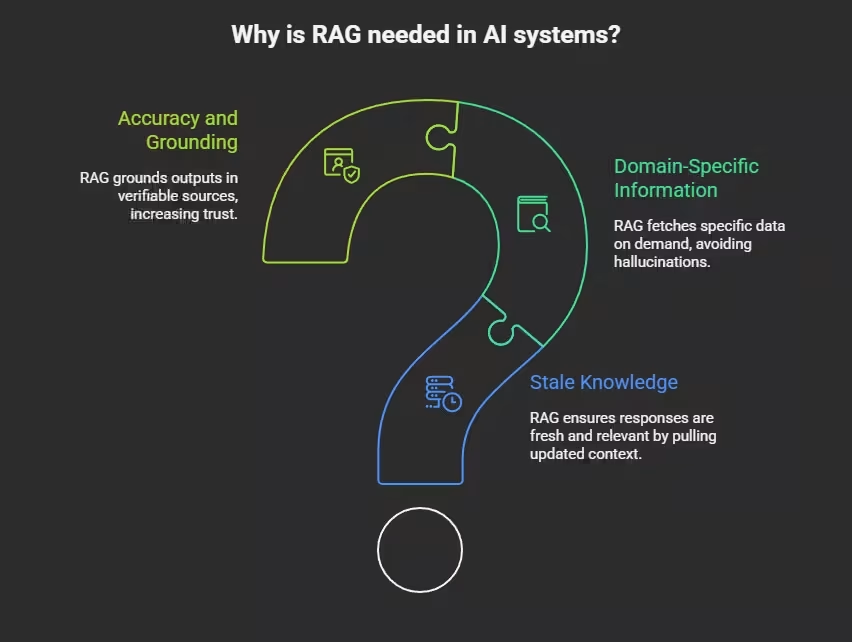
Stale Knowledge
LLMs have a fixed knowledge cutoff, the date up to which they were last trained. This means they may confidently provide outdated or incorrect answers about recent events, new products, or policy changes.
Some information and data may not be relevant to the date and time. So RAG plays a crucial part over here. By pulling in updated context from a database, RAG ensures that responses remain fresh and relevant.
Domain-Specific Information
A general-purpose model trained on internet-scale data won’t automatically know about your company’s product catalog, an internal research archive, or a customer’s unique history. With RAG, the model can fetch this domain-specific data on demand and weave it into its answers.
For example, a chatbot designed to handle customer queries can retrieve product specifications directly from a database rather than hallucinating them.
Accuracy and Grounding
LLMs sometimes “hallucinate” which means producing plausible but false answers. By constraining the model to respond only within the retrieved context, RAG grounds its outputs in verifiable sources. This not only improves accuracy but also increases trust in AI-driven systems.
Together, these motivations explain why RAG is emerging as the default pattern for enterprise AI adoption. Instead of retraining massive models every time new data arrives, organizations can maintain an updated database while reusing the same LLM backbone.
How RAG Works: The Technical Breakdown
Although RAG feels seamless from a user’s perspective, under the hood, it follows a structured pipeline.
1. Data Ingestion & Indexing
- Raw documents such as FAQs, research papers, policy manuals, or product descriptions are collected.
- These documents are broken into smaller chunks and converted into vector embeddings using models like Sentence Transformers or OpenAI embeddings.
- The embeddings are stored in a vector database such as FAISS, Pinecone, Weaviate, or Milvus for efficient similarity search.
2. Retrieval Phase
- When a user query arrives, it too is converted into an embedding.
- The system searches the vector database for semantically similar documents.
- The top matches (often called “retrieved passages”) are selected.
3. Augmentation Phase
- Retrieved passages are injected into the prompt as additional context.
- The design of this step is critical: prompts may include source citations, summaries, or ranked snippets to ensure the LLM processes them effectively.
4. Generation Phase
- The augmented prompt is passed into the LLM.
- The model generates a response that blends its own training with the retrieved data, producing an answer that is both coherent and contextually grounded.
This architecture is versatile. While it’s most often used with text, the same principles apply to images, audio, or other modalities. For instance, “image RAG” can retrieve similar images from a database and use them as stylistic or content guides during generation.
In short, RAG is not just an add-on to LLMs. It’s a structural solution that enables them to adapt, specialize, and remain relevant in real-world applications.
Also Read: Step-by-Step Guide to Building AI Agents in n8n Without Code
Use Cases of RAG in Modern AI Systems
RAG is already powering some of the most impactful AI applications today. Its ability to blend retrieval with generation makes it suitable across industries and use cases.
1. Chatbots and Virtual Assistants
One of the most common applications of RAG is in conversational agents. Instead of relying on generic training data, a RAG-powered chatbot can pull from company documentation, product catalogs, or knowledge bases.
This allows it to provide accurate answers about specific services, troubleshoot issues, or guide customers through complex tasks.
2. Question-Answering Systems
RAG excels in environments where precision is critical. In domains like healthcare, law, or education, queries often require authoritative answers grounded in verified knowledge.
By retrieving relevant passages from trusted sources, RAG ensures answers are not just fluent but also correct and accountable.
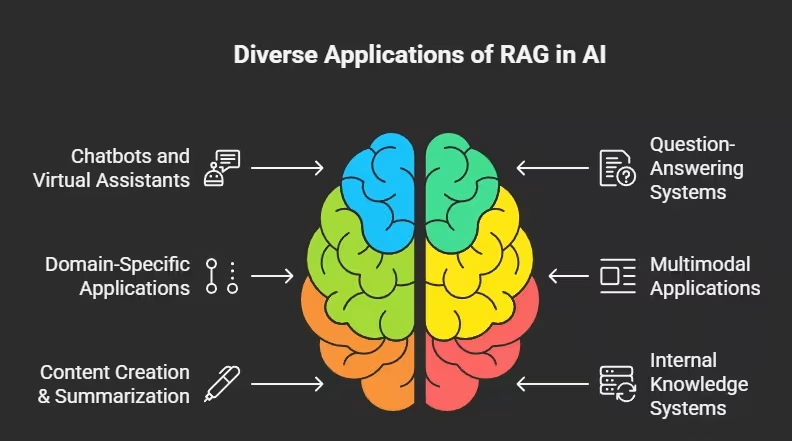
3. Domain-Specific Applications
Whether it’s biotech research, financial analysis, or internal enterprise tools, many organizations operate in domains where knowledge evolves rapidly. With RAG, models can tap into the latest white papers, financial filings, or regulatory updates without retraining.
4. Multimodal Applications (Image RAG)
Although RAG is usually discussed in the context of text, its principles extend to other modalities.
For example, in image generation, a system can retrieve similar images with specific styles or content and use them as guidance. This approach enables more tailored and creative outputs aligned with user needs.
5. Content Creation and Summarization
Writers, analysts, and journalists can benefit from RAG by grounding generated drafts in recent data. Instead of fabricating statistics or references, the model retrieves them from reliable databases, ensuring accuracy while saving time.
6. Internal Knowledge Systems
Enterprises often struggle with fragmented internal knowledge. A RAG-powered assistant can serve as a unified gateway, allowing employees to query policies, HR documents, or technical manuals in natural language and receive context-aware answers instantly.
Across all these use cases, the core value remains the same: grounded generation that combines the flexibility of LLMs with the reliability of external data.
Conclusion
Retrieval-Augmented Generation (RAG) is a cornerstone of modern AI. By combining retrieval with generation, it enables models to deliver accurate, current, and domain-specific responses. From chatbots to legal research to even image generation, RAG ensures AI outputs are grounded in reliable knowledge rather than static memory.
Its real strength lies in building trust and adaptability—two essentials for deploying AI in real-world workflows. As businesses scale AI adoption, RAG will remain central to making systems both practical and dependable.
Take the Next Step: Master Agentic AI with Interview Kickstart
Want to go beyond RAG and learn how to design full-fledged AI agents that drive automation and innovation?
Interview Kickstart’s Agentic AI Career Boost is a 14-week program designed for software engineers, product leaders, and tech professionals.
With live mentorship from FAANG+ experts, hands-on projects, and specialized learning tracks, you’ll gain practical skills in RAG, multi-agent systems, orchestration, and real-world deployment. By the end, you’ll be ready to build intelligent AI workflows that deliver impact and accelerate your career.
FAQs – Use Cases of RAG
1. What is Retrieval-Augmented Generation (RAG)?
RAG combines retrieval and generation, enabling AI models to produce accurate, context-aware, and up-to-date responses grounded in external knowledge.
2. How does RAG improve Large Language Models?
It reduces hallucinations, enhances accuracy, and allows models to stay current by retrieving data from trusted sources.
3. What are common use cases of RAG?
Chatbots, legal research tools, healthcare assistants, recommendation systems, and knowledge-intensive enterprise applications.
4. Is RAG relevant for non-technical professionals?
Yes, RAG powers no-code AI tools, making it accessible for managers, analysts, and product leaders.