
Java interview questions for testers focus on one core goal. Do you know how to use Java to write solid automation tests, debug failures, and read real test code with purpose? For QA SDET and automation roles, these questions check core Java ideas like OOP and collections. You can expect exception handling and logic used in Selenium frameworks.
This matters because Java is still dominant in testing stacks. The 2025 survey by Stack Overflow reports that Java is used by about 29% of professional developers worldwide1.
At the same time, the global software testing market continues to grow, driven by automation and AI-assisted testing, according to Mordor Intelligence2. That is why interviewers expect testers to think like programmers, not script runners.
In this article, we break down Java interview questions for testers for different domains, share evaluation criteria used by interviewers, and help you prepare with QA and SDET examples.
Java interview questions for testers follow a structured multi-stage path designed to evaluate both testing acumen and coding proficiency, particularly with Java-based automation tools. This process varies by firm but emphasizes practical skills like framework implementation and test case design early on.
| Stage | Format | Duration | Focus Areas |
| Round 1 | Recruiter Screen | 15-30 mins | Role fit, Java experience, basic Java interview questions for testers |
| Round 2 | Technical Phone Screen | 45-60 mins | Core Java fundamentals, simple coding challenges, automation basics like Selenium with Java |
| Round 3 | Virtual/Onsite Loop | 4-5 rounds, 45-60 mins each | In-depth Java interview questions, test framework design, behavioral scenarios, and system testing depth |
| Round 4 | Hiring Committee Review | Varies | Overall bar raise, feedback synthesis, and offer alignment |
Processes differ across giants like Amazon and Google. Recruiter rounds often filter for alignment rather than deep Java interview questions, while technical screens determine advancement through targeted Java interview questions for testers.
Also Read: What Does a Test Engineer Do? — Role, Skills, and Responsibilities
Java interview questions for testers center on five core domains that blend programming prowess with testing expertise, ensuring candidates can automate reliably and think like developers.
These evaluation areas span rounds but prioritize practical application over theory.
| Domain | Subdomains | Interview Rounds | Depth |
| Core Java Fundamentals | OOP, collections, exceptions, multithreading | Phone Screen, Loop | High |
| Coding & Data Structures | Arrays, strings, graphs, and problem-solving | Phone Screen, Loop | High |
| Test Automation Frameworks | Selenium, TestNG/JUnit, Page Object Model | Technical Screen, Loop | High |
| Testing Methodologies & APIs | SDLC/Agile, REST testing, CI/CD | All Rounds | Medium-High |
| Behavioral & Leadership | STAR stories, collaboration, ownership | All Rounds | High |
Interview questions on Java for testers probe these domains to gauge if you can build scalable test suites amid production pressures. Core Java sets the foundation, as weak OOP leads to brittle automation code. Coding challenges mimic real defects, while framework design reveals your ability to maintain suites at scale.
For deeper prep on interview questions on Java for testers, align stories with company values like Amazon’s Leadership Principles.
Also Read: Top 10 Amazon Leadership Principles Interview Questions

Java interview questions for testers span critical domains to identify SDETs who code like engineers while thinking like quality advocates. These interview questions on Java for testers blend language mastery with automation strategy, ensuring you build reliable suites for microservices-scale apps.
Java interview questions for testers heavily test core Java fundamentals to ensure you can craft robust, efficient automation scripts without introducing bugs.
What Interviewers Are Evaluating?
Interviewers assess your command of Java’s building blocks like OOP principles, collections, exceptions, and concurrency to predict if you’ll write maintainable test code.
They value depth in trade-offs, like thread-safety in test runners, and how you handle follow-ups on production pitfalls like memory leaks. Seniors must demonstrate judgment, such as favoring immutable objects in shared test data.
Core Java fundamentals interview questions:
Q1. What is the difference between JDK, JRE, and JVM?
JDK includes tools like the compiler needed for development. JRE is used to run Java applications. JVM executes bytecode in a platform-independent way. In testing, you use the JDK to build and run Selenium automation projects.
Q2. Explain the difference between String, StringBuilder, and StringBuffer.
String is immutable and creates new objects on modification, which is costly in loops. StringBuilder is mutable and not thread safe, making it ideal for single-threaded test utilities. StringBuffer is mutable and thread-safe, so it fits parallel test execution.
Q3. What is the difference between an abstract class and an interface? When to use each in testing?
Abstract class allows partial implementation and state; interface mandates full implementation (default methods since Java 8). Use abstract for base test classes with shared logic (e.g., WebDriver setup); interfaces for contracts like TestListener.
Q4. Differentiate between HashMap and Hashtable.
HashMap allows null keys/values, non-synchronized (faster), while Hashtable disallows nulls, synchronized (thread-safe but slower). In tests, I prefer ConcurrentHashMap for shared data in multi-threaded suites.
More practice questions:
How to approach these questions?
Coding challenges in Java interview questions for testers mimic debugging real-world data issues, like parsing JSON responses or validating arrays from APIs.
What interviewers are evaluating?
They evaluate problem-solving under time constraints, code cleanliness, and optimization awareness. They are also key to writing performant locators or data-driven tests. Expect probes on edge cases (nulls, empties) and Big O; seniors must discuss scalability, like handling 10k test inputs.
Coding & data structures interview questions:
Q5. Write a program to find duplicates in an array.
Use HashSet: Iterate, add if absent, print if exists. Time: O(n), Space: O(n).
Set<Integer> set = new HashSet<>();
for (int num : arr) {
if (!set.add(num)) System.out.println(“Duplicate: “ + num);
}
Ideal for detecting repeated test IDs.
Q6. Check if a string is a palindrome (ignore case/spaces).
Reverse and compare: Clean string, use two pointers.
String clean = str.toLowerCase()
.replaceAll(“\s”, “”);
int left = 0, right = clean.length() – 1;
while (left < right) {
if (clean.charAt(left++) != clean.charAt(right–)) return false;
}
return true;
Useful for validating symmetric UI elements.
Q7. Find the index of the first non-repeating character in a string. Return -1 if none exists. Use O(n) time and discuss HashMap usage for test result validation.
Two-pass approach: first count frequencies with HashMap, then find the first char with count == 1.
import java.util.*;
public class FirstNonRepeating {
public static int firstNonRepeating(String input) {
if (input == null || input.isEmpty()) return -1;
Map<Character, Integer> freq = new HashMap<>();
for (char c : input.toCharArray()) {
freq.put(c, freq.getOrDefault(c, 0) + 1);
}
for (int i = 0; i < input.length(); i++) {
if (freq.get(input.charAt(i)) == 1) {
return i;
}
}
return -1;
}
public static void main(String[] args) {
System.out.println(firstNonRepeating(“swiss”) == 2);
System.out.println(firstNonRepeating(“leetcode”) == 0);
System.out.println(firstNonRepeating(“aabb”) == -1);
System.out.println(firstNonRepeating(“testcase”) == 4);
}
}
Time: O(n), Space: O(1), assuminga limited charset. Testers use this for log analysis or unique test ID validation.
More questions to practice:
How to approach these questions?
Java interview questions for testers in framework rounds check your ability to design reusable suites, write reliable automation code, and scale tests for CI.
What interviewers are evaluating?
Common test automation framework interview questions:
Q8. What is Page Object Model, and why use it?
Page Object Model groups page element locators and user actions into dedicated classes. This keeps test code short and easy to read. It reduces duplication across test cases and ensures updates stay local to one page object.
A call like LoginPage.login(username, password) allows tests to remain high-level and focused on behavior rather than UI details.
Q9. Explain TestNG annotations and their order
A common lifecycle order goes like:
Use @DataProvider for parameter-driven tests.
Q10. How to handle dynamic elements in Selenium?
Prefer explicit waits such as WebDriverWait with expected conditions for visibility or clickability. Avoid Thread. sleep since it creates flakiness.
Q11. Difference between @Test and @BeforeMethod in TestNG.
@Test marks the test case. @BeforeMethod runs setup before each test. Use @BeforeMethod for per-test initialization, such as resetting test data or logging in.
More questions to practice:
How to approach these questions in Java Tester interviews?
Java interview questions for testers in this domain check that you align tests with the SDLC and that you validate backend behavior with robust API checks. Expect questions on REST testing, contract checks, mocks, and CI integration.
What interviewers are evaluating?
Common testing methodologies and APIs questions and answers
Q12. What is the difference between REST and SOAP?
REST is an architectural style that is stateless and uses HTTP methods and JSON or XML payloads. SOAP is a protocol with strict XML envelopes and formal standards. For REST tests, assert status codes and validate response schema
Q13. How to automate API tests with RestAssured?
Example chain:
Q14. What is BDD and Cucumber?
BDD uses Gherkin-readable scenarios that map to step definitions. This makes tests clear for devs and PMs and ties tests to acceptance criteria
Q15. What are the different types of API testing?
Functional checks for endpoints load tests using tools like JMeter, security checks based on OWASP contract tests are often done with Pact for consumer-driven validation. Use Pact for contract verification.
More practice questions to prepare for:
How to approach these questions in interviews?
Behavioral rounds in Java interview questions for testers reveal how you drive quality in collaborative and high-stakes environments. Interviewers dissect past actions to predict if you’ll champion test pyramids amid sprint pressures or defer to devs on flakiness.
What interviewers are evaluating?
They prioritize measurable impact over anecdotes:
Common behavioral and leadership interview questions
Q16. Describe a time your tests caught a critical prod bug. What was the root cause and impact?
Q17. Tell me about a conflict with a developer over test validity. How did you resolve it?
Q18. How have you scaled a test suite from hundreds to thousands of tests?
More questions to practice:
How to approach these questions?
Also Read: Behavioral Interview Questions for Software Developers
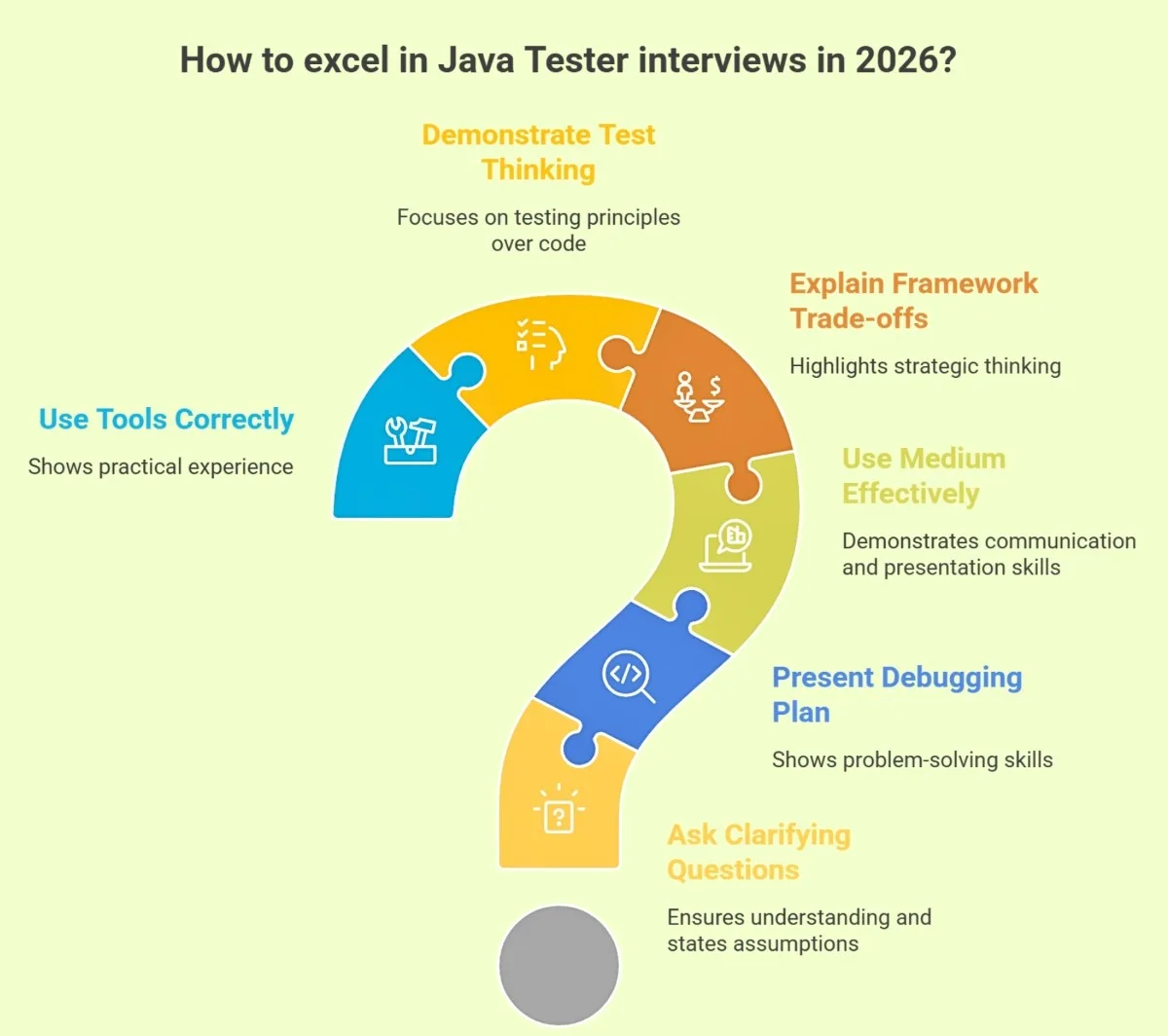
Many Java testers fail interviews not because they lack knowledge, but because they execute poorly under real interview conditions. This is exactly why strong preparation for Java interview questions for testers goes beyond memorization.
Candidates jump into answers too fast, miss clarifying constraints, struggle to reason aloud, or fail to show ownership when scenarios turn ambiguous. Top performers treat Java interview questions for testers as problem-solving conversations, not exams.
Start by asking one precise clarifying question. Then say the assumption you will use. Candidates who do this avoid wasted work and appear confident. Candidate threads show that clarifying first separates strong performers from guessers.
When given a bug or flaky test problem, explain the exact steps you will run to reproduce it. Mention specific Java diagnostics such as log filters, stack trace lines, thread dump time windows, and a small Java repro test.
Interviewers want a reproducible approach more than a perfect, immediate fix. This style is strongly recommended in real-world Interview questions on Java for testers discussions.
Be fluent in whiteboards, shared editors, and CoderPad-style interfaces. Start with a one-line outline, then code. Practice switching between pseudo code and real Java. Candidates fail interviews not for wrong logic but for poor medium execution.
If you name a pattern, say why you picked it and what you gave up. For example, explain why Page Object Model improved maintenance or why contract tests with Pact reduced flaky UI checks. Concrete trade-offs beat buzzwords every time.
When solving a task list, a few test cases, including negative and flaky scenarios. Show how you would gate this with CI and what a failing test would mean for the pipeline. Smart candidates tie code to risk and to deployment safety.
If you reference a tool’s name, a relevant command, or a snippet. For API testing, mention RestAssured example chains. For UI tests, name the locator strategy and wait used. This shows hands-on skill and not textbook knowledge.
Java tester interviews in 2026 are no longer about listing tools or reciting frameworks. Interviewers expect you to explain Java decisions, testing trade-offs, and real production impact with clarity. You are judged on how you debug failures, design automation at scale, validate APIs, and communicate ownership under pressure.
The Interview Kickstart’s Test Engineering Interview Program is designed to fill this exact gap. It trains Java testers to perform in interviews, not just prepare content. You practice realistic interview scenarios, refine explanations, and learn how senior interviewers evaluate depth, signal, and decision-making.
What does the program focus on?
So, stop over-preparing and start performing. Join Interview Kickstart and crack Java tester interviews with confidence.
Also Read: 7 Key Prerequisites for a Test Engineering Course: Prepare for Success
Preparing for Java testing interviews is hard when expectations are vague, questions feel unpredictable, and feedback loops are missing. Many strong testers fail not because they lack skills, but because they do not practice how those skills are evaluated under pressure.
This guide breaks that cycle by showing what actually gets assessed, how interviewers think, and how to respond with clarity and depth. If you approach Java interview questions for testers with structured thinking, strong debugging narratives, and measurable outcomes, interviews stop feeling random.
Treat Java interview questions as signals of decision-making, not trivia recall. Practice Interview questions on Java for testers by explaining trade-offs, test strategy, and impact, not just syntax. Focus on execution, communication, and ownership.
With deliberate practice, real examples, and clear metrics, you can move from anxious preparation to confident performance. Interviews become a reflection of your engineering maturity, not a guessing game.
Show runnable work, not screenshots. Add a clean repo with a small framework, clear READMEs, sample data, and CI proof. One project should clearly map to Java interview questions for testers and explain what scenarios it covers and how to run them.
Yes, but you need proof. Show unit and integration tests, automation projects, or dev work with test ownership. Hiring managers care more about evidence than titles when reviewing Java interview questions readiness.
Use containers or local VMs with repeatable setups. Keep small apps you can break and test. This setup helps you practice realistic interview questions on Java for testers without production access.
Phone screens often use shared editors. On-site rounds may allow your IDE. Practice both so you can answer Java interview questions for testers smoothly, even without IDE shortcuts.
Research market ranges and give a range, not a number. Negotiate total comp, not just base. Strong performance in interview questions on Java for testers gives you leverage to ask confidently.
Related Articles:








Time Zone:

Time Zone: Asia/Kolkata
Time Zone: Asia/Kolkata
Hands-on AI/ML learning + interview prep to help you win
Explore your personalized path to AI/ML/Gen AI success

Time Zone: Asia/Kolkata
Hands-on AI/ML learning + interview prep to help you win
Time Zone: Asia/Kolkata
Hands-on AI/ML learning + interview prep to help you win
Explore your personalized path to AI/ML/Gen AI success


