Artificial Intelligence vs. Machine Learning vs. Deep Learning: Today, AL, ML, and DL are the most popular and widely used fields of technology that have revolutionized industries and their operations. They are leading the way people interact with technology and even carry out many of their routine tasks.
These technologies have become so intertwined, that it has become crucial for the tech professionals to know the differences between artificial intelligence vs machine learning vs deep learning. This way they will have a better understanding of the technologies they should use and the potential impact that it can have.
In this blog, we explain what is AI, ML, and DL and give you the differences between artificial intelligence vs. machine learning vs. deep learning to expand your understanding about these technologies.

What is Artificial Intelligence?
The field where experts build computers and machines with the ability to reason, learn, and act in a way similar to that of human beings. Artificial Intelligence (AI) can perform all those tasks where human intelligence is required. It is also used in building models, computers, and machines that involve data whose scale exceeds the human capability to analyze.
It includes several disciplines and domains like computer science, data and analytics, software engineering, philosophy, etc.
The use cases and applications of AI are several. For instance, it is used in data analytics, making predictions and forecasts, natural language processing, etc.
AI is aimed at building self-reliant machines that can think and act just like a human being.
The Amazon Echo is a very good example of an AI-driven product. It is a smart speaker that uses a virtual assistant AI technology named Alexa. The Echo is capable of interacting with humans through voice. It can follow a given set of instructions to perform activities like play music, setting alarms, playing audiobooks, and even providing real-time information such as news, weather, sports, traffic reports, etc.
There are four main types of artificial intelligence:
- Reactive Machines: These are reactive systems and they don’t have any memory and don’t rely on past information to make decisions
- Limited Memory: They refer the past data and information added to it over a period of time
- Theory of Mind: It contains systems that can understand human emotions and how they influence the decision-making process
- Self Awareness: These models are aware of their capabilities and understand their internal state, predict the feelings of other people, and act accordingly
What is Machine Learning?
Machine learning (ML) is a subset of AI and focuses on enabling systems to autonomously learn and improve without the need for any explicit set of instructions. They use ML algorithms which are able to recognize patterns and data to make predictions.
ML works by accessing vast amounts of both structured and unstructured data and learns from them to predict the future. It uses several algorithms and techniques to learn from the data.
Primarily, there are three types of machine learning:
- Supervised Learning: It is an ML model that uses labeled data for training and maps a particular input to an output. Typically, the end result or the outcome is known in supervised learning. The ML model trains on the data of this output. For example, to train the model to identify pictures of apples, it is fed pictures labeled as apples.
- Unsupervised Learning: It uses unlabeled or unstructured data to learn from patterns. In this ML model, the output is not known beforehand, instead, the algorithm learns from the data without any human interference or input. Unsupervised learning then categorizes the data into different groups based on their attributes. For instance, this ML model is capable of categorizing pictures of apples and bananas on its own. As a result, unsupervised learning is very effective at descriptive modeling and pattern matching.
- Reinforcement Learning: It is an ML model that learns by doing. Therefore, it performs a series of trials and experiments to learn. Its ‘agent’ uses a feedback loop to keep updating and improving its performance until it comes within the required range. Upon performing within the desired parameters, the agent gets positive feedback, and if it misses its targets then it gets negative feedback.
What is Deep Learning?
A subset of ML, deep learning processes and analyzes information using artificial neural networks. Each layer of the neural network is composed of computational nodes layered within the deep learning algorithms. Each of these layers consists of an input, output, and hidden layer.
This network is fed with training data that helps the algorithm learn and improve its accuracy. If there are more than three layers in a network, then it is said to be ‘deep’ and is known as deep learning.
The deep learning algorithms are based on the human brain and uses a logical structure to perform data analysis. Today, deep learning is used in many of the tasks performed by the AI such as image and speech recognition, object detection, natural language processing, and more.
Some of the commonly used neural networks in deep learning are as follows:
- Recurrent Neural Networks (RNNs): The recurrent neural networks use time series data or any data set that involves sequences. It has a memory that it uses to keep track of whatever happened in the previous layer and acts as a contingent to the current layer’s output.
- Convolutional Neural Network (CNNs): The convoluted neural network consists of some of the most common neural networks present in modern-day artificial intelligence. Further, it uses several layers to filter different parts of an image before putting it back together.
- Generative Adversarial Networks (GANs): The generative adversarial networks consist of two neural networks – generator and discriminator that compete against one another to ultimately improve the accuracy of the output.
Artificial Intelligence vs. Machine Learning vs. Deep Learning
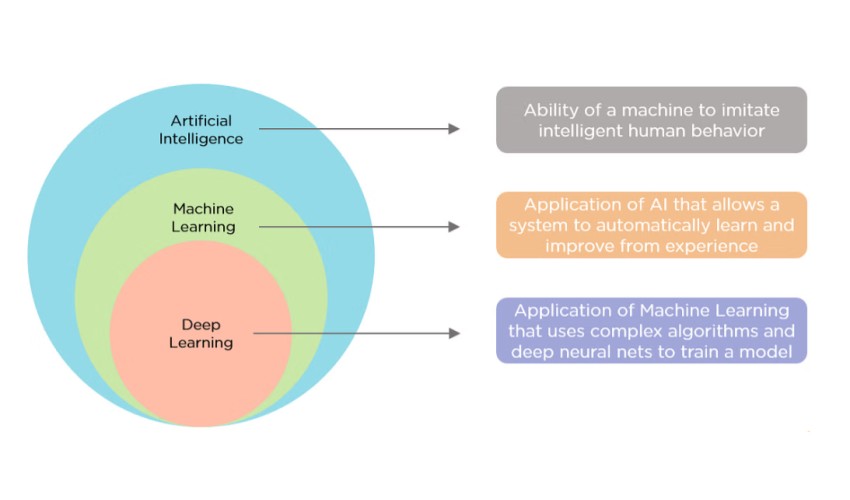
The following table shows the differences between artificial intelligence vs machine learning vs deep learning.
| Artificial Intelligence (AI) | Machine Learning (ML) | Deep Learning (DL) |
| It consists of components of both machine learning and deep learning | It is a subset of artificial intelligence | It is a subset of machine learning |
| It is a computer system capable of mimicking human-like intelligence through accurate decision-making | It is an AI algorithm that helps a system to learn from data | It is an ML algorithm that uses deep neural network to analyze data and provide output |
| In AI search trees and complex maths is involved | Using complex functionalities like K-Means, Support Vector Machines, and others you can visualize data | You can break the complex functionalities into lower dimension features by adding more layers |
| AI emphasizes on increasing the chances of success and not accuracy | Its goal is to increase the accuracy and not focus much on the success | Its aim is to achieve higher rank in accuracy when trained with a large data set |
| It is divided into three categories – Reactive Machines, Limited Memory, Theory of Mind, Self-Awareness | Three types of ML – supervised, unsupervised, and reinforcement learning | Consists of three common neural networks – RNNs, CNNs, and GANs |
| The efficiency provided by ML and DL influences the efficiency of AI | Since it cannot work for longer dimensions or handle higher amounts of data, it is less efficient than DL | It is more powerful than ML because it can easily handle larger data sets |
| The AI systems can be rule, knowledge, or data-based | The algorithm learns through trials and experiments, receiving feedback in the form of rewards or punishments | It consists of several layers of interconnected neurons that are capable of processing data in a hierarchical manner |
Master Machine Learning with Interview Kickstart
Machine learning is a highly technical and competitive domain. With the world becoming digital and an increase in the use of different software and technologies, the role of ML Engineers is important. Interview Kickstart is a pioneer when it comes to helping professionals prepare for interviews and get their dream job.
IK’s Machine Learning Interview Masterclass is designed and taught by FAANG+ engineers and is aimed at helping you prepare well for the interviews.
Our Flagship Machine Learning Course will help you learn the key ML concepts that you often will have to use as a machine learning engineer. In this course, you will learn programming with Python, deep learning, generative AI, & more. You will also carry out a capstone project to strengthen your learning about the domain.
Our instructors are highly experienced ML professionals who will guide you through every step of the course. They will also help you crack even the toughest ML interviews at FAANG+ companies.
In this course, you will learn everything from DSA to system design to ML concepts about supervised and unsupervised learning, deep learning, and more. Our expert instructors will also help you create ATS-clearing resumes, optimize your LinkedIn profile, and build a personal brand.
Read the different success stories and experiences of our past learners to understand how we have helped them get their dream jobs.
FAQs: Artificial Intelligence vs. Machine Learning vs. Deep Learning
Q1. Can machine learning models improve over time?
Yes, machine learning models can improve over time by learning from new data, refining predictions, and updating their algorithms based on real-world feedback.
Q2. What industries are adopting deep learning the fastest?
Deep learning is being rapidly adopted in industries like autonomous vehicles, natural language processing, financial services, and entertainment (e.g., recommendation systems).
Q3. Is reinforcement learning used outside of gaming?
Yes, reinforcement learning is applied in robotics, industrial automation, and in optimizing logistics and operations across various industries.
Q4. What role does AI play in cybersecurity?
AI helps in cybersecurity by detecting anomalies, identifying threats in real-time, and automating responses to cyber attacks to enhance protection.
Q5. Can deep learning models be used for creative tasks?
Yes, deep learning models like GANs are used in creative tasks, such as generating art, music, and even writing text by learning from large datasets.
Related reads:
- How to Become a Machine Learning Engineer in 2024?
- What is Machine Learning? A Comprehensive Guide
- Machine Learning vs. Data Science — Which Has a Better Future?
- Top 30 Machine Learning MCQs with Answers