Crafting the best FAANG resume template for software engineers requires more than listing skills, it demands a resume engineered for clarity, measurable impact, and alignment with high-scale engineering expectations. FAANG recruiters operate in high-velocity screening environments, often spending just 6-8 seconds on an initial resume scan.
Recruiters at Facebook, Apple, Amazon, Netflix, and Google etc prioritize candidates who demonstrate problem-solving ability, system design exposure, and quantifiable impact. Even small projects can stand out if they include metrics, for example, improved performance, reduced latency, or increased throughput, since resumes that reference measurable achievements are significantly more likely to pass both ATS and human screening.
This blog breaks down the core components of a FAANG-ready resume, including technical identity, project ownership, leadership signals, and modern engineering practices. Whether you need the best FAANG resume template for software engineers as a fresher or a senior professional, these guidelines help you match FAANG expectations confidently.
Key Takeaways
- The best FAANG resume template for software engineers should follow a clean, ATS-friendly structure with clear sections for experience, projects, skills, and measurable achievements.
- Explore FAANG resume templates as per experience. For a freshers should highlight DSA strength, internships, and academic work, while mid-level engineers must focus on ownership, product impact, and collaboration across teams.
- Selection of resume templates as per profile and experience, displaying clarity, engineering depth, and contributions to scalable systems.
- Senior and principal candidates resume templates focus on architectural decisions, system design, major migrations, on-call leadership, incident resolution, mentoring, and long-term engineering skills.
What FAANG Recruiters Look Out for in a Resume?
FAANG recruiters review thousands of resumes every month, so they scan quickly for signals that demonstrate impact, technical depth, and a scalability mindset. Your resume must clearly demonstrate that you can operate in high-complexity, high-ownership environments. Here are the core elements that FAANG recruiter look for.
Clean Resume Structure & ATS Optimization
A FAANG resume must be clean, readable, and ATS-friendly. Recruiters scan for:
- A clear hierarchy with sections such as Experience, Projects, Skills, Education
- Bullet-based achievement statements
- Consistent formatting
- No paragraphs of text
They also expect keyword alignment with job descriptions, e.g., “REST APIs,” “Kubernetes,” “React,” “machine learning pipelines,” “distributed systems,” etc.
Strong Problem-Solving & Technical Skills
FAANG teams prioritise candidates who can handle algorithmic thinking and system design challenges. Recruiters generally look for strong problem-solving & technical skills such as:
- Proficiency in data structures & algorithms (DSA)
- Experience with backend frameworks, distributed systems, and microservices
- Hands-on skills in languages like Python, Java, C++, Go, TypeScript
- Familiarity with cloud platforms (AWS, GCP, Azure)
Resumes that reference real technical decisions, “reduced API latency,” “improved query efficiency,” “optimised CPU usage”, tend to stand out.
Impact-Driven Achievements
FAANG recruiters scan for quantifiable impact, not job descriptions. Bullet points without numbers are usually ignored.
Examples they love:
- “Improved recommendation accuracy by 22% using ML models”
- “Reduced page load time by 40%, increasing retention”
- “Optimized data pipeline to process 10M+ records per day”
- Metrics communicate scale, ownership, and measurable outcomes
Experience with Scalable Systems
FAANG companies operate at a massive scale. Recruiters look for candidates who have worked on:
- High-traffic applications
- Large databases
- Distributed computing
- Automation pipelines
- CI/CD & DevOps workflows
Even small-company candidates can highlight scalability by showcasing system optimisations, concurrency handling, or cloud deployments.
High-Quality Projects or Product Ownership
If you are early stage in your career, projects give an edge over others. FAANG recruiters evaluate:
- Code quality and GitHub activity
- End-to-end project ownership
- Real-world use cases
- Complexity of architecture
- They prefer fewer, deeper projects over many shallow ones.
Leadership & Cross-Functional Collaboration
FAANG values candidates who can work across product, design, and engineering teams. Your resume should showcase:
- Leadership roles
- Stakeholder communication
- Mentorship experience
- Cross-team project execution
Role-Specific Terminology and Modern Engineering Practices
To ensure compatibility with both ATS systems and recruiter expectations, the resume must include keywords aligned with the role, terms such as microservices architecture, distributed computing, low-latency services, cloud-native development, CI/CD pipelines, A/B experimentation, or fault-tolerant systems. These reflect familiarity with industry-standard engineering practices.
Clean, Minimal, Single Page Layout
FAANG recruiters prioritize readability and clarity. The resume must follow a clean, one-page layout with consistent spacing, structured sections, standard fonts, and ATS-friendly formatting. Overly designed templates, tables, icons, or graphical elements reduce compatibility and are discouraged.
Indicators of Leadership, Collaboration, and Ownership
FAANG companies hire engineers who can influence technical direction, mentor peers, work cross-functionally, and take ownership of complex initiatives. References to design reviews, code reviews, mentorship, stakeholder collaboration, or leading engineering discussions demonstrate maturity and leadership potential, even in individual contributor roles.
Also Read: 150+ Power Words to Make your Resume Stand Out
Key Components of a Best FAANG Resume Templates for Software Engineers
A FAANG-ready resume is a strategic document that demonstrates technical competence, engineering rigor, product-oriented thinking, and the ability to deliver impact at scale.
Recruiters at companies like Meta, Google, Amazon, Apple, and Netflix evaluate resumes within seconds, scanning for indicators of strong problem-solving ability, architectural understanding, and cross-functional execution.
The components below reflect what FAANG hiring teams consistently prioritize.
Clear Technical Identity and Professional Branding
The resume must establish your technical identity immediately. This includes a clean header with your contact details, GitHub or LinkedIn profiles, and a professional title that accurately reflects your core specialization, such as Backend Engineer, Machine Learning Engineer, Full Stack Developer, or Data Engineer. FAANG recruiters value clarity, precision, and alignment with role expectations.
Executive-Style Professional Summary
A FAANG resume benefits from a concise, high-impact professional summary. In two or three lines, it should highlight:
- Your years of experience
- Your primary technical domain
- Key strengths (e.g., distributed systems, cloud architecture, ML model deployment, performance optimization)
- A top-line achievement that demonstrates business impact
This section functions as a strategic positioning statement, showcasing your value as an engineering professional.
Strategically Structured Technical Skills Matrix
FAANG companies look for depth, not breadth. A well-structured skills section should segment your competencies into Programming Languages, Frameworks, Cloud Platforms, Databases, DevOps Tooling, and Data/ML Technologies.
This matrix helps recruiters quickly assess your technological alignment with the role. All listed skills should be relevant, current, and technically defensible during interviews.
Impact-Oriented Professional Experience
This is the core of the FAANG resume. Recruiters look for evidence of:
- System-level contribution
- End-to-end feature ownership
- Performance optimization and scalability improvements
- Strong engineering problem-solving
Achievements must be expressed using metrics such as response-time reduction, throughput improvement, cost optimization, dataset scale, user adoption, or reliability gains. FAANG companies prioritize engineers who demonstrate an ability to build, optimize, or maintain systems that operate under significant load and complexity.
Technically Robust Projects Demonstrating Engineering Judgment
For early-career candidates or professionals transitioning roles, projects serve as an important evaluation point. Strong FAANG-style projects typically include:
- Distributed system design
- ML/AI model training and deployment
- Cloud-native applications
- Production-level microservices
- Data pipeline development
- Automation or developer tooling
These projects should reflect architecturalral thinking, modern tech stack usage, and real-world problem solving, supported by links to source code or deployment environments.
Concise and Relevant Educational Background
The education section is kept factual and minimal, degree, institution, and graduation year. For recent graduates, relevant coursework such as algorithms, operating systems, database systems, and machine learning adds value.
Academic distinctions, research publications, or competitive programming achievements may also be included if they strengthen your technical profile.
Certifications and Specialized Technical Training
Although not mandatory, certifications from AWS, GCP, or Azure, along with advanced training in machine learning, data engineering, or system design, help demonstrate professional development and domain expertise. FAANG values candidates who actively invest in technical upskilling.
Volunteering and Extracurricular Activities
In volunteering & extracurricular activities, you can highlight impactful contributions outside work, such as leadership roles, open-source involvement, tech communities, event organizing, or social initiatives. These demonstrate teamwork, initiative, communication skills, and a well-rounded personality, qualities FAANG recruiters value.
Also Read: How to List Experience on a Software Engineering Resume
Sample of Best FAANG Resume Templates for Software Engineers
FAANG recruiters evaluate resumes using a highly standardized, impact-first lens. Your resume must show technical excellence, architectural reasoning, product awareness, and engineering impact at scale. By aligning with the best FAANG resume template for software engineers, you increase your chance of passing initial filters and getting interview calls.
Below are four powerfully structured resume templates, designed for beginners, experienced engineers, senior engineers, and principal-level professionals, each optimized for FAANG hiring expectations.
Beginner / Fresher FAANG Resume Template for Software Engineers

This template format is built for students, new graduates, and early-career engineers entering the industry. At this stage, FAANG companies look for problem-solving fundamentals, hands-on coding ability, and strong project execution.
Core Resume Strategy
A fresher’s resume must compensate for limited professional experience by showcasing:
- Strong CS fundamentals (DSA, OS, DBMS, CN)
- High-quality academic or personal projects
- GitHub activity demonstrating clean, modular code
- Internships, coding contests, or hackathons
- Curiosity, initiative, and the ability to ship working solutions
Template Structure
The template structure shows how beginners should organize their resume so each section highlights capability, clarity, and technical skills. You should follow the structure below:
- Professional Header – Name, GitHub, LinkedIn, Portfolio
- Technical Summary – 2 lines emphasizing core strengths
- Technical Skills – Languages, frameworks, cloud basics
- Key Projects (Flagship Section)
- Internship Experience
- Education & Achievements
Key Vocabulary & Phrases
To strengthen the resume’s credibility, the following vocabulary helps beginners adopt the language FAANG recruiters instinctively look for in engineering profiles:
- “Implemented production-grade…”
- “Designed end-to-end architecture for…”
- “Optimized algorithm to reduce time complexity…”
- “Integrated cloud-based storage using AWS services…”
- “Applied OOP and modular design principles to…”
Example Points
The examples below illustrate how an entry-level candidate should convert projects and internships into concise, quantifiable, engineering-driven achievement:
- “Implemented a distributed log-processing system using Python and Kafka capable of ingesting 1M+ events/hour, performing real-time analysis with 92% accuracy.”
- “Designed and deployed a containerized microservice on Docker + AWS EC2, reducing request-response latency by 35% through optimized thread management.”
- “Created a machine learning classification model using Scikit-Learn, improving F1 score from 0.72 to 0.88 by hyperparameter tuning and feature engineering.”
This template signals strong fundamentals, good coding habits, and readiness for FAANG interviews.
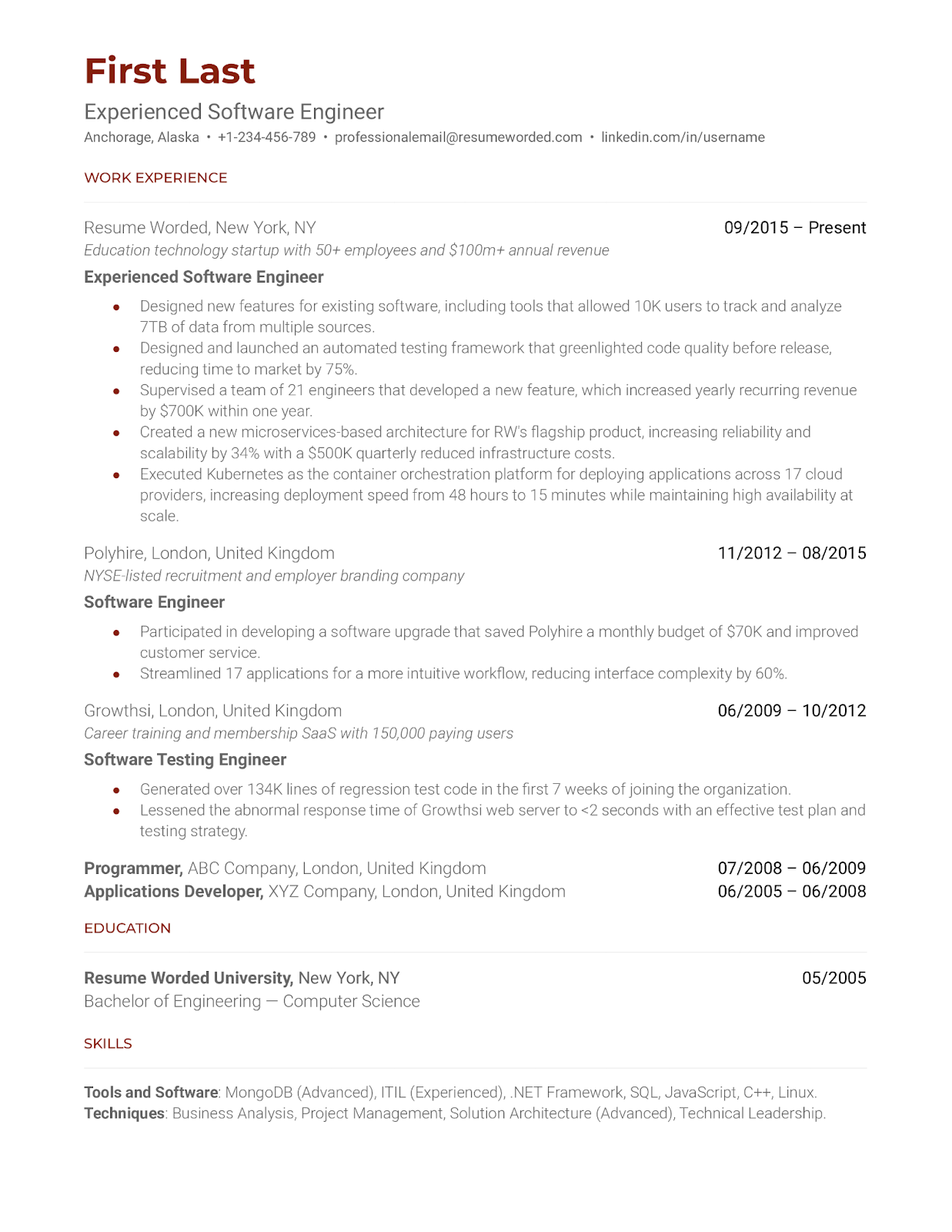
FAANG Resume Template for Experienced Software Engineers (2–6 Years)
This format is ideal for professionals with hands-on development experience in product or SaaS companies. FAANG recruiters now look for technical ownership, system thinking, and measurable impact.
Core Resume Strategy
This section shifts the focus to mid-level engineers who must now communicate ownership, system thinking, and measurable engineering impact. The principles outlined next capture exactly what FAANG expects at this stage.
- Independent ownership of features or subsystems
- Experience with microservices, APIs, cloud infra, CI/CD pipelines
- Problem-solving at scale (performance tuning, reliability improvements)
- Collaboration with product, QA, design, and infra teams
- Impact tied to KPIs such as latency, throughput, error reduction
Template Structure
To organize these mid-level contributions effectively, the following structure provides a clean, recruiter-optimized format that highlights system ownership and progressive career growth.
- Executive Summary
- Technical Skills Matrix
- Work Experience (Primary section)
- Technical Projects / Contributions
- Certifications / Cloud Skills
- Education
Key Vocabulary & Terminology
To match FAANG’s evaluation language, the following terminology helps experienced engineers articulate architectural decisions, scaling efforts, and cross-functional execution.
- “Architected and shipped…”
- “Enhanced system observability using Prometheus/Grafana…”
- “Reduced P99 latency by…”
- “Built resilient, horizontally scalable microservices…”
- “Orchestrated container deployments using Kubernetes…”
- “Optimized SQL queries improving read/write efficiency…”
Example Points
The examples below demonstrate how mid-level engineers should frame their contributions in a way that highlights growth, depth, and tangible performance improvements.
- “Architected RESTful microservices using Spring Boot, Redis, and MySQL, enabling 38% higher throughput and reducing backend timeout errors by 62% across peak traffic periods.”
- “Refactored legacy monolith into domain-driven microservices, reducing deployment frequency from 3 hours to under 10 minutes via Docker and GitHub Actions.”
- “Implemented distributed caching layer using Redis Cluster, decreasing database load by 45% and increasing system availability to 99.97%.”
This template signals ability to ship features reliably, optimize systems, and contribute to complex codebases.
Senior Software Engineer FAANG Resume Template (6–12 Years)
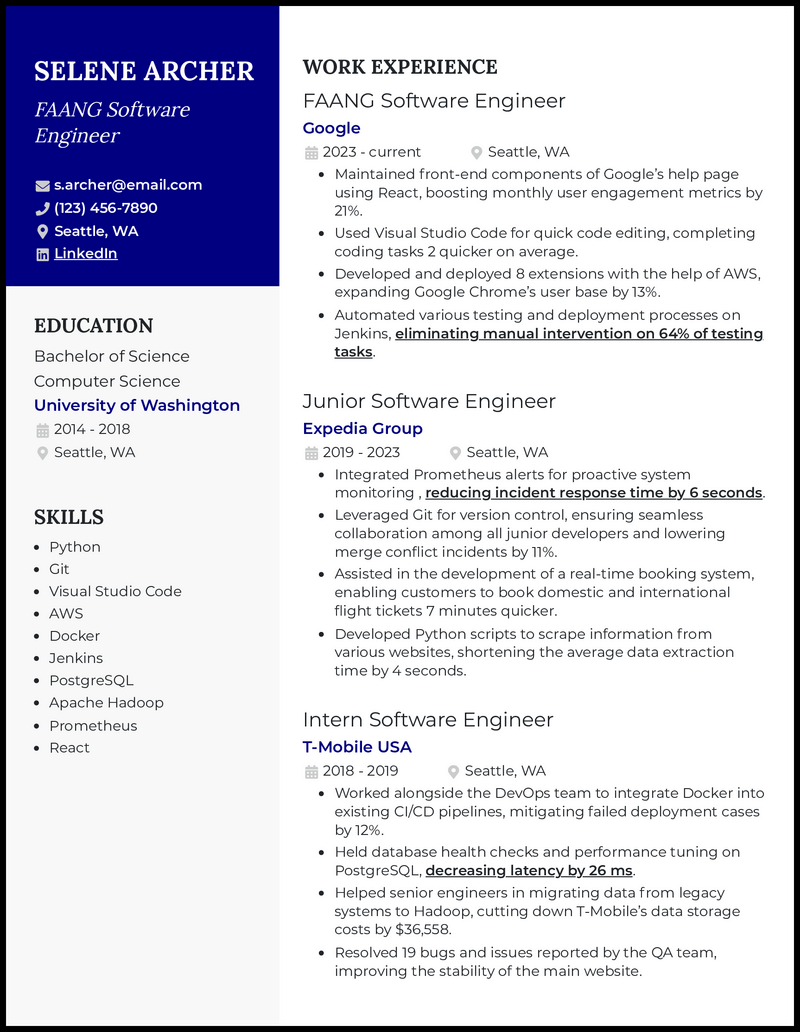
For senior ICs and technical leads, FAANG expects architectural reasoning, leadership, mentoring, and the ability to drive engineering strategy.
Core Resume Strategy
At the senior level, the resume must reflect architectural leadership, cross-team influence, and long-term technical decision-making. The resume that captures these expectations should include.
- System-level ownership (architecture + design)
- Ability to lead engineering discussions
- Driving cross-functional tech initiatives
- Improving SLAs, SLOs, reliability metrics
- Delivering business impact through technical decisions
- Mentoring junior engineers and conducting design/code reviews
Template Structure
Aligning with senior software engineer expectations, the structure below illustrates how senior engineers should present their career narrative, focusing on system ownership and multi-team impact.
- Leadership Summary (2–3 lines)
- Core Engineering Competencies
- Senior-Level Experience
- Architectural Projects / System Designs
- Leadership Contributions (Code reviews, mentorship)
- Patents / Publications / SPEAKING (if any)
Key High-Level Vocabulary
To showcase the seniority and architectural fluency, the following terminology helps communicate organizational influence, scale, and design leadership.
- “Spearheaded the architectural redesign of…”
- “Drove alignment across engineering, product, and infra teams…”
- “Established performance SLOs improving reliability to…”
- “Led end-to-end delivery of mission-critical systems…”
- “Implemented shard-based scaling architecture to support…”
- “Introduced service-level observability enhancements…”
Example Points
The sample below demonstrate how a Senior Engineer conveys system-wide impact, architectural contributions, and reliability improvements at FAANG standards.
- “Led the architectural overhaul of a high-traffic payments engine processing 50M+ daily transactions, improving systemreliabilityty to 99.98% and reducing failures by 83%.”
- “Implemented a distributed rate-limiting mechanism using Redis + NGINX, ensuring consistent performance under 10x traffic spikes.”
- “Mentored a team of 9 engineers, standardized code review processes, and drove engineering best practices that reduced production defects by 42%.”
This template signals leadership, maturity, architectural competence, and readiness for staff roles.
PRO-Level (Principal Engineer, Architect) FAANG Resume Template
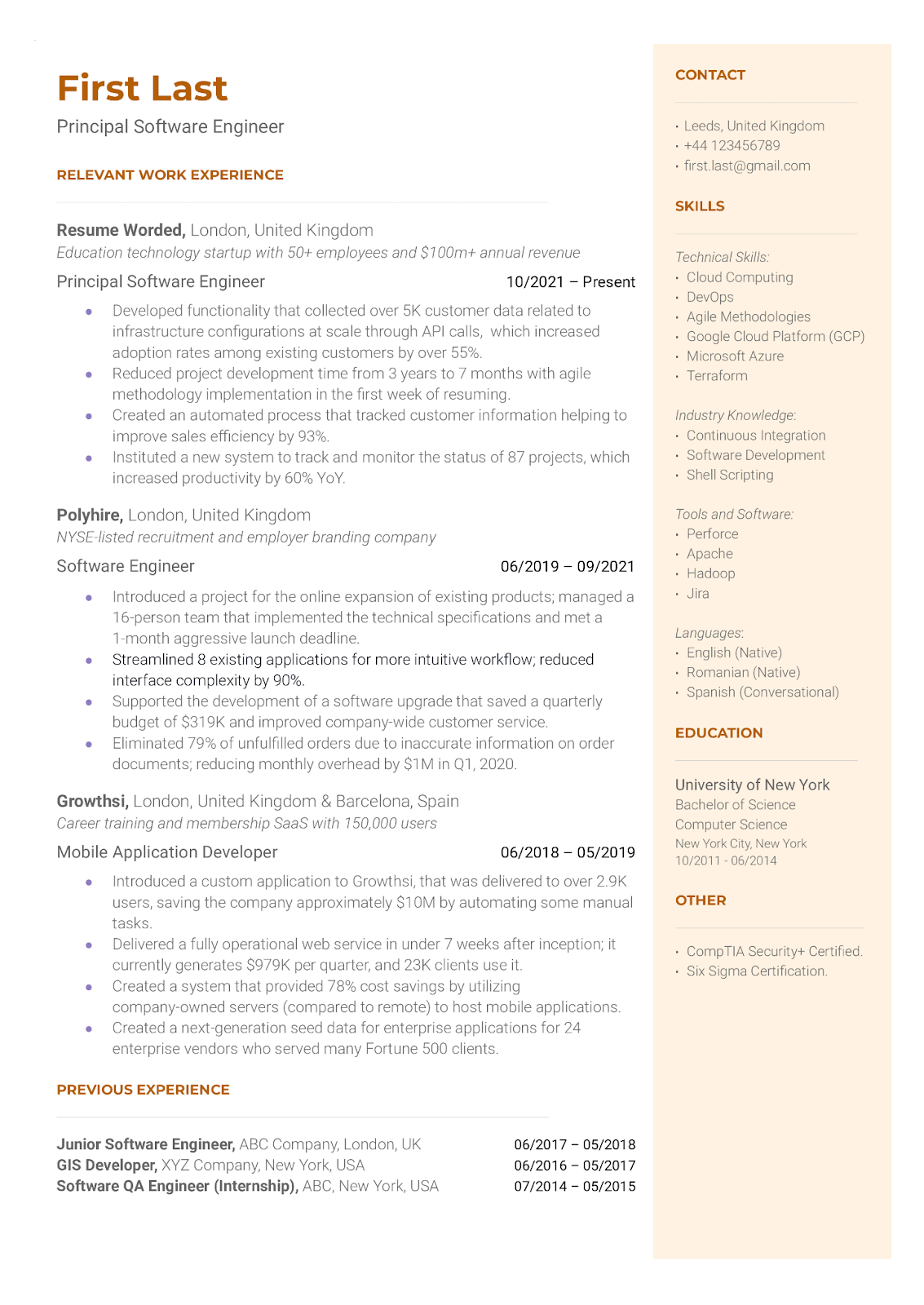
At this level, FAANG companies evaluate vision, strategic influence, cross-org impact, technical governance, and architectural leadership. Your resume must reflect thinking at the system, platform, and organizational scale.
Core Resume Strategy
At the Staff/Principal tier, recruiters assess technical vision, enterprise-scale leadership, and cross-org architectural impact. Here you should reflect the points below for this executive IC level.
- Company-wide architectural ownership
- Definition of technical vision and long-term strategy
- Platform-level scalability & reliability improvements
- Multi-team orchestration
- Organizational influence through best practices
- Deep expertise in distributed systems, infra, ML systems, or platform engineering
Template Structure
To help staff engineers present their achievements with strategic clarity, the following structure enables you to communicate influence, foresight, and company-wide impact with precision.
- Strategic Leadership Summary
- Core Architectural Competencies
- Org-Level Engineering Experience
- Platform Scale Achievements
- Architecture Case Studies (Important)
- Patents, Open-Source Work, Publications
- Technical Vision & Org-Level Initiatives
High-Level Vocabulary & Terminology
Since FAANG evaluates principal engineers through the lens of strategic impact and architectural governance, the terminology below strengthens your executive engineering narrative.
- “Defined multi-year technical roadmap for…”
- “Established architectural governance across X+ teams…”
- “Orchestrated migration to cloud-native, event-driven architecture…”
- “Drove platform observability improvements reducing MTTR by…”
- “Implemented global distributed systems with geo-redundancy…”
- “Influenced product strategy through data-driven engineering decisions…”
Example Points
The examples below illustrate what enterprise-scale impact looks like on a FAANG-caliber Staff/Principal resume, emphasizing strategy, scalability, and leadership footprint.
- “Spearheaded the platform-wide transition from monolithic architecture to distributed microservices, enabling user scaling from 10M to 120M+ MAUs, improving deployment velocity by 300%.”
- “Defined technical vision and architectural governance for 6 engineering teams, driving cross-org alignment on reliability, observability, and cloud cost optimization.”
- “Implemented global failover architecture using AWS Route 53, EKS, and RDS Multi-AZ, reducing MTTR from 45 minutes to under 5 minutes and achieving five nines reliability for critical APIs.”
This template signals executive-level engineering leadership, architectural excellence, and organization-wide impact.
Common FAANG Resume Mistakes to Avoid
To get hired at top tech giants like FAANG (Facebook/Meta, Amazon, Apple, Netflix, Google), your résumé must be concise, impactful, and tailored. Many strong candidates get rejected simply because of avoidable mistakes. Below is a refined breakdown of the most common pitfalls, organized for clarity and easy reading.
Content-Related Mistakes
Your resume’s structure, and what you mention in your resume can determine whether your application is shortlisted or filtered out. Let’s break down the content-related mistakes you must avoid next:
- Focusing on responsibilities instead of impact: Recruiters want results, not tasks. Replace generic lines like “Responsible for creating dashboards” with measurable achievements such as “Built interactive Tableau dashboards that reduced reporting time by 75% and uncovered $1.2M in cost-saving opportunities.”
- Being generic and failing to tailor your resume: A one-size-fits-all resume doesn’t work for FAANG. Customize each application by aligning skills, keywords, and project priorities with the specific job description.
- Not using data or metrics to quantify achievements: Numbers immediately make your accomplishments credible. Use this formula: “Achieved X as measured by Y by doing Z.”
- Including irrelevant or outdated information: Avoid adding unrelated hobbies, very old job roles (10–15+ years), or basic skills like “Microsoft Word”. Space is limited, prioritize value.
- Using clichés and buzzwords without evidence: Phrases like “team player” or “hard worker” add no value. Demonstrate these traits through your accomplishments and leadership examples.
- Using an outdated resume objective: Objective statements are unnecessary and self-focused. Replace them with a professional summary that quickly shows your strengths and value to the company.
- Lying or exaggerating skills/experience: FAANG companies verify credentials thoroughly. Any form of dishonesty can result in immediate rejection and long-term reputational damage.
Formatting Mistakes
Formatting and structural errors are some of the fastest ways to disqualify an otherwise strong candidate in FAANG hiring pipelines. Recruiters evaluate hundreds of resumes per week, and clarity, consistency, and technical readability are non-negotiable. Therefore, you must take care of the following points.
- Poor or overly creative formatting: FAANG recruiters prefer clean, simple, ATS-friendly layouts. Use standard fonts, consistent spacing, and clear headings to improve readability.
- Making the resume too long: Keep it one page for early to mid-career professionals; two pages max for those with 10+ years of relevant experience. Brevity shows clarity and discipline.
- Ignoring ATS (Applicant Tracking Systems): Use standard section titles like Work Experience, Skills, Education, and avoid graphics, tables, or images. Include both acronyms and full terms (e.g., “Search Engine Optimization (SEO)”).
- Typos, grammar errors, or inconsistent formatting: Even a single mistake can signal carelessness. Proofread thoroughly, use tools like Grammarly, and get a second pair of eyes to review.
- Using an unprofessional email or incorrect contact information: Always use a professional email format (e.g., firstname.lastname@gmail.com). Ensure your phone number, LinkedIn, and portfolio links are current.
Is Your Resume FAANG Ready
The first step to get through the FAANG+ organization is clearing the resume screening process. A well-structured resume cannot be prepared in a hurry, especially if you’re aiming for FAANG+ organizations. It requires a well structured resume template to demonstrate problem-solving ability, technical skills, and quantifiable impact for the targeted role and job profile.
If you are not confident about your resume. Interview Kickstart Resume Analysis tool will fine tune your resume with insights from FAANG+ recruiters. Upload your resume now and get personalized recommendations and in-depth gap analysis. Be FAANG+ ready with confidence.
Conclusion
The best FAANG resume template for software engineers is more than just a list of skills, it is a strategic document that demonstrates technical expertise, measurable impact, and scalable engineering problem-solving. With recruiters spending only seconds reviewing resumes and most being filtered by ATS, clarity, structure, and quantified achievements are essential to stand out.
Whether you are a fresher, mid-level engineer, senior Individual contributors, or principal-level professional, adopting the best FAANG resume template for software engineer, positions you to capture recruiter attention and significantly improve your chances of landing interviews at FAANG companies.
FAQs: FAANG Resume Template for Software Engineers
Q1. What makes a resume FAANG-ready for software engineers?
A FAANG-ready resume highlights technical depth, system-level thinking, measurable impact, and ownership. Recruiters prioritize problem-solving, distributed systems experience, cloud expertise, and concise, metric-driven bullet points.
Q2. How long should a FAANG software engineer resume be?
Freshers should use 1 page, experienced engineers 1–2 pages. Focus on clarity, measurable achievements, and system-level contributions. Only include relevant technical skills, projects, and impact-driven experience.
Q3. Which sections are essential in a FAANG software engineer resume?
The key sections include Professional Header, Technical Summary, Skills Matrix, Experience, Projects, Education, and Certifications. Each should emphasize measurable achievements, scalability, and technical alignment with FAANG expectations.
Q4. How can early-career engineers make their resume stand out for FAANG roles?
Highlight projects, internships, hackathons, and coding competitions. Emphasize measurable results, system-level thinking, cloud deployment, optimization, and include GitHub links showcasing production-ready, modular code.
Q5. Are keywords important in a FAANG software engineer resume?
Yes, keywords like microservices, REST APIs, distributed systems, CI/CD, cloud, machine learning pipelines help ATS pass rates and signal relevant expertise alongside quantifiable achievements.
Related Articles
- How to Write a Professional Resume – A Guide
- How to Structure Your Software Engineering Resume
- Technical Skills Definition and Examples
- Hard Skills vs Soft Skills