The recurring question asked by IT professionals is ‘How does continuous upskilling protect you in a competitive job market?’ Continuous upskilling you by managing skill gaps, adapting to market shifts, staying relevant, increasing job security and indispensability, fitting you with in-demand skills, and enhancing your earnings.
Continuous learning should align with your core skills and career objectives. At the same time, you should also take up lateral, supporting, or T-shaped skills. Be clear about your career objective; you want to move up, laterally, or straight up into key roles.
Job security does not come from a single skill, as there is a danger of obsolescence and irrelevance. Continuous upskilling, on the other hand, fits you with new skills, becoming adaptable and agile to fit new roles, and be ready for any downturn in the economy.
You can upskill, reskill, or cross-skill based on your capability. A structured approach that suits your learning pace is recommended. Follow the learning path, and monitor your progress. The blog answers questions on continuous upskilling and steps to take to protect you in a competitive job market.
Key Takeaways
- Continuous upskilling is about developing new skills or enhancing existing ones.
- Continuous upskilling helps you stay relevant in the job market since you have learnt about the latest tools and technologies.
- Several factors have disrupted the job market, and these are rapid technology advancements, AI, remote working, and an uncertain economy.
- Continuous upskilling helps you to navigate these uncertainties since you have learnt about emerging tech and important human-centric skills.
- Develop a personal advancement and learning plan with a multi-step strategy.
Why Job Security No Longer Comes From One Skill
Several factors have proved that job security no longer comes from a single skill and that continuous upskilling is the answer. Some factors are rapid developments in technology that render current skills obsolete, global economic downturns, and changing organizational needs.
These factors have created a fast pace for change with the unbundling of roles. Stability has moved from organizations to individuals. Specialized skills have become obsolete, and the need is for continuous learning, adaptability, and transferable skills that can be used across sectors.
Let us look at some reasons for these changes.
Automation and AI: AI has automated manual and routine tasks such as data entry, invoicing, writing basic code, testing, deployment, monitoring, onboarding employees, and many other tasks. Workers who did these tasks are now obsolete and would need to upskill.
Rapid industry evolution: Several tools are available for digital transformation. Shifting consumer demands force entire departments and roles to be reshaped or made redundant. Cost pressures and automation force several jobs to disappear.
Global competition and gig economy: Remote work, freelancing, gig, and part-time work open work to the global workforce and talent. They are often ready to work at lower costs for longer hours. Organizations hire staff for a specific project, and long-term stability is lost.
Restructuring: Big tech firms acquire other firms, there are mergers, strategy changes, old product suites are dropped, and new ones are introduced. These factors can render even long-serving employees redundant, and loyalty does not guarantee job security.
Skill Security: Career insurance is possible by developing diverse, future-proof skills and using old skills as learning steps for continuous learning.
What Is Continuous Upskilling?

Continuous upskilling is a long-term process where professionals develop new skills or enhance their existing skills. Continuous upskilling helps them to stay updated, relevant, and capable in a dynamic job market. They can manage career transitions smoothly and are relatively layoff-proof.
People who continuously learn are adaptable to changes; they can shift between technologies and manage changes brought by automation and changing business needs. Let us look at the important features of continuous learning.
- Adaptability: Continuous learning allows learners and organizations to remain abreast of technology developments and manage shifts in industry demands, preventing obsolescence.
- Broad expertise: Learners develop deeper and wider knowledge of various technologies, allowing them to work in multiple roles and sectors.
- Blended skills: Continuous learners develop hard skills with expertise in digital tools, AI, and human skills such as collaboration and problem-solving
- Strategic investment: Continuous learning may involve some costs and time. However, these are strategic investments that provide returns in the long term.
- Future proofing: Continuous learning provides a higher level of future proofing since you have learnt new skills and can adapt to market changes
Also Read: 10 Future-Proof Skills Every Engineer Should Learn in 2026 Before It’s Too Late
What Skills to Consider for Continuous Upskilling?
Continuous upskilling should focus on one core area and then lateral areas to develop T-shaped skills. In addition to technical skills that get you jobs, you should also develop human-centric skills. Organizations look for leaders, motivators, mentors, and people with problem-solving skills.
Let us look at some skills that protect you in competitive job markets.
Technical Skills
- Generative AI, prompt engineering: Using AI tools for automation, code generation, testing, other IT project work, creative content, refining AI output,
- Data analysis and visualization with AI: Collect, process, and analyze data with AI tools and implement in workflows, deep expertise in Python, SQL
- Cybersecurity: Use AI to identify and mitigate cyber threats, enhance security
- Cloud computing: Expertise in AWS, Azure, Google Cloud, and developing SaaS, IaaS, PaaS, and other services
- Digital marketing: Using gen AI to create marketing collaterals, market in social media, SEO, and content management strategies.
Human-centric soft skills
- Analytical thinking and problem-solving: Finding the root causes of complex problems and developing solutions
- Adaptability and flexibility: Ability to adapt to new situations, flexible to relearn new processes, resiliency in changing environments
- Emotional intelligence: Managing self and others’ emotions, as this is critical for high-pressure situations
- Creativity and innovation: Developing new and innovative solutions, original thinking to improve processes and products.
- Communication: Clarity in thought, ideas, verbal and written skills, and active listening are important for remote and hybrid work environments.
Leadership skills
- Project management: Managing projects, resources, risks, and delivering on time and within specified costs.
- Leadership and social influence: Motivate teams, mentor, and guide them to deliver the best solutions
- Growth mindset: Develop a proactive approach for self-development, monitoring self-growth, and identifying weak areas
Why the Job Market Is More Competitive Than Ever
The job market has become very competitive, and there is a glut of skilled professionals and a low demand. Several factors, such as technology, economic shifts, rationalized hiring and downsizing, skill gaps, and others.
These factors have created oversaturation and a tight market for job seekers. Let us look at the reasons for the competitive market.
- New automation tools: Several tools have rendered the older jobs redundant. Previously niche jobs such as deployment manager, delivery manager, and infrastructure developer are now replaced by automated tools that create, deploy, and deliver cloud infrastructure.
- Cloud services: Cloud service providers offer SaaS, PaaS, IaaS, and other ready-to-use solutions. As a result, expert developers are not needed since organizations can procure these solutions at far lower costs.
- Overhiring: Post-pandemic, hiring increased since organizations anticipated a rise in demand that did not happen. Talent that was hired could not be deployed in projects
- Economic uncertainty: Tariffs and trade policies have forced companies to freeze development projects. These factors have reduced the number of positions available.
- Job portals: Free and easy-to-use job portals see thousands of applications for a few positions. Firms use ATS to scan resumes, making it difficult for people to be shortlisted
- Skill gaps: With the increased use of new technologies, older workers with legacy skills find that their skills are not aligned with new requirements.
- Remote work: Many organizations use the services of consultants, remote workers, and part-time consultants. They are paid a fixed amount without the burden of extra employee costs. Full-time staff are seeing reduced employment.
Also Read: What are The Top 10 High Income Skills to Learn in 2026?
How Continuous Upskilling Protects Your Career
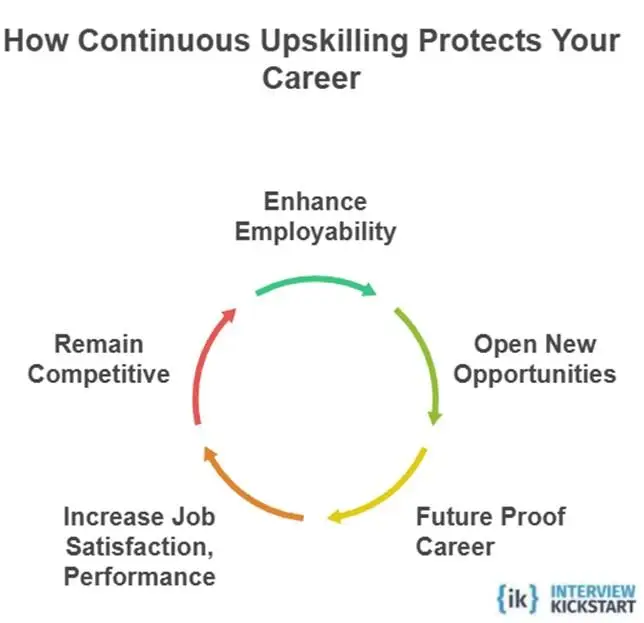
Continuous upskilling provides several advantages to the learner and the organization. You remain relevant and have the skills to enhance your current role, and it provides a means to future-proof against market upheavals.
When an internal requirement for new talent arises, the company will prefer you since you are working here. Let us look at the reasons.
Future-proofs the Career
- Automation proof: About 50% of jobs will be removed due to automation. Continuous learning and upskilling help you transition to human-centric roles that cannot be automated. Some of these jobs require complex problem-solving and critical thinking.
- Prevents stagnation: With continuous upskilling, you learn new skills and are ready for new roles, preventing stagnation and obsolescence.
- Reduces redundancy: With new skills, you face lower risks of redundancy.
Increases employability
- Increased demand: Professionals who continuously upskill, gain certification, and skills see increased calls from recruiters
- Higher earnings: Professionals with new skills can earn higher wages through freelancing and consultancy
- Career progression: People who continuously upskill can get more promotions, responsibilities, and advance in their career
Flexibility and opportunities
- Smooth transition: Upskilling helps to transition smoothly to new roles and enter new sectors
- Internal mobility: Continuous upskilling allows you to find new roles in your current organization
Performance and job satisfaction
- Positivity and confidence: Continuous upskilling helps you to learn new tools, makes you more effective, and boosts your confidence
- Higher engagement: People who continuously upskill gain more support in their roles, and this increases engagement
Also Read: FAANG Engineers Are Mastering These 10 AI Skills Right Now—Here’s Your Chance to Catch Up
3 Strategies You Can Follow for Continuous Upskilling in 2026
Undertaking continuous upskilling needs to be done with a structured strategy. The strategy should be about work that must be done and solving real business problems. Learning popular skills without understanding their application will not be productive since organizations want skills that can be used in their projects.
The strategies for continuous upskilling are:
- Role-based upskilling: This type is to build practical skills to succeed in their current roles. Upward movement is expected in their current role. Examples are sales reps who need CRM training, customer service agents who need improved communication skills, and marketing specialists who need SEO and campaign planning. Join courses that teach these specific skills.
- Reskilling: This strategy is for taking up training in new and in-demand skills. Some lateral movement, if needed, and reskilling help in this transition. As the organization changes, reskilling provides the means to transition into high-value areas. Examples of reskilling are operations staff reskilling in data analytics, support staff taking up digital sales, and customer support learning AI onboarding skills.
- Cross-skilling: This strategy is for those who have expertise in their current roles and want to move to other roles not directly related to their current role. This approach means you are moving to another domain. Cross-skilling helps to provide a broader literacy and across functions, enhancing the abilities and opportunities. A high aptitude and intelligence are needed. Some examples are HR learning about finance and metrics, product managers learning UX, sales, data analysis, and team lead learning about cross-departmental roles.
What are the Steps for Continuous Upskilling
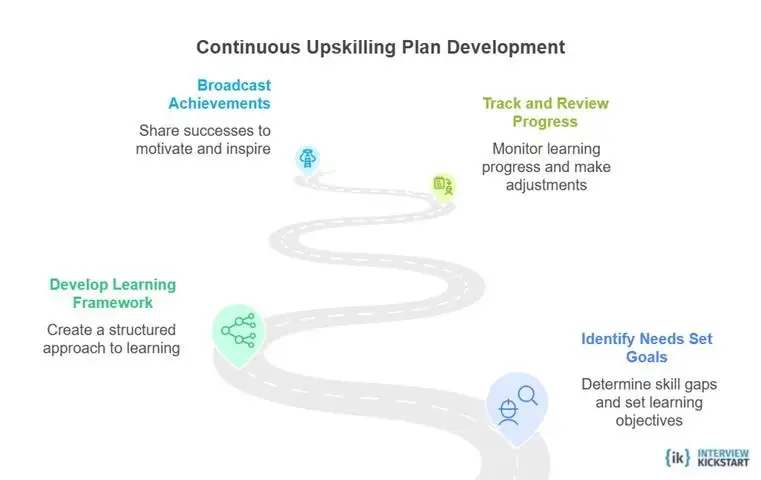
Adopting an appropriate strategy and the skill is critical in continuous upskilling. Research the skills that have the best domain with the best long-term prospects, realistically evaluate your intelligence and capability, and then move forward.
Skills like AI and ML developer are promising, but you don’t match their basic qualifications. Let us look at the steps for continuous upskilling.
Step 1. Identify Needs and Set Goals
- Skills Audit: Analyze your skills, gaps, qualifications, existing workforce capabilities, and future business goals, and identify critical gaps.
- Research long-term potential: Study the potential and future demand for the skill before you invest time and money.
- Define objectives: Set SMART objectives and a roadmap on how you plan to achieve them.
- Map career paths: Research and set the future roles, the required skills to transition, and the time and funds needed
Step 2. Develop a learning framework
- Personalize learning paths: The path is for you. A pat for your colleague may not be suitable for you. Create training content that suits the roles you target, career stages, and individual needs.
- Diverse methods: Use a combination of online courses, workshops, and on-the-job training to cater to different learning styles. Volunteer for free NGO work and open-source projects. They will not pay but give you top references.
- Embrace microlearning: Take up short, focused learning modules of a few days that fit easily into daily schedules.
- Experiential learning: Take up stretch assignments, volunteer for cross-functional projects, and job shadowing.
Step 3. Track and review progress
- After each course, review the progress and check if your learning is in line with market requirements.
- If the review and audit do not follow your objectives, modify the plan as per new tech developments and changing industry requirements.
- Apply for certification exams to see where you stand.
Step 4. Broadcast your achievements
- Once you gain sufficient knowledge and certifications, add them to your CV
- Create a portfolio, write articles, and build your personal brand
- Subtly start applying for jobs, take up freelancing or consultancy work
Also Read: How to Position Yourself for High-Value Tech Roles (Before AI Takes Yours)
Conclusion
The blog discussed the topic of how continuous upskilling protects you in a competitive job market. Continuous upskilling is about developing new skills continuously so that you are updated on the latest technology developments.
Continuous upskilling needs to combine technical, human-centric, and leadership skills. Continuous upskilling protects by future-proofing your career, increasing employability, accessing flexible opportunities, increasing performance, and providing job opportunities.
Long-term job security is fading, and several factors have created uncertainties in the market. These factors include automation and AI, rapid industry evolution, global competition and talent, restructuring, and skill security.
The job market has become very competitive due to several factors. These factors are new automation tools, cloud services, over hiring, economic uncertainty, job portals, skill gaps, and the rise of remote work.
Adopt one or more of the strategies for continuous upskilling, which include role-based upskilling, reskilling, and cross upskilling. Use a multi-step strategy for continuous upskilling by identifying needs, self-audit of skills, and setting goals. Develop a learning framework, track progress, and broadcast achievements.
Continuous upskilling is a long-term process, and results are not immediate. It requires persistence, patience, time, and money. Start today.
FAQs: Continuous Upskilling
Q1. What is continuous upskilling?
Continuous upskilling is a long-term process of developing new skills and upskilling to remain updated on tech advancements and the job market. As the industry evolves, you need to learn new skills to stay relevant.
Q2. Why is continuous upskilling important?
Several factors have disrupted the market. These are AI and automation, economic shifts, cloud services, and the rise in remote work. These factors have increased competition and a demand for new skills, rendering old skills obsolete.
Q3. How does continuous upskilling help?
Professionals with continuous upskilling provide new skills to allow them to fit new internal and external roles.
Q4. What skills should I learn for continuous upskilling?
For continuous upskilling, develop core technical skills that are transferable, along with human-centric skills and industry-emerging skills.
Q5. How should I start continuous upskilling?
Decide on role-based, cross, or reskilling. Follow the multi-step process discussed in this blog.
References
Recommended Reads:
- Skills and Expertise Employers are Looking For in Tech Candidates in 2026
- How to Showcase Your Expertise to Attract High-Value Roles in 2026?
- Why Do Tech Professionals Need Stronger Evidence of Skills in 2026?
- What are the Top Engineering Skills you must Learn in 2026 to Stay Relevant
- How to Build Future-Proof Skills to Stay Ahead of Automation in 2026?