Anthropic launched Code Review for Claude Code on March 9, 2026, a multi-agent PR review system that runs automatically on GitHub, costs $15 to $25 per review, and is available only on Team and Enterprise plans. It is not an auto-approver. Human sign-off remains required. For engineering teams running high PR velocity with AI-generated code, this is worth a structured pilot.
Table of Contents
- What Anthropic Actually Launched
- How the Multi-Agent Architecture Works
- Why Code Review Has Become a Bottleneck
- The Numbers Engineers Should Actually Track
- Pricing, Access, and Hard Constraints
- What This Changes Day to Day
- The Broader Significance for Engineering Teams
- Where It Delivers the Most Value
- Risks and Open Questions
- How to Run a Useful Pilot
- Key Facts and Pilot Metrics at a Glance
On March 9, 2026, Anthropic launched the Code Review feature for Claude Code, currently available as a research preview for Team and Enterprise customers. This is not a minor quality-of-life addition. It marks a genuine architectural shift in how AI participates in software delivery, moving from the generation layer into the review layer. Engineers, engineering managers, platform teams, and anyone investing in AI upskilling need to understand what this system does, how it works under the hood, and what it costs before they adopt it.
What Anthropic Actually Launched
Code Review is a multi-agent pull request analysis system that runs automatically on GitHub whenever a PR is opened on an enabled repository. It dispatches multiple specialized agents in parallel, each looking for a different class of problem: logic errors, security vulnerabilities, edge cases, and regressions. A verification pass filters out low-confidence findings before anything is posted. The result lands on the PR as a single high-signal summary comment, along with inline comments anchored to the specific lines where issues were found.
This is not a linter, a static analyzer, or a rule-based flag system. The agents read the diff in the context of the broader codebase, reason about behavior, and verify their findings before surfacing them. The distinction matters technically and operationally.
Admins enable the feature in Claude Code settings, install the GitHub App, and choose which repositories to activate it on. Developers do not need to configure anything once it is live.
How the Multi-Agent Architecture Works
The system uses a two-phase design. In the first phase, a fleet of agents examines the code diff concurrently. Each agent focuses on a specific category of issue rather than doing a general read. This specialization is deliberate: security vulnerabilities, state management bugs, and logic errors require different reasoning patterns and benefit from agents that are scoped rather than generalized. This is a core principle of AI agent orchestration, and Code Review is one of the clearest production examples of it applied to developer tooling.
In the second phase, a verification layer reviews each agent’s findings and scores them for confidence. Only findings that cross an 80% confidence threshold are posted to the PR. This threshold was chosen to keep the false-positive rate low, partially mitigating the hallucination risk that affects most LLM-based tools. Anthropic’s internal data backs that up: less than 1% of surfaced findings have been marked incorrect by engineers.
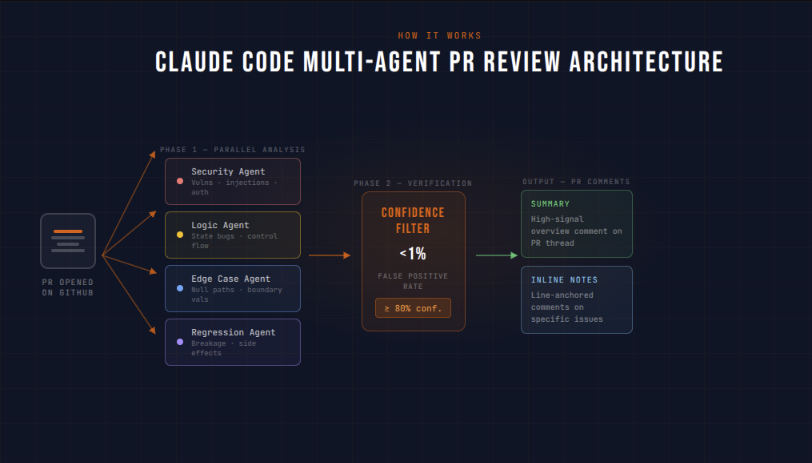
The number of agents assigned to a review scales with PR size and complexity. Large or risky changes receive deeper analysis with more agents; small or low-complexity PRs receive a lighter pass. This is important for cost management, which is addressed below.
Engineers can also trigger reviews manually via @claude review or @claude review once in the PR thread, and the feature can be configured to run on every push rather than just on PR creation.
Why Code Review Has Become a Bottleneck
Anthropic’s explanation for building this is straightforward: code output per engineer has grown 200% in the past year, driven largely by AI coding assistants. Review capacity has not scaled with that output. The result is that more PRs get cursory reads than thorough ones, and the risk surface of each merge has quietly expanded. This is one of the more significant challenges facing software engineering teams right now.
Before deploying Code Review internally, only 16% of Anthropic PRs received substantive review comments. After adoption, that figure rose to 54%. The system does not approve PRs; that decision remains with a human. But it closes the gap between what is shipping and what is being meaningfully reviewed.
A concrete internal example illustrates the value: a one-line change to a production service looked routine on the diff and would normally have earned a quick approval. Code Review flagged it as critical. The change would have broken authentication for the service, the kind of failure mode that reads as innocuous in isolation but is consequential at runtime. It was fixed before merge.
- Code output per engineer grew 200% in one year. Review bandwidth did not.
- Before Code Review, only 16% of Anthropic PRs got substantive comments. After: 54%.
- The system is designed to close the review gap, not to replace human approval judgment.
- A single missed one-line auth bug illustrates why depth in review matters.
The Numbers Engineers Should Actually Track
Anthropic has published operational metrics from internal use that give a realistic baseline for what to expect:
Detection rate by PR size
- Large PRs (over 1,000 lines changed): 84% receive findings, averaging 7.5 issues per review
- Small PRs (under 50 lines): 31% receive findings, averaging 0.5 issues per review
Other key metrics
- Average review duration: ~20 minutes
- False positive rate: Less than 1% of findings marked incorrect by engineers
- Internal review coverage change: 16% to 54% of PRs receiving substantive comments
These numbers indicate that Code Review delivers the most value on complex, high-volume, or risky changes. Teams with high PR velocity and large diffs are the primary beneficiaries in the current iteration. Small, routine PRs will generally receive lighter passes with fewer findings.
Pricing, Access, and Hard Constraints
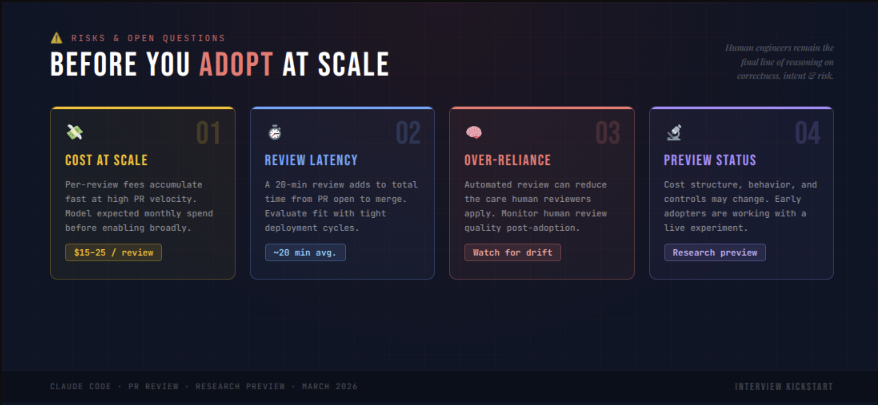
Code Review is billed separately from standard Claude usage, based on token consumption during the multi-agent review process. Reviews average $15 to $25 each, scaling with PR size and complexity.
Anthropic provides spending controls at several levels:
- Monthly organization caps: Set a total monthly limit across all reviews for the organization
- Repository-level activation: Enable reviews only on the repositories where it makes financial and operational sense
- Analytics dashboard: Track PRs reviewed, acceptance rates, and total spend per repository
ZDR incompatibility: Organizations with Zero Data Retention enabled cannot use Code Review. If your org requires ZDR for compliance, this feature is not currently available to you.
GitHub only: GitLab, Azure DevOps, and Bitbucket are not supported at launch. GitHub is the only integration in the research preview.
What This Changes Day to Day
The practical effects on engineering workflow are worth thinking through carefully rather than assuming they will be uniformly positive.
On the positive side, engineers reviewing large diffs will have a prioritized list of high-confidence issues to examine rather than having to scan every line. This should reduce both review time and the cognitive load of catching subtle bugs in code they did not write.
The system also creates a structural incentive to keep PRs smaller. When the cost of a review scales with PR size and the quality of findings decreases for larger diffs, teams naturally begin to prefer smaller, more focused changes. That is a workflow improvement with benefits that extend well beyond the AI review itself.
On the configuration side, the quality of Code Review output depends partly on the guidance files in the repository. Teams that invest time in CLAUDE.md and REVIEW.md files, explicitly stating conventions, known patterns to flag, and areas of particular risk, will get more precise and contextually relevant findings. This is not optional polish; it is a meaningful input to output quality.
Bonus Tip
CLAUDE.md the same way you would write an onboarding guide for a senior contractor. Name the non-obvious things: security-critical paths, known tricky state flows, patterns your team has intentionally avoided, and the conventions that matter most to reviewers. The more specific it is, the tighter the findings become.One concern that engineers have raised publicly is the self-review problem: AI-generated code being reviewed by another AI system. The multi-agent design partially addresses this by having independent agents verify each other’s findings before anything surfaces. However, it does not eliminate the underlying concern that certain classes of systematic errors in AI-generated code may not be caught by AI reviewers trained on similar distributions. Human validation remains essential.
The Broader Significance for Engineering Teams
Code Review signals where agentic AI in software development is heading. The trajectory is not just toward faster code generation; it is toward AI systems that participate in the quality gates of the delivery pipeline itself.
This shift has real implications for team structure and skill requirements. Engineers who configure and govern multi-agent systems will need different skills than engineers who simply use AI coding assistants. Understanding how to write effective guidance files, how to interpret and validate AI-generated findings, how to set spending controls that balance coverage against cost, and how to measure whether the system is actually improving bug detection rates are now practical engineering competencies. The technical skill set demanded of senior engineers is actively expanding in this direction.
For engineering managers, the cost model introduces a new line in the engineering budget. At $15 to $25 per review, a team running 100 PRs per month is looking at $1,500 to $2,500 monthly in Code Review costs alone, before factoring in variation by PR size. That is a justifiable investment if it is measurably reducing post-merge bugs, but it requires deliberate tracking to verify.
For teams already working on or moving into agentic AI systems, the design of Code Review is also a useful reference architecture. A pattern of parallel specialized agents followed by a confidence-scored verification pass before any output is committed applies well beyond code review. If you are building or governing multi-agent systems, understanding that pattern in a well-documented production deployment is valuable.
IK’s Agentic AI for Software Engineers course covers exactly this kind of architecture: how multi-agent pipelines are designed, where confidence scoring and verification layers fit in, and how to build the oversight skills that are becoming mandatory for senior engineers working with agentic systems. Engineering managers can find a parallel track in the Agentic AI for Engineering Managers course.
Where It Delivers the Most Value
Based on available data and early customer reports, Code Review is best suited for:
- High-velocity teams where human reviewers are genuinely stretched and PRs are frequently getting cursory reads
- Large or architecturally complex PRs where the surface area is too wide for a single reviewer to cover thoroughly
- Security-sensitive codebases where catching vulnerabilities before merge justifies a higher per-review cost
- Teams heavily using AI coding assistants, where the volume of AI-generated code has outpaced confident human review coverage
- Distributed or async teams where review turnaround time is a recurring bottleneck
It is less suited for small teams with low PR volume, repositories under ZDR constraints, or organizations on individual plans.
It is also worth noting the real-world case Anthropic surfaced from TrueNAS. On a ZFS encryption refactor in the open-source middleware, Code Review identified a latent type mismatch in adjacent code that was silently clearing the encryption key cache on every sync. It was a pre-existing bug in code the PR happened to touch, the kind of issue a human reviewer scanning the changeset would not immediately go looking for. That is precisely where the full-codebase context of the multi-agent approach pays off.
Risks and Open Questions
Several concerns merit honest consideration before adopting this at scale.
Latency: A 20-minute average review adds to total time from PR open to merge. Teams with tight deployment cycles should evaluate whether this fits their process.
Over-reliance: There is a documented behavioral pattern where automated review reduces the care human reviewers apply to their own pass. Monitor whether human review quality is declining after adoption.
Research preview status: The feature is still evolving. Cost structure, behavior, and controls may change. Teams adopting now are working with a live experiment.
The self-review problem deserves its own note. When AI-generated code is reviewed by another AI, there is a legitimate architectural concern that the same distribution biases in the generation model may surface in the review model. The independent multi-agent design reduces this risk but does not eliminate it. Human engineers remain the final line of reasoning about correctness, intent, and risk.
How to Run a Useful Pilot
A structured pilot produces far better signal than a broad rollout. Here is a practical approach:
- Select two or three representative repositories: one with high PR volume and large diffs, one security-sensitive, one with smaller routine changes. Diversity in the pilot reveals how the tool behaves across workload types.
- Write or update guidance files before enabling:
CLAUDE.mdandREVIEW.mdshould explicitly name conventions, known risk areas, and patterns the team cares about. Output quality is meaningfully better with clear context. - Set monthly repository-level spend caps before you start. Do not wait until the first billing cycle to discover the cost profile.
- Run for a full sprint cycle and track: PRs reviewed, findings accepted, time to merge with and without AI review, and spend per repository.
- Compare against pre-pilot baselines. If acceptance is high and pre-merge bug catch rate is improving, the investment is justified. If most findings are dismissed, adjust guidance files before scaling.
Teams considering a broader shift toward agentic tooling in their SDLC might also explore how DevOps to MLOps transition are reshaping the skills engineers need when AI systems enter the delivery pipeline.
Key Facts and Pilot Metrics at a Glance
| Item | Detail |
|---|---|
| Launch date | March 9, 2026 |
| Availability | Research preview, Team and Enterprise plans only |
| Platform support | GitHub only (GitLab, Azure DevOps, Bitbucket not yet supported) |
| Average cost per review | $15 to $25 |
| Average review time | ~20 minutes |
| Trigger options | On PR creation, after each push, or manually via @claude review |
| False positive rate | Less than 1% marked incorrect by engineers |
| ZDR compatibility | Not available for Zero Data Retention organizations |
| Confidence threshold | 80% minimum before a finding is posted |
Metrics to Track in a Pilot
- PRs reviewed vs. total PRs opened
- Findings accepted vs. findings dismissed
- False positive rate over time
- Time to merge (with AI review vs. baseline)
- Bugs caught pre-merge vs. post-merge
- Spend per repository per month
- Human review quality indicators (comment depth, coverage)