A FAANG Software Engineering Resume is far more than a summary of skills; it is a precise, results-driven narrative that reflects engineering excellence, strategic ownership, and product impact at scale. A FAANG Software Engineering Resume is a strategic articulation of how your engineering decisions created value at scale.
For recruiters at companies like Meta, Amazon, Apple, Netflix, and Google, your resume must translate complex technical contributions into clear, measurable outcomes. Think in terms of system-wide performance gains, cost-efficient architectures, and products that scaled to millions of users. Recruiters are drawn to specifics like “reducing API latency by 30%”, “designing distributed systems that process 10M+ requests per day”, or “leading infrastructure migrations that saved 15% in cloud expenses”. A FAANG resume is a strategic blueprint of engineering outcomes, and results.
In this article, we will guide you on how to build FAANG Software Engineering resume that recruiters will love!
Why Your Resume Matters in FAANG Hiring
You might believe that your portfolio, GitHub repos, or LeetCode badges are enough to stand out. But here’s the truth: your resume is what gets you in the room. Everything else comes later. Especially in FAANG hiring, where you’re just one of thousands of applicants, a crisp, thoughtful, and strategic resume is your launchpad.
To understand this better, let’s explore it step by step, just like a structured learning module
1. The ATS Gatekeeper
Every FAANG company uses an Applicant Tracking System (ATS). This is software that scans your resume for keywords, formatting, and relevance. If it doesn’t find what it’s looking for, your resume gets filtered out, often before a human ever sees it. No matter how talented you are, if your resume can’t pass this first digital gatekeeper, you’re invisible.
2. Recruiters Scan; They Don’t Read
If your resume does pass the ATS, the recruiter’s scan is next. And guess what? They spend just 6–8 seconds scanning each resume. That’s not a lot of time. Your job is to make the important parts scream out at them:
- Clear section headers
- Quantified accomplishments
- Easy-to-skim bullet points
- No fluff
3. Competition is Ruthless
FAANG companies receive thousands of applications for a single role. And many applicants have degrees from top-tier schools, experience in startups, and serious technical portfolios. What’s going to set you apart? A resume that speaks the language of impact, scale, and ownership.
4. Your Resume Is Your Product
Think of your resume the same way you’d think about a product. It needs a clean interface (formatting), clear messaging (content), and it needs to solve a problem (prove you’re a great fit). Treat it like something you’d launch to the public.
Also Read: Why a Resume Matters for Software Engineers
What Do FAANG Recruiters Look For in Resumes?
Before refining your resume, it is important to understand a core principle: FAANG recruiters do not seek perfection; they seek proven problem-solvers. Your resume should clearly demonstrate your ability to solve complex challenges, create tangible value, and operate at scale.
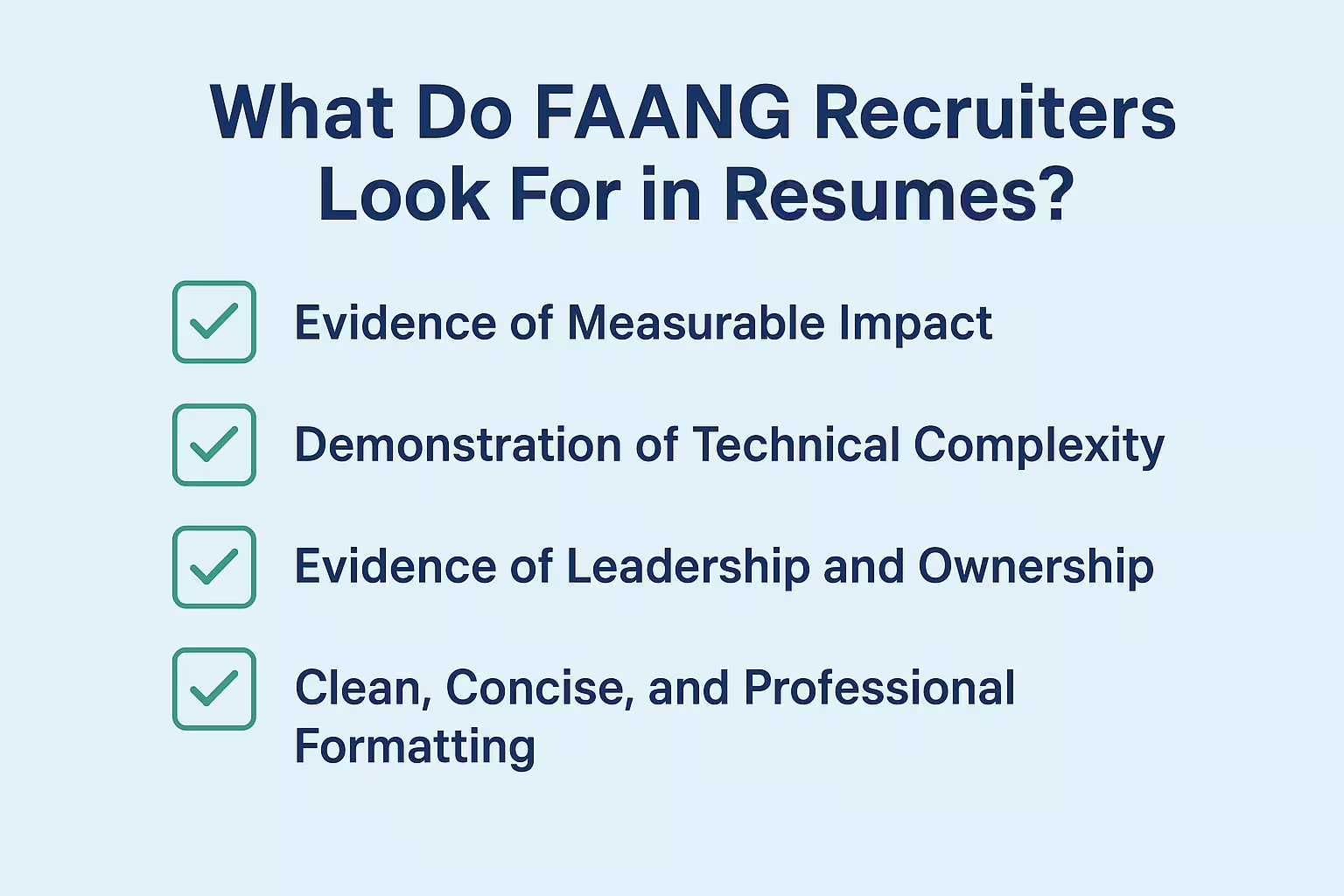
1. Evidence of Measurable Impact
FAANG recruiters prioritize engineers who understand and deliver measurable business value. This means every bullet point on your resume should reflect specific, quantified outcomes rather than vague responsibilities.
Ineffective example:
Worked on improving backend systems.
Effective example:
Refactored backend services, reducing API response time by 43% and improving uptime to 99.97% across 12M+ user sessions monthly.
Key takeaway: Use metrics to convey scope, scale, and impact. This shows not only your technical ability but also your awareness of business outcomes, a key hiring signal at companies like Google and Meta.
2. Demonstration of Technical Complexity
Top-tier companies value engineers who can think critically and work with complex systems. Your resume should reflect:
- System design and architecture experience
- Distributed and scalable systems work
- Production-grade infrastructure exposure
- Use of data structures and algorithms in real applications
- Performance tuning and reliability improvements
Highlighting these experiences illustrates your depth as an engineer and aligns with Google’s focus on computational thinking and Netflix’s1 emphasis on context over control.
3. Evidence of Leadership and Ownership
You do not need a management title to demonstrate leadership. Recruiters look for engineers who take initiative, guide others, and influence outcomes.
Strong indicators include:
- Driving end-to-end project delivery
- Mentoring interns or junior developers
- Identifying and resolving systemic issues
- Contributing to architectural decision-making
This reflects a behavior-driven interpretation of leadership, which is emphasized in both Netflix’s and Google’s hiring principles.
4. Clean, Concise, and Professional Formatting
The format of your resume should prioritize clarity and function over creativity. Recruiters often spend less than 10 seconds on an initial review.
Formatting principles:
- Use readable, professional fonts (e.g., Arial, Calibri, Roboto)
- Keep margins clean and consistent
- Use bullet points, not paragraphs
- Avoid dense or rambling descriptions
- One-page resumes are preferred for those with less than 7 years of experience; two pages are acceptable for senior professionals only if content is impactful and relevant
Google explicitly emphasizes the importance of readability and “scannability” in its resume advice to engineering candidates.
Step-by-Step Guide to Building a FAANG Resume
Here is a step-by-step guide to build a FAANG resume
Step 1: Conduct a Structured Brain Dump
Set aside 30 minutes to collect information. List out:
- All roles, internships, and significant projects
- Technologies used in each
- Problems solved, and your approach
- Any available performance metrics
- Team structure, constraints, and timelines
At this stage, your goal is to gather raw content without judgment.
Step 2: Filter for Relevance and Depth
Once the brain dump is complete, critically evaluate each item. For every role or experience, ask:
- Is this relevant to the role I am targeting?
- Does it show depth in engineering or leadership?
- Can I quantify the value I delivered?
Remove any content that feels generic, unmeasurable, or misaligned with your target role. Avoid stating passive participation (e.g., “attended meetings”) and instead focus on action and impact.
Step 3: Write Results-Driven Bullet Points
Use this structure for bullet points:
[Action Verb] + [What You Did] + [How You Did It] + [Quantified Result]
Example 1:
Led migration from monolithic architecture to containerized microservices (Docker, Kubernetes), reducing deployment time by 65% and cutting system downtime by 40%.
Example 2:
Developed a Python-based internal tool to automate data validation, saving 15+ hours/week and reducing manual errors by 30%.
Recommended action verbs:
- Designed
- Built
- Refactored
- Launched
- Optimized
- Spearheaded
- Automated
- Reduced
- Scaled
Avoid passive or vague verbs such as “helped,” “supported,” or “participated in.”
Step 4: Organize for Clarity and Skimmability
Structure your resume with clearly defined, industry-standard sections:
1. Header
Include your full name, professional email, phone number, LinkedIn profile, and GitHub (if applicable).
2. Summary (Optional)
A 2–3 line professional summary can be helpful if you are pivoting industries or roles. It should clarify your specialization and value proposition.
3. Technical Skills
Group your skills by category for readability. For example:
Languages: Python, Java, Go
Frameworks: React, Django, Spring Boot
Cloud/DevOps: AWS, Docker, Kubernetes, Terraform
Databases: PostgreSQL, MongoDB, Redis
4. Work Experience
List roles in reverse chronological order. Each job should include:
- Job Title, Company, Dates
- 3–6 bullet points focused on accomplishments, ordered by impact
5. Projects (Essential for early-career candidates)
Include 2–3 significant projects. For each, highlight:
- Objective or problem solved
- Tools and technologies used
- Results or adoption level
6. Education
Include degree, institution, graduation year, and GPA (if recent and >3.5).
More Sections:
- Certifications
- Awards or publications
- Volunteer work
- Open-source contributions
Step 5: Tailor the Resume for Each Application
A tailored resume dramatically improves callback rates. Consider the following:
- Match keywords and phrases from the job description
- Reflect domain-specific expertise (e.g., fintech, streaming, e-commerce)
- Highlight projects or responsibilities relevant to the team’s focus
- Emphasize experience at a similar scale (e.g., “millions of users,” “global availability,” “99.99% uptime”)
According to LinkedIn’s2 Recruiter Insights, resumes that naturally mirror job descriptions (without keyword stuffing) are far more likely to surface in search filters and recruiter scans.
Also Read: 10 Full Stack Developer Resume Tips to Land Your Dream Job
Common Mistakes You Should Avoid While Building FAANG Resume
Even strong candidates often lose out because of resume basics. Here are the most common pitfalls, and how to fix them:
Generic Bullets
If a bullet point could describe anyone, it doesn’t add value. Instead of “Worked on UI components,” highlight measurable outcomes like “Built UI components that improved page load time by 18%.”
Tool Soup
Listing every technology you’ve ever touched doesn’t make you stronger; it makes your focus unclear. Curate your tech stack to the tools you know deeply and can confidently discuss.
Lack of Metrics
Numbers tell your story better than words. Even academic projects or internships can include metrics, “Optimized algorithm to reduce runtime by 2s,” or “Built a prototype that reached 1K+ users.”
Spelling & Grammar Errors
Attention to detail is non-negotiable. A single typo can suggest carelessness. Use tools like Grammarly, proofread aloud, and get peer feedback before sending.
Overly Long Resumes
If you have under 6 years of experience, a three-page resume is a red flag. Keep it concise: one page for juniors, two for senior professionals, with every line earning its place.
Final Polish To Your Resume: The Human Touch
Your resume is almost ready, but before sending it out, give it one last refinement. Think of this step as your final quality check before launch.
Ask Yourself the Right Questions
- Does it sound like me and reflect my authentic story?
- Would I be impressed as a hiring manager reading this?
- Is the impact of my work easy to spot at first glance?
- Are the results quantified, clear, and meaningful?
Practical Final Steps
- Read it as a recruiter would: Print it or view it fresh to catch errors and flow issues.
- Get external feedback: Share it with a senior peer, mentor, or industry professional.
- Seek expert review: Submit it for a FAANG-style resume review (e.g., Interview Kickstart’s program) to benchmark against top hiring standards.
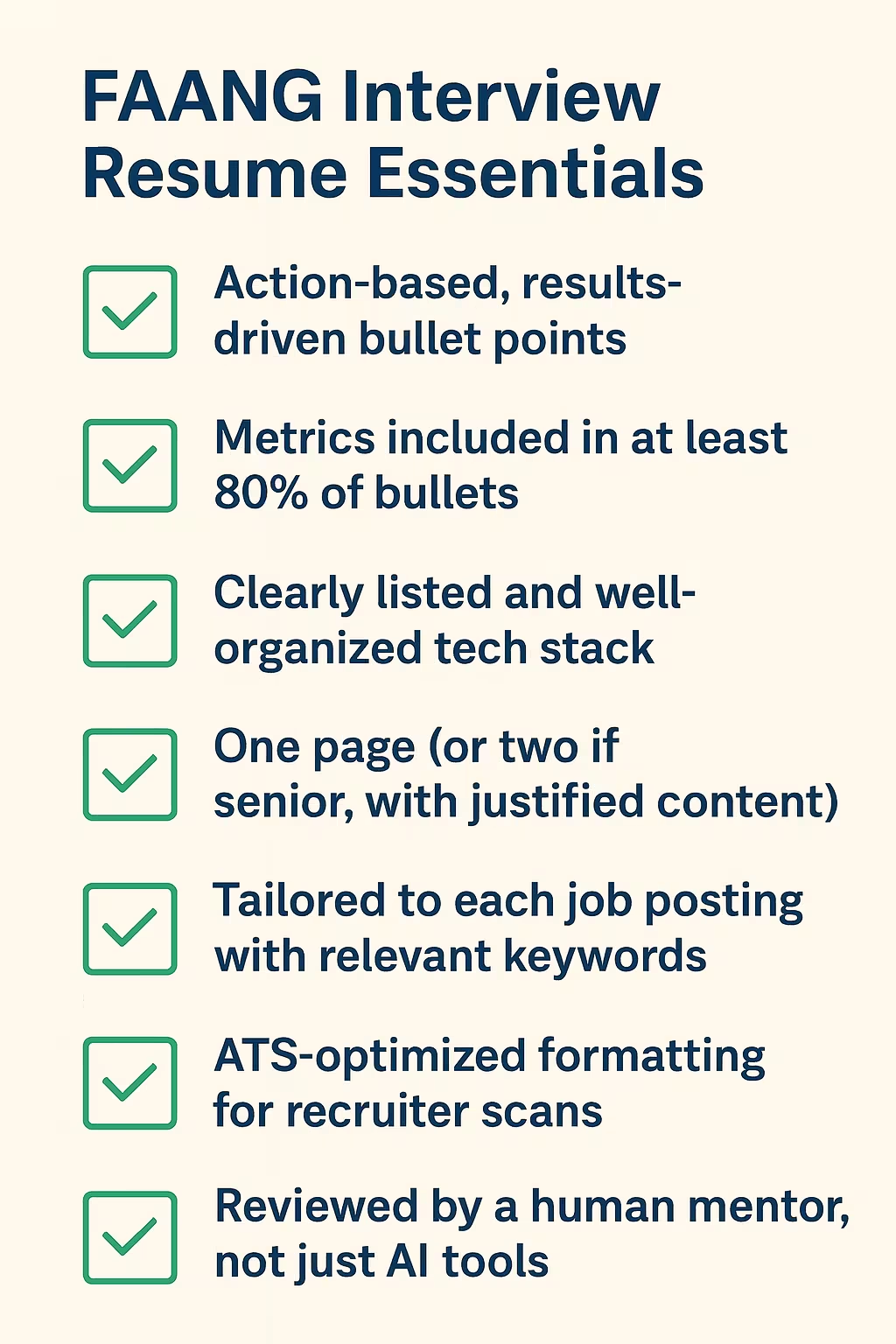
Recap Checklist: Is Your Resume FAANG-Ready?
Conclusion
Building a FAANG software engineer resume isn’t about listing every job or every skill you have.Your resume should tell a compelling story of impact, growth, and engineering excellence. The truth is, your resume is more than just a summary of your past; it’s a pitch for your future.
We’ve walked through what matters: clarity over clutter, outcomes over effort, and structure that speaks recruiter. And the best part? Every mistake we covered is fixable. Whether you’re early in your career or aiming for your next big move, you can build a resume that doesn’t just pass the filters but earns you the interview.
Top candidates don’t just write code. They communicate value. They write resumes that reflect how they solve problems at scale, collaborate effectively, and think like systems engineers, even on paper.
Want to Build a FAANG-Ready Resume That Gets Interviews?
If you’re serious about landing interviews at top companies, the next step is clear. Join Interview Kickstart’s masterclass:
How to Crack FAANG Interviews in the Era of AI.
In this exclusive session, you’ll learn:
- How AI is Already Embedded in FAANG+ Interviews
- AI Insights by Role
- Understand what AI readiness means for SWE, PM, EM, TPM, and data roles.
- Live Demo: Build & Explain an Agent
Led by FAANG hiring managers and technical coaches, this isn’t theory; it’s actionable insight. Whether you’re optimizing your resume or preparing for high-stakes interviews, this masterclass is your shortcut to getting noticed in the most competitive hiring landscape ever.
Reserve your free spot here and start building the kind of resume that opens real doors.
FAQS
1. What do FAANG recruiters look for in a resume beyond technical skills?
FAANG recruiters look for evidence of impact, scalability, and leadership potential, not just coding ability. They value resumes that highlight measurable results, cross-functional collaboration, and problem-solving at scale.
2. How do I write a FAANG software engineer resume that stands out?
Resumes competent for FAANG tend to place the impact before the description of responsibilities. List accomplishments using the STAR method (Situation, Task, Action, Result). Make sure to quantify your results, such as, “Reduced API latency by 35%.” Keep the formatting clean, highlight relevant skills, and add ATS-friendly keywords that are specific to that job.
3. Are there any FAANG resume templates in Google Docs or Word I can use?
Yes, you can use minimalist resume templates available in Google Docs and Microsoft Word. The best FAANG templates are usually one-page, ATS-friendly, and avoid excessive design elements. Tools like Overleaf (for LaTeX) or Canva (with ATS-compatible exports) also provide structured templates tailored for tech roles.
4. What does a sample resume for a software engineer with 2 years of experience look like?
As the title suggests, this two-year-strong experience resume should emphasize key projects (system design, APIs, and automation scripts). Result-driven accomplishments, such as “Improved testing efficiency by 25% via automation,” would suffice nicely. Core technical skills like Python, Java, React, AWS, etc. If the candidate lacks strong animal exposure, internships and relevant coursework may be beneficial.
5. What format should I use for a FAANG resume: PDF, Word, or Google Docs?
Online submission is best done with a PDF file, as it retains the formatting. For quick editing and tailoring of versions, go for Word and Google Docs. In addition, some types of recruiters also accept PDF formats generated in LaTeX because of their neat layout.