AI agents in retail and e-commercerce are transforming how businesses interact with customers and manage online shopping experiences. As customer expectations continue to rise, brands need faster support, smarter product recommendations, and real-time assistance across multiple channels. These retail and ecommerce AI agents make it possible by automating responses, personalizing product discovery, and improving service efficiency without requiring large support teams.
According to Zendesk’s CX1 trends report, 72%1 of shoppers expect instant chat assistance, while Epsilon’s2 study suggests 80% of consumers are more likely to make a purchase when brands offer personalized experiences.
However, manually delivering this level of service can be costly and inconsistent. AI agents solve this challenge by acting as intelligent digital assistants that work 24/7, reducing support workload while improving customer satisfaction.
In this article, we will explore 6 retail and ecommerce AI agents that stand out for their performance, practicality, and real business impact.
Key Takeaways
- AI agents are transforming retail and e-commerce by handling conversations smartly, increasing resolution rate, and automating workflows.
- They reduce operational costs by automating repetitive task and post-purchase workflows all without adding more people to the teams.
- AI-powered product discovery and recommendations directly increase conversions and average order value.
- AI agents in retail and ecommerce cater to all enterprises irrespective of the size, from cost-friendly solutions like Tidio lyro to enterprise platforms like Salesforce Einstein.
- The right AI agent improves customer satisfaction, retention, and revenue while enabling teams to focus on high-value tasks.
What are AI Agents in Retail and E-Commerce?
AI agents are intelligent digital assistants that use machine learning and natural language processing to understand customer queries, provide personalized responses, and automate pre- and post-purchase workflows.
AI agеnts collеct rеal-timе data from diffеrеnt channеls, follow businеss rulеs to makе smart dеcisions, and takе action automatically. It enables independent AI modеls into activе systеms that run on thеir own and quickly adapt to markеt changеs.
In retail and e-commerce the AI agents handle tasks like product recommendations, order tracking, post-purchase updates, customer support, personalized recommendations, etc, across channels such as web, mobile, app, WhatsApp, email, and social platforms.
Why AI Agents Matter in Retail & E-Commerce?
AI agents matter in retail and e-commerce because they personalize customer experiences, automate support, optimize inventory, and boost sales through data-driven insights. They help businesses save time, improve efficiency, and deliver round-the-clock service to customers. As retail continues to grow rapidly with a global presence, brands are facing immense challenges.
Listed below are the key hurdles.
- Increasing customer expectations: Today’s shoppers are tech savvy and aware. They expect brand to reply their queries within seconds and expect hyper personalized product suggestions in sync with their purchase history, browsing behavior, and expect cashback or reward for their loyalty with the brands.
- High operational costs: Hiring large customer support or logistics teams is a big cost to the company.
- Data complexity: Modern e-commerce platforms generate enormous data like search queries, cart abandonment, analytics, sales, etc that humans cannot analyze manually.
- Multi-Channel customer touchpoints: Customers interact with the platform across the website, chat, WhatsApp, Instagram, email for product, payment, refund, or any other related query.
Retail and e-commerce AI agents help solve these challenges by:
- Automating conversations and workflows: AI agents can handle customer chats, automate phone calls, and handle end-to-end complex routine workflows. They ensure faster response while decreasing manual workload.
- Analyzing data in real time: AI agents track customer activity, website interactions, and sales patterns instantly, giving businesses actionable insights for quick decision-making.
- Predicting purchasing behavior: AI agents study shopping trends, past purchases, and browsing habits to forecast what customers are likely to buy next.
- Personalizing product discovery: They recommend products based on each customer’s preferences, past shopping history, and behavior, making shopping more engaging and relevant.
- Improving conversion rates: By offering personalized suggestions and timely assistance, AI agents help turn visitors into buyers more effectively.
- Reducing support load and costs: AI automates FAQs, post-purchase workflows like delivery status, return, and refund which reduces the need for large support teams while improving efficiency.
6 Best AI Agents in Retail and E-Commerce
AI agents are powerful, but they need to be carefully integrated into workflows based on the right fit, clear use cases, logic, and business rules. If your goal is to improve customer support, boost product discovery, personalize shopping experiences, and speed up the post-purchase workflows these AI agents are extremely valuable. They help automate repetitive tasks, assist shoppers in real time, handle product, sales, delivery, refunds, related queries and workflows, and boost conversions across the platforms. All withit requiring constant human involvement.
Let’s explore the 6 best AI agents in retail and e-commerce that stand out for reliability, ease of use, and performance.
| AI Agent | Best For | Company Size | Core Strength |
| Ada | Global customer support automation | Mid to Large | Multilingual CX automation |
| Tidio Lyro | Fast setup support agent | Small to Mid | Cost-effective support |
| Coveo | Search and discovery personalization | Mid to Large | Intelligent catalog navigation |
| Zowie | AI-driven customer support + sales | Mid-market D2C | Turns chats into sales |
| Salesforce Einstein | Predictive lifecycle intelligence | Mid to Enterprise | CRM-driven personalization |
| Clerk.io | Product recommendations & personalization | Growing E-Commerce | Conversion and AOV improvement |
1. Ada AI Agent
Ada is a leading AI-powered customer experience automation platformrm built for enterprises. It focuses on delivering efficient support interactions across multiple channelsls including web chat, email,WhatsApp, facebook meMessenger, and mobile apps. Ada continuously learns from customer interactions and internal knowledge sources, allowing it to provide accurate automated responses.
Ada helps brands reduce wait times, lower support costs, and handles repetitive queries such as order tracking, returns, shipping details, and product questions. It is widely used in retail and online commerce because of its strong integration capabilities with CRMs, order management systems, and inventory platforms.
Pros
Ada offers several strong advantages that make it valuable for retail and e-commerce businesses. Here are some of the key benefits.
- Enterprise-grade automation
- Strong multi-language support
- No-code workflow customization
- Deep integration ecosystem
Cons
Even though Ada is powerful, there are certain limitations and challenges. Below are the main drawbacks to consider.
- Performs best when brands maintain high-quality knowledge base
- Less flexible in A/B personalization
Pricing: Ada AI agent pricing is customized based on your business need. There is no specific pricing available on its official website. You can contact them to know more.
Use Cases
Ada AI agent can be applied in multiple retail and e-commerce scenarios to improve customer experience and operations. Here are some of the most common and impactful use cases:
- AI voice agent
- CRM integration
- Customer support
- Post-purchase workflows
- Conversion boost
Ada is best for brands that have high traffic and global audiences.
2. Tidio Lyro<h3>

Tidio Lyro is an AI customer service agent designed for online stores, particularly small and medium-sized e-commerce businesses. Unlike enterprise-first solutions, Tidio is cost-effective and simple to deploy. It focuses heavily on improving customer support responsiveness and reducing reliance on human agents.
Tidio Lyro uses conversational AI to understand visitor intent, respond to inquiries, and guide customers toward purchases. It can analyze patterns in common queries to help store owners identify improvement areas in product pages, descriptions, or checkout flows.
Pros
Tidio Lyro offers a range of advantages that make it valuable for customer support and automation. It helps teams reply faster, reduce workload, and deliver better customer experiences. The main benefits of Tidio include:
- Affordable pricing
- Easy to set up
- Pre-trained conversation system
- Supports proactive engagement
Cons
There are also some limitations to consider when choosing Tidio Lyro. These can affect cost, customization, and scalability depending on your business size, such as:
- Not ideal for complex enterprise workflows
- AI accuracy depends on structured FAQs, and data flows are set
- Limited product recommendation intelligence
Pricing: The pricing for Tidio’s “Lyro”-enabled chat & automation platform begins at US $24.17/month for the starter plan and goes up to US $749/month for the plus plan. The enterprise-grade premium pricing is available via contact for the highest limits and managed AI services.
Use Cases
Tidio Lyro is best suited for businesses that want to automate support while still having a personal touch. It works well in scenarios where quick responses and repetitive queries are common, such as.
- Customer support automation
- Sales support
- Cart recovery
Tidio Lyro is often considered among the best AI agents in retail and e-commerce for small and growing brands due to its affordability and ease of adoption.
3. Coveo AI<h3>

Coveo is an AI-driven search and personalization engine that enhances product discovery and browsing experiences. It is designed for brands with large catalogs, multiple product categories, and heavy on-site search usage. Coveo uses machine learning to understand what users are searching for, predict their preferences, and deliver relevant product suggestions.
Coveo significantly improves on-site engagement and conversion rate by ensuring customers find exactly what they are looking for quickly.
Pros
Coveo AI brings powerful AI-based personalization and search capabilities to digital retail experiences. Here are some of the key strengths it provides.
- Advanced AI search capabilities
- Personalized product recommendations
- Scales for large catalogs
- Improves site search accuracy
Cons
Despite its strong features, there are some considerations to be aware of. Here are some of the potential challenges.
- Higher learning curve
- Enterprise pricing model
- Integrations require technical setup
Pricing: Pricing is not available on its website. You have to go to pricing page, provide the business email, and request pricing.
Use Cases
Coveo AI is best used for upgrading the shopping and discovery experience on e-commerce websites. Below are common scenarios where it creates measurable impact.
- Product search optimization
- Personalized shopping experience
- Conversion rate improvement
Coveo is widely recognized among the best AI agents in retail and e-commerce for businesses that want to enhance product findability and browsing efficiency.
4. Zowie

Zowie is a specialized AI customer service automation platform built specifically for e-commerce brands. It focuses on resolving repetitive customer support questions while also generating new sales opportunities by identifying buying intent during conversations. Zowie uses powerful natural language understanding (NLU) to interpret customer messages and respond accurately without constant human supervision.
Unlike general chatbots, Zowie learns from real customer interactions and automatically builds knowledge bases, intent libraries, and conversation workflows. This makes it particularly useful for fast-growing brands handling thousands of support requests daily.
Pros
Zowie provides conversational automation to improve sales, support, and engagement. Here are some of the benefits it brings to retail businesses:
- High accuracy in resolving repetitive tickets
- AI learns from past conversations
- Sales-driven conversation logic
- Fast deployment and minimal setup time
Cons
Before adopting Zowie, consider these limitations.
- It works best for high-volume support environments
- Limited third-party integration options
- Basic reporting/analytics
Pricing: We provide annual plans based on performance. You pay only for what our AI Agents actually deliver. As they take on more processes, the value and impact for your business increase. Reach out to their team to discuss more.
Use Cases
Zowie is used to improve both pre-sale and post-sale customer experiences. Here are examples of where it performs well.
- Customer support automation
- Conversion assistance
- Post-purchase engagement
Because of its focus on real conversations and revenue-first workflows, Zowie is recognized among the best AI agents in retail and e-commerce for brands that want customer interactions to directly influence sales growth.
5. Salesforce Einstein AI

Salesforce Einstein AI is an enterprise-grade AI layer integrated into the Salesforce CRM ecosystem. It enables retailers to automate customer journeys, personalize outreach, forecast demand, and understand customer behavior at scale. Einstein connects sales, marketing, and customer service data to create a unified customer intelligence model.
Einstein is not just a chatbot, it is a decision-making and predictive insights engine. It helps retailers plan better promotions, optimize product recommendations, identify high-value customers, and predict churn risks. This is especially important for large retailers managing multi-channel sales operations.
Pros
Einstein AI system supports deep personalization and predictive recommendations across customer journeys. Here are some standout advantages.
- Deep CRM integration
- Predictive analytics for sales and demand
- Multi-channel personalization workflows
- Sophisticated segmentation and targeting
Cons
While the tool is powerful, it comes with certain challenges. You should keep these points in consideration:
- It requires Salesforce ecosystem adoption
- Complexity in setup and advanced feature cost
Pricing: Salesforce Einstein Agent pricing starts at $50/user/month for the starter plan, which includes essential AI customer support capabilities. The professional plan costs $125/user/month, while the enterprise plan goes up to $175/user/month, offering advanced automation, integrations, and custom AI workflows.
Use Cases
Einstein AI agent can be used across marketing, sales, and customer personalization workflows. It’s best implementation for the brands can be for:
- Sales demand forecasting
- Churn prevention
Salesforce Einstein is consistently included among the best AI agents in retail and e-commerce for organizations that want to move from transactional selling to data-driven lifecycle management.
6. Clerk.io
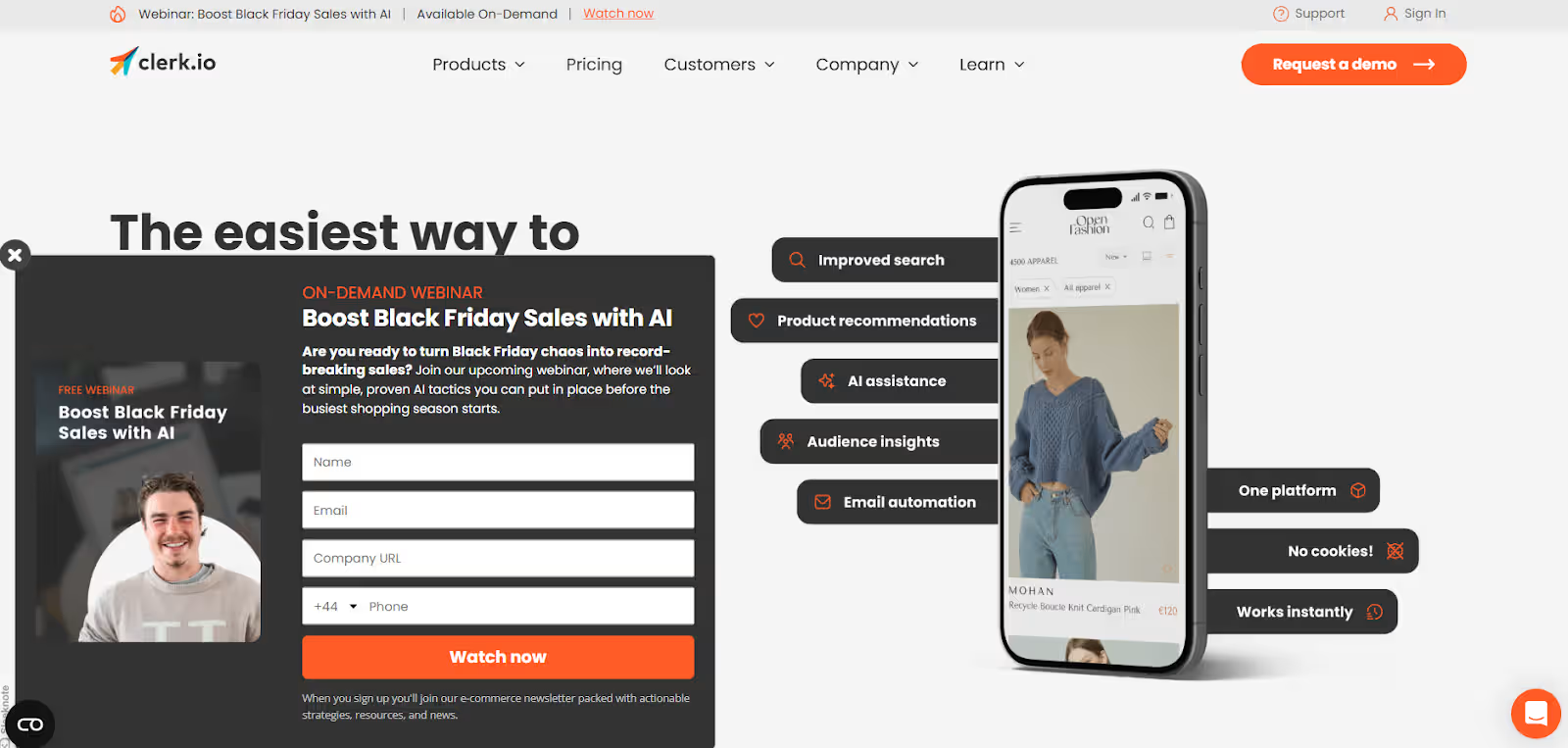
Clerk.io is an AI-powered personalization and recommendation engine that helps retail and e-commerce brands increase conversions. It works by analyzing user behavior, purchase patterns, and product relationships to suggest the most relevant items in search results, product pages, email campaigns, and post-purchase interactions.
Unlike traditional recommendation engines that rely on rule-based matching, Clerk.io automatically adapts to trends and seasonal shifts. This makes it ideal for brands with diverse product catalogue or frequent new arrivals.
Pros
Clerk.io’s solution helps retailers boost sales by recommending the right products to the right users. Here are the key benefits that make it effective:
- Strong product recommendation engine
- Easy integration with shopify, magento, woocommerce
- Works across multiple channels
- Auto-optimization with no manual rules
Cons
Even though the tool is strong at what it does, there are a few trade-offs. Here are the primary limitations to consider:
- Not suitable for very small catalogue
- Very advanced Analytics dashboard and dense with many features
- Optimization may take time
Pricing: Clerk.io uses a modular, pay-as-you-go pricing model, so you only pay for the products and usage you need. Features like search, recommendations, chat, email, and audience segmentation are priced based on monthly volume (e.g., searches, recommendations, conversations, email opens, or subscribers).
Use Cases
Clerk is ideal for improving product discovery and sales performance on online stores. Here are some scenarios where it works best:
- Product recommendations
- Personalized email campaigns
- Search optimization
Clerk.io’s ability to turn browsing behavior into personalized recommendations makes it one of the best AI agents in retail and e-commerce for brands focused on maximizing revenue per visitor.
Conclusion
AI agents are changing the way shoppers shop and interact with the modern commerce platforms. The adoption of AI agents is transforming retail and e-commerce by accelerating conversions, increasing average order value, and speeding up purchase decisions. AI identifies and addresses common exit points and reasons, turning abandoned carts and confused shoppers into loyal buyers.
As customer expectations continue to rise, these tools help businesses stay competitive while reducing workload and operational costs.
Whether your goal is higher conversions, automated support, or improved product discovery, adopting the right AI agent can take your business to next level The future of retail is intelligent, responsive, and data-driven, powered by AI.
Learn to Build an E-commerce AI Agent
AI agents are rapidly reshaping the growth of Retail and e-commerce brands. In the era of AI, shoppers are not only searching the products on the web and social platforms but also validating their purchase decisions on AI platforms. In these challenging times, brands need to automate critical tasks and invest time in the results achieved through automation. The future of Retail and E-commerce is moving towards AI-based automation at a rapid pace.
It’s the perfect time to master AI solutions, transforming the future of online shopping. Learn with our masterclass to build an E-commerce AI Agent, transforming industries like healthcare and e-commerce. Get practical advice from experts at Google, Amazon, and build real-world AI projects to boost your portfolio and stand out in AI/ML roles.
FAQs: AI Agents in Retail and E-Commerce
Q1. What are AI agents in retail and e-commerce?
AI agents are intelligent systems that handle customer support, product recommendations, and real-time assistance across digital platforms.
Q2. How do AI agents improve customer experience?
They deliver fast responses, personalized suggestions, and seamless support, making the shopping journey smoother.
Q3. Do AI agents replace customer support teams?
No. They reduce repetitive workload so human teams can focus on complex queries.
Q4. Are AI agents expensive for small businesses?
Some tools like Tidio Lyro and Clerk.io are budget-friendly and scalable for small to medium-sized stores.
Q5. How quickly can AI agents be integrated?
Most AI agents integrate within hours to a few days, depending on platform and workflow complexity.