AI for personalized affiliate campaigns is no longer a futuristic idea—it’s the present reality of affiliate marketing. For years, affiliates relied on broad targeting, banner ads, and the hope that their links would find the right audience. Today, that shotgun approach doesn’t cut it. Consumers expect experiences that feel tailored, relevant, and timely—and AI makes that possible at scale.
This article breaks down how affiliates can harness AI to design campaigns that don’t just reach people but resonate with them. We’ll explore practical strategies, tools, benefits, and even the challenges of personalization, with insights you can act on right away.
Key Takeaways
- AI for personalized affiliate campaigns transforms broad targeting into precision marketing.
- Micro-segmentation and dynamic creatives drive deeper engagement.
- Predictive analytics ensures affiliates anticipate customer needs.
- Personalization across channels creates consistent experiences.
- Ethical, cost, and privacy challenges must be managed carefully.
Smart Strategies to Use AI in Affiliate Marketing
Adopting AI is only half the battle; the real magic happens when affiliates apply it strategically. With AI for personalized affiliate campaigns, affiliates can move from generic blasts to precision-driven campaigns. Let’s explore the smartest strategies.
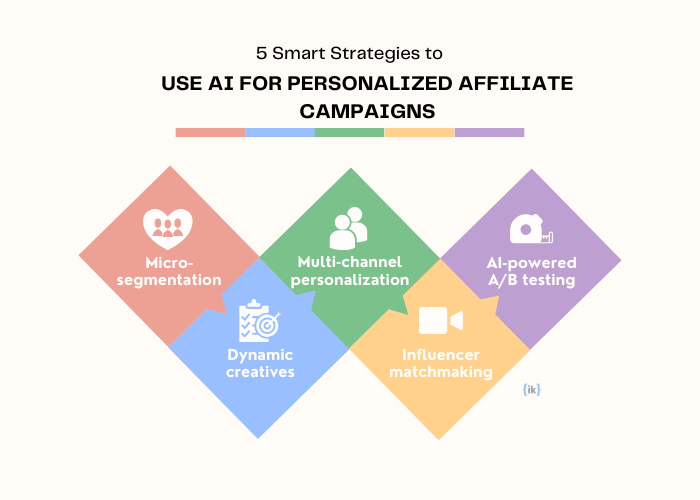
The following are some of the smartest strategies that help use AI for personalized affiliate campaigns:
- Micro-segmentation
- Dynamic creatives
- Multi-channel personalization
- Influencer matchmaking
- AI-powered A/B testing
Now, let’s look at them in detail.
1. Micro-segmentation
Instead of broad categories like “men” or “women,” AI breaks audiences into hyper-specific groups. For instance, late-night mobile shoppers might respond differently from weekday desktop users. Affiliates can create tailored campaigns for each micro-segment, boosting engagement.
With AI for personalized affiliate campaigns, affiliates can create highly relevant campaigns for each group. For example, a campaign tailored for parents shopping during back-to-school season will look different from one targeting young professionals on fitness journeys.
Micro-segmentation ensures that no audience feels like just another face in the crowd.
2. Dynamic creatives
AI-driven creatives adapt in real time. A customer who recently browsed sports gear might see ads featuring limited-time discounts on running shoes, while another user gets recommendations for yoga mats.
Dynamic creatives make marketing feel personal, not generic.
3. Multi-channel personalization
AI ensures consistent personalization across platforms—email, search, social, and websites. For example, someone who clicks on an affiliate blog about meal kits might later see retargeted Facebook ads and receive a personalized discount email.
Customers rarely stick to one channel. They might click a blog, open an email, then see a retargeted ad on Instagram. AI for personalized affiliate campaigns ensures personalization stays consistent across every touchpoint.
This seamless journey builds trust and keeps customers engaged across touchpoints.
4. Influencer matchmaking
AI analyzes audiences to connect affiliates with the right influencers or publishers. Instead of wasting money on partnerships with high reach but low relevance, affiliates can target influencers whose audiences are likely to convert.
This approach prioritizes quality over quantity in partnerships.
5. AI-powered A/B testing
Traditional A/B testing is slow, requiring weeks of data before results become clear. AI accelerates the process by testing multiple variations simultaneously and automatically favoring the top performer.
Faster testing means affiliates can iterate more quickly and capture results sooner.
By adopting these strategies, affiliates move from scattershot campaigns to precision-driven marketing.
Also Read: AI tools for marketing
Why Personalization Matters More Than Ever
Consumers are flooded with marketing messages daily, and generic campaigns quickly get lost in the noise. Personalization cuts through the clutter, offering individuals exactly what they’re looking for. According to McKinsey, companies that lead in personalization generate 40% more revenue than their peers1.
For affiliates, this translates into better click-through rates, stronger engagement, and higher conversions. Personalization isn’t just about showing a product—it’s about delivering the right product, in the right context, at the right time. And AI is the engine that makes this possible.
In short, personalization is no longer optional; it’s the standard that separates thriving affiliates from struggling ones.
The Role of AI in Affiliate Marketing
The role of AI in affiliate marketing is to transform raw customer data into actionable insights. AI automates segmentation, predicts intent, and delivers personalized recommendations—at a scale no human team could achieve.
Affiliates can’t manually analyze thousands of data points per visitor, but AI thrives on this complexity. From clicks and searches to purchase histories and browsing behaviors, AI identifies patterns that reveal what each customer is most likely to want next. This means affiliates can serve offers that feel timely and relevant, boosting both customer experience and conversions.
What’s more, AI adapts in real time. As customer behaviors shift, AI models update automatically, ensuring campaigns stay relevant without requiring constant manual tweaks. In a fast-moving digital environment, this agility is invaluable.
AI acts as the unseen engine that allows affiliates to personalize campaigns effectively and efficiently.
Core AI Capabilities Affiliates Can Leverage
AI offers a wide range of features, but not all are equally valuable for affiliates. The most impactful capabilities are those that directly enhance personalization, targeting, and performance.
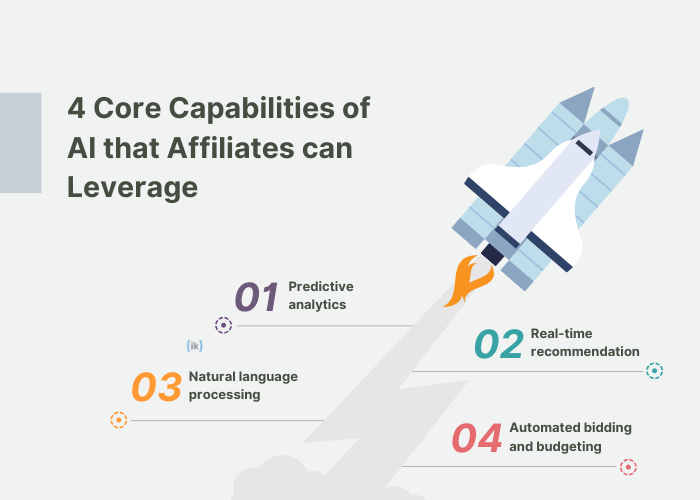
Let’s look at some of the core AI capabilities that affiliate marketers can use to their advantage:
- Predictive analytics
- Real-time recommendation engines
- Natural language processing
- Automated bidding and budgeting
Let’s look at them in detail:
1. Predictive analytics
Predictive analytics looks at historical data to forecast future behavior. For affiliates, this means identifying which users are most likely to convert, unsubscribe, or buy again. Instead of spreading budgets thinly, predictive models focus resources on the prospects with the highest potential ROI.
Imagine an affiliate promoting travel packages. Predictive analytics might reveal that certain users are more likely to book trips during holidays, while others respond better to off-season discounts. Affiliates can tailor campaigns accordingly, increasing efficiency and conversions.
2. Real-time recommendation engines
Recommendation engines use browsing and purchasing history to suggest relevant products or services. For affiliates, this is game-changing. A visitor browsing running shoes could be shown complementary items like fitness trackers or water bottles—leading to larger cart values.
These engines keep customers engaged by making discovery effortless. Instead of overwhelming them with endless options, affiliates can highlight what’s most relevant at that moment.
3. Natural language processing (NLP)
NLP enables machines to understand and generate human-like language. Affiliates can use NLP to create dynamic ad copy, personalized email subject lines, or even chatbot conversations that adapt to each user.
For example, an NLP-powered system can adjust tone for different audiences—playful for younger demographics, professional for business audiences—improving engagement across campaigns.
4. Automated bidding and budgeting
AI can also manage bidding strategies in real time. Rather than manually adjusting ad spend, affiliates can let algorithms automatically shift budgets toward higher-performing placements. This ensures that campaigns are continuously optimized for the best possible returns.
When affiliates use AI for affiliate marketing, personalization goes from a manual task to an automated advantage.
These capabilities make AI for personalized affiliate campaigns scalable and effective.
Also Read: How to Use AI for Marketing
Benefits of Using AI for Personalized Affiliate Campaigns
Using AI for personalized affiliate campaigns delivers clear and measurable benefits:
- Better targeting: Campaigns reach audiences who are most likely to engage, reducing wasted impressions.
- Higher conversion rates: Relevant offers mean more clicks, sign-ups, and purchases.
- Efficiency at scale: AI automates processes that would otherwise take hours of manual work.
- Improved customer loyalty: Personalized experiences foster stronger, longer-term relationships.
- Data-driven insights: Affiliates gain deeper visibility into what works, enabling smarter decisions over time.
The true benefit is efficiency; affiliates can scale personalization efforts without dramatically increasing workload.
Challenges in Using AI for Personalized Affiliate Campaigns
While AI for personalized affiliate campaigns offers tremendous opportunities, it isn’t without hurdles. Affiliates who dive in too quickly without understanding the limitations may find themselves wasting money—or worse, losing customer trust.
One of the most pressing issues is data privacy. Regulations like GDPR in Europe and CCPA in California impose strict rules on how customer data can be collected, stored, and used. Affiliates that mishandle personal information, even unintentionally, can face hefty fines and reputational damage. Trust is hard to build and very easy to lose, so privacy compliance must be a top priority.
Another challenge is AI bias and transparency. Algorithms learn from historical data, which can include hidden biases. For instance, if past campaigns favored one demographic, AI might inadvertently continue excluding other valuable groups. This creates ethical concerns and may hurt campaign performance in the long run. Affiliates need to regularly audit their AI tools to ensure fair, transparent outcomes.
There’s also the cost barrier. Many sophisticated AI platforms are priced for enterprise budgets, not small affiliates. While affordable options exist, they may lack advanced features. This can create a gap between large networks that can afford state-of-the-art AI and individual affiliates who are just starting out.
Tool overload is another overlooked issue. With so many AI platforms available, affiliates often get caught up in shiny-object syndrome—testing every new tool without a clear strategy. This leads to fragmented data, wasted spend, and inconsistent campaign execution. Choosing fewer tools that integrate well and support long-term goals is often more effective.
Finally, the learning curve remains significant. Even with user-friendly interfaces, AI requires a baseline understanding of analytics, machine learning, and data interpretation. Affiliates who lack this foundation may underuse the technology or misinterpret results. Upskilling is essential to get the full value from AI.
In short, affiliates must balance innovation with responsibility. AI can transform campaigns, but only when used with careful planning, ethical oversight, and a solid understanding of the risks involved.
Also Read: Role of AI in Content Marketing
Conclusion
AI for personalized affiliate campaigns is no longer a futuristic concept—it’s here, reshaping how affiliates engage with audiences every day. By combining predictive analytics, recommendation engines, and dynamic creatives, affiliates can offer customers experiences that feel tailored rather than transactional. This doesn’t just boost conversions; it builds trust and loyalty in a noisy digital landscape.
At the same time, success depends on more than tools. Affiliates need a balance of strategy, ethical data use, and human storytelling to ensure campaigns resonate authentically. Technology may do the heavy lifting, but creativity and responsibility turn clicks into lasting relationships.
As AI evolves, the affiliates who learn, adapt, and experiment will stay ahead of the curve. Personalization isn’t just the future of affiliate marketing—it’s the differentiator that will separate winners from the rest.
FAQs: AI for Personalized Affiliate Campaigns
Q1. What is AI for personalized affiliate campaigns?
It’s the use of artificial intelligence to design affiliate campaigns that adapt to customer behavior, preferences, and intent in real time. This includes predictive targeting, tailored recommendations, and automated optimization.
Q2. How does personalization improve affiliate performance?
Personalized campaigns resonate more with audiences, leading to higher click-through rates, stronger conversions, and better customer retention. Research shows companies that excel at personalization generate up to 40% more revenue compared to competitors.
Q3. Which AI tools should affiliates start with?
Begin with tools that solve your biggest pain point. For example, Jasper for content creation, HubSpot for segmentation, and Dynamic Yield for personalization. Over time, you can integrate advanced platforms for bidding and predictive analytics.
Q4. What are the main challenges in using AI in affiliate marketing?
Challenges include data privacy compliance (GDPR, CCPA), AI bias, high costs for advanced tools, and the steep learning curve. Affiliates must start small, choose tools carefully, and prioritize ethics and transparency.
Q5. Will AI replace affiliate marketers?
No. AI can automate tasks and optimize campaigns, but affiliates provide the human creativity, storytelling, and strategic judgment that machines can’t replicate. The best results come from blending AI efficiency with human insight.