Article written by Rishabh Dev under the guidance of Alejandro Velez, former ML and Data Engineer and instructor at Interview Kickstart. Reviewed by Suraj KB, an AI enthusiast with 10+ years of digital marketing experience.
Today, how to use AI for marketing is not a question of “if”, but “when” and “how effectively” as businesses worldwide witness an unprecedented revolution in customer engagement and revenue generation. From Coca-Cola using AI-generated personalized advertisements to reach millions of consumers to small e-commerce stores using AI chatbots to increase sales by 67%1, artificial intelligence has proved its ability to deliver measurable results across businesses of all sizes.
In recent years, the marketing landscape has evolved, and only those organizations that have mastered AI integration are dominating the markets. Modern customers expect personalized experiences, instant responses, and relevant content, which are difficult to fulfill without AI assistance.
Whether you are an experienced marketer looking to optimize existing campaigns or a business owner looking to understand how AI can transform your marketing efforts, this comprehensive guide will explain where and how to use AI for marketing, best practices, use cases, and mistakes to avoid.
Key Takeaways
- AI empowers marketers to create personalized content, automate tasks, and analyze customer behavior at scale, boosting efficiency and ROI across all channels.
- Top use cases include content generation, email marketing, customer segmentation, social media management, analytics, and customer support.
- Start small and scale wisely by setting clear goals, piloting a use case, monitoring KPIs, and expanding based on real results.
- Best practices include maintaining a human touch, utilizing clean data, prioritizing customer privacy, and regularly training teams.
- Avoid common mistakes, such as over-automation, ignoring data quality, and skipping planning—AI is a powerful tool, but it requires thoughtful execution.
What Does “Using AI for Marketing” Mean?
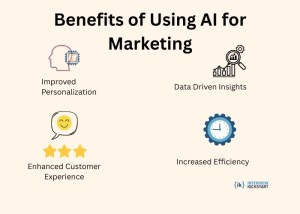
Artificial Intelligence (AI) has become a cornerstone of modern marketing strategies, with more and more companies moving towards using AI for marketing. AI marketing uses artificial intelligence to make decisions on the basis of data collected and analysed.
AI in marketing can be described as the process of using AI methods and tools like data models, algorithms, and machine learning to provide customer insights. Modern marketers use these to optimize spending, customize content, and personalize the customer journey.
Marketing AI identifies trends, makes predictions, and performs various digital tasks that typically require human intelligence and decision-making by using machine learning and deep learning. There are two types of AI marketing that you must know about: predictive AI and generative AI. While predictive AI analyzes patterns in data to anticipate outcomes, generative AI creates new content by generating new images, text, and videos based on the data it has been trained on.
AI marketing generally involves the tools that generate and deliver targeted messages at the best times possible using customer data. It also comprises using artificial intelligence to create blog outlines for chatbots that learn from user interactions.
AI helps marketers save a lot of time and cost that they otherwise would spend manually analyzing data and developing targeted campaigns.
Where and How to Use AI for Marketing

Let’s break down the key areas where you can use AI for marketing to enhance performance and engagement.
1. Content Creation
One of the most popular applications of generative AI in marketing is for content creation. AI tools for marketing like Jasper, ChatGPT, Claude, and others are capable of generating blog posts, social media captions, email text, video scripts, and more.
Companies across various industries utilize GenAI to produce diverse forms of content. Coca-Cola, the beverage giant, is a prime example of a company leveraging generative AI. The company uses AI to generate several variations of its “Share a Coke” ads based on customer preference data. Similarly, The Washington Post is another leading company in its sector that utilizes GenAI to write articles across various niches, enabling its journalists to focus on more complex stories.
2. Customer Segmentation & Targeting
Another area where AI excels in marketing is analyzing vast amounts of customer data and segmenting it based on criteria like behavior, preferences, demographics, and more. It enables precise customer targeting and personalization. Machine learning algorithms are capable of identifying patterns in the customer journey and predicting the segments with a higher likelihood of conversion.
Spotify’s ‘Discover Weekly’ playlist is a perfect example of AI-driven customer segmentation. The platform analyzes listening habits, song preferences, and user behavior to create personalized playlists for its users. This results in higher engagement and retention rates.
3. Email Marketing
Using AI for email marketing involves leveraging machine learning to optimize send times, personalize content, and predict subscriber behavior. AI can analyze when individual subscribers are most likely to open emails, what subject lines resonate with different segments, and which content drives the highest engagement.
Airbnb uses AI to personalize its email marketing campaigns, analyzing user search history and preferences to recommend relevant properties. This AI-driven approach has significantly improved their email open rates and booking conversions.
4. Social Media & Ads
When exploring how to use AI for social media marketing, consider tools that can schedule posts, analyze engagement patterns, and optimize ad performance. AI can determine the best times to post, suggest hashtags, and even create visual content.
Facebook’s (Meta) advertising platform uses AI to optimize ad delivery, automatically adjusting bids and targeting to maximize results. Starbucks leverages AI to analyze social media sentiment and adjust its marketing campaigns accordingly, ensuring they stay relevant to current trends and customer preferences.
5. Analytics and Reporting
AI transforms raw data into actionable insights through advanced analytics and automated reporting. These tools can identify trends, predict future performance, and provide recommendations for optimization.
Google Analytics utilizes AI to provide insights, such as customer lifetime value predictions and conversion probability. Adobe’s marketing cloud employs AI to analyze customer journeys across multiple touchpoints, helping marketers understand which channels drive the most value.
6. Customer Support
AI-powered chatbots and virtual assistants can handle routine customer inquiries, provide instant responses, and qualify leads. This improves customer experience while freeing up human agents for more complex issues.
Sephora’s chatbot on Facebook Messenger uses AI to provide personalized beauty advice and product recommendations. The bot can answer questions about products, provide tutorials, and even book appointments, handling thousands of interactions simultaneously.
How to Use AI for Marketing: A 5-Step Process
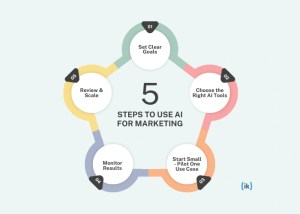
Here’s a simple yet effective approach to using AI in your marketing efforts:
1. Set Clear Goals
Before implementing any AI solution, define what you want to achieve. Are you looking to increase conversion rates, reduce customer acquisition costs, or improve customer satisfaction? Clear goals will guide your AI tool selection and implementation strategy.
2. Choose the Right AI Tools
Research and select the best AI tools for marketing that align with your goals and budget. Consider factors like ease of use, integration capabilities, and scalability. Popular options include HubSpot for CRM automation, Mailchimp for email marketing, and Hootsuite for social media management.
3. Start Small – Pilot One Use Case
Begin with a single use case to test the waters. This might be automating email campaigns or using AI for social media scheduling. Starting small allows you to learn the system, measure results, and build confidence before expanding.
4. Monitor Results
Track key performance indicators (KPIs) to measure the impact of your AI implementation. Compare metrics before and after implementation to understand the ROI. Use A/B testing to optimize AI-generated content and campaigns.
5. Review & Scale
Analyze the results from your pilot program and identify areas for improvement. Once you’re satisfied with the performance, gradually scale your AI usage to other marketing functions. Continuous monitoring and optimization are crucial for long-term success.
Best Practices in Using AI for Marketing
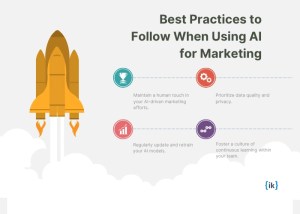
Always maintain a human touch in your AI-driven marketing efforts. While AI can automate many tasks, human creativity and strategic thinking remain irreplaceable. Ensure your AI tools complement rather than replace human expertise.
Prioritize data quality and privacy. AI systems are only as good as the data they’re trained on. Implement robust data collection and cleaning processes, and ensure compliance with privacy regulations like GDPR and CCPA.
Regularly update and retrain your AI models. Consumer behavior and market conditions change constantly, so your AI systems need regular updates to maintain effectiveness. Schedule periodic reviews and retraining sessions.
Foster a culture of continuous learning within your team. AI technology evolves rapidly, and staying updated with the latest developments is crucial for maintaining a competitive advantage.
6 Common Mistakes to Avoid When Using AI for Marketing

While AI offers tremendous potential for marketing success, many businesses stumble during implementation by making avoidable errors. Learning from these common pitfalls can save you time, money, and frustration while ensuring your AI marketing initiatives deliver the results you’re expecting.
- Using AI without proper planning: Jumping into AI without clear objectives or understanding of your current processes can lead to wasted resources and poor results. Take time to assess your needs and create a strategic implementation plan.
- Over-relying on AI for creative decisions: While AI can generate content and provide insights, human intuition and creativity are still essential for developing compelling marketing strategies and emotional connections with customers.
- Neglecting data security and privacy: AI systems often process sensitive customer data, making security a top priority. Implement proper data protection measures and ensure compliance with relevant regulations.
- Trying to automate everything immediately: Resist the temptation to automate all processes at once. Gradual implementation allows you to learn from each phase and make necessary adjustments before scaling up.
- Ignoring data quality and accuracy: Poor data leads to poor AI performance. Ensure your data is clean, relevant, and regularly updated to maintain effective AI-driven marketing campaigns.
- Failing to train your team properly: AI tools are only as effective as the people using them. Invest in proper training and change management to ensure the successful adoption of new marketing initiatives across your team.
Real-World Use Cases & Applications
Netflix uses AI to analyze viewing patterns and preferences, enabling it to recommend content that keeps users engaged. Their recommendation engine is responsible for 80% of the content watched on the platform, demonstrating the power of AI in customer retention.
Amazon’s AI-powered product recommendations drive 35% of its revenue. Their algorithms analyze browsing history, purchase patterns, and similar customer behavior to suggest relevant products, significantly increasing average order value.
Domino’s Pizza implemented AI chatbots for order taking, reducing wait times, and improving customer satisfaction. Their AI system can handle complex orders and modifications, processing thousands of orders simultaneously during peak hours.
Mastercard uses AI for fraud detection, analyzing transaction patterns in real-time to identify suspicious activities. Their AI system reduces false positives by 50% while improving fraud detection accuracy.
Conclusion
Learning how to use AI for marketing is no longer optional—it’s essential for staying competitive in today’s digital landscape. From content creation to customer support, AI offers countless opportunities to improve efficiency, personalization, and results.
The key to successful AI implementation lies in starting with clear goals, choosing the right tools, and maintaining a balance between automation and human creativity. As AI technology continues to evolve, marketers who embrace these tools while following best practices will be best positioned to drive growth and success.
Remember, AI is a tool to enhance your marketing efforts, not replace human strategy and creativity. By combining the power of artificial intelligence with human insight and creativity, you can create marketing campaigns that are both highly efficient and deeply engaging.
FAQs: How to Use AI for Marketing
1. What is the best AI tool for marketing beginners?
HubSpot’s free CRM offers AI-powered features that are perfect for beginners, including email automation and lead scoring. It’s user-friendly and integrates well with other marketing tools.
2. How much does AI marketing software typically cost?
AI marketing tools range from free basic plans to enterprise solutions costing thousands monthly. Most small businesses can start with tools like Mailchimp ($10-20/month) or Canva Pro ($15/month).
3. Can AI replace human marketers completely?
No, AI cannot replace human marketers entirely. While AI excels at data analysis and automation, human creativity, strategy, and emotional intelligence remain crucial for effective marketing.
4. How long does it take to see results from AI marketing tools?
Most businesses see initial results within 2-4 weeks of implementing AI tools. However, significant improvements typically become apparent after 2-3 months of consistent use and optimization.
5. Is AI marketing suitable for small businesses?
Yes, many AI marketing tools are designed for small businesses with affordable pricing and user-friendly interfaces. Tools like Buffer, Hootsuite, and Mailchimp offer AI features accessible to smaller teams.
6. What data do I need to start using AI for marketing?
You need customer data such as demographics, purchase history, website behavior, and engagement metrics. Most AI tools can work with basic customer information and improve as you collect more data.
7. How do I measure the ROI of AI marketing tools?
Track metrics like conversion rates, customer acquisition costs, engagement rates, and time saved. Compare these metrics before and after AI implementation to calculate ROI.
8. Are there any risks associated with AI marketing?
Main risks include data privacy concerns, over-reliance on automation, and potential bias in AI algorithms. Proper implementation and monitoring can mitigate these risks effectively.
9. Can AI help with visual content creation?
Yes, AI tools like Canva Magic Design, Adobe Sensei, and DALL-E can create images, graphics, and videos. These tools can generate visual content based on text descriptions or brand guidelines.
10. How do I ensure my AI marketing complies with privacy regulations?
Choose AI tools that are GDPR and CCPA compliant, implement proper data consent mechanisms, and regularly audit your data collection and processing practices to ensure compliance.