System design interviews are not just about coding, they test your ability to architect scalable, reliable, and maintainable systems. They evaluate how you approach complex problems, handle trade-offs, and make decisions under uncertainty.
These interviews are common for senior engineers, staff engineers, and architects aiming for roles at top tech companies. Candidates are expected to demonstrate mastery of both low-level design (LLD) and high-level design (HLD) concepts, as well as scalability, fault tolerance, and common architectural patterns.
In this guide, we cover 50 must-know system design interview questions with answers. You’ll get insights into foundational LLD topics like class design, data structures, and algorithms, as well as advanced HLD concepts including distributed systems, load balancing, caching, and fault-tolerant architectures. Navigate through the sections to explore LLD vs HLD questions and prepare thoroughly for your interview.
Key Takeaways
- System design interviews test architecture thinking, problem-solving, and trade-off reasoning.
- Both LLD and HLD are crucial; LLD focuses on implementation, HLD on system scalability.
- Understand core patterns like Singleton, Observer, Factory, and Strategy for practical designs.
- Scalability, caching, fault tolerance, and observability are evaluated across distributed systems.
- Real-world practice with diagrams, code snippets, and mock scenarios improves readiness.
Top 50 System Design Interview Questions
The questions in this guide progress from foundational LLD concepts to advanced HLD architecture topics. Start with low-level design to strengthen your understanding of component design, then move to high-level design to handle distributed systems and large-scale architectures.
Top Low-Level System Design Interview Questions
Low-Level Design (LLD) questions assess your ability to break down system architecture into individual components. They focus on modules, classes, data structures, and interface design, measuring how you implement systems cleanly and efficiently.
These questions test clarity, modularity, and maintainability in your code. Strong LLD skills show that you can translate high-level architecture into functional, scalable, and testable components.
Q1. What is Low-Level System Design in software development?
Low-Level Design (LLD) focuses on the detailed implementation of system components, including classes, methods, and modules. It ensures components interact seamlessly while remaining maintainable and efficient.
LLD emphasizes modularity, code readability, and adherence to design patterns. Key areas include data structures, algorithms, and interface contracts.
- Class design and relationships
- Data structures and algorithms
- Interface contracts
- Maintainability and testability
public class User {
    private String id;
    private String name;

    public User(String id, String name){
        this.id = id;
        this.name = name;
    }

    public String getId() { return id; }
    public String getName() { return name; }
}
Pro Tip: Focus on creating modular, testable components with clear interfaces.
Q2. How does database indexing optimize query performance?
Indexes allow the database to locate rows without scanning the entire table, improving read performance. They are essential in read-heavy systems for faster query response times.
Indexes incur storage and write overhead, so they must be used judiciously. Effective indexing balances query speed with storage and update costs.
| Aspect |
With Index |
Without Index |
| Query Speed |
Fast |
Slow |
| Storage |
Extra required |
None |
| Write Cost |
Higher |
Lower |
CREATE INDEX idx_user_id ON Users(id);
Pro Tip: Use indexes judiciously, too many indexes slow down writes.
Q3. Key considerations in designing a relational database schema
Database schema design ensures efficient data storage, retrieval, and integrity. A robust schema prevents anomalies and supports scalability.
Normalization, indexing, constraints, and partitioning are critical. Thoughtful design minimizes performance bottlenecks and simplifies maintenance.
- Normalization to remove redundancy
- Primary and foreign keys
- Data types selection
- Constraints (NOT NULL, UNIQUE)
- Indexing strategies
- Partitioning/sharding for large datasets
CREATE TABLE Orders (
    order_id INT PRIMARY KEY,
    user_id INT REFERENCES Users(id),
    amount DECIMAL(10,2)
);
Pro Tip: Balance normalization with query performance; denormalize selectively for speed.
Q4. Why is concurrency control important in multi-threaded systems?
Concurrency control prevents race conditions, deadlocks, and inconsistent data in systems where multiple threads access shared resources.
Effective concurrency management ensures system stability and data integrity under heavy load.
- Pessimistic locking: locks resources for writes
- Optimistic locking: validates updates before committing
- Transactional mechanisms: ensures atomicity and consistency
Pro Tip: Use pessimistic locking for write-heavy workloads; optimistic locking for read-heavy.
Q5. What are UML Behavioral Diagrams?

Behavioral diagrams model system behavior over time. They show interactions between components and dynamic changes in system state.
The four main types include use case, activity, sequence, and state diagrams. Each serves a specific purpose in capturing system behavior.
- Use Case: captures system-user interactions
- Activity: models workflow and process steps
- Sequence: shows interactions over time
- State: represents state transitions of objects
Q6. How do you model a sequence diagram for a user login process?
Sequence diagrams illustrate step-by-step interactions between components. For login, interactions occur between the user, frontend, auth service, and database.
This helps identify bottlenecks, order of operations, and responsibilities of each component.
User -> Frontend: Enter credentials
Frontend -> AuthService: Validate credentials
AuthService -> DB: Query user info
DB --> AuthService: Return user data
AuthService --> Frontend: Auth token
Frontend --> User: Display login success
Pro Tip: Sequence diagrams help visualize inter-component communication clearly.
Q7. How would you model the behavior of a system using a state diagram?
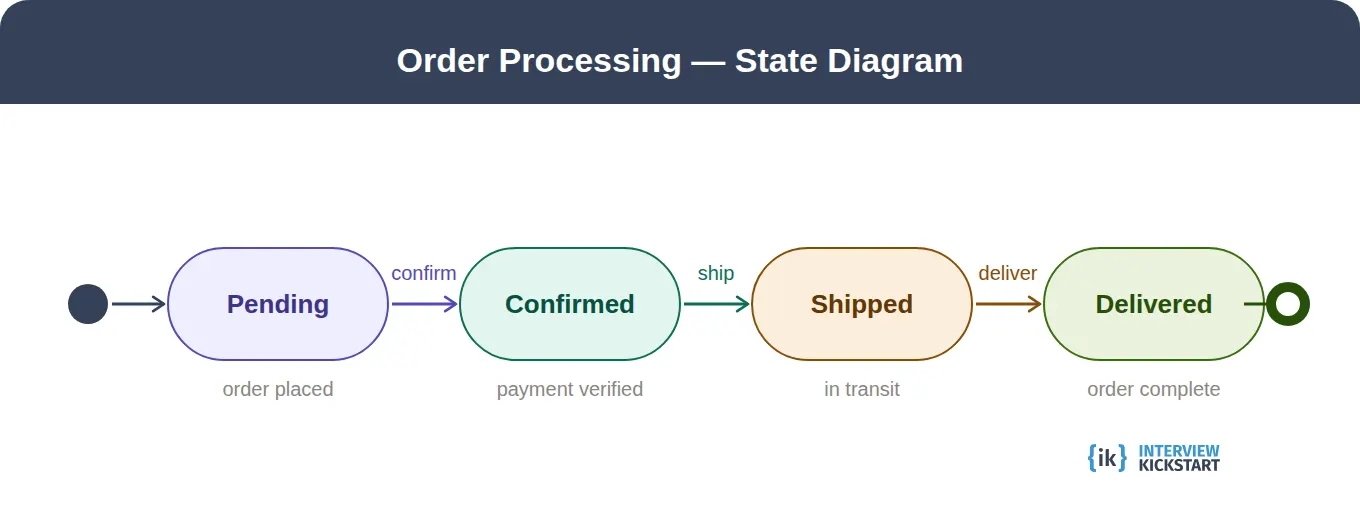
State diagrams depict all possible states of a component and transitions triggered by events.
For example, an order system can have states: Pending → Confirmed → Shipped → Delivered, helping track workflow and edge cases.
[Pending] --> [Confirmed] : Payment received
[Confirmed] --> [Shipped] : Order packed
[Shipped] --> [Delivered] : Delivered to customer
Q8. What factors influence the choice of data structures in LLD?
Data structures impact performance, memory, and maintainability. Choosing the right structure depends on access patterns, mutability, and ordering needs.
Using the optimal data structure improves efficiency and simplifies algorithms.
| Data Structure |
Best Use Case |
Time Complexity |
| Array |
Random access |
O(1) |
| Linked List |
Frequent inserts/deletes |
O(n) |
| HashMap |
Key-value lookup |
O(1) |
| Tree |
Sorted data |
O(log n) |
Q9. What are the benefits of normalization?
Normalization eliminates redundancy and ensures data integrity. It reduces update anomalies and improves consistency.
It also helps save storage space and enhances query performance when done appropriately.
| Before Normalization |
After Normalization |
| Multiple addresses per user repeated in table |
Separate Address table linked by user_id |
Q10. How do you design an efficient logging and monitoring system?
Logging and monitoring track system behavior and performance. Effective design ensures quick identification and resolution of issues.
Key elements include log levels, structured logging, centralized aggregation, and alerting for anomalies.
App -> Log Agent -> Aggregator -> Dashboard
Pro Tip: Use structured logs and centralized aggregation for observability at scale.
Top Low-Level Design Interview Questions
These next LLD questions dive deeper into design patterns, versioning, logging, and security. Mastering them shows you can implement scalable and maintainable components.
Understanding design patterns, logging strategies, and secure system design at the LLD level helps you produce code that is robust, testable, and easier for teams to maintain.
Q11. What are Design Patterns?
Design patterns are reusable solutions to common software design problems. They provide templates for structuring code efficiently and maintaining scalability.
They are categorized into Creational, Structural, and Behavioral patterns.
- Creational: Object creation mechanisms (e.g., Singleton, Factory)
- Structural: Class and object composition (e.g., Adapter, Composite)
- Behavioral: Interaction patterns (e.g., Observer, Strategy)
Q12. Why are Design Patterns important in software development?
Design patterns improve code maintainability, readability, and reusability. They allow teams to communicate solutions with a shared vocabulary.
They provide proven templates, reduce errors, and facilitate scalability across projects.
- Promote reusability
- Enable clear communication among developers
- Provide proven solutions to common problems
- Improve maintainability
Q13. Explain the Singleton Design Pattern with use cases.
The Singleton pattern ensures only one instance of a class exists. It provides a global access point for that instance.
It is useful for shared resources like configuration managers, loggers, and thread pools.
public class Logger {
    private static Logger instance;

    private Logger() {}

    public static Logger getInstance() {
        if (instance == null) {
            instance = new Logger();
        }
        return instance;
    }
}
Pro Tip: Singleton can introduce hidden global state, consider dependency injection when possible.
Q14. What is the Observer Design Pattern?
The Observer pattern defines a one-to-many dependency. When one object changes state, its dependents are notified automatically.
It is widely used in event systems, UI frameworks, and pub-sub messaging systems.
interface Observer {
    void update();
}

class Subject {
    List<Observer> observers = new ArrayList<>();
    void attach(Observer o){ observers.add(o); }
    void notifyAllObservers(){ observers.forEach(Observer::update); }
}
Q15. Pros and Cons of the Factory Design Pattern
The Factory pattern centralizes object creation logic, providing flexibility and decoupling clients from concrete classes.
It improves maintainability but can introduce additional complexity if overused.
| Pros |
Cons |
| Decouples object creation from usage |
More classes and complexity |
| Promotes code reusability |
Can overcomplicate simple systems |
| Supports polymorphism |
Debugging can be harder |
class ShapeFactory {
    static Shape getShape(String type){
        if(type.equals("Circle")) return new Circle();
        else return new Square();
    }
}
Q16. Strategy Design Pattern in Java
The Strategy pattern defines a family of algorithms and makes them interchangeable. It allows the algorithm to vary independently from clients.
Common use cases include payment processing, sorting strategies, or compression techniques.
interface PaymentStrategy {
    void pay(int amount);
}
class CreditCardPayment implements PaymentStrategy {
    public void pay(int amount){ System.out.println("Paid "+amount+" with Credit Card"); }
}
class PayPalPayment implements PaymentStrategy {
    public void pay(int amount){ System.out.println("Paid "+amount+" with PayPal"); }
}
Q17. How would you design logging for a distributed system?
Distributed systems require centralized logging for observability. Logs should include correlation IDs and structured formats for traceability.
Each service should log consistently, and aggregation should allow real-time analysis and alerting.
Services -> Log Shipper -> Central Log Store -> Dashboard
Q18. How does database replication improve reliability and performance?
Replication maintains copies of data across multiple nodes. Primary-replica setups improve read performance and ensure availability in case of failures.
Sync replication prioritizes consistency; async replication prioritizes performance and availability.
| Replication Type |
Latency |
Consistency |
Failover |
| Synchronous |
Low |
Strong |
Automatic |
| Asynchronous |
Very Low |
Eventual |
Manual/Automatic |
Q19. How do you handle versioning and backward compatibility in LLD?
Versioning ensures that new features do not break existing clients. It maintains stability across API changes.
Strategies include API versioning, feature flags, and deprecation cycles. A well-planned versioning strategy simplifies client upgrades.
interface PaymentServiceV1 {
    void pay(int amount);
}
interface PaymentServiceV2 {
    void pay(int amount, String currency);
}
Q20. How do you design a secure authentication and authorization system?
Secure systems require robust authentication and authorization mechanisms. Token-based authentication (JWT), RBAC, and MFA are common practices.
Secure session management, proper storage of credentials, and auditing help maintain integrity and prevent breaches.
Login Request -> Auth Service -> JWT Token -> Resource Access
Pro Tip: Always enforce secure token storage, rotation, and expiration policies.
Top High-Level System Design Interview Questions
High-Level Design (HLD) questions evaluate your ability to architect systems that scale, are fault-tolerant, and maintainable. Interviewers look for both conceptual understanding and practical trade-offs.
These questions test distributed system knowledge, API design, caching strategies, data consistency, and system observability, key skills for senior engineers, staff engineers, and architects.
Q21. What are the key components of a High-Level Design (HLD)?
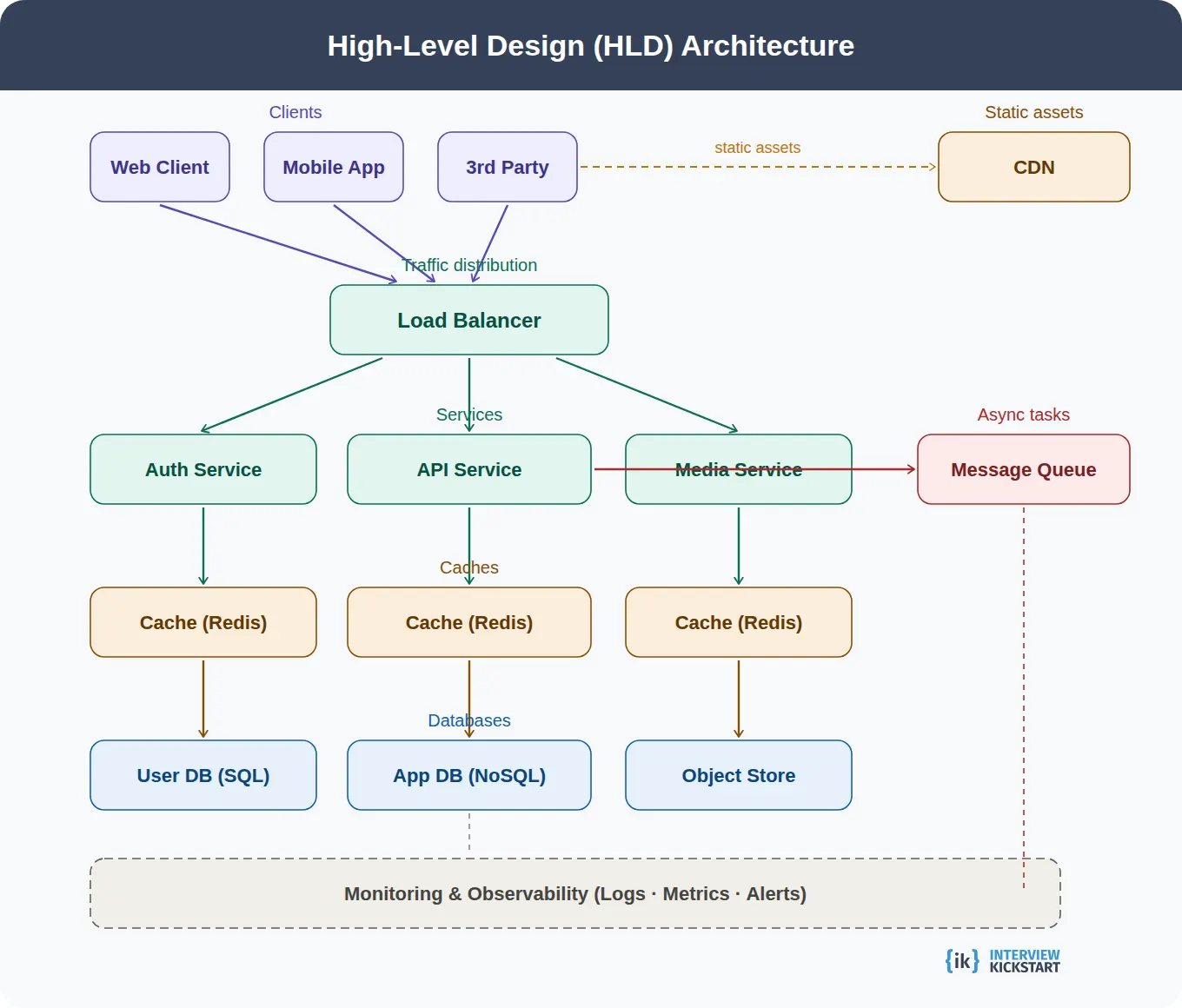
HLD components define the system’s overall architecture. They specify how modules interact, what services exist, and how data flows.
Core components include clients, load balancers, services, databases, caches, CDNs, message queues, and monitoring systems. Properly mapping these ensures scalability and reliability.
Clients -> Load Balancer -> Microservices -> Databases / Cache -> CDN -> Monitoring
Q22. What strategies ensure high availability in a distributed system?
High availability ensures minimal downtime. Designing systems with redundancy, failover, health checks, and geographic distribution is critical.
Each strategy helps reduce single points of failure and ensures service continuity even during outages or network issues.
- Redundancy: Duplicate critical components to prevent failures.
- Failover: Automatically switch to standby systems.
- Health checks: Monitor services and restart unhealthy components.
- Geographic distribution: Deploy across regions to avoid localized outages.
Q23. How do you ensure observability in a distributed system?
Observability ensures you can monitor, debug, and understand system behavior in production. It combines logs, metrics, and traces.
Each pillar provides a different insight: logs for events, metrics for quantitative data, and traces for request flows. Tools like Prometheus, Jaeger, and ELK are commonly used.
| Tool |
Type |
Use Case |
| Prometheus |
Metrics |
Monitoring system performance |
| Jaeger |
Traces |
Distributed request tracking |
| ELK |
Logs |
Error detection and debugging |
Q24. How do you ensure high availability in an HLD?
Techniques like active-active clusters, load balancing, and auto-scaling keep services available even during heavy traffic or component failures.
Active-active failover allows multiple live instances; auto-scaling dynamically adjusts resources, ensuring smooth handling of sudden spikes.
Active-Active Cluster:
Data Center 1 <-> Load Balancer <-> Service Instances
Data Center 2 <-> Load Balancer <-> Service Instances
Q25. What is load balancing, and why is it important in HLD?

Load balancing distributes incoming traffic across multiple servers. It prevents overloading a single server and enhances responsiveness.
Algorithms like round-robin, least connections, and IP hash are common. Proper load balancing reduces latency and improves system resilience.
| Algorithm |
Description |
| Round Robin |
Sequentially distributes requests |
| Least Connections |
Routes to server with fewest active connections |
| IP Hash |
Maps clients to servers consistently |
Clients -> Load Balancer -> Server Pool
Q26. Key considerations for designing a scalable system in HLD
Scalability ensures systems handle growth without performance degradation. Stateless services, horizontal scaling, caching, sharding, and async processing are critical.
These techniques allow systems to expand seamlessly and maintain responsiveness under load.
| Consideration |
Technique |
When to Apply |
| Stateless Services |
Use minimal local state |
For easy scaling |
| Horizontal Scaling |
Add servers |
High traffic systems |
| Database Sharding |
Partition data |
Large databases |
| Caching Layers |
Reduce DB load |
Read-heavy endpoints |
| Async Processing |
Message queues |
Background tasks |
Q27. How do you handle security concerns in HLD?
Security must be integrated at multiple layers: network, application, data, and monitoring. Encryption, firewalls, and access control are essential.
Monitoring and audit logs ensure anomalies are detected quickly, while proper auth/authz mechanisms enforce permissions correctly.
| Layer |
Techniques |
Tools |
| Network |
VPC, Firewalls, TLS |
AWS Security Groups, GCP Firewall |
| Application |
Auth/Authz, Input Validation |
OAuth2, JWT |
| Data |
Encryption at rest/in transit |
KMS, SSL |
| Monitoring |
Audit Logs |
ELK, CloudWatch |
Q28. What is caching in HLD, and why is it important?
Caching temporarily stores frequently accessed data to reduce latency and database load. Proper caching improves responsiveness and system performance.
Strategies include write-through, write-back, and cache-aside. Selecting the right approach depends on consistency requirements and access patterns.
| Cache Strategy |
Description |
Use Case |
| Write-Through |
Update cache and DB simultaneously |
Consistency-critical data |
| Write-Back |
Update DB later |
High write throughput |
| Cache-Aside |
Load data into cache on demand |
Read-heavy workloads |
Q29. What are the steps involved in designing an API in HLD?
API design defines how clients interact with services. Proper design ensures maintainability, scalability, and security.
Key steps include defining resources, choosing protocols (REST/GraphQL/gRPC), designing endpoints, handling auth, versioning, and rate limiting.
GET /users -> List users
POST /users -> Create user
PUT /users/{id} -> Update user
DELETE /users/{id} -> Delete user
Q30. How do you ensure data consistency across distributed systems?
Consistency guarantees that all nodes reflect the same data. Distributed systems may face trade-offs between consistency, availability, and partition tolerance.
CAP theorem guides decisions: eventual consistency, strong consistency, or SAGA patterns can be applied based on requirements.
| Consistency Model |
Trade-off |
When to Use |
| Eventual |
High availability, low consistency |
Social feeds |
| Strong |
Consistency over availability |
Financial transactions |
| SAGA |
Distributed transactions |
Order processing |
Q31. What are the benefits of system design?
Effective system design reduces technical debt and ensures systems can scale efficiently.
It also promotes team alignment, faster onboarding, resilience, and maintainability, leading to sustainable software growth.
- Scalability planning
- Reduced technical debt
- Team alignment
- Faster onboarding
- Resilience
Q32. What is fault tolerance, and why is it important in HLD?
Fault tolerance allows systems to continue functioning despite failures. It ensures high reliability and user satisfaction.
Techniques include circuit breakers, retries with exponential backoff, and bulkhead patterns, minimizing the impact of failures on system operations.
Request -> Circuit Breaker -> Service -> Fallback
Q33. How do you design for disaster recovery in HLD?
Disaster recovery (DR) ensures business continuity during catastrophic failures. Planning includes RTO/RPO targets, backups, multi-region deployments, and documented runbooks.
Testing DR plans regularly ensures readiness and minimizes downtime in real scenarios.
| DR Strategy |
RTO |
RPO |
Cost |
| Multi-region replication |
Minutes |
Seconds |
High |
| Backup and restore |
Hours |
Minutes |
Medium |
| Hot standby |
Minutes |
Seconds |
High |
Q34. What is Event-Driven Architecture (EDA) in HLD?
EDA decouples components via events. Producers emit events; consumers react asynchronously, improving scalability and flexibility.
Common use cases include order processing, notifications, and audit logging, allowing systems to handle dynamic workloads efficiently.
Producer -> Event Bus -> Consumers
Q35. What role does fault tolerance play in HLD?
Fault tolerance complements high availability. While HA ensures uptime, fault tolerance ensures graceful degradation and redundancy under failures.
Key patterns include failover, redundancy, and graceful degradation, protecting user experience and critical operations.
- Graceful degradation: System continues with reduced functionality.
- Failover: Automatic switch to standby resources.
- Redundancy: Duplicate components to prevent single points of failure.
Q36. How do you design for disaster recovery in HLD? (Testing Focus)
While Q33 focused on DR planning, here we emphasize DR testing. Testing ensures the DR strategy works effectively in real-world failure scenarios.
Tabletop exercises, failover drills, and chaos engineering help validate DR readiness, identify gaps, and reduce downtime risk.
- Tabletop exercises: Walkthrough DR plans with teams.
- Failover drills: Simulate switching to standby resources.
- Chaos engineering: Introduce controlled failures to test resilience.
Q37. Event-Driven Architecture (EDA) Trade-offs
EDA improves scalability and decoupling, but it has trade-offs. Not every system benefits from event-driven design.
EDA can introduce complexity, increased latency, and potential consistency challenges. Request-response patterns may be simpler for synchronous operations.
| Aspect |
EDA |
Request-Response |
| Coupling |
Loose |
Tight |
| Latency |
Higher due to async |
Lower |
| Complexity |
Higher |
Lower |
| Scalability |
High |
Moderate |
Q38. Key considerations for designing a logging and monitoring system in HLD
Distributed systems generate massive logs and metrics. Aggregation, collection, and alerting strategies are essential for observability.
Key considerations include log aggregation, metric collection, distributed tracing, alert thresholds, and retention policies. Properly implemented, monitoring supports troubleshooting and capacity planning.
| Tool |
Type |
Best For |
| ELK |
Logs |
Error tracking |
| Prometheus |
Metrics |
Resource monitoring |
| Jaeger |
Tracing |
Distributed request tracking |
| Grafana |
Visualization |
Dashboarding metrics |
Q39. Design considerations for real-time systems
Real-time systems prioritize low latency, quick response, and event-driven processing. They are common in streaming, trading, or gaming applications.
Considerations include low-latency requirements, event streaming frameworks, stateful vs stateless processing, and backpressure handling. Correct architecture ensures predictable performance.
Data Source -> Stream Processor -> Output System
(Handle event ordering, retries, and backpressure)
Q40. Principles of RESTful API design in HLD
RESTful APIs ensure predictable, maintainable, and scalable service interfaces. They are widely used for client-server interactions.
Key principles include statelessness, uniform interface, resource-based URLs, HTTP verbs, versioning, and proper error handling. Following these principles ensures robust API design.
GET /users -> List all users
POST /users -> Create new user
GET /users/{id} -> Retrieve user
PUT /users/{id} -> Update user
DELETE /users/{id} -> Delete user
Q41. What is a message broker in HLD?
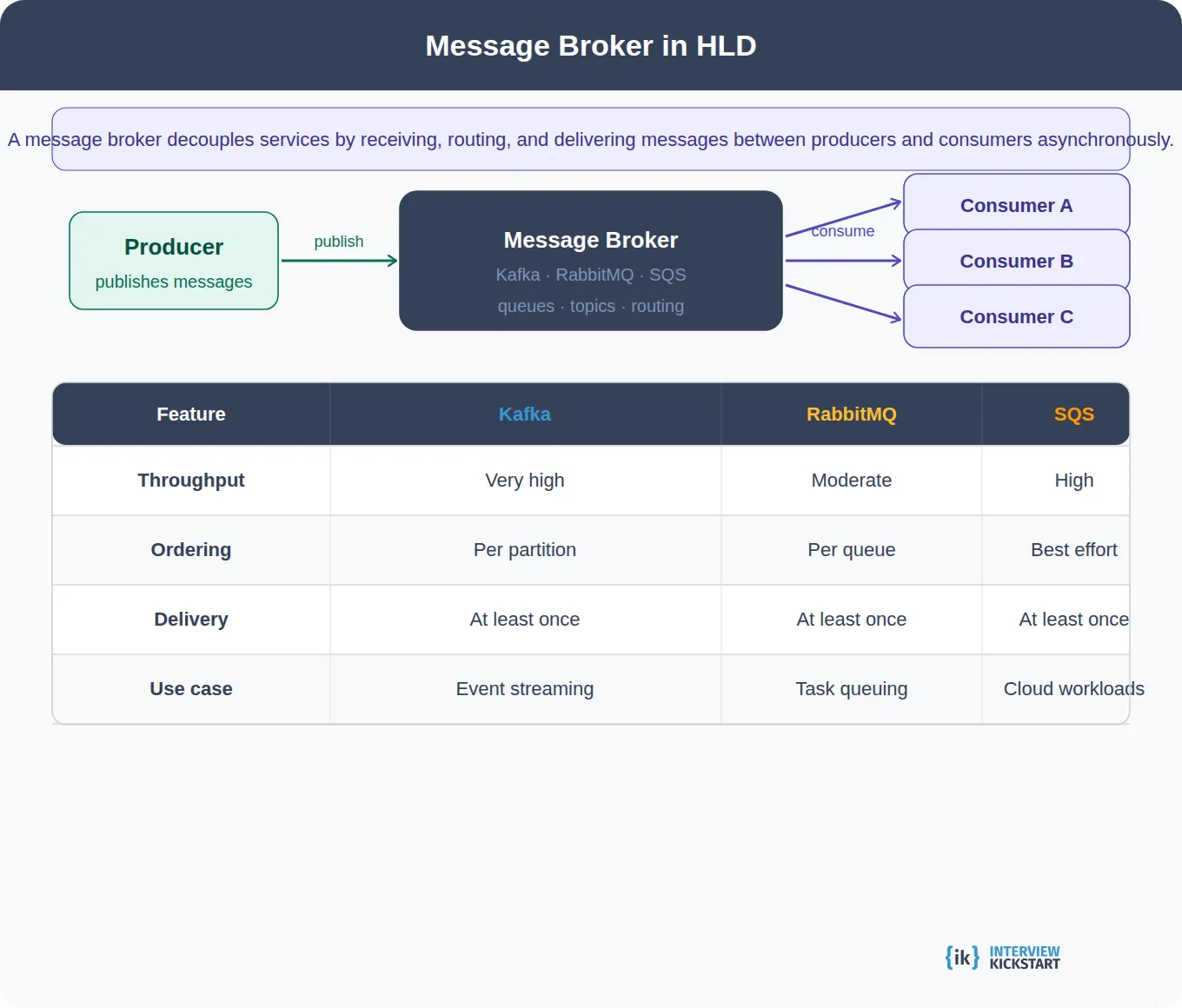
Message brokers decouple producers and consumers, enabling asynchronous communication and improving system scalability.
Popular brokers include Kafka, RabbitMQ, and AWS SQS. Each offers different guarantees regarding throughput, ordering, and delivery semantics.
| Broker |
Throughput |
Ordering |
Delivery Guarantee |
Use Case |
| Kafka |
High |
Partition-based |
At least once |
Event streaming |
| RabbitMQ |
Medium |
FIFO |
At most once / At least once |
Task queue |
| SQS |
Medium |
Approximate FIFO |
At least once |
Decoupled microservices |
Q42. How does a CDN provide high availability and low latency?
CDNs cache content closer to end users, reducing latency and offloading traffic from origin servers.
Edge caching ensures content is served quickly, improving responsiveness for static assets, videos, or APIs. Multi-region CDNs enhance fault tolerance and global reach.
Q43. Considerations for designing a fault-tolerant network infrastructure
Network-level failures impact overall system reliability. Fault-tolerant designs prevent outages and ensure connectivity.
Considerations include redundant network paths, DDoS protection, health checks, and DNS failover. Diagramming redundant paths helps visualize resilience.
Client -> Router1 -> Switch -> Server
       -> Router2 -> Switch -> Server (Redundant path)
Q44. Role of containerization in HLD
Containers provide isolation, portability, and efficient resource utilization. They enable consistent environments across development and production.
Containers start faster than VMs, reduce overhead, and support microservices deployment. Docker and Kubernetes are standard tools.
| VM |
Container |
| Slow startup |
Fast startup |
| Higher resource usage |
Efficient resource usage |
| Full OS |
Shared OS |
| Isolation |
Good isolation |
| Use case |
Monolithic apps |
Microservices |
Q45. Difference between horizontal and vertical scaling in HLD
Horizontal scaling adds machines; vertical scaling adds resources to existing machines. Choosing depends on cost, capacity, and limits.
Horizontal is ideal for stateless services and distributed systems. Vertical works for monolithic apps with database constraints.
| Scaling |
Cost |
Limits |
Complexity |
Best For |
| Horizontal |
Medium |
High |
Moderate |
Distributed services |
| Vertical |
High |
Hardware limits |
Low |
Monolithic systems |
Q46. How do you design a database for a large-scale application?
Large-scale databases require decisions about SQL vs NoSQL, sharding, indexing, replication, and connection pooling.
Sharding distributes data for performance, while read replicas handle heavy queries. Connection pooling ensures efficient resource usage.
| Use Case |
Recommended DB Type |
| Transactional data |
SQL |
| Unstructured/scale-out data |
NoSQL |
Q47. Role of a reverse proxy in system design
Reverse proxies manage traffic, offload SSL, and route requests efficiently. They enhance security and performance.
Functions include SSL termination, load balancing, caching, and request routing.
Client -> Reverse Proxy -> Backend Services
Q48. How do microservices improve scalability and maintainability in HLD?
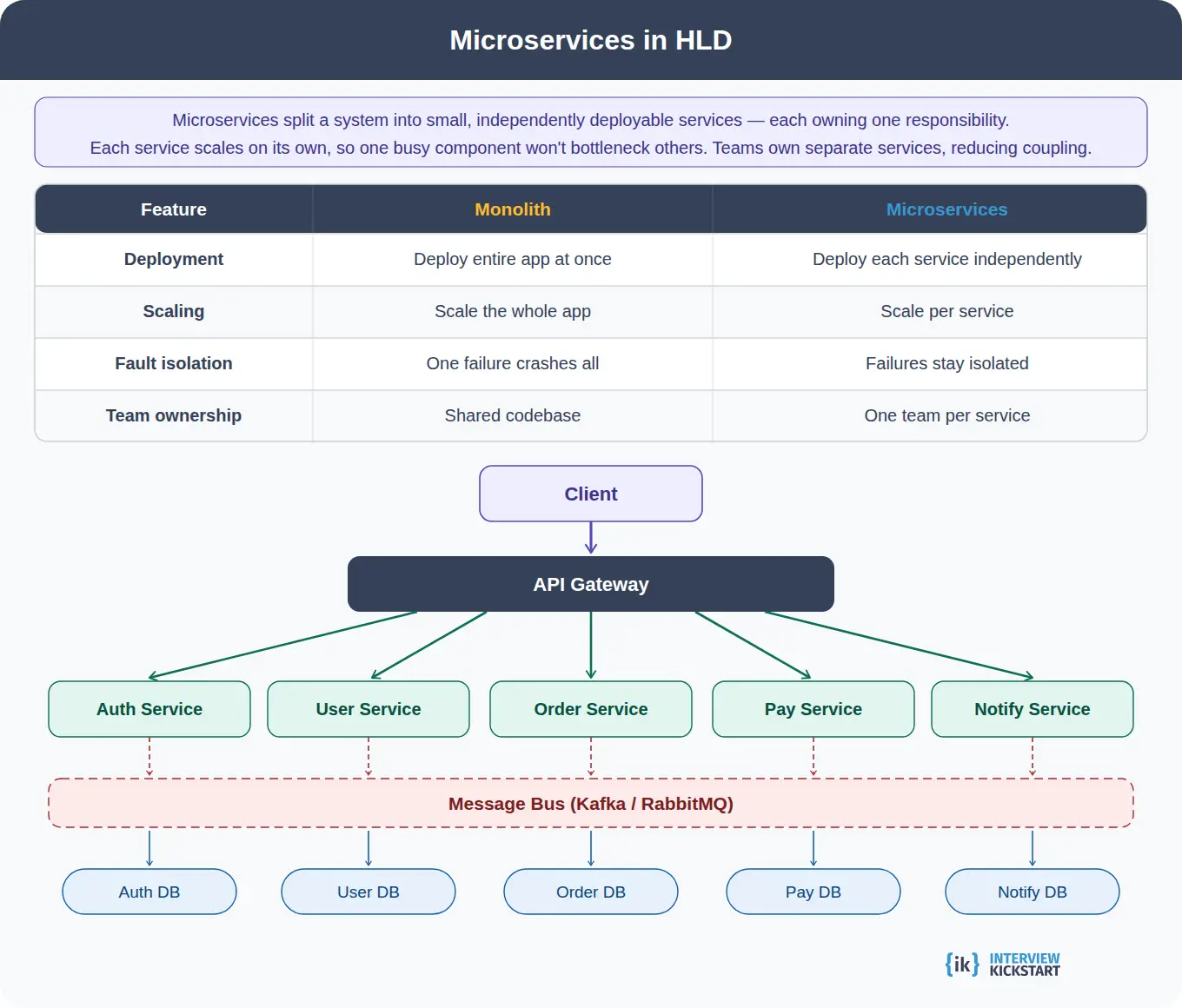
Microservices break monoliths into independent, deployable services. Each service can scale independently.
They improve fault isolation, team ownership, and deployment flexibility. Comparison with monoliths highlights advantages in scaling and maintainability.
| Aspect |
Monolith |
Microservices |
| Deployment |
Single |
Independent |
| Scaling |
Whole app |
Individual services |
| Fault isolation |
Low |
High |
| Team ownership |
Shared |
Service-level |
Q49. Role of API gateways in HLD

API gateways centralize traffic management, authentication, rate limiting, and logging. They are the entry point to microservices.
Functions include auth, rate limiting, routing, request transformation, and logging.
Client -> API Gateway -> Microservices
Q50. How do you handle rate limiting and throttling in system design?
Rate limiting protects systems from overload. Throttling controls request processing speed.
Algorithms include token bucket, leaky bucket, and fixed window. Proper implementation prevents system degradation during traffic spikes.
| Algorithm |
Behavior |
Best Use Case |
| Token Bucket |
Allows bursts |
API services |
| Leaky Bucket |
Uniform rate |
Streaming |
| Fixed Window |
Limits per interval |
Simple APIs |
// Example: Token Bucket pseudocode
tokens = bucket_capacity
onRequest:
    if tokens > 0:
        allow request
        tokens -= 1
    else:
        reject request
How to Crack the System Design Interview
System design interviews evaluate reasoning, trade-offs, and technical judgment. A structured approach improves outcomes.
First, clarify requirements, constraints, and assumptions. Next, design high-level architecture, then dive into low-level modules, explaining design decisions.
How system design interviews are structured
Typical interviews last 45–60 minutes. They start with a problem statement, followed by clarifying questions, HLD, and deep dives into LLD.
Interviewers assess both technical knowledge and communication skills throughout.
Common evaluation criteria
- Trade-off reasoning
- Scalability thinking
- Communication clarity
- Handling ambiguity
- Knowledge of distributed systems
Common mistakes candidates make
- Jumping to a solution without clarifying
- Over-engineering
- Ignoring trade-offs
- Not communicating assumptions
For a more detailed guide, explore How to Crack a System Design Interview.
Prepare to Land Your Next Software Engineering Role
Cracking software engineering interviews requires more than coding; it’s about demonstrating your skills confidently. The Software Engineering Interview Prep program by Interview Kickstart gives you expert-led training, 1:1 coaching, and live sessions with FAANG+ instructors to help you excel in both technical and behavioral interviews.
Practice in realistic mock interviews, receive actionable feedback, and sharpen your career toolkit with resume building, LinkedIn optimization, and personal branding guidance. Step into every interview prepared, confident, and ready to succeed.
Conclusion
System design interviews are a critical measure of your ability to architect scalable, reliable, and maintainable systems. By mastering both Low-Level Design (LLD) and High-Level Design (HLD), you not only demonstrate technical proficiency but also showcase your problem-solving approach, decision-making, and understanding of trade-offs.
Consistent practice with real-world examples, diagrams, and coding exercises is what separates successful candidates from the rest. Use this guide to systematically review LLD and HLD concepts, study common patterns, and prepare answers with clarity and confidence. Remember, the more you simulate real interview scenarios, the more naturally you can articulate your designs under pressure.
FAQs: System Design Interview Questions
Q1. What is the main difference between High-Level Design (HLD) and Low-Level Design (LLD)?
HLD focuses on system architecture and interactions; LLD focuses on component-level implementation and class design.
Q2. Why is horizontal scaling often preferred over vertical scaling?
Horizontal scaling distributes load across machines, improving fault tolerance and cost efficiency. Vertical scaling has hardware limits and higher costs.
Q3. What does ‘read-heavy’ mean?
Read-heavy systems have more read than write operations. This influences designs like using read replicas and caching layers.
Q4. Why are design patterns like Singleton and Factory important?
They improve code reuse, maintainability, and ensure standard solutions for common problems in software design.
Q5. How can you ensure a system remains available even if parts fail?
Techniques include redundancy, failover mechanisms, and circuit breakers to maintain uptime during failures.
References
- Software Developers, Quality Assurance Analysts, and Testers
- CompTIA Tech Jobs Report
Recommended Reads: