Spring is a Java framework used to build Java applications with minimal effort. It provides the infrastructure needed for an application, allowing you to focus on the business logic of the app. Spring Boot sits on the Spring Framework and minimizes the effort needed for detailed, manual configurations.
Spring is widely used in Java application development since it is modular and flexible with embedded Tomcat and Jetty servers. It removes the need for boilerplate configurations, quick setup, has enterprise-level features, allows easy integration, and testing.
This blog covers several important topics that help you answer Spring interview questions. Spring programming interview questions are common, and this blog helps you to crack Java Spring interview questions.
Key Takeaways
- Spring interview questions evaluate your expertise in the Spring framework and coding.
- Spring is a Java framework used to build Java applications with less effort.
- Spring Framework is a modular Java platform that gives infrastructure support to build enterprise-grade applications.
- Spring Core is the main plank of the Spring framework, with inversion of control and dependency injection as the main components.
- Java Spring beans are objects that are controlled by the BeanFactory or the ApplicationContext Spring container.
- Autowiring automatically injects dependencies in the bean without using manual configuration.
- Spring Boot is a framework sitting on the Spring platform
- Spring programming interview questions are on important terms such as Spring MVC, dispatcher servlet, controller, View Resolver, and others
- Read and practice coding extensively in a Java IDE, since Spring programming interview questions require you to write the code for problems
What is the Spring Framework?
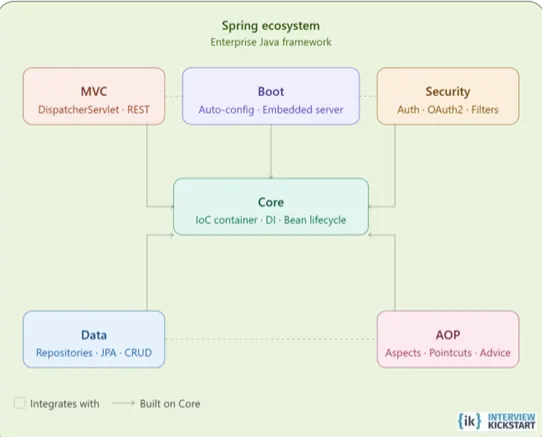
The Spring Framework is a modular Java platform that gives infrastructure support to build enterprise-grade applications. It removes the complexity of Java application coding and development by providing the essential code, allowing efforts to be run on business logic.
Among the frequently asked Spring interview questions are the advantages of the Spring framework. Developers use the modules to select only the ones needed for the project. It has dependency injection with plain old Java objects, allowing for easy testing, and it supports Java, Kotlin, Groovy, and other JVM languages.
Spring interview questions focus on evaluating your expertise in the Spring framework. Java Spring interview questions will feature coding rounds on the Spring Framework. So, prepare for Spring programming interview questions by practicing coding in a Java IDE.
Spring Core and Dependency Injection Interview Questions
Spring Core is the main plank of the Spring Framework. It has the Inversion of Control (IoC) container that controls and administers the lifecycle and configuration of beans or application objects.
Dependency Injection is the main pattern used by Spring core to give objects dependencies and not force the object to develop them on its own. Spring interview questions focus on evaluating your expertise in Spring Boot.
Java Spring interview questions will feature in coding rounds. So, prepare for Spring programming interview questions by practicing coding in a Java IDE.
Bean Lifecycle Flowchart
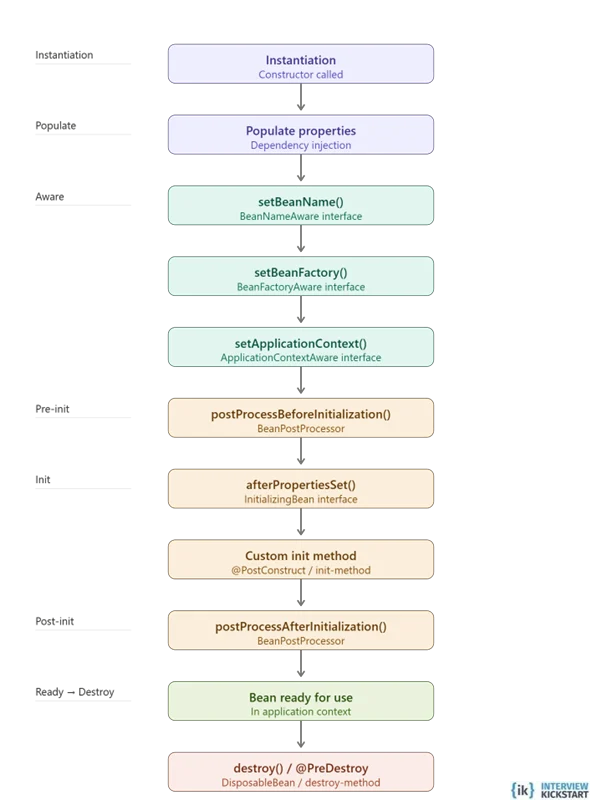
The Bean Lifecycle flowchart is given below. In the flow chart, purple boxes are core creation steps (instantiation + DI). Teal-colored boxes are Aware interfaces of the instances from which the bean learns about its container.
Amber boxes are the initialization hooks of pre, during, and post. Green boxes indicate that the bean is live, and Coral shows the destruction when a context shutdown is reached. Spring interview questions test your expertise in beans.
What are Dependency Injection (DI) and Inversion of Control (IoC)?
In inversion of control or IoC, the framework controls the flow and lifecycle of objects and not the application code, thus reducing coupling. Dependency injection, or DI, is a design pattern to implement IoC, where the dependencies of a class are injected from the outside and not developed or created internally.
Code snippet example of dependency injection
// 1. Define an abstraction (Interface)
interface Engine {
    void start();
}

// Code snippet of inversion of control:

public class Main {
    public static void main(String[] args) {
        // The external code (Main) acts as the "IoC Container"
        Engine gas = new GasEngine();
        Car myCar = new Car(gas); // Injecting the dependency

        myCar.drive();
    }
}
What are Spring Beans?
Java Spring beans are objects that are controlled by BeanFactory or ApplicationContext Spring containers. They are used for implementing dependency injection. They are created in the Spring inversion-of-control container.
What are Bean Scopes in Spring?
Bean Scopes explain the instances of Spring Bean creation and their life in the Spring container. Several scopes of Bean are available, and these are Singleton, Prototype, Request, Session, Application, and WebSocket.
Comparison of Bean Scopes is:
| Scope |
Description |
Lifecycle |
| Singleton (default) |
Only one instance per Spring container |
Created once, shared everywhere |
| Prototype |
New instance every time requested |
Created each time, not fully managed after creation |
| Request |
One instance per HTTP request |
Lives for a single web request |
| Session |
One instance per HTTP session |
Lives for a user session |
| Application |
One instance per web application |
Shared across the entire app |
| WebSocket |
One instance per WebSocket session |
Lives for WebSocket lifecycle |
Difference Between BeanFactory and ApplicationContext
BeanFactory is used when a minimal, lazy-loaded configuration is needed. ApplicationContext is utilized when the requirements for the complete Spring features.
Table of BeanFactory and ApplicationContext.
| Feature |
BeanFactory |
ApplicationContext |
| Initialization |
Lazy initialization (beans created only when requested) |
Eager initialization (beans created at startup by default) |
| Auto-adds behavior (e.g., logging, AOP, etc.) |
Does NOT automatically register BeanPostProcessors or advanced features |
Automatically registers BeanPostProcessors (supports AOP, logging, etc.) |
| Sends & listens to app-wide events |
Not supported |
Supports event publishing and listening (ApplicationEvent) |
| Multi-language support |
No built-in support |
Supports internationalization (i18n via MessageSource) |
| Best used for |
Lightweight apps, memory-constrained environments |
Enterprise apps, full-featured Spring applications |
What is Bean Wiring?
Bean Wiring is the method to link Spring Beans. It helps to inject one bean into another and meet dependencies.
Explain the Spring Bean Lifecycle
The Spring Bean Lifecycle includes the sequence that a bean faces from creation to destruction in the Spring container. The life cycle steps are:
- Bean Instantiation: In this step, Spring forms the bean object. Example: Create a new car
- Dependency Injection: The required dependencies are injected into the bean. Example: Injects the engine into the bean or car
- Initialization: Initialization methods are called. Example: Petrol is filled in the car
- Bean Ready to Use: All components are configured, and the bean is used in the application. Example: The car starts running.
- Destruction: Spring calls the destroy methods when the container shuts down. Example: A car is recalled and destroyed.
What is Autowiring in Spring?
Autowiring automatically injects dependencies in the bean without using manual configuration. It removes the need for XML wiring and gives clean code without errors.
Spring Boot Interview Questions
Spring interview questions focus on evaluating your expertise in Spring Boot. Java Spring interview questions will feature in coding rounds. So, prepare for Spring programming interview questions by practicing coding in a Java IDE.
What is Spring Boot?
Spring Boot is a framework sitting on the Spring platform. It reduces the requirements of Java application development, makes coding simpler, and removes the need for advanced manual configuration.
Difference Between Spring and Spring Boot
Comparison table of differences between Spring and Spring Boot is:
| Aspect |
Spring Framework |
Spring Boot |
| Configuration |
Manual configuration (XML or Java-based, more setup required) |
Auto-configuration with minimal setup (@SpringBootApplication) |
| Built-in Web Server |
No built-in server (needs external server like Tomcat) |
Embedded server (Tomcat, Jetty, Undertow) included |
| Deployment |
Deploy WAR file to external server |
Run as standalone JAR with embedded server |
| Pre-bundled Library Sets |
No predefined sets; dependencies added manually |
Starter dependencies (e.g., spring-boot-starter-web) |
| Setup Effort |
Higher (more configuration and setup time) |
Lower (quick startup, less boilerplate) |
What does @SpringBootApplication annotation do?
@SpringBootApplication combines three key Spring annotations into a single-entry point for a Spring Boot application. unit. It is a convenience annotation that makes Spring Boot automatically start, configure, and scan the application.
Code snippet is:
@SpringBootApplication
public class MyApplication {

    public static void main(String[] args) {
        SpringApplication.run(MyApplication.class, args);
    }
}
What embedded servers are supported in Spring Boot?
Embedded servers in Spring Boot run web apps without the need to use external servers. Spring Boot supports several embedded servers. These include Apache Tomcat, Jetty, Undertow, and Netty.
What is Spring Boot Actuator?
Spring Boot Actuator is a production-ready module. It has tools for management and monitoring applications. An actuator is used to monitor metrics, health, and the internal state of running apps.
What are Spring Boot Starter Projects?
Spring Boot Starter Projects are dependency packages in Spring Boot pre-configured to add required functionality. There is no need to manually manage their dependencies. By adding one starter, all dependencies are brought together, and there is no need to add multiple libraries.
Spring MVC Interview Questions
Spring Framework Java interview questions are invariably on MVC. Prepare for Spring programming interview questions by practicing coding using real examples. Read Java blogs, tech articles, and be ready to answer Spring interview questions.
What is Spring MVC?
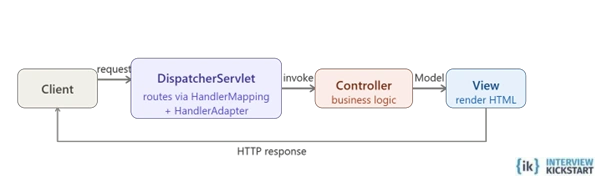
Spring Model-View-Controller (MVC) is a module to create REST APIs and web applications as per the MVC design pattern. When users make an HTTP request, it is sent to the DispatcherServlet front controller that processes the request, Data is processed, and users get the View.
What is DispatcherServlet?
DispatcherServlet is the central front controller in the Spring MVC framework. It serves as the single-entry point for all incoming HTTP requests, manages the request lifecycle, guides requests to relevant controllers, manages view resolution, and models’ data to generate responses. It is like a receptionist in an office who manages visitors.
What is a Controller in Spring MVC?
In Spring MVC, Controller is a class managing HTTP requests and gives responses in view or JSON. The controller calls services and business logic, prepares data and gives a response.
An example of a code snippet is:
@Controller
public class HelloController {

    @GetMapping("/hello")
    public String sayHello(Model model) {
        model.addAttribute("message", "Hello World");
        return "hello"; // view name
    }
}
What is ViewResolver?
ViewResolver is used to map the logical view name that is returned by a controller into a view file, such as a template, HTML, or JSP. Popular ViewResolvers are InternalResourceViewResolver used for JSP, ThymeleafViewResolver used for Thymeleaf templates, and FreeMarkerViewResolver used for FreeMarker.
What are Spring MVC Annotations?
Spring MVC Annotations help in configuring and controlling web application behaviour in a declarative manner. They provide the shortcuts for web components and request handling.
The following table gives key Spring MVC annotations.
| Annotation |
Purpose |
| @Controller |
Marks a class as a web controller (returns views) |
| @RestController |
Marks a class as REST controller (returns JSON/XML) |
| @RequestMapping |
Maps HTTP requests to classes/methods |
| @GetMapping |
Handles HTTP GET requests |
| @PostMapping |
Handles HTTP POST requests |
| @PutMapping |
Handles HTTP PUT requests |
| @DeleteMapping |
Handles HTTP DELETE requests |
| @RequestParam |
Binds query parameters from URL |
| @PathVariable |
Extracts values from URL path |
| @RequestBody |
Converts request body (JSON) to Java object |
| @ResponseBody |
Sends return value as HTTP response body |
| @ModelAttribute |
Binds form data to Java object |
| @ExceptionHandler |
Handles exceptions in controllers |
Spring AOP Interview Questions
Spring AOP – Aspect-Oriented Programming is an important module of the Spring Framework. Spring Framework Java interview questions are on this topic. Expect Spring programming interview questions in coding rounds.
What is AOP in Spring?
Aspect-Oriented Programming (AOP) is a method that helps to separate cross-cutting issues, such as logging, security, and transactions, from the main business logic. An extra behavior is added without changing the code. This is a critical topic in Spring interview questions.
What are Aspect, Advice, and Pointcut?
Aspect, Advice, and Pointcut are components of AOP that apply cross-cutting logic. They work as a rule system by pointing out where to apply, actions, and the container.
The following table explains the three concepts.
| Term |
What it means |
Real Example |
| Aspect |
A class that groups cross-cutting logic (logging, security, etc.) |
LoggingAspect class handling all logging |
| Advice |
The action to perform at a specific point |
Log message before a method runs |
| Pointcut |
Expression that selects where the advice should run |
Apply logging to all service layer methods (execution(* service.*.*(..))) |
Difference Between Spring AOP and AspectJ
Spring AOP is simple, limited, and used in most applications, while AspectJ is complex, powerful, and full-featured.
The following table presents the differences between Spring AOP and AspectJ.
| Feature |
Spring AOP |
AspectJ |
| Framework Type |
Part of Spring Framework |
Separate AOP framework |
| Weaving Type |
Runtime (proxy-based) |
Compile-time, post-compile, and load-time |
| Join Points Supported |
Only method execution |
Method calls, constructors, fields, etc. |
| Complexity |
Simple and easy to use |
More powerful but complex |
| Performance |
Slightly slower (proxy-based) |
Faster (compiled weaving) |
| Dependency |
Works only with Spring-managed beans |
Works with any Java class |
| Configuration |
Minimal (annotations/XML) |
Requires compiler or weaving setup |
| Use Case |
Common enterprise apps (logging, transactions) |
Advanced AOP needs (deep instrumentation) |
| Learning Curve |
Easy |
Steeper |
Spring JDBC and Hibernate Interview Questions
Spring JDBC and Hibernate are the favorite topics in Spring interview questions. Be prepared for coding tests as part of the Spring programming interview questions. Interviewers seek hands-on coding and implementations for their Java Spring interview questions.
What is Spring JDBC?
Spring JDBC is an important module that makes databases easy with the Java Database Connectivity API. There is no need to use handling statements, opening and closing connections, and iteration.
What is the JDBC Template?
JDBC Template is the central class in the JDBC core package of the Spring Framework and handles repetitive code used to access a database.
What is Hibernate ORM?
Hibernate ORM or Object-Relational Mapping is a Java framework that is a bridge and maps Java objects to database tables. Developers use ORM to easily carry out database operations with object-oriented commands. Complex SQL queries are avoided.
What is Spring DAO?
Spring DAO, or Data Access Object is a support module from the Spring Framework. It simplifies the process of application interaction with databases.
Spring Interview Questions for Freshers
Spring interview questions for freshers are on the basic terms of the Spring framework. Java Spring interview questions for freshers do not delve deep into coding or complex integration issues.
What are the Different Types of IoC Containers in Spring?
An IoC (Inversion of Control) Container is used to create, configure, and manage the lifecycle of beans. Two types of IoC are available: the BeanFactory, a Basic Container, and ApplicationContext, an advanced container with several features.
What are the Different Components of a Spring Application?
Components of Spring application are configuration, Spring container, Beans or objects, dependency injection, Aspect-Oriented Programming, Data Access Layer, and service layer.
What are the Different Modules of the Spring Framework?
Different models of Spring framework are core container, data access, web module, AOP, instrumentation module, messaging module, and test module.
What are the Limitations of Autowiring in Spring?
Limitations of autowiring are: lack of clarity, multiple beans problem, not suitable for all dependencies, tight coupling risk, limited control, performance overhead, and hidden dependencies.
What is @Autowired Annotation in Spring?
@Autowired in the Spring framework is a type of annotation used for auto-injection of dependencies in a class.
What is a Spring Configuration File?
Spring Configuration File helps in identifying the set-up of the application. It tells the beans to create and configure, and their connection.
What is the Difference Between @Component, @Service, @Repository, and @Controller?
Differences are given in the following table.
| Annotation |
What it Marks |
When to Use It |
| @Component |
Generic Spring-managed bean |
Use for any class that doesn’t fit other categories (utility/helper classes) |
| @Service |
Business logic layer |
Use for classes that contain business logic (service layer) |
| @Repository |
Data access layer (DAO) |
Use for classes that interact with the database |
| @Controller |
Web layer (handles user requests) |
Use in Spring MVC to handle HTTP requests and return views |
Spring Interview Questions for Intermediates
Spring interview questions for intermediate-level candidates with 1-5 years’ experience, evaluate core technical concepts and practices. You will be asked core coding problems in the Spring programming interview questions.
What are the Different Ways to Perform Dependency Injection in Spring?
Dependency Injection (DI) can be run in three ways. They are constructor injection, setter injection, and field injection.
Difference Between Setter Injection and Constructor Injection
The differences between setter injection and constructor injection are:
| Feature |
Constructor Injection |
Setter Injection |
| How it works |
Dependencies passed via constructor |
Dependencies set via setter methods |
| Timing |
At object creation |
After object creation |
| Use case |
Mandatory dependencies |
Optional dependencies |
| Object state |
Always fully initialized |
May be partially initialized |
| Immutability |
Supports (final fields) |
Not supported |
| Null safety |
High (cannot skip dependency) |
Lower (can forget to set) |
| Readability |
Clear (all deps in constructor) |
Less clear (spread across setters) |
| Testing |
Easier (constructor args) |
Slightly harder |
| Circular dependency |
Problematic |
Can resolve |
| Spring recommendation |
Preferred |
Situational |
What is @Qualifier Annotation? How Does it Resolve Autowiring Ambiguity?
The @Qualifier is used with @Autowired to indicate the bean to be injected when multiple candidates of the same type are available. It resolves the confusion when multiple instances of a bean are present.
What are the Different Types of Spring Transaction Propagation?
Transaction propagation explains the behavior of a method in a transaction. within an existing transaction. The types of propagation are:
| Propagation Type |
Behavior |
When to Use |
| REQUIRED (default) |
Joins existing transaction, or creates a new one if none exists |
Most common use case |
| REQUIRES_NEW |
Suspends current transaction and starts a new one |
Independent operations (e.g., logging) |
| SUPPORTS |
Joins transaction if present, else runs without transaction |
Optional transactional behavior |
| NOT_SUPPORTED |
Suspends current transaction and runs non-transactionally |
Performance-critical non-TX tasks |
| MANDATORY |
Must run inside an existing transaction, else throws exception |
Strict transactional rules |
| NEVER |
Must NOT run inside a transaction, else throws exception |
Enforce non-transactional execution |
| NESTED |
Runs within a nested transaction (savepoint) if a transaction exists |
Partial rollback scenarios |
What is the Difference Between @RequestMapping and @GetMapping?
The annotation @GetMapping gives cleaner, more efficient code when handling GET requests. The annotation @RequestMapping gives flexibility and multiple HTTP methods.
What is Weaving in Spring AOP?
Weaving links aspects of cross-cutting concerns with the business logic application code to develop an executable object. It injects logging, security transactions, and extra behavior without changing the code.
What is the Difference Between Spring ORM and Spring JDBC?
The differences between Spring ORM and Spring JDBC are given in the following table.
| Feature |
Spring JDBC |
Spring ORM |
| Approach |
Low-level database access |
High-level abstraction using ORM frameworks |
| Working Style |
Uses SQL queries directly |
Works with objects mapped to database tables |
| Boilerplate Code |
Reduced (compared to plain JDBC) but still requires SQL |
Minimal (ORM handles most DB operations) |
| Learning Curve |
Easier if you know SQL |
Requires understanding ORM concepts |
| Control over Queries |
Full control (write custom SQL) |
Limited control (mostly handled by ORM) |
| Performance |
Faster for simple, fine-tuned queries |
Slight overhead due to abstraction |
| Integration |
Works directly with JDBC API |
Integrates with frameworks like Hibernate, JPA |
| Transaction Management |
Supported via Spring |
Supported (often better integrated with ORM) |
| Mapping |
Manual mapping (RowMapper) |
Automatic object-relational mapping |
| Flexibility |
High (custom queries, fine control) |
Less flexible but more productive |
| Use Case |
When you need precise SQL control |
When working with complex domain models |
| Example Class |
JdbcTemplate |
HibernateTemplate, JPA repositories |
How Does Spring Boot Auto-Configuration Work Internally?
Auto-configuration in Spring Boot configures the application automatically. Inputs and conditions used are dependencies in the classpath, existing beans, and application properties.
What is @Transactional in Spring?
The @Transactional annotation controls database transactions declaratively. It ensures that all database operations succeed or all fail.
What is the Purpose of spring-boot-maven-plugin?
Spring-boot-maven-plugin simplifies the use of Apache Maven to make the task of building, packing, and operating applications smooth and easy. It helps to run applications without errors, packages the code as an executable JAR/ WAR, and manages lifecycle dependencies.
Spring Interview Questions for Experienced Developers
Spring interview questions for experienced developers are on real-world applications. Spring programming interview questions evaluate your skills in building scalable and cost-appropriate solutions.
How is Data Validation Done in the Spring Web MVC Framework?
Data validation is managed with Java Bean Validation and the internal validation infrastructure. The workflow starts when the controller receives a data request. The request is bound to a model object with annotations, and validation is triggered with validation frameworks and constraints. Errors are moved to BindingResult for resolution by the controller.
Code for DTO validation is:
import jakarta.validation.constraints.*;

public class UserDTO {

    @NotBlank(message = "Name is required")
    @Size(min = 3, max = 20)
    private String name;

    @Email(message = "Invalid email")
    @NotBlank(message = "Email is required")
    private String email;

    @Min(value = 18, message = "Age must be >= 18")
    private int age;

    // getters & setters
}
Explain Spring MVC Architecture
MVC Architecture uses the Front Controller pattern. In this pattern:
- DispatcherServlet acts as the central coordinator
- It delegates requests to handlers via HandlerMapping, executes controller logic
- The controller binds and validates data
- The request resolves views with the ViewResolver or JSON in REST
What is Spring Batch? What is a Tasklet?
Spring Batch framework provides high-volume, batch processing—handling of large datasets. It has features such as chunk-based processing, transaction management, restart/retry capability, and job scheduling and monitoring. It is used for ETL jobs, report generation, and data migration.
Tasklet is a single-operation step in Spring Batch. It runs once for each step and is used for file cleaning, email posting, stored procedures execution, and managing data updates.
What is Component Scan? How is it performed in Spring Boot?
Component scanning is used to detect and register beans in the IoC container by scanning the classpath for stereotype annotations. It is triggered with @SpringBootApplication. It scans the main class packages and sub-packages with the ClassPathBeanDefinitionScanner and registers beans in the ApplicationContext.
What is Spring Security? What is CSRF?
Spring Security provides authentication, authorization, and protection against web vulnerabilities. CSRF, or Cross-Site Request Forgery, is a type of hacking where a malicious site tricks a logged-in user’s browser into sending unwanted requests to another trusted site.
What is Spring WebFlux? What are Mono and Flux?
Spring WebFlux provides services for high-concurrency, asynchronous applications. It is used for streaming data microservices and APIs. There are two types of WebFlux, Mono and Flux. Mono emits 0 or 1 element asynchronously, and an example is a single response, such as fetching a user. Flux emits 0..N elements asynchronously.
Is it Possible to Use Spring MVC and WebFlux in the Same Application?
Yes. It is possible to use WebFlux and Flux in the same application, for legacy migration. Some constraints are that reactive benefits need a reactive runtime with architecture separation.
What is @Transactional? Difference Between Declarative and Programmatic Transaction Management?
The @Transactional annotation defines the scope of a single database transaction. It is used at the class level, and automatically manages transaction stages of begin, commit, and rollback. There are two types of transaction management, declarative and programmatic.
The following table compares them.
| Feature |
Declarative Transaction Management |
Programmatic Transaction Management |
| Definition |
Transactions are defined via annotations (@Transactional) or XML |
Transactions are controlled manually via code, using PlatformTransactionManager |
| Ease of Use |
Simple, clean, less boilerplate |
Verbose, more boilerplate |
| Coupling |
Loosely coupled with business logic |
Tightly coupled with business logic |
| Rollback Handling |
Automatic rollback on exceptions |
Developer must call rollback manually |
| Configuration |
Annotation-based (@Transactional) or XML |
TransactionTemplate or TransactionManager API |
| Use Case |
Most common, standard enterprise apps |
Complex scenarios needing dynamic control over transaction boundaries |
What is Spring Data JPA?
Spring Data JPA is a module that uses JPA – Java Persistence API for simpler data access. It gives a high-level abstraction over JPA and helps run CRUD operations and complex queries without boilerplate code.
How Does Spring Boot Handle Exceptions? What is @ControllerAdvice?
Spring MVC exception handling framework helps to manage web app exceptions. The @ControllerAdvice annotation component allows global exception handling for all controllers.
Code snippet to handle exceptions is:
// Handle specific exception
@ExceptionHandler(ResourceNotFoundException.class)
public ResponseEntity<Map<String, Object>> handleNotFound(ResourceNotFoundException ex) {
    Map<String, Object> error = new HashMap<>();
    error.put("timestamp", LocalDateTime.now());
    error.put("message", ex.getMessage());
    error.put("status", HttpStatus.NOT_FOUND.value());
    return new ResponseEntity<>(error, HttpStatus.NOT_FOUND);
}
What are Spring Profiles?
Spring Profiles mechanisms group and isolate beans and configurations for environments such as dev, test, and prod. They provide environment-specific configuration without changing code.
Are Singleton Beans in Spring Thread-Safe?
No, Spring singleton beans are not thread-safe if mutable states exist. They are shared across threads and not thread safe.
What is Spring Cloud?
Spring Cloud has several tools and frameworks built on top of Spring Boot for building distributed, cloud-native microservices. It integrates Netflix OSS, Consul, Zookeeper, and Kubernetes for building resilient cloud applications.
The following table gives Spring Cloud components, uses, and features.
| Term / Component |
Purpose / Description |
Real-World Example / Use Case |
| Spring Cloud Config |
Centralized configuration management for distributed systems. |
Store and manage configuration for microservices in Git or local repository. |
| Spring Cloud Netflix Eureka |
Service discovery server and client for microservices. |
Microservices register themselves with Eureka; other services discover them dynamically. |
| Spring Cloud Netflix Ribbon |
Client-side load balancer for microservices. |
Distributes HTTP requests across multiple instances of a service. |
| Spring Cloud Netflix Zuul / Gateway |
API Gateway / Edge service for routing and filtering requests. |
Route requests from clients to appropriate microservices, handle cross-cutting concerns like auth. |
| Spring Cloud OpenFeign |
Declarative REST client for microservices. |
Define REST clients using interfaces instead of manually writing HTTP calls. |
| Spring Cloud Sleuth |
Distributed tracing for microservices. |
Adds trace IDs to logs to track requests across services. |
| Spring Cloud Bus |
Propagates configuration changes or events across microservices. |
Update configuration centrally; changes automatically propagate to all instances. |
| Spring Cloud Gateway |
Modern API gateway, replacing Zuul in new apps. |
Route, filter, and secure HTTP requests to backend services. |
| Spring Cloud Contract |
Consumer-driven contract testing for microservices. |
Ensure that microservices follow agreed API contracts. |
| Spring Cloud Stream |
Abstraction for messaging systems (Kafka, RabbitMQ). |
Microservices communicate asynchronously via message brokers. |
| Spring Cloud Security |
Security integration for microservices. |
Centralized authentication and authorization across microservices. |
| Spring Cloud Kubernetes |
Integrate Spring Cloud apps with the Kubernetes ecosystem. |
Service discovery, configuration, and secrets management using Kubernetes resources. |
| Spring Cloud LoadBalancer |
Client-side load balancing replacement for Ribbon. |
Distribute requests to microservice instances in modern Spring Cloud setups. |
Miscellaneous Questions for a Spring Interview
Miscellaneous Spring interview questions on several topics and their answers are given in this section.
Difference Between @RestController and @Controller
Differences between @RestController and @Controller are:
| Feature |
@Controller |
@RestController |
| Purpose |
Handles web requests and returns views |
Handles REST APIs and returns data |
| Return Type |
Typically returns View name |
Returns JSON/XML response body |
| @ResponseBody |
Must be added manually |
Automatically applied |
| Use Case |
Traditional web apps (UI-based) |
RESTful web services (APIs) |
| Output |
HTML, JSP, Thymeleaf |
JSON, XML |
| Annotation Type |
Class-level annotation |
Combination of @Controller + @ResponseBody |
Difference Between @PathVariable and @RequestParam
The following table gives differences between @PathVariable and @RequestParam:
| Feature |
@PathVariable |
@RequestParam |
| Source |
URL path |
URL query parameter |
| Example URL |
/users/10 |
/users?id=10 |
| Usage |
Extract dynamic values from URI |
Extract query string values |
| Required by default |
Yes |
Yes (can be made optional) |
| Optional support |
Not directly (needs alternative mapping) |
Yes (required = false) |
| Best Use Case |
RESTful APIs (resource identification) |
Filtering, sorting, optional inputs |
| Annotation Position |
Inside URL mapping (/users/{id}) |
Method parameter only |
What are Safe REST Operations? What HTTP Methods Does REST Use?
Safe operations are readonly and are HTTP methods that do NOT modify server data.
| HTTP Method |
Changes data? |
Same result every time? (Idempotent) |
Use case |
| GET |
No |
Yes |
Retrieve data |
| POST |
Yes |
No |
Create new resource |
| PUT |
Yes |
Yes |
Update/replace entire resource |
| PATCH |
Yes |
No |
Partial update of resource |
| DELETE |
Yes |
Yes |
Delete resource |
How Can You Handle Exceptions in the Spring MVC Environment?
Handling exceptions in the Spring MVC environment with several approaches. These are: @ExceptionHandler, @ControllerAdvice, @ResponseStatus, and ResponseEntity.
How Can You Achieve Localization in Spring MVC?
Localization in Spring MVC is used to display content in different languages location for users. Steps used are: Create Message Files, Configure MessageSource, Configure LocaleResolver, Add LocaleChangeInterceptor, and Use Messages in View.
How Can You Upload a File in a Spring MVC Application?
The MultipartFile command is used to upload a file. Use the MultipartFile command to receive a file, and the form should have enctype=”multipart/form-data. Configure multipart settings and upload.
What is @Primary Annotation in Spring? How is it used?
@Primary helps to resolve ambiguity when multiple beans of the same type exist. It instructs Spring the bean that should be preferred by default during autowiring.
What is @Configuration? How is it Different From @Component?
@Configuration is an annotation that defines a configuration class containing @Bean methods. Differences between @Configuration and @Component are given in the following table:
| Feature |
@Configuration |
@Component |
| Purpose |
Defines configuration class with bean methods |
Marks a class as a Spring bean |
| Usage |
Used with @Bean methods |
Used for auto-detection (component scanning) |
| Bean Creation |
Explicit via methods |
Implicit via class scanning |
| Proxy Behavior |
Uses CGLIB proxy (ensures singleton beans) |
No proxy by default |
| Typical Use |
Java-based configuration |
Service, DAO, utility classes |
| Example |
App config class |
Business logic class |
What are Spring Boot DevTools?
Spring Boot DevTools enhances developer productivity by allowing automatic restart and faster development.
What is @Cacheable? How Does Spring Caching Work?
@Cacheable caches the result of a method. When the same method is called again with the same input, the result is given from the cache instead of executing the method.
What is a Circular Dependency in Spring? How is it resolved?
Circular dependency happens when several Spring beans depend on each other directly or indirectly. A cycle is created, causing Spring to fail during bean creation.
What is CommandLineRunner in Spring Boot?
CommandLineRunner is an interface that helps to run code after the Spring Boot application starts. It runs the logic after the application context is loaded, and it is used for initialization tasks.
// Example: simple initialization logic
int sum = 0;
for (int i = 1; i <= 5; i++) {
    sum += i;
}
What is a JobRepository in Spring Batch?
The JobRepository component stores metadata about batch jobs. It stores data of Job instances,Job executions, Step executions, and Job status.
FAQs on Spring Interview Questions
This section presents FAQs on Spring Framework Java interview questions. Some common Java Spring interview questions and their answers are given below.
What are the Key Features of the Spring Framework?
Key features of the Spring Framework are: Inversion of Control, DI, transaction management, Aspect-Oriented Programming, MVC framework, and data access. It has a modular architecture with a flexible and enterprise-ready framework.
What are the Most Important Spring Annotations to Know for Interviews?
Spring has several important annotations. For Spring interview questions, prepare DI, Web, AOP, Transactions, and Configuration annotations.
How Long Does it Take to Learn Spring Framework for Interviews?
Depending on your background, experience, and hours of dedicated practice, it takes 2-6 weeks to prepare for Spring interview questions. Java beginners take 4-6 weeks, Intermediate-level take 2-4 weeks, and experienced developers take 1-2 weeks.
How Many Interview Rounds Does a Spring Developer Interview Have?
Spring Framework Java interview has 3-5 rounds for developer roles. Typical rounds are aptitude, 2 rounds of technical, 1 round managerial, and an HR round.
What Skills are Required to Crack a Spring Developer Interview?
Skills required to crack a Spring interview question are OOP concepts, Collections, Exception Handling, Multithreading, Java 8+, Spring and Spring Boot, Annotations, Spring MVC, REST APIs, Database and ORM, Tools, Microservices, and soft skills.
How Should Beginners Prepare for Spring Interviews?
To prepare for Spring programming interview questions, learn core Java, Spring basics, and then learn Spring Boot. You need to practice REST APIs, learn database integration, and build mini projects.
Is Spring Framework Still Relevant in 2026?
Yes. Spring Boot is widely used in backend development, microservices, and scalable system development.
Are You Ready to Nail Your Next Spring Interview?
You have studied the Spring interview questions and answers for freshers and experienced developers. The guide gave detailed insights and in-depth concepts of Spring Boot. Build on this learning and develop yourself into a confident Spring Boot developer.
Rather than textbook responses, interviews evaluate your understanding, explanation of concepts, real project implementations, and outstanding project work. Prepare mini-projects and a portfolio, and give a link for interviewers. Study and read tech blogs and practice coding.
Conclusion
The blog Spring interview questions and answers for freshers and experienced developers presented detailed insights into the questions and answers expected in Spring interviews. Several important topics and frameworks were covered.
Cracking Java Spring interview questions requires a full understanding of core concepts, frameworks, and real-world applications. Practicing common spring interview questions helps developers build confidence. Prepare coding by solving problems in a Java IDE.
While Spring Framework Java interview questions are tough, strong preparation can help crack the interviews.
References
- Software Developers, Quality Assurance Analysts, and Testers
- 2026 Java Tech Salary Guide
Recommended Reads: