20+ Python Scripting Interview Questions 2026: Your Complete Prep Guide
20+ Python Scripting Interview Questions 2026: Your Complete Prep Guide
Last updated by Nahush Gowda on Feb 28, 2026 at 05:29 PM
|
Reading Time: 3 minute
Article written by Nahush Gowda under the guidance of Jacob Markus, Senior Data Scientist at Meta, AWS, and Apple leader, now coaching engineers to crack FAANG+ interviews. Reviewed by Manish Chawla, an engineering leader with nearly two decades of experience scaling systems
Last updated on Feb 28, 2026 at 05:29 PM
|
Reading Time: 3 minutes
Preparing for Python scripting interview questions in 2026 requires deep knowledge of Python coding for several use cases and instances. This guide covers sample Python scripting interview questions and answers that you will face in Python coding rounds.
Python is a vast language with a maze of questions, and you have to prepare for scripting interview questions in Python. This guide presents basic Python interview questions on data structures to advanced scripting challenges.
This guide prioritizes real Python interview questions, with evaluation intent, and realistic answer depth over exhaustive theory or generic prep lists.
Key Takeaways
Python scripting interview questions test real-world problem-solving, not just theory
Technical domains assessed in interviews are basic Python, file and data operations, scripting, multi-threading, and object-oriented programming.
Strong Python fundamentals and knowledge of core practices are essential for success.
Senior-level interviews focus on design, propagation, and production-ready error strategies.
Following best practices improves code stability and maintainability.
Structured preparation with practical examples and mock interviews increases interview confidence.
Python Scripting Interview Process
Landing a Python scripting role typically involves going through 2-4 structured rounds, where each one is designed to assess a different dimension. These rounds focus on evaluating your communication skills, culture fit, technical knowledge, system-level thinking, and more.
Understanding what each stage looks for helps you walk into the interview prepared, not just practiced.
Python scripting interviews last for around 3-4 rounds, and the total time for all these rounds combined is between 5-7 hours. Generally, the coding/technical round is the hardest one, while automation, performance, and error-handling are the key themes evaluated in this interview.
Stage
Format
Duration
Focus Areas
Round 1
Recruiter Screen
30-40 minutes
Relevant experience, project works, role alignment, and salary expectations
Round 2
Technical Screen
45–60 mins
Python fundamentals, Scripting-based problems, Debugging exercises, File and API handling tasks
💡 Python Scripting Interview Prep: Don’t treat the behavioral round as an afterthought. Round 3 often combines system design with behavioral questions in the same loop – give a concise STAR format story ready for dubbing failures, cross-team collaboration, and ownership under ambiguity.
Domains Tested in Python Scripting Interviews
Domains
Subdomains
Interview Rounds
Depth
Basic Python
Environment setup and virtual environments, system paths and directories, input/output operations, Command-line interface basics, package management and dependencies
Technical Screen
Medium
File and Data Operations
file formats, Data transformation scripts, CSV and JSON, handling large files
On-site/ virtual screen
High
Scripting multi-threading
external processes, Environment variables and configuration, Error recovery and retry mechanisms, Scheduling and cron jobs, Email and notification integration
OOP principles, decorators, context managers, descriptors, and metaclasses
On-site/ virtual screen
High
Table 2: Interview domains for Python scripting interview questions
Python scripting interview questions cover several domains and their sub-domains or topics. Python interview questions will be asked in all interview rounds and phases, either as theory or through Python coding problems.
How to approach these questions: When answering Python scripting interview questions 2026, avoid one-line textbook definitions. Structure your answer like this:
Zed Shaw says in his book Learn Python the Hard Way, “People who can code in the world of technology companies are a dime a dozen and get no respect. People who can code in biology, medicine, government, sociology, physics, history, and mathematics are respected and can do amazing things to advance those disciplines.”
👉 Pro Tip: Read and work on solved examples, write code for problems, and test.
Domain 1: Basic Python Interview Questions
Basic Python scripting interview questions evaluate fundamental knowledge of Python, writing basic code, and experience with real-world examples.
What interviewers are evaluating?
In a basic Python scripting interview, interviewers evaluate how you think, structure logic, and solve practical problems, along with basic knowledge. They evaluate if you can translate a problem into logical steps and if you write clean loop logic.
In Python basic interview questions, they test if you can split problems into reusable components with clean, readable functions without repeating code. They want to know if you can write robust scripts, anticipate failures, know more than just theory, and use Python in real implementations.
For senior roles, interviewers expect candidates to go beyond correctness and demonstrate judgment, ownership, and impact.
As mentioned by Mark Lutz, the author of Learning Python: Powerful Object-Oriented Programming, “a rule of thumb is to use docstrings for functional documentation (what your objects do) and hash-mark comments for more micro-level documentation.”
Common Python interview questions and answers:
Q1. Is Python interpreted or compiled?
A: Python is an interpreted language since code runs directly from the source. Internally, most implementations first compile the source into a low-level intermediate bytecode, which is then executed by the Python Virtual Machine (PVM).
Q2. How does Python manage memory?
A: Python uses a private heap space to manage memory with a built-in garbage collector and reference counting to automatically free up unused memory.
Q3. What are dictionaries and sets?
A: A dictionary is used to store data as unordered key-value pairs with curly braces {}. Keys must be unique and immutable. A set is an unordered collection of unique items, also defined with curly braces.
Q4. What is a lambda function?
A: A lambda function is a small, anonymous function defined with the lambda keyword that can take any number of arguments but only has one expression.
Q5. What is the difference between a list and a tuple?
A: Lists are mutable or changeable ordered collections defined with square brackets []. Tuples are immutable or unchangeable ordered collections defined with parentheses ().
Sample questions for practice:
What is mutable vs immutable in Python?
Explain type casting with examples.
Write a program to verify if a string is a palindrome.
How do you reverse a string?
Describe the difference between arguments and parameters.
Explain Exceptions and BaseException.
How is JSON data read in Python?
Write the code to remove blank lines from a text file.
Domain 2: File and Data Operations Interview Questions
Python scripting interview questions for file and data operations evaluate your knowledge of core file handling, data structures, using Pandas and NumPy for data manipulation.
What interviewers are evaluating?
Interviewers evaluate you on your ability for safe handling, memory usage awareness, clean coding, and structured data handling. This domain is critical for automation, cloud support, DevOps, and data roles. You are examined for skills in JSON file handling, with dictionaries and nested data, and memory awareness.
They test your understanding of handling data safely, processing information, and practical problem skills, and not just theory. You are expected to write minimalistic and maintainable code. You are evaluated on how well you handle resources responsibly and prevent data corruption and memory leaks.
Common Python interview questions and answers on file and data operators:
Q6. What are the differences between loc and iloc in Pandas?
A: loc is used for label-based indexing, selecting data based on row and column labels. iloc is used for integer-based indexing, selecting data based on integer positions (from 0 to length-1).
Q7. How will you locate the most frequent word in a large file in a memory-safe way?
A: Process the file line by line or in chunks, updating a frequency count as you go. For very large datasets, libraries like Dask are recommended.
Q8. How will you merge two DataFrames?
A: Use functions of: pd.concat(): Stacks DataFrames vertically or horizontally.
df.merge(): Combines DataFrames based on one or more shared columns (keys), offering flexible join types (inner, outer, left, right).
df.join(): A convenience method primarily for merging DataFrames based on their indices.
Q9. Write a Python code to count the frequency of unique items in a list or a DataFrame column.
A: For a list, use the collections.Counter class or a dictionary. For a Pandas DataFrame column, use the value_counts() method. The code is:
fromcollectionsimportCounter
my_list = [1, 2, 2, 3, 4, 4, 4]
print(Counter(my_list))
# In Pandas # df[‘column_name’].value_counts()
Q10. How to process a 64 GB log file without running out of memory?
A: Process the file in chunks or line by line using generators. Instead of loading the entire file into memory with file.read(), iterate over the file object, which yields one line at a time, keeping memory usage low. The code is:
defread_large_file(file_path): withopen(file_path, ‘r’) asf: forlineinf: yieldline.strip() # Use yield to create a generator
forlineinread_large_file(‘large_log.txt’): # process line pass
Python interview questions and answers on file and data operators for practice:
Write a script to clean old log files older than 30 days.
How do you handle FileNotFoundError?
How will you interact with the operating system for file management tasks such as checking if a file exists, deleting a file, getting file size, renaming, using the os and pathlib modules?
Explain with examples the differences between iterators and generators, and when to use generators for memory-efficient data processing, especially with large datasets.
Describe the methods of Python memory management for reference counting and garbage collection work, and the techniques to optimize memory usage in scripts.
How will you profile Python code to identify performance bottlenecks?
For a DataFrame, explain the method to identify and handle missing values.
Explain the trade-offs of time and space complexity for different built-in data structures for specific operations like membership testing, insertion, and retrieval.
Domain 3: Python Scripting Interview Questions
In core Python scripting interview questions, you are evaluated for problem-solving skills, understanding of foundational Python concepts, ability to write clean and “Pythonic” code, and practical application of knowledge to real-world scenarios.
What interviewers are evaluating?
In Python basic interview questions and Python advanced interview questions, you are evaluated for writing correct, clean, and idiomatic code that addresses real-world problems. They want engineers with Python thinking with readable code, meaningful variables, and modular functions.
Code should be minimalistic and avoid needless complexity, memory efficient without long loops, and on time complexity basics. They want to see your logic, automate repetitive tasks, and if the code is maintainable.
In Python interview questions, they expect architectural thinking, scalability and performance optimization, ability to handle concurrency and parallelism, error handling, API integration, and awareness of security.
Common Python scripting multi-threading interview questions and answers:
Q11. What is Global Interpreter Lock and its impact on multithreading in CPython?
A: GIL is a mutex and permits single thread execution of Python bytecode at a time. It simplifies memory management but limits true CPU-bound parallelism. For CPU-bound tasks, the multiprocessing module uses separate processes, each with its own interpreter and memory space is used to utilize multiple cores.
Q12. What is the difference between a shallow copy and a deep copy?
A: Shallow copy with copy.copy()) is used to create a new object but only copies the references to nested objects; modifying a nested object in the copy will affect the original. Deep copy with copy.deepcopy()) duplicates all nested objects, creating an independent copy.
Q13. Explain the structure of a large-scale Python project?
A: A standard project layout is created with packages, directories with __init__.py files, separating concerns into modules such as models/, services/, tests/, and managing dependencies using tools like pip and virtualenv.
Q14. How do you process large files?
A: To handle files larger than available memory such as finding the first non-repeating character in an 8GB file, use collections.Counter to stream the file in two passes: counting frequencies, then identifying the unique character.
Q15. How will you design the Least Recently Used (LRU) cache with time complexity for both get and put?
A: Use a combination of a hash map (dictionary) and a doubly linked list, or simply the OrderedDict from the collection’s module.
Practice Python scripting interview questions:
Write a script to compress a directory, add a timestamp to the filename, and delete backups older than 7 days.
Design a command-line tool that accepts input/output file paths, has a verbosity flag, and a dry-run option.
How does Python’s memory management work?
What are metaclasses, and when would you use them?
What are the problems in using mutable objects like lists or dictionaries and default function arguments, and how to avoid this common bug?
How do you read command-line arguments in Python?
Describe the method to securely store and access API keys or sensitive credentials with environment variables within a Python application?
Write an algorithm to detect a cycle in a singly linked list.
In Python scripting multi-threading interview questions, interviewers examine your understanding of concurrency concepts, synchronization mechanisms, and trade-offs.
What interviewers are evaluating?
Interviewers evaluate conceptual clarity, using threads for network and multiprocessing for CPU-heavy work. You should demonstrate expertise in implementing a thread pool, parallelizing API calls, creating a producer-consumer model, and processing file chunks concurrently.
Advanced questions require you to design concurrent systems and discuss best practices, such as minimizing lock contention, using fine-grained locking, employing immutable objects where possible, and optimizing code for scalability.
Interviewers examine your ability to manage exceptions in threads, articulate the memory overhead of multiprocessing, and edge cases such as starvation, deadlocks, and livelocks. Senior roles should know how to minimize shared states, create design failure-tolerant systems, and benchmark before optimizing.
Common Python scripting multi-threading interview questions and answers:
Q16. When are the threading module and multiprocessing module used?
A: The threading module is used for I/O-bound tasks. The GIL is released during I/O operations, allowing other threads to run concurrently, and enhancing application responsiveness and efficiency.
The multiprocessing module is used for CPU-bound tasks. It creates separate processes, each with its own Python interpreter and memory space, so they bypass the GIL and can run truly in parallel on multiple CPU cores.
Q17. How do you prevent deadlock?
A: Deadlock happens when multiple threads are blocked forever, each waiting for a resource that the other holds. To prevent deadlocks, acquire locks in a consistent, predefined order across all threads. Use lock timeouts such as lock.acquire(timeout=…)) to stop indefinite waiting.
Q18. Explain the method to handle exceptions in threads in Python?
A: Unhandled exceptions in a thread make the specific thread exit, but the parent thread will keep running. The exception is not automatically propagated to the main thread. Use frameworks to handle thread exceptions that capture return values and exceptions, such as the concurrent.futures.ThreadPoolExecutor that returns Future objects. The process allows you to check for results or exceptions in the main thread using the result() or exception() methods.
Q19. How do you prevent Race Conditions?
A: A race condition arises when multiple threads try to change shared data simultaneously, creating unpredictable results. To prevent, use synchronization primitives from the threading module:
Lock (Mutex): Ensures only one thread executes a critical section at a time.
RLock (Reentrant Lock): Allows a single thread to acquire the same lock multiple times without deadlocking itself.
Semaphore: Limits the number of threads that can access a resource concurrently.
Q20. Why should you use a ThreadPoolExecutor and not create threads manually?
A: Creation of manual threads is resource-intensive and difficult to scale. The concurrent.futures.ThreadPoolExecutor allows reuse and maintains a pool of worker threads. This decreases the overhead of constant creation/destruction. It also simplifies task queuing and result handling through Future objects.
Practice Python scripting multi-threading interview questions:
What is the difference between threading, multiprocessing, and asyncio?
Describe thread synchronization mechanisms in Python.
Write a code for a producer-consumer problem with Python threads and queues.
Give a use case for ThreadLocal storage.
Give the code where 10 threads increment a global counter 100,000 times each.
Explain the status of a daemon thread when the main program exits?
Explain why Python’s multithreading does not give a speed boost for CPU-bound tasks?
Write a script to process 10GB of log files daily, with calls for an external API for enrichment, and outputs structured reports.
Python scripting Object-Oriented Programming (OOP) interview questions are on OOP principles, design, and problem-solving skills. ‘
What interviewers are evaluating?
In scripting interview questions in Python, you are evaluated on skills for bundling data and methods in a class, and on the use and challenges of inheritance. Implementing abstractions with the abc module, using polymorphism in Python, duck typing is evaluated.
You should have expert knowledge of the advantages and challenges of OOP design choices in real-world cases. You should follow PEP 8 style guidelines while writing code with appropriate exception handling and test strategies.
Senior roles evaluation is based on your knowledge of __slots__ to reduce memory overhead and your understanding of how the Global Interpreter Lock (GIL) impacts object-oriented code in multi-threaded environments.
Common Python OOPS interview questions and answers:
Q21. Write the code to implement a Thread-Safe Singleton.
Q24. Explain metaclasses in Python, and their use.
A: When you create a class, Python uses a metaclass as the default type. Metaclasses allow you to modify the class creation process, enabling you to enforce certain coding conventions or add methods automatically to newly created classes. They are an advanced feature and are used in frameworks like Django ORMs to define complex model structures.
Q25. What is the use of __slots__ attribute, and when is it used?
A: Python instances store attributes in a dynamically __dict__ dictionary, which allows adding new attributes at runtime. The __slots__ attribute explicitly declares the only attributes an instance can have, preventing the creation of __dict__. This reduces the memory consumption of objects and increases speeds of attribute access, making it useful for applications that create millions of small instances.
Practice Python scripting OOPS interview questions:
Design a payment processing system supporting CreditCard, UPI, PayPal, and Crypto.
How will you implement a Thread-Safe LRU Cache Class-Based?
Present the design of a Role-Based Access Control System to support users, roles, permissions, and role inheritance.
How will you implement a custom ORM-Like Base Model?
Present the design for a reusable API client class that handles retries, with exponential backoff, supports rate limiting, and logs all requests.
Design an immutable configuration object that cannot be modified after creation, supports hashing, and serves as a dictionary key.
How do you implement a custom descriptor for type validation using StringField, IntegerField, and EmailField?
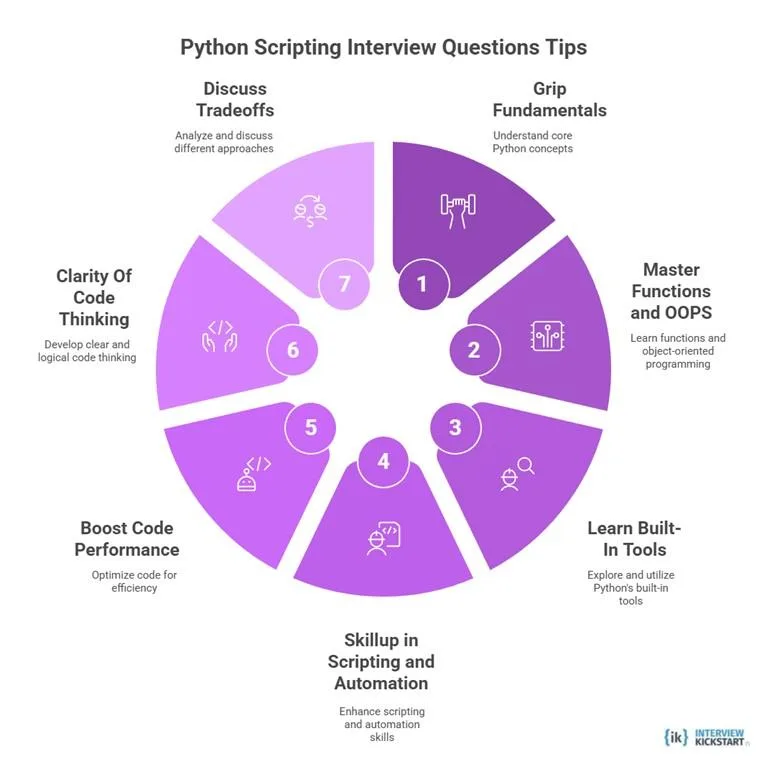
5 Tips to Crack Python Scripting Interview Questions in 2026
Figure 1: Tips to Crack Python Scripting Interview Questions in 2026
Python interview questions tips are to master the fundamentals and core concepts of Python scripting. First, always clarify the context before answering.
If the interviewer asks about OOPS design, confirm whether the discussion is about core design, OOP principles, decorators, context managers, descriptors, and metaclasses, or a combination. Context shapes depth.
Second, structure answers consistently. Definition, example, production implication, trade-off. This pattern works across all Python scripting interview questions and answers.
Third, communicate trade-offs clearly. Checked versus unchecked is not a binary debate. Explain the impact on API design and maintainability.
Fourth, practice writing clean code without IDE support. Whiteboard discipline matters.
Finally, avoid panic when discussing production failures. Interviewers are evaluating composure and reasoning.
Serious About Python Scripting? Prepare Like a FAANG Candidate
You’ve worked through the Python scripting interview questions. Now it’s time to prepare like a serious Python Scripting Engineering candidate aiming for FAANG+ roles.
The Software Engineering Interview Prep course by Interview Kickstart is designed by FAANG+ engineering leaders who know exactly what top companies expect. The program covers data structures, algorithms, core Python concepts, and other interview-relevant topics that matter in real hiring loops. You can select from Frontend, Backend, Fullstack, and Engineering Manager tracks.
You get personalized 1:1 technical coaching, homework guidance, and detailed solution discussions. You’ll also go through mock interviews with Silicon Valley engineers in real-world simulated environments, followed by structured, actionable feedback to sharpen your performance.
Beyond technical prep, Interview Kickstart supports your career growth with resume building, LinkedIn optimization, personal branding guidance, and live behavioral workshops.
If you’re targeting high-impact Python scripting engineering roles at top-tier companies, this is preparation built for results, not just practice.
Conclusion
Preparing for Python scripting interview questions requires more than memorizing definitions. It requires understanding how failure shapes system design.
Strong candidates demonstrate clarity, production awareness, and structured reasoning. Whether answering scripted interview questions, Python interview questions at the entry-level or senior level, depth and composure matter.
Continue practicing real-world scenarios. Analyze OOPS use cases, write experimental code, and run it in an IDE to find structural problems. Download datasets and experiment with different file formats.
Preparation done thoughtfully transforms interviews from interrogation into technical discussion.
FAQs: Python Scripting Interview Questions
Q1. What are the most common Python scripting interview questions?
Common scripting interview questions in Python are on key domains and their sub-domains. The domains are basic Python, file and data operations, scripting, and object-oriented programming.
Q2. How do I prepare for Python basic interview questions and Python advanced interview questions?
Implementation and hands-on experience are critical, along with theory. Practice with question banks, write and test code, understand how code is implemented, and attend mock interviews.
Q3. How deep should I prepare for senior roles?
A: Python interview questions for senior roles are on system-level performance, tech stack, design of APIs and systems, and managing large projects.
Q4. How to approach Python basic interview questions and Python advanced interview questions on OOPS?
Practice writing code for different scenarios and questions. Your code must be minimalistic, clean, and well commented.
Q5. What is the AI environment for test coding?
To prevent cheating and malpractices, coding tests are run in an AI-controlled IDE. Your eye movements are tracked, you are not allowed to change the screen, and you are not allowed to look at other screens.
References
Software Developers, Quality Assurance Analysts, and Testers