
Apple fullstack engineer interview questions are a prerequisite to preparing for one of the most competitive tech interviews in the U.S. These questions cover coding, problem-solving solving system design, and real-world engineering challenges.
The U.S. Bureau of Labor Statistics projects software developer jobs to grow about 15 percent from 2024 to 20341, much faster than the average for all careers, and creating roughly 129,200 openings per year.
That makes mastering fullstack concepts valuable for today’s job market. Nearly half of U.S. developers report working remotely or hybrid work environment, which influences interview formats and candidate expectations.
In this article, we will walk you through the most common Apple fullstack engineer interview questions, provide sample answers, explain what interviewers look for, and share practical preparation tips, too.
Apple fullstack engineer interview questions are designed to test how you think, not just what you know. The interview loop usually spans multiple rounds, and each one evaluates a different skill set. Understanding this structure early helps you prepare with intent instead of guessing.
Most Apple fullstack candidates start with a recruiter screen focused on role fit and experience. This is followed by one or two technical screens with coding problems. These questions are similar in style to Apple’s fullstack developer interview questions seen on coding platforms.
Later rounds include live coding with an engineer and a system design interview for mid to senior roles. The process often ends with a hiring manager or behavioral round. These stages closely resemble Apple fullstack software engineer interview questions shared by past candidates.
Interviewers look for structured problem-solving and clear communication. They care about how you break down Apple fullstack engineer interview questions and explain trade-offs. Writing correct code matters, but so does reasoning aloud.
For full-stack roles, Apple also evaluates frontend judgment, backend design choices, and ownership mindset. Candidates who balance technical depth with clarity tend to stand out.
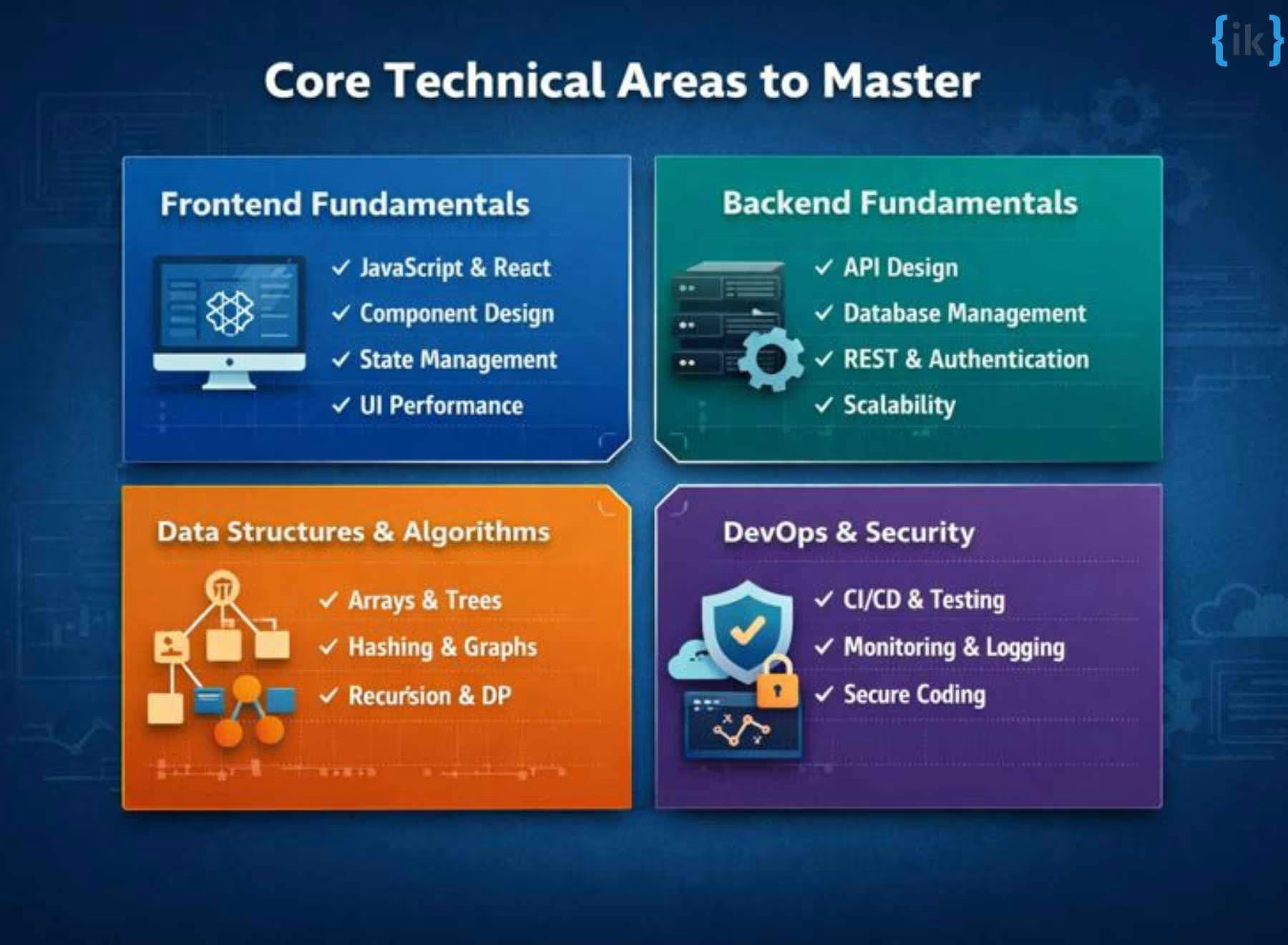
Apple fullstack engineer interview questions span multiple layers of the stack. Apple expects balanced engineers who can move between frontend, backend, and systems thinking without losing depth.
Preparing these areas well makes Apple fullstack developer interview questions feel predictable instead of overwhelming.
You are expected to be comfortable with modern JavaScript and component-based frameworks like React. Focus on component design, state management, rendering performance, and accessibility.
Interviewers often probe how you handle real UI trade-offs, not just syntax. Many Apple fullstack software engineer interview questions test how you think about user experience and maintainability.
Backend questions focus on API design, data flow, and reliability. You should understand REST principles, authentication, database interactions, and error handling. Apple fullstack engineer interview questions often explore how backend choices affect frontend performance and scalability.
Strong fundamentals still matter. Arrays, strings, hashing, trees, and graphs appear frequently. Focus on common patterns like two pointers, sliding window, recursion, and basic dynamic programming. These show up consistently across Apple fullstack developer interview questions.
Apple values production-ready thinking. Be prepared to discuss testing strategies, CI pipelines, logging, monitoring, and basic security practices like secure authentication and data protection. These topics often separate average answers from strong ones.
Recommended Read: Full Stack Developer Interview Questions and Answers
Coding rounds are the most decisive part of the Apple fullstack engineer interview questions. These interviews are designed to evaluate structured thinking, not speed typing. Apple interviewers want to see how you reason through a problem, validate assumptions, and arrive at a maintainable solution under realistic constraints.
Most coding rounds resemble Apple fullstack developer interview questions, but with an added emphasis on clarity and correctness over clever tricks.
Apple frequently asks medium-difficulty problems rooted in fundamentals. You should be comfortable with:
Dynamic programming appears occasionally, but interviewers care more about whether you recognize patterns than whether you memorize formulas. These problem types consistently show up in Apple fullstack software engineer interview questions shared by past candidates.
Live coding is less about finishing fast and more about communicating clearly. Interviewers actively evaluate:
Strong candidates treat live coding like a collaborative problem-solving session, not a test. This mindset aligns well with how Apple teams actually work.
When answering Apple fullstack engineer interview questions, follow a repeatable structure:
This approach shows maturity and engineering discipline, which interviewers value highly.
Consider a problem like merging overlapping intervals. A strong answer explains why sorting is required, how comparisons work, and what happens with edge cases such as empty input or single intervals. The final code is simple, readable, and supported by a clear complexity explanation.
This level of reasoning is what separates average answers from strong ones in Apple fullstack interviews.
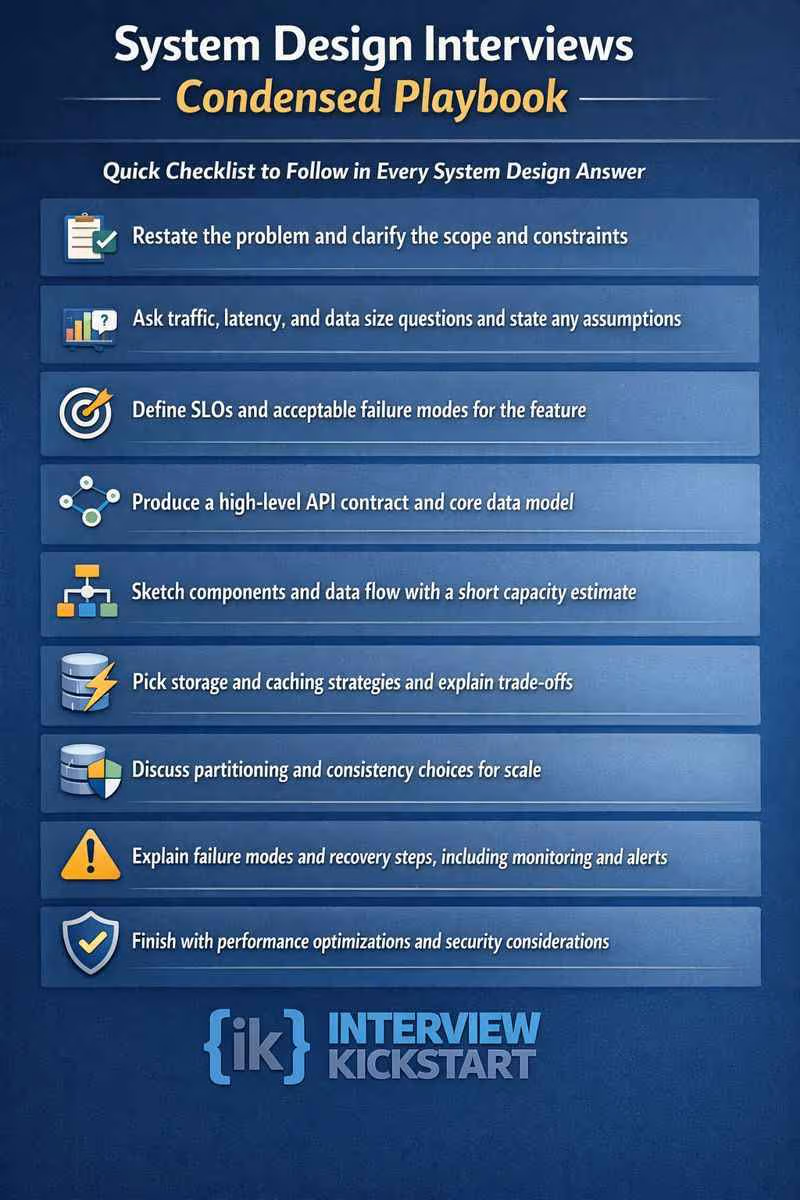
Apple fullstack engineer interview questions include system design for mid and senior roles. Interviewers expect a crisp, reproducible process that demonstrates your ability to design reliable systems at scale and clearly explain trade-offs.
Use this checklist when answering Apple fullstack engineer interview questions and when practicing Apple fullstack developer Interview Questions.
Always show your math. Interviewers look for clear assumptions and a reasonable back-of-the-envelope calculation. Use this pattern.
Example calculation:
Here’s the math:
This leads to a small service on a low scale. If you scale numbers up, interviewers will see you can reason across orders of magnitude.
Example architecture diagram for a notification service
Here’s a simple ASCII diagram for interview use:
|
Client -> API Gateway -> Load Balancer -> App Server | | v v Cache Message Queue -> Worker Pool -> Database | v CDN |
Explain each piece briefly when you draw it. Cover where you would place caching, how you would shard the database, and how you would handle retries from the queue.
Make these trade-offs explicit when tackling Apple fullstack engineer interview Questions and when preparing Apple fullstack software engineer interview questions practice scenarios.
Name possible failures and the mitigation you would add. Its examples are:
Also, define two simple SLOs you would propose and how you would measure them. Example SLOs
During the interview, you can:
This systematic approach converts vague Apple fullstack engineer interview questions into a reproducible template. Practice it with a few sample problems until your sketches are fast and your spoken explanation is tight.
Recommended Read: Full Stack Developer Interview Questions and Answers
Apple fullstack engineer interview questions will probe both frontend and backend depth. Below, we compare the two and give ready scenarios to practice. Use this when you practice Apple fullstack developer interview questions and Apple fullstack software engineer interview questions.
Quick differentiation table
| Area | Frontend focus | Backend focus |
| Primary goal | Deliver fast, accessible, and correct UI | Build reliable, scalable server-side logic |
| Core skills tested | React patterns state management rendering perf accessibility | API design, database, and concurrency, fault tolerance |
| Common question types | Reconcile state with async data, implement UI behavior, optimize render path | Design an API versioning strategy, choose a DB, and handle race conditions |
| Evaluation criteria | User experience, reasoning, code readability, performance measurements | Correctness under failure capacity reasoning observability |
| Sample short task | Implement debounced search with keyboard accessibility and tests | Design a paged search API with a rate limit and idempotent operations |
| What makes the answer strong | Explain UI trade-offs offs show instrumentation, and measurable gains | Show capacity math, propose concrete failure recovery and monitoring |
Include the primary keyword and both secondary keywords naturally when you describe these tasks during practice.
Each scenario focuses on what interviewers expect you to explain out loud, not just what you build. The goal is to help you practice structured reasoning, clear communication, and trade-off discussion so your answers sound confident, deliberate, and aligned with real production engineering decisions.
Task: Build a typeahead search box that queries a paged API and displays results with full keyboard navigation.
What to state and show during the interview
Task: Design a paged search API that supports filtering and returns consistently sorted results under heavy traffic.
What to state and show during the interview
Task: Design a feature end-to-end where the frontend implements optimistic UI for submitting a form, and the backend accepts the request, validates, and persists with eventual consistency.
When you answer this in a mock interview, say the following steps aloud:
This combined scenario maps directly to Apple fullstack engineer interview questions and helps you show cross-stack thinking when practicing Apple fullstack developer interview questions.
Looking for a real full-stack mock interview?
See how candidates structure answers, explain trade-offs, and handle live coding in a realistic Interview Kickstart mock interview. This video helps you understand what strong Apple fullstack interview responses sound like in real time.
A structured plan helps you cover Apple fullstack engineer interview questions without burnout or random practice. This 30-day plan focuses on high signal topics that consistently appear in Apple fullstack developer interview questions and Apple full-stack software engineer interview questions.
Focus on strengthening core foundations and setting up your practice workflow.
Increase problem difficulty and introduce time pressure.
Shift focus to system design and cross-stack thinking.
Use this week to simulate the real interview experience.
For candidates who want hands-on practice, real interview feedback, and structured coaching across coding and system design, Interview Kickstart’s Full-Stack Interview Preparation course is worth exploring.
The program focuses on realistic interview scenarios, mock interviews with experienced engineers, and targeted feedback aligned with how Apple evaluates fullstack candidates.

Many strong engineers struggle with Apple fullstack engineer interview questions, not because of weak technical skills, but due to avoidable mistakes during interviews. Knowing these pitfalls in advance can improve your performance in Apple fullstack developer interview questions and Apple fullstack software engineer interview questions.
Candidates often jump straight into coding or designing without confirming requirements. This leads to solving the wrong problem or missing edge cases. Always restate the problem, ask about constraints, and confirm expected behavior before writing code or drawing diagrams.
Take the first one to two minutes to clarify inputs, outputs, and constraints. Interviewers see this as a sign of structured thinking.
Another common issue is adding unnecessary complexity early. Interviewers prefer a correct and readable solution over an overly optimized one. Start with the simplest working approach. Then explain how you would optimize it if needed. This shows good judgment during the Apple fullstack engineer interview questions.
Silence during coding makes it hard for interviewers to follow your thought process. Even correct solutions can score poorly if reasoning is unclear. Think aloud. Explain why you chose a specific data structure or approach. This is especially important in Apple fullstack software engineer interview questions.
Many candidates describe components but fail to explain why they chose them. Interviewers care deeply about trade-offs. For every major decision, state at least one alternative and why you did not choose it. This demonstrates senior-level thinking.
Candidates often stop after writing code without validating it. This signals incomplete thinking. Walk through at least two edge cases and discuss time and space complexity. This habit consistently improves interview outcomes.
Preparing for an Apple fullstack engineer interview is less about covering everything and more about practicing the right things well. Apple looks for engineers who can think clearly, communicate decisions, and balance frontend and backend trade-offs without overcomplicating solutions.
Strong interviews feel structured and calm, not rushed or clever. If you focus on core fundamentals, practice explaining your approach out loud, and rehearse realistic scenarios, the interview becomes predictable.
Use Apple fullstack developer interview questions to sharpen coding fundamentals and Apple fullstack software engineer interview questions to refine system design and cross-stack thinking.
Consistent practice, thoughtful trade-off discussions, and clear communication are what ultimately separate good candidates from great ones.
Yes. Many teams still use take-home tasks, especially for role fit or product teams. Treat them as an interview deliverable by keeping the scope small, documenting trade-offs, including tests, and explaining design choices during the interview. If the timeframe feels unreasonable, ask your recruiter for clarification or an extension.
Timelines vary by team, but two weeks is a common ballpark. If the recruiter gave no timeline, send a polite follow-up a week after the interview, then one more after another week. Many candidates report waiting from a few days up to several weeks, depending on hiring cycles.
Use the language that you can express algorithms clearly in. For iOS or low-level roles, Swift/Objective-C or C++ may be expected, but for general fullstack interviews, Python, Java, or JavaScript are usually acceptable. If in doubt, ask the recruiter what the interviewer prefers.
Apple’s office policy and team needs vary. Some roles are hybrid or require on-site presence; others are more flexible but often expect US time zone alignment. Always confirm location and on-site expectations with the recruiter before you commit to the interview process.
Direct, detailed feedback is rare. Most candidates receive a brief decision (yes or no). If you want actionable feedback, ask the recruiter for high-level areas to improve. Sometimes they can share non-sensitive guidance. Expect silence or a summary rather than a full critique.


Time Zone:







Time Zone:

Time Zone: Asia/Kolkata
Time Zone: Asia/Kolkata
Hands-on AI/ML learning + interview prep to help you win
Explore your personalized path to AI/ML/Gen AI success

Time Zone: Asia/Kolkata
Hands-on AI/ML learning + interview prep to help you win
Time Zone: Asia/Kolkata
Hands-on AI/ML learning + interview prep to help you win
Explore your personalized path to AI/ML/Gen AI success


