Preparing for Amazon software engineer coding interview questions takes focused practice and a clear strategy. These interviews test correctness, edge-case thinking, and how you articulate tradeoffs out loud.
Hiring is still competitive, with 74%1 of developers claiming landing a role feels difficult, according to HackerRank’s 2025 Developer Skills Report. Nearly half of employers still include algorithmic coding questions in technical assessments, per the 2025 State of Tech Hiring report from CoderPad and CodinGame.
In this article, we cover six company-relevant problems with tight walkthroughs and a pattern cheat sheet. You’ll also get copy-ready talk tracks mapped to Amazon leadership principles, a practical 4-week plan, and a live-interview checklist to use before every loop.
Key Takeaways
- Focus on core topics such as arrays, strings, trees/graphs, dynamic programming, sorting, and hashing.
- Use pattern recognition (two pointers, sliding window, hash maps, heaps, DFS/BFS, DP).
- Practice with timed mocks and full loops to simulate Amazon SDE coding interview questions.
- Follow a day-before checklist: light review, a timed practice, and a final tech check.
- Communicate clearly: restate the problem, ask clarifying questions, give a brute force then optimized plan, handle edge cases, and state complexity.
How the Amazon Software Engineer Interview Is Structured?
Amazon’s software engineer interviews are known for their rigorous focus on coding skills. The process typically includes an initial phone screen, a timed online coding assignment, and finally, the on-site Loop interviews.
In each technical round, candidates usually solve one or two algorithmic problems. For example, the remote Amazon coding test lasts ~90 minutes and involves solving 2–3 problems on data structures and algorithms.
Successful candidates then enter the on-site loop of 3–4 rounds (often 2 coding rounds, followed by design and behavioral rounds). The coding rounds assess problem-solving with data structures and algorithms.
- Phone screen (initial): 15–30 min with a recruiter. Expect basic technical questions and scheduling of the coding assignment.
- Online coding assignment: ~90-minute timed test on a coding platform (e.g., HackerEarth), requiring 2–3 coding problems in core algorithms and data structures.
- Second phone screen: Sometimes added for clarification; may include another coding or design question.
- On-site loop: 3–4 rounds. Typically, the first 1–2 rounds are coding, and the last 1–2 rounds cover system design and Amazon’s leadership principles.
Successful candidates must also clear a bar raiser behavioral interview round.
This process tests how you solve Amazon SDE coding interview questions under pressure. Prepare for 2 coding rounds and a behavioral Bar Raiser. Practice the exact error handling and edge-case checks common in Amazon SDE coding interview questions.
Common Coding Question Topics
Amazon coding interview patterns come from core topics. Knowing these patterns helps you map a new problem to a tested approach.
The table below summarizes the key areas and example problem types you should practice:
| Topic |
Typical Problems |
| Arrays & Searching |
Find min/max, sliding-window sums, two-sum variants, rotate arrays, and leaders in an array. Use Amazon coding interview patterns to spot two-pointer or hashing solutions. |
| Strings & Hashing |
Palindrome check, anagram detection, substring search, K-anagrams, character frequency, string compression. These are frequent in Amazon SDE coding interview questions. |
| Graphs & Trees |
Tree/graph traversals (DFS/BFS), lowest common ancestor, connectivity, shortest path, cycle detection. Practice DP patterns often seen in Amazon SDE coding interview questions. |
| Dynamic Programming |
Fibonacci variants, knapsack, coin change, longest increasing subsequence, matrix path count. |
| Sorting & Greedy |
Merge sort/quick sort coding, interval merging, minimum swaps to sort, scheduling/interval problems. |
| Recursion & Backtracking |
Recursive sequence generation, subset/permutation generation (e.g., N-Queen, graph permutations). These recur in Amazon SDE coding interview questions |
These topics come up frequently in Amazon questions. For example, common Amazon problems include Two Sum, Sliding Window Maximum, Valid Anagram, and Word Break, which all involve the above themes.
Amazon often asks questions on arrays, strings, trees/graphs, dynamic programming, and interval problems. Mastery of these areas will prepare you for almost any Amazon software engineer coding interview question.
Also Read: A Complete Guide to Amazon Interview Process and Coding Interview Questions
Top Preparation Strategies for an Amazon Software Engineer Coding Interview
Effective preparation requires structured practice. The following strategies will help you tackle Amazon software engineer coding interviews:
- Master data structures & algorithms: Focus on the core topics listed above. Practice implementing arrays/lists, stacks, queues, trees, graphs, and heaps, and understand sorting and searching techniques. Name the Amazon coding interview patterns when you read a problem.
- Use a familiar programming language: Pick a high-level language you know well. Fluency reduces syntax bugs during Amazon SDE interview questions. As interview advisors note, a succinct language like Python helps you focus on problem logic.
- Practice on coding platforms: Target Amazon-specific questions, solve Amazon SDE coding interview questions, and tag problems by pattern. Practicing previous Amazon questions and similar ones builds familiarity with the style and difficulty. Track how many Amazon coding interview patterns you can solve in 20 minutes.
- Simulate mock interviews: Practice mock interviews with peers or mentors. This helps you think aloud and refine your communication. Research shows that explaining your thought process is as important as finding the solution. Use tools or classes to get feedback on both coding and communication.
- Focus on clean code and communication: Always write clear, well-structured code and narrate your approach. Amazon values code clarity and the problem-solving process. Outline your plan before coding, handle edge cases, and discuss time/space complexity as you go.
These strategies incorporate best practices for Amazon software engineer coding interview questions.
Pattern Cheat Sheet Quick Grid
A compact pattern guide is the fastest way to map a new problem to an approach during an Amazon software Engineer coding interview. It also lets you map problems quickly to Amazon coding interview patterns.
| Pattern |
When to pick it |
Canonical problem |
Time target |
| Two pointers |
Pairing, sorted arrays, subarray sums |
Two sum variant |
10 to 12 min |
| Sliding window |
Substring or subarray with a dynamic window |
Longest substring without repeat |
15 to 20 min |
| Hash map |
Frequency, index lookup, dedupe |
Two sum, count patterns |
10 to 15 min |
| Heap |
Top k problems and merging sorted streams |
Merge k sorted lists |
20 to 25 min |
| DFS BFS |
Tree and graph traversals and reachability |
LCA, shortest path |
20 to 30 min |
| Dynamic programming |
Overlapping subproblems and optimal substructure |
Knapsack, LIS |
25 to 40 min |
| Greedy |
Local optimum gives global |
Interval scheduling |
15 to 25 min |
| Union find |
Connectivity and cycle detection |
Connected components |
15 to 25 min |
Practice naming the pattern and one concrete step for each pattern in under 30 seconds. That cut in recognition time reduces panic during live Amazon coding rounds.
Practice Problems Core Set
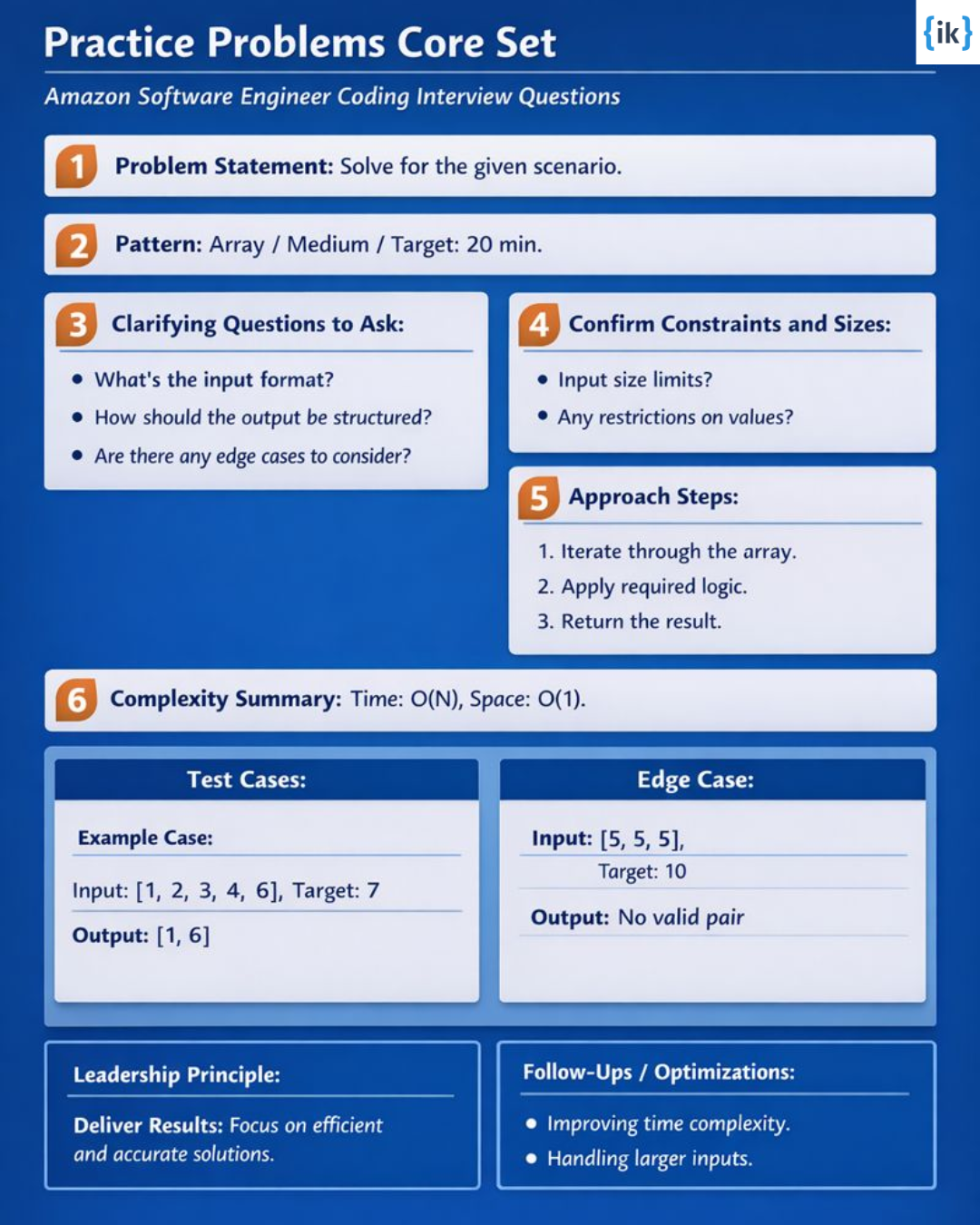
This core set focuses on patterns that appear repeatedly in Amazon software engineer coding interview questions. Each problem follows a consistent micro-template, so you can practice execution, communication, and decision-making the same way interviewers evaluate you.
Problem 1: Two Sum Variant
- Problem statement: Find indices of two numbers that add up to a target.
- Pattern and difficulty: HashMap. Easy. Target time: 10 to 12 minutes.
- Clarifying questions: Ask whether numbers are unique. Confirm whether indices are zero-based or one-based.
- Constraints: Confirm whether the input size can reach millions.
- Approach: Traverse the array once. Store seen values in a HashMap. For each number, check if the complement already exists.
- Complexity: Time O(n). Space O(n).
- Test cases:
- Input [2, 7, 11, 15], target 9 returns [0, 1]
- Edge case [3, 3], target 6 returns [0, 1]
- Talk track: I validate assumptions first, then use a single-pass solution to ensure correctness and efficiency.
- Follow-ups:
- What if the array is sorted?
- What if values need to be returned instead of indices?
Problem 2: Longest Substring Without Repeating Characters
- Problem statement: Find the length of the longest substring with all unique characters.
- Pattern and difficulty: Sliding window. Medium. Target time: 18 minutes.
- Clarifying questions: Ask whether the character set includes Unicode. Confirm whether to return the length or the substring.
- Constraints: Confirm maximum string length.
- Approach: Expand a sliding window while tracking last seen positions. Shrink the window when duplicates appear.
- Complexity: Time O(n). Space O(charset size).
- Test cases:
- Input abcabcbb returns 3
- Edge case empty string returns 0
- Talk track: I optimize for linear time since this impacts user-facing latency at scale.
- Follow-ups: Return the actual substring. Track indices instead of length.
Problem 3: Merge K Sorted Lists
- Problem statement: Merge k sorted linked lists into one sorted list.
- Pattern and difficulty: Heap. Medium. Target time: 20 to 25 minutes.
- Clarifying questions: Ask whether list nodes can be reused. Confirm the total number of nodes.
- Constraints: Total node count across all lists.
- Approach: Insert each list head into a min heap. Repeatedly pop the smallest node and push the next node from that list.
- Complexity: Time O(n log k). Space O(k).
- Test cases:
- Multiple lists merging correctly
- Edge case: all lists empty returns an empty list
- Talk track: I use a standard data structure to reduce complexity and bug risk.
- Follow-ups: Divide-and-conquer merging approach.
Problem 4: Lowest Common Ancestor in a Binary Tree
- Problem statement: Find the lowest common ancestor of two nodes in a binary tree.
- Pattern and difficulty: Depth-first search. Medium. Target time: 20 to 25 minutes.
- Clarifying questions: Confirm both nodes exist. Ask whether parent pointers are available.
- Constraints: Tree size and depth.
- Approach: Use postorder traversal. Return the current node when both targets are found in different subtrees.
- Complexity: Time O(n). Space O(h) for the recursion stack.
- Test cases:
- Balanced tree with nodes in separate subtrees
- Edge case single-node tree
- Talk track: I walk through test cases to demonstrate correctness and build confidence.
- Follow-ups: Iterative solution using parent pointers.
Problem 5: Shortest Path in a Weighted Graph
- Problem statement: Find the shortest path between two nodes in a weighted graph.
- Pattern and difficulty: Graphs with Dijkstra. Medium hard. Target time: 25 to 30 minutes.
- Clarifying questions: Confirm no negative weights. Ask about graph representation.
- Constraints: Number of nodes and edges.
- Approach: Apply Dijkstra using a min priority queue. Stop early when the destination is reached.
- Complexity:
- Time O(E log V)
- Space O(V).
- Test cases:
- Known shortest path graph
- Edge case unreachable destination
- Talk track: I explain why Dijkstra fits the constraints and avoids unnecessary computation.
- Follow-ups: A star heuristic. Multi-source Dijkstra.
Problem 6: Partition Array Into K Equal Sum Subsets
- Problem statement: Determine if an array can be split into k subsets with equal sum.
- Pattern and difficulty: Backtracking with DP. Hard. Target time: 30 to 40 minutes.
- Clarifying questions: Ask about negative numbers. Confirm bounds for n and k.
- Constraints: Practical limits for backtracking.
- Approach: Sort descending. Use backtracking with pruning and memoization using bitmasking.
- Complexity: Exponential in the worst case, heavily pruned in practice.
- Test cases:
- Valid partition returns true.
- Edge case mismatched sum returns false
- Talk track: I prioritize a working solution first, then prune aggressively to optimize.
- Follow-ups: Heuristic approximations for larger inputs.
This prepares you for deeper follow-ups and senior-level Amazon software engineer coding interview questions.
💡 Pro Tip: After mastering these, practice converting O(n²) solutions into O(n log n). Also, rehearse take-home style problems where correctness, readability, and trade-offs matter as much as raw speed.
A Practical Plan for Amazon Coding Interview Success

This live interview checklist and four-week practice plan will prepare you for Amazon software engineer coding interview questions. Use the checklist to highlight the Amazon coding interview patterns you chose and why. Saying the pattern aloud clarifies your approach to Amazon SDE coding interview questions.
Live Interview Performance Checklist
Start of interview:
- Restate the problem in your own words and confirm outputs.
- Ask two clarifying questions and repeat constraints.
- Outline a brute force, then the intended optimized approach.
- State time and space complexity for each plan.
- Implement a short, correct baseline.
- Run two tests, including an edge case.
- Summarize the final complexity and next improvements.
If you feel stuck, ask yourself:
- Explain what you tried and why.
- Offer a simpler solution you can implement now.
- Ask for hints if allowed.
Keep each item on one line. Read it once before you code. This checklist directly maps to how interviewers grade Amazon Software Engineer Coding Interview Questions and to common Amazon SDE coding interview questions feedback.
Focus each day on Amazon coding interview patterns and on clear explanations. Use timed mocks to mirror real pressure. Use the checklist during every mock to turn practice into reliable performance for Amazon software engineer coding interview questions.
Also Read: How to Prepare for the Amazon Coding Challenge
Common Pitfalls to Avoid in Amazon Coding Rounds
Many engineers lose their momentum by neglecting foundations and speed, failing to simulate the 100% focus required for a 90-minute simulation. Here are common pitfalls to avoid and a cheat sheet to systematically eliminate friction and master the final 24 hours of your prep:
1. Panic and rush to code
- Mistake: Many candidates start coding without a plan.
- Fix: Outline the approach in 60 seconds. Speak two sentences about the plan. Then code. That reduces syntax bugs.
2. Ignoring constraints and wrong algorithm choice
- Mistake: Using O n squared where O n log n is required.
- Fix: Ask limits upfront. If n can be a million, default to linear or n log n solutions. Say I assume n can be large, so I will target O n or O n log n. Assume large n and pick scalable Amazon coding interview patterns.
3. Overengineering and Lost Time
- Mistake: Building a complex structure before proving correctness.
- Fix: Deliver a correct baseline in 8 to 12 minutes. Then optimize. If the interviewer asks for faster, explain your next step and why.
4. Forgetting leadership principles in coding rounds
- Mistake: Treating coding as purely technical.
- Fix: Prepare one sentence per LP mapped to tradeoffs. Use them when you explain optimizations. Keep each sentence under 12 words.
Practice this routine in every mock, so it becomes automatic in the loop.
Day Before Timeline and One-Page Cheat Sheet
| Time of Day |
What to Do |
| Morning |
Light review. Scan one-page cheat sheet for patterns and three talk tracks. Do not cram new topics. Focus on Amazon coding interview patterns. |
| Afternoon |
Rehearse one easy and one medium problem within 25 minutes. Time yourself. Run leadership principle one-liners. Practice Amazon SDE coding interview questions under time. |
| Evening |
Do a final tech check. Open the editor you will use. Test the audio and camera. Close unneeded apps. Print or save the one-page cheat sheet to your desktop. Sleep early. |
Example talk tracks you can copy
- Ownership: I found the root cause and added a simple test to prevent regressions.
- Dive deep: I validated the worst-case input and chose the algorithm for scale.
- Customer obsession: I optimized the common path to reduce user latency.
If you want guided, hands-on help to speed up your prep, consider Interview Kickstart’s Agentic AI for Tech Low-Code course.
Conclusion
Amazon software engineer coding interviews test your mastery of algorithms and data structures under pressure. Throughout the process, from phone screens to the on-site Loop, expect to solve array, string, graph, DP, and sorting problems.
Success comes from focused practice. Solve many problems, time yourself, and work on explaining your solutions clearly. Use all available resources, including InterviewKickstart’s guides and courses.
By following a structured preparation plan, practicing mock interviews, and learning from each attempt, you’ll build the confidence needed to ace the Amazon coding interview. Practice Amazon SDE coding interview questions with timed mocks and full loops.
Lastly, stay persistent, review your mistakes, and keep improving, and you will be able to crack those Amazon coding questions with the right strategy and effort.
FAQs: Amazon Software Engineer Coding Interview Questions
Q1. Will Amazon’s online assessment flag tab switching or copy-paste activity?
Yes. Recent candidates report that Amazon’s OA logs tab switches and clipboard actions. If you accidentally trigger a warning, stay calm and finish the test. Afterward, email the recruiter immediately with a brief explanation and context. Clear communication matters more than pretending it didn’t happen.
Q2. Should I submit the OA if I can’t finish all problems?
Yes. Submit a clean, working partial solution. Interviewers prefer correct logic with clear comments over rushed, buggy code. If something is incomplete, briefly explain what you would do next and why. Many candidates progress even without full completion when reasoning is strong.
Q3. How should I split time in a 90-minute Amazon coding test?
Scan all problems first for 5–10 minutes. Identify the hardest one early. Spend about 35–40 minutes on the hardest problem, 25–30 minutes on the easier one, and reserve the last 10–15 minutes for testing and fixes. This prevents getting stuck too long on the wrong problem.
Q4. What should I do if the interviewer goes silent during a coding round?
Pause briefly, then summarize your current plan and next step out loud. If silence continues, ask a direct but professional question like, “Would you like me to code this approach or first walk through edge cases?” Short prompts help re-engage without sounding unsure.
Q5. Can I ask the recruiter about the loop structure before interviews?
Yes. Many recruiters will share whether the loop includes two coding rounds, system design, or additional behavioral interviews. Asking upfront helps you prioritize preparation. If details aren’t shared, assume at least two coding rounds plus a Bar Raiser.
References
- Hiring Reality 2025: Developer Skills and Interview Trends