
The Amazon full stack engineer system design interview questions are designed to test how well you think, from user interactions on the screen to APIs, data storage, and performance at scale. Interviewers want to see how you connect frontend decisions with backend architecture and explain those tradeoffs clearly.
This matters even more in 2026. Full-stack roles remained a top hiring priority in 2025, and companies expect engineers to bridge UI, API, and data concerns. Jobs-on-the-rise reports list full-stack engineers among high-demand roles in 20251.
In this article, we’ll give you a comprehensive, repeatable 7-step answer framework, six Amazon sample questions, front-end tradeoffs to call out, and common mistakes to avoid before appearing for the Amazon interview.
Amazon full stack engineer system design interview questions evaluate how to clearly frame the problem, propose a high-level design, and justify choices with numbers.
Use this rubric to guide your answer and show frontend impact and operational thinking. The Amazon full stack engineer system design interview questions mindset helps you prioritize what to show.
| Evaluation area | Weight | What the interviewer looks for | Strong signal |
| Problem framing and clarifying questions | 10% | Asks clarifying questions about users, scale, SLAs, data retention, and failure modes. | States 3 clear assumptions before starting the design. |
| High-level architecture and component boundaries | 20% | Draws a clear HLD showing components and data flow. | Name each component and explain why it exists. |
| Data model and API design | 15% | Design tables or objects that match access patterns. | Calls out indexes and read vs write tradeoffs. |
| Low-level design for the critical path | 15% | Deep dives into the critical path with algorithms and failure handling. | Explains idempotency, retries, pagination, or batching. |
| Frontend impact and UX reasoning | 10% | Considers latency budgets, caching, optimistic UI, and error handling. | Explains how UX changes with backend decisions. |
| Performance, scaling, and operational thinking | 15% | Provides realistic capacity estimates and a scaling plan. | Proposes caching, sharding, or async processing where appropriate. |
| Tradeoffs, testing, and monitoring | 10% | Weighs alternatives and proposes validation and monitoring. | Name specific metrics and concrete tests. |
| Communication and structured thinking | 5% | Presents ideas in a clear, logical order. | Summarizes the design and ends with a validation plan. |
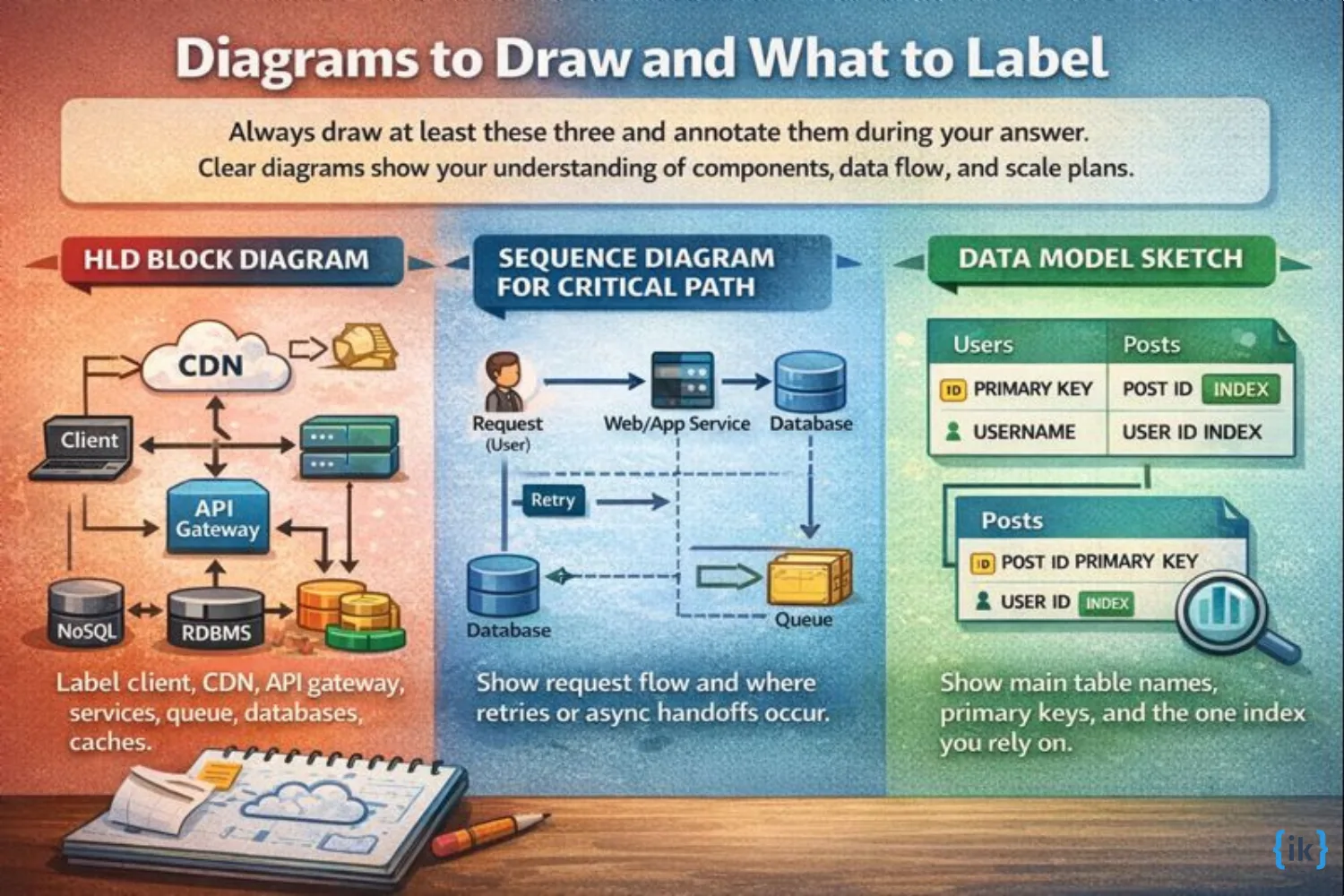
Diagrams make the Amazon full stack engineer system design interview questions concrete. A clear HLD, a short sequence diagram, and a compact data model make your thinking visible and let interviewers verify component boundaries, critical paths, and the index choices you relied on.
Also Read: How to Crack Full Stack System Design Interview Questions? With Example
After the evaluation criteria are clear, what matters most is how you run the interview. In Amazon full stack engineer system design interview questions, the opening minutes set the direction, time management decides how deep you can go, and concrete validation keeps your design grounded in reality.
Treat this as a short full-stack system design interview guide for execution and delivery.
These techniques also apply directly when you practice the Amazon full stack system design sample questions under timed mock conditions.
A design is only credible if you can prove it works in production. Call out specific tests and metrics, so you look like an owner.
Mention p95 latency, error rate, throughput, and tail latencies when you explain how you would validate Amazon full stack engineer system design interview questions.
Your first minute sets the tone for the entire interview. A clear opening script signals structured thinking, aligns expectations early, and gives the interviewer confidence in how you will drive the discussion.
| “I will confirm the user flow and three success metrics. Then I will sketch a high-level architecture and list key APIs. After that, I will deep dive into the critical path and cover frontend tradeoffs. I will finish with capacity estimates and a validation plan.” |
This script maps to the full-stack system design interview guide and keeps your answer focused for the Amazon full stack engineer system design interview questions.
Time management decides whether your answer feels complete or rushed. Having a mental time split helps you prioritize the critical path, show depth where it matters, and still leave space to summarize tradeoffs and validation.
Follow this split and narrate it:
If time runs out, say what you would do next. That shows prioritization. Use this timing plan in every mock for the Amazon full stack engineer system design interview questions.
Even strong candidates get interrupted, rushed, or pushed into uncomfortable corners. Short, rehearsed rescue lines help you regain structure, make reasonable assumptions, and continue confidently without freezing or overexplaining.
| Situation | What to say | Why it works |
| The interviewer asks you to speed up | “I will focus on the checkout critical path and then list three items I would add with more time.” | Shows prioritization under time pressure and reassures the interviewer that you know what to cut and what to defer. |
| The interviewer asks for alternatives. | “Option A reduces latency but costs more. Option B saves cost but needs more operational effort. I prefer A for customer experience.” | Demonstrates structured tradeoff thinking and customer-first decision making. |
| You are unsure about a detail | “I assume X for now. If X is different, I would change Y to Z.” | Makes assumptions explicit and shows adaptability without freezing or guessing. |
These concise lines fit the full-stack system design interview guide and help with Amazon full stack engineer system design interview questions.
Here’s a real full-stack mock and steal the framework. Check this video to see how FAANG interviewers think and what you must say to score higher.
This is the script you should use in every Amazon full stack engineer system design interview questions session. Say the step name as you move through it. Keep sentences short. Show tradeoffs and show the frontend impact.
Below are the exact steps you should move through during the interview.
Use the above answering mechanism in this full-stack system design interview guide approach to structure every answer.

Weak answers stay abstract and unverifiable, while strong answers anchor decisions in scale, constraints, and validation. The difference is not tooling. It is how clearly you translate ideas into measurable, production-ready choices.
Use the Amazon full stack system design sample questions to practise turning weak answers into strong answers for Amazon full stack engineer system design interview questions.
Understanding system design concepts is not enough for Amazon full-stack interviews. What matters is applying them under time pressure, explaining tradeoffs clearly, and adjusting when interviewers push deeper. This is where many strong candidates struggle, and a gap often shows up in the Amazon full stack engineer system design interview questions.
The Interview Kickstart’s Full Stack Engineering Interview Masterclass is built to solve that exact problem. It focuses on realistic, Amazon-style full-stack problems and repeated, structured practice aligned with Amazon full stack engineer system design interview questions.
What you get from the program:
If you are serious about converting preparation into performance, this kind of guided practice can meaningfully raise your interview confidence and outcomes.
Use these Amazon full stack system design sample questions as timed mocks. Each sample answer shows HLD, LLD, frontend notes, capacity math, and tests. Practice them until you can state the critical path clearly and fast.
The Amazon full stack engineer system design interview questions are the type of problems these drills reflect.
“I will serve typeahead from a sharded in-memory index with per-item caching. I target about 1,700 RPS after buffer. I will shard by prefix to keep p95 under 150 ms and validate with a 10-minute load test.” Practise this one as a timed drill for Amazon full stack engineer system design interview questions.
“I will use a transactional order write and idempotent payment requests, decouple fulfillment with a queue, protect inventory with optimistic locking, and validate by replaying idempotency keys and running failure injection tests.”
This sample maps exactly to the full-stack system design interview guide and is a common Amazon full-stack engineer system design interview question topic.
“I will use presigned resumable uploads to object storage, process variants asynchronously with idempotent workers, serve via CDN, and validate with end-to-end upload and worker failure tests.”
This aligns with the Amazon full stack system design sample questions set and prepares you for client-side UX tradeoffs in Amazon full stack engineer system design interview questions.
“I will serve personalized recommendations from a regional in-memory cache with cohort fallbacks, merge nearline signals for freshness, lazy load on the client to protect TTI, and validate with A B tests and cache miss load tests.”
This practice exercise is a key item in the full-stack system design interview guide and is often asked in Amazon full stack engineer system design interview questions.
“I will use a device registry and a fanout service with durable queues, push directly for small groups and use partitioned workers for large fanout, and validate with device churn and chaos tests.”
“I will use client-side CRDTs with a sync gateway that merges ops and broadcasts deltas, compact op logs into snapshots, and validates with concurrent edit and reconnection replay tests.”
This aligns tightly with the full-stack system design interview guide and fits into the Amazon full stack engineer system design interview questions practice.
Common mistakes include skipping clarifiers, no capacity math, missing frontend impact, and weak validation. Fix them with short scripts, work estimates, and two validation tests per design.
The full-stack system design interview guide approach helps prevent these errors when you rehearse Amazon full stack engineer system design interview questions.
Many candidates jump into diagrams with hidden assumptions. That wastes time and costs you points. Fix it by asking two to three focused questions in the first 45 to 60 seconds and then state your assumptions out loud.
Say something like:
Practice a 60-second clarifier routine for five sample prompts. Time it and get it under 60 seconds.
Vague answers feel hand wavy. Interviewers want evidence that you can reason about scale. Fix it by always doing a work estimate for the busiest endpoint. Use round numbers and state assumptions. Use phrases like:
“Assuming 10 million DAU and 10 percent peak hour, that maps to X RPS. I will add a 2x buffer.”
For practice, pick three services, then compute RPS targets in under two minutes.
High level only shows breadth, not implementability. Fix it by choosing one critical path and deep diving into that path with sequence steps, APIs, and failure handling. Say, “I will deep dive the checkout path and show retries and idempotency.”
For one mock problem, draw the sequence diagram and write the retry logic in 10 minutes.
Full-stack roles require client thinking. Ignoring the client loses marks. Fix it by naming at least two frontend optimizations for each design. Example items: debounce, local cache, optimistic update, skeleton UI.
Here’s a sample phrase:
“On the client, we will debounce by 200 ms and use local cache for recent queries.”
For three problems, list two client-side optimizations each and explain tradeoffs in 90 seconds.
Interviews get tight. Have short rescue lines ready and use them. If time is low, say:
“I will focus on the critical path and then list three additional items I would cover.”
If asked for an alternative fast, say:
“Option A improves latency but costs more. Option B saves cost but needs more ops work. I prefer A for customer experience.”
If you do not know a detail, I say:
“I assume X. If X differs, I would change Y to Z, and I can explain that quickly.”
Practice using rescue scripts in a timed mock where you must stop after 20 minutes and deliver the summary.
Before you finish, always run this checklist out loud:
Ask 2 clarifiers and state 3 assumptions, give one worked RPS estimate, draw HLD and label components, show one API with example response, deep dive one critical path, mention two frontend optimizations, propose two tests and two metrics, summarize in one sentence.
System design for full-stack roles is a repeatable skill. Use this full-stack system design interview guide to structure your answers. Rehearse Amazon full-stack system design sample questions as timed mocks. Be explicit about frontend tradeoffs.
Start by clarifying the scope and assumptions, then draw a clear high-level design, and finally, deep dive into a single critical path with low-level details. Be explicit about frontend tradeoffs, speak your capacity estimates aloud, and always close with concrete validation tests and monitoring metrics.
The most effective next step is consistent practice. Rehearse the sample questions in timed mocks, review your explanations for clarity, and refine how you justify tradeoffs under time pressure.
With consistent practice, you will learn to crack Amazon fullvstack engineer system design interview questions easily.
Expect both, but the balance depends on the level and the team. For mid and senior full-stack roles, you will often face one or two timed coding rounds plus a system design round. For senior hires, system design often carries more weight, while for entry and mid-levels, coding carries more weight.
Start vendor-neutral, and name types of services first, then mention concrete AWS options only if it helps clarify tradeoffs. Interviewers care about the reasoning behind a choice more than the brand name. If you do pick AWS services, explain why that service fits the cost, reliability, or operational constraints.
A Bar Raiser is an independent interviewer whose job is to make sure hiring standards are consistent and high. They may ask tougher or cross-cutting questions, and they pay close attention to ownership culture and long-term thinking. Treat them like any other technical interviewer, but be prepared to explain trade-offs and link technical choices to their impact on the customer.
Not usually. Frontend implementation tasks are more common in frontend-focused screens. For full-stack system design, expect questions that require you to reason about perceived performance, client caching, and UX tradeoffs rather than writing component code. If a frontend coding task arises, it will typically be presented in a separate frontend interview or as a take-home exercise.
After the loop interviewers submit feedback, the hiring manager, bar raiser, and recruiter review the packet. Timing varies, but candidates typically receive a decision within a few days to a few weeks, depending on scheduling and debrief cycles. If you need an update, ask your recruiter politely for the expected timeline and any next steps.
Full-stack engineering demand in 2025
Related Articles








Time Zone:

Time Zone: Asia/Kolkata
Time Zone: Asia/Kolkata
Hands-on AI/ML learning + interview prep to help you win
Explore your personalized path to AI/ML/Gen AI success

Time Zone: Asia/Kolkata
Hands-on AI/ML learning + interview prep to help you win
Time Zone: Asia/Kolkata
Hands-on AI/ML learning + interview prep to help you win
Explore your personalized path to AI/ML/Gen AI success


