Data Engineering tools are reshaping how modern companies collect, process, and manage data at scale. As data environments grow more complex, traditional workflows struggle to maintain speed with the demands of real-time analytics, automation, and data quality assurance. Artificial intelligence now fills this gap, turning static pipelines into intelligent, self-optimizing systems capable of detecting issues, adapting to changes, and continuously improving performance.
Across industries, data engineers are using tools not only to automate repetitive tasks but also to enhance decision-making, reduce downtime, and improve reliability. From anomaly detection and schema drift management to smart data transformations, these data engineering tools are helping teams move from reactive maintenance to proactive intelligence.
This article will explore the top 10 data engineering tools in 2025 and the key benefits they offer to modern data teams in shaping the future of intelligent data infrastructure.
Key Takeaways
- Data engineering tools are redefining the field, powering data pipelines, smart transformations, and predictive monitoring.
- The importance of data engineering tools like Databricks, Snowflake, and dbt Cloud lies in their ability to unify analytics, machine learning, and transformation on a single intelligent platform.
- These next-gen tools are reducing manual effort and adapting dynamically to data structure changes for uninterrupted, high-quality delivery.
- With AI-driven anomaly detection and real-time visibility, organizations can now ensure data integrity and strengthen stakeholder trust.
- Strategic adoption through pilots, governance, and upskilling is essential to building future-ready, insight-driven data ecosystems.
Why Data Engineering Tools are an Integral Part of Modern Data Solutions in 2025
Data engineering tools are specially developed platforms that enable organizations to design, build, automate, and monitor data pipelines across complex, high-volume environments. These data engineering tools are becoming an important aspect of modern data architecture. They combine AI, automation, governance, and observability to help with real-time decision-making and scalable analytics.
According to Gartner’s 2028 forecast1, 55% of enterprise architecture teams will depend on automated governance tools to manage data pipelines and maintain quality as well as compliance.
The following are the reasons why data engineering tools have become essential:
- They power the end-to-end data lifecycle, from ingestion and transformation to validation, observability, and delivery.
- Automation reduces manual intervention, enabling faster, error-resistant pipelines through features like self-healing workflows and smart orchestration.
- They ensure real-time analytics readiness, support businesses to respond instantly to changing data and operating conditions.
- Built-in governance and quality controls support compliance, traceability, and data trust across hybrid and multi-cloud settings.
- They shift teams from reactive to proactive data management, using AI to anticipate issues, optimize performance, and enable insight-driven operations.
Top 10 Data Engineering Tools to use in 2025
From automation to intelligent monitoring, modern data engineering tools have reformulated efficiency and innovation. The following top 10 Data Engineering Tools in 2025 are helping businesses improve their workflows, make them more flexible, and ensure they always get high-quality, useful data.
1. Databricks AI and Lakehouse Intelligence
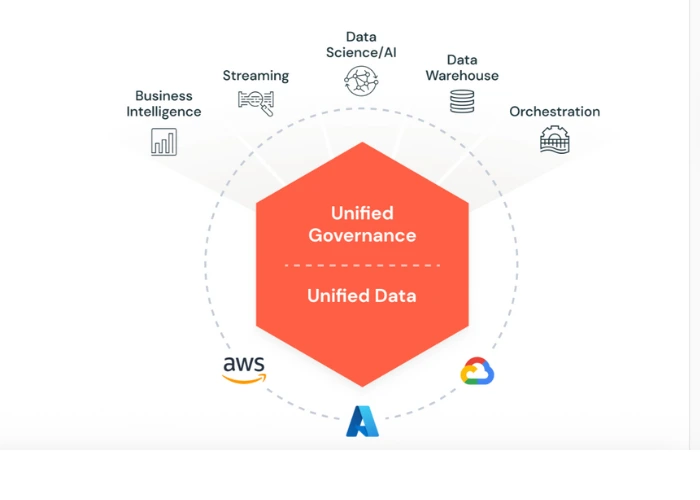
One of the top tools in data engineering is Databricks, which is primarily a collaborative platform for all teams to carry out data engineering, analytics, and machine learning. Databricks AI was among the first data engineering tools to integrate AI in the Lakehouse, which not only helped automate different data processes but also came with built-in intelligence to make them smarter and more effective.
Real-World Application: Lakehouse AI helps data engineers work smarter by automating complex tasks. It detects schema changes, generates code from natural language, and uses predictive analysis to spot pipeline issues early. For example, a telecom company can use Databricks to automatically adjust Spark clusters, also to monitor streaming data for problems, and utilize AI-powered optimization to reduce ETL errors.
| Key features | Result |
| Unified platform | Combines AI, ML, and data engineering under one roof. |
| Predictive monitoring and optimization | Powers embedded large language models. |
| Seamless governance and lineage | Through deep integration with Unity Catalog. |
2. Snowflake Cortex
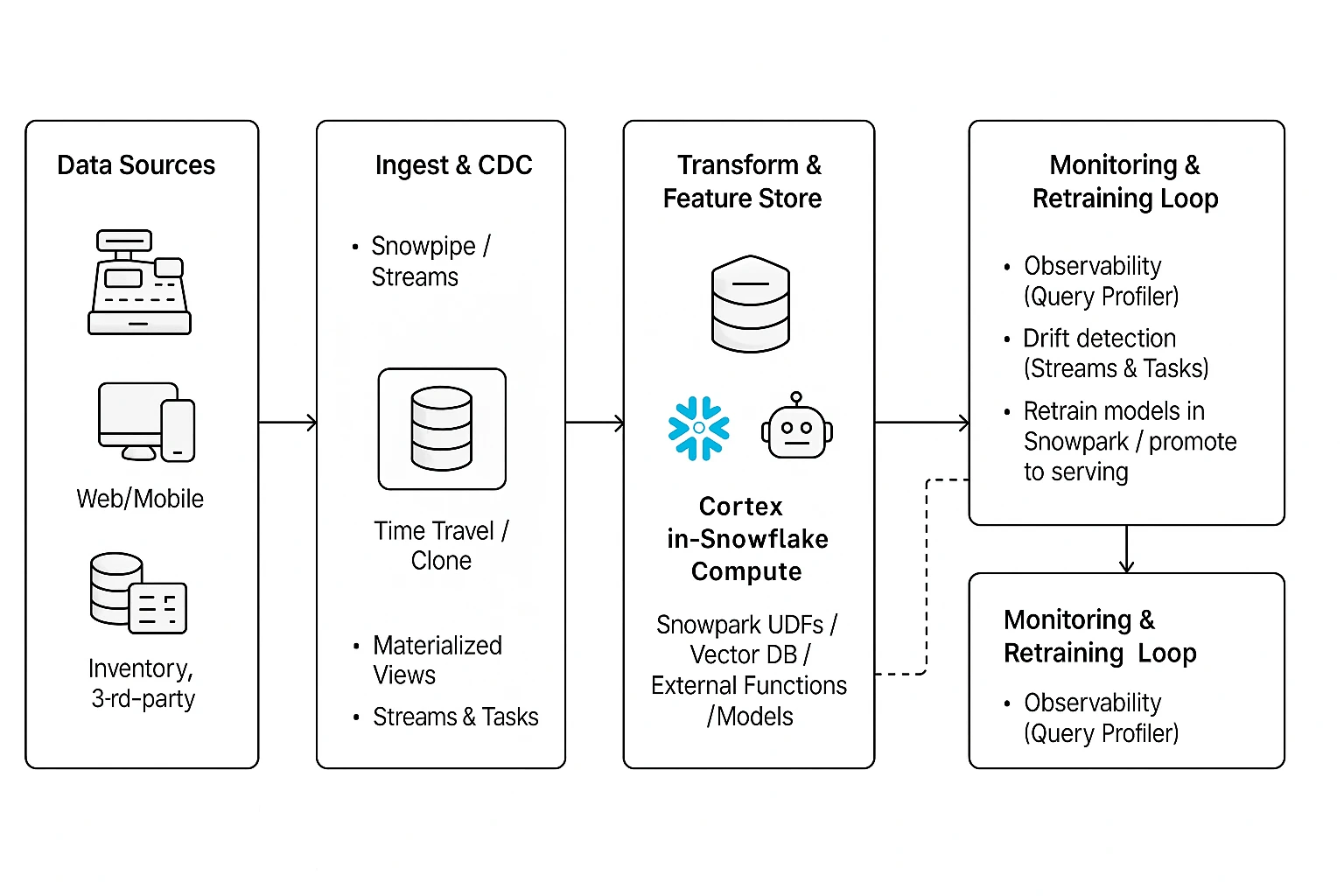
Snowflake Cortex is transforming the traditional concept of a data warehouse by adding AI and machine learning features right into the Snowflake platform. This data engineering tool helps engineers to develop, deploy, and run AI workloads using the native Snowflake using normal SQL or API queries. Data is no longer transferred to third-party tools or ML environments. The Cortex not only gives access to pre-trained LLMs, vector functions, and automated intelligent processes but also to the topmost-secret data ecosystem. It also provides support when it comes to anomaly detection, forecasting, and text analysis.
Real-World Application: A retail company can use Cortex to predict product demands, spot unusual sales patterns, and create easy summaries of performance data. All these tasks run inside Snowflake, which leads to a delay, less data movement, and enables real-time insights.
| Key features | Result |
| Native AI & LLM integration | Access pre-trained models directly in SQL for text generation, summarization, and embeddings. |
| End-to-end automation | Execute ML inference, forecasting, and optimization without separate infrastructure or data pipelines. |
| Enterprise-grade security | AI workloads operate exclusively under Snowflake’s governance and compliance framework. |
3. Alteryx Machine Learning & Auto Insights
Alteryx has grown from a basic analytics program to a full-fledged AI-driven data engineering platform. By integrating automation, intelligence, and a great user interface, it becomes less complicated to carry out difficult data tasks. The Auto Insights tool provides the identification of main trends and anomalies by itself. Whereas the Machine Learning Designer helps data teams build and deploy models with minimal coding. Together, these data engineering tools help organizations to find accurate insights faster than ever
Real-World Application: Alteryx in the healthcare field does not just organize patient data into categories; it also applies an analytics layer for risk identification and creates visualizations for the interpreter’s ease at the end of the process. This allows the data engineers and analysts to save considerable time and use that time for decision-making during the manual data preparation process.
| Key features | Result |
| Automated data preparation and enrichment | Simplifies cleansing, blending, and transformation tasks. |
| Integrated machine learning workflows | Supports model training and deployment directly within pipelines. |
| Visual, low-code interface | Enables both engineers and analysts to collaborate effectively. |
4. dbt Cloud with AI Assistant
dbt Cloud (Data Build Tool) continues to serve as the core of the modern data stack. Its AI Assistant introduces a new layer of intelligence that helps data engineers to write efficient SQL, optimize data models, and uphold consistent data quality. dbt helps to build a dependable system that helps to fetch the data effectively.
Real-World Application: When a fintech firm employs dbt Cloud, it can count on the AI Assistant to instantly write SQL queries according to the business’s needs, enforce uniform naming conventions, and identify logic or performance errors throughout the development process. As a result, this helps in saving time, reducing human errors, and effectively organizing the data models that provide the analytics.
| Key features | Result |
| Automatic model documentation | Creates clear, standardized descriptions for datasets and models. |
| Smart query support | Suggests improvements and helps debug SQL directly in the workspace. |
| Built-in data quality checks | Detects inconsistencies before deployment. |
5. Fivetran Smart Pipelines
Fivetran remains a leader in automated data integration and has taken a major step forward with the launch of Smart Pipelines. Its AI-driven system ensures that data pipelines remain stable and reliable, even when data sources change, such as when APIs are updated or data structures are modified. This intelligent adaptation reduces manual maintenance and allows data teams to run analytics continuously without interruption.
Real-World Application: Companies that use more than one SaaS platform, such as Salesforce, HubSpot, or Shopify, typically have problems when schema or API updates make it hard to sync data. Fivetran’s Smart Pipelines not only find these changes, but they also automatically fix them by properly remapping and notifying the users. This keeps the data consistent and prevents downtime.
| Key features | Result |
| AI-assisted connector management | Monitors and adjusts data source connections automatically. |
| Automatic schema drift correction: | Updates pipeline mappings when source structures change. |
| Self-healing logic | Prevents sync failures and minimizes manual intervention. |
6. Hevo Data
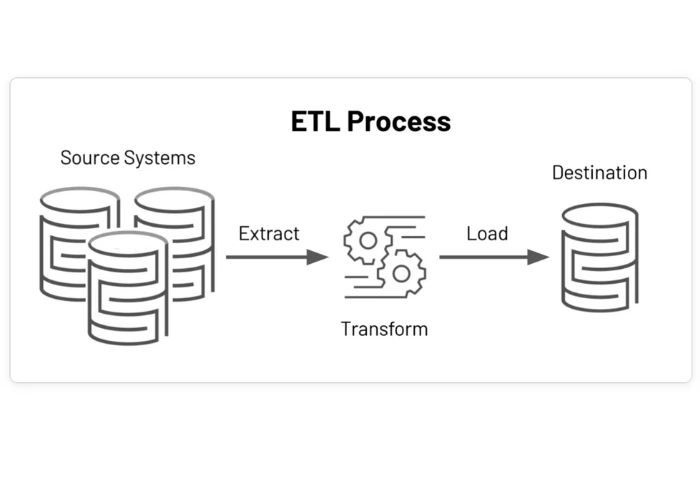
Hevo Data is already considered one of the leading AI-powered ETL platforms for providing real-time intelligence over data pipelines. The machine learning models that are incorporated in this solution do not stop their work ever; they evaluate the data ingestion patterns, and at the same time, target the inefficiencies and offer suggestions on the performance improvements. As a result, teams maintain smooth and reliable data flows with minimal oversight.
Real-World Application:
Hevo is one of the leading data engineering tools used in the e-commerce industry. It is capable of identifying slow or failing data sources, predicting synchronization delays, and even dynamically allocating resources to maintain performance. Companies that use this proactive data engineering tool save hours of manual troubleshooting and provide real-time insights into business operations.
| Key features | Result |
| Predictive performance monitoring | Alerts users to potential ETL slowdowns before they occur. |
| Low-code setup | Simplifies the creation and management of complex data pipelines. |
| Real-time visibility | Offers transparent tracking of pipeline health and data freshness. |
7. Great Expectations and Generative Validation
Great Expectations remains one of the most reliable frameworks for data quality validation. The new Generative Validation tool leverages AI that has been trained on historical datasets to automatically recommend validation criteria based on the past behavior of the data. This automation reduces manual effort and helps maintain consistent and trustworthy data pipelines.
Real-World Application: A bank or any other lending institution that receives and evaluates thousands of loan requests every day may utilize Great Expectations to detect errors like differing currency formats, unreported credit scores, and wrong date intervals. By catching such problems beforehand, the financial institution gets access to reliable data that prevents expensive errors along with error-free analytics and compliance reports.
| Key features | Result |
| AI-generated validation rules | Learns from past data to suggest new, context-aware checks. |
| Continuous improvement | Adapts to evolving data patterns over time. |
| Broad ecosystem compatibility | Integrates seamlessly with dbt, Airflow, Spark, and other orchestration tools. |
8. Apache Airflow with Intelligent Orchestration

Apache Airflow remains a leading choice for managing data workflows. The company recently added AI-powered features that automatically schedule, predict delays, and recover from failures. These improvements make pipeline management smarter, efficient, and more reliable.
Real-World Application: An AI-enhanced Airflow can help a media company running nightly data refreshes by dynamically adjusting DAG schedules based on past run times and resource usage. Such a system can automatically detect potential bottlenecks, redistribute workload, and even fine-tune execution timings to fulfill the service-level agreements (SLAs). All of this can be done with minimal or zero human intervention.
| Key features | Result |
| Open-source flexibility | Seamlessly integrates with diverse data stacks and cloud environments. |
| Self-healing workflows | Automatically retries or reorders tasks when failures occur. |
| AI observability plugins | Extend visibility into resource usage and performance trends. |
9. MonteCarloData Observability Platform
MonteCarloData assists organizations in ensuring the reliability and trustworthiness of their data pipelines. It uses AI-driven anomaly detection and context-aware root cause analysis to quickly identify the exact source of data issues, whether it’s a schema change, a failed ETL job, or an external system outage. This allows data teams to resolve the issues effectively and maintain the data quality across the system.
Real-World Application: For a global logistics company, MonteCarloData can distinguish if a drop in delivery accuracy is because of a broken ETL process or a third-party API failure. This data engineering tool ensures data reliability by finding such problems early.
| Key features | Result |
| AI-based anomaly correlation | Connects data quality incidents to specific upstream causes. |
| End-to-end lineage tracing | Visualizes how data flows and where errors originate. |
| Continuous monitoring | Tracks data freshness, volume, and schema drift across systems. |
10. Talend AI and Data Fabric
Talend’s AI-augmented Data Fabric is a single intelligent platform that integrates data handling, quality, and governance. This new technology uses the traditional ETL process along with machine learning to uncover data quality problems and eliminate duplicates. It even suggests the best way to change the data based on the actions performed on it in the past and the way it is being used currently. This comprehensive method allows companies to have clean, compliant, and reliable data even in hybrid environments.
Real-World Application: Talend AI helps organizations to keep their data clean and compliant across multiple platforms. Its AI engine automatically checks data quality, detects issues, and alerts teams managing both cloud and on-premise data early on. As a result of this proactive approach, data engineering teams can prevent issues from getting out of hand and maintain the consistency and trustworthiness of data across all their platforms.
| Key features | Result |
| Unified data governance and transformation | Centralizes management across integration, quality, and compliance. |
| AI-based data quality scoring | Continuously evaluates and improves data reliability. |
| Automated de-duplication and transformation recommendations | Reduces manual workload for data teams. |
A Comparison of the Top Data Engineering Tools
Here’s a detailed comparison of the top data engineering tools in 2025, outlining their core goals and key advantages:
| Goal | Best Fit | Key Advantage |
| Unified analytics & ML | Databricks AI | Predictive optimization within a single lakehouse |
| Warehouse intelligence | Snowflake Cortex | learning within the database and query summarization |
| Accessible machine learning | Alteryx | Drag-and-drop automation with clarity |
| Transformation consistency | dbt Cloud | Natural-language modeling and dependency checks |
| Reliable ingestion | Fivetran / Hevo | Self-healing connectors and predictive scaling |
| Data quality & validation | Great Expectations | Generative rule discovery |
| Workflow resilience | Airflow | Predictive scheduling from historical data |
| Observability | MonteCarloData | Root-cause tracing and anomaly prediction |
| Governance | Talend | Continuous compliance monitoring |
Criteria for Choosing the Right Data Engineering Tools
Every AI-powered platform offers different levels of capabilities; for instance, some provide intelligence, while some are capable of automating tasks. The following five criteria can help distinguish between and select the right data engineering tools:
- Embedded AI Capability: Prefer tools with machine learning integrated into their core design, not as an additional feature.
- Transparency & Explainability: A trustworthy AI system should show why it recommends a change or adjustment.
- Integration Flexibility: Ensure compatibility with existing lakehouses, warehouses, and orchestration frameworks.
- Control & Override Options: Even when automation is used, decision-making should be a manual process. Monitoring and supervision of every stage is necessary to make the right decisions.
- Cost Efficiency & Scalability: AI should help to control the infrastructure costs of infrastructure and reduce them by eliminating needless processes. via needless processing.
These principles help teams to invest in data engineering tools that improve performance without risking governance or cost discipline.
Learn How Data Engineering Tools Can Transform Your Work in 2025
Mastering data engineering tools has become essential for those professionals who are looking to grow their careers in AI-driven fields such as machine learning, data science, business intelligence, etc. These data engineering tools help organizations to manage complex data flows and turn information into smarter decisions. Our Data Engineering Masterclass, led by FAANG experts, is designed to help you master modern data engineering through live problem-solving, AI-powered data pipeline projects, and real-world capstone challenges. In this course, you will also learn interview strategies and hands-on experience building scalable systems with GenAI and modern architectures.
Conclusion
Data engineering tools in 2025 are essential for building scalable, reliable, and intelligent data pipelines. They help construct reliable and scalable data pipelines with intelligent features. With rising demand for real-time analytics, automated workflows, and trustworthy data quality, these tools help teams streamline operations, reduce manual effort, and respond faster to business needs.
The right data engineering tools help companies turn raw data into trusted insights. The modern solutions mix automation, observability, and built-in governance to enhance decision-making and facilitate continuous growth in an increasingly data-driven world.
FAQs: Top Data Engineering Tools
Q1. What are some major AI tools for data analysis in 2025?
The main AI data analysis tools of 2025 include Power BI Copilot, Tableau GPT, Google Vertex AI, Databricks AI, and Snowflake Cortex. These top-tier tools have innovative predictive capabilities beyond visualization, as well as natural language querying and automated analytics.
Q2. Why should data engineers use data engineering tools?
Data engineers should use data engineering tools to automate data workflows, ensure accuracy, and save time. The tools for data engineering provide a greater degree of scalability, reliability, and efficiency, which helps engineers concentrate on creating intelligent real-time data systems.
Q3. What are analytics engineering tools?
Analytics engineering tools are responsible for cleaning and formatting raw data in such a way that it is ready for analysis. These tools serve as a link between data engineering and analytics, providing consistent and reliable insights through automated modeling and transformation.
Q4. How do data engineering tools ensure data security and compliance?
Data engineering tools help maintain data security and compliance through access controls, encryption, data masking, etc. These measures help ensure that the data is protected, not just when it is being processed, but also when it is in storage. Such practices ensure that the data complies with regulations like GDPR, CCPA, HIPAA, etc.
Q5. Which tools are worth learning for an aspiring data engineer?
Databricks, Snowflake, dbt, Apache Airflow, and Fivetran are some of the best tools for aspiring data engineers because they cover the core areas like integration, transformation, orchestration, and analytics. Additionally, they can be used with Python, SQL, and data observability tools, making it easier to build scalable, dependable, and AI-ready data pipelines.