Preparing for complex SQL interview questions is more than just knowing the syntax. Experienced professionals are expected to demonstrate their thinking, optimize the queries, and design scalable & maintainable solutions for real-world data problems.
Today, interviewers are more interested in understanding your reasoning capabilities, performance awareness, and how you approach tricky scenarios than in testing whether you remember a join or a subquery.
This guide is designed for professionals preparing for SQL-heavy roles in fields such as data engineering, backend, or analytics. It covers the typical interview processes, the domains evaluated during interviews, sample questions with detailed answers, and actionable tips to help you crack the interview.
By the end of this guide, you’ll have a clear understanding of how to tackle complex SQL queries, interview questions, and present your knowledge convincingly.
Key Takeaways
- Complex SQL interviews test problem-solving, not just syntax.
- Interviewers evaluate logic, structure, and edge-case handling.
- Real-world questions combine joins, aggregations, and window functions.
- Clear communication improves your overall interview performance.
- Focused preparation increases your chances of cracking FAANG backend roles.
Typical SQL Interview Process
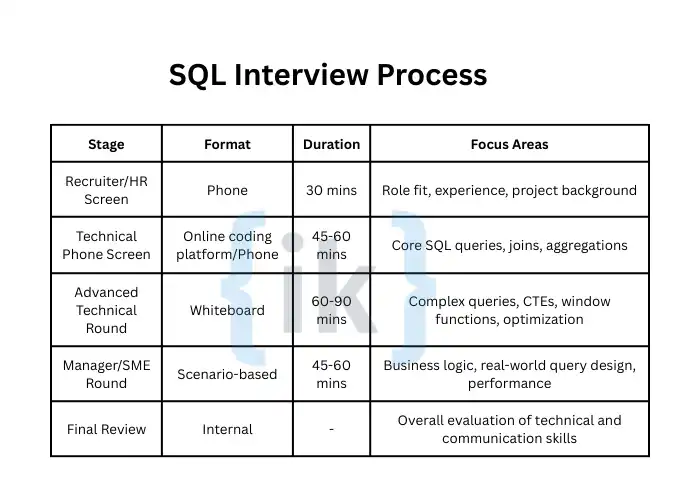
While each organization has its own nuances, the interview process for senior SQL roles generally follows this structure:
💡 Pro Tip: Interviewers pay close attention to how you approach and reason, not just the final query. Therefore, explaining your logic clearly often scores higher than the perfectly written SQL in isolation.
Domains Evaluated in SQL Interviews

Instead of listing questions by round, SQL interviews focus on evaluating various key skill domains. Understanding what is being assessed can help you efficiently structure your interview preparation.
Also Read: 50+ Advanced SQL Interview Questions and Answers to Master SQL
Domain 1: SQL Fundamentals
What interviewers are evaluating?
Even in complex interviews, candidates are expected to demonstrate a strong foundation. SQL fundamental questions gauge how well you understand data retrieval, aggregation, joins, and subqueries, and how clearly you communicate your logic.
Common SQL fundamental questions with answers
Q1. Generate a report that shows employees and their managers.
A classic SELF-JOIN scenario:
SELECT
e.employee_id,
e.name
AS
employee_name,
m.name
AS
manager_name
FROM
employees
e
LEFT JOIN
employees
m
ON
e.manager_id
=
m.employee_id;
Explanation: This query helps interviewers see whether you can reason through hierarchical data and understand self-referential table structures.
Q2. Show the latest used product
Using MAX on a datetime field:
SELECT
product_id,
MAX(last_used)
AS
latest_used
FROM
product_usage
GROUP BY
product_id;
This complex SQL interview question tests whether you can identify aggregate functions and groupings effectively.
Q3. Find customers with the highest orders between a date span.
This involves CTEs, JOINs, and date conversion:
WITH
order_summary
AS
(
SELECT
customer_id,
SUM(order_amount)
AS
total_orders
FROM
orders
WHERE
order_date
BETWEEN
‘2025-01-01’
AND
‘2025-12-31’
GROUP BY
customer_id
)
SELECT
c.customer_name,
os.total_orders
FROM
order_summary
os
JOIN
customers
c
ON
os.customer_id
=
c.customer_id
ORDER BY
os.total_orders
DESC;
Q4. What is the difference between INNER and LEFT JOIN?
INNER JOIN returns only the matching rows, while the LEFT JOIN returns all rows from the left table, with NULLs for unmatched rows.
Q5. Explain the differences between WHERE and HAVING.
WHERE filters the rows before aggregation, but HAVING filters the rows after aggregation.
More SQL fundamental questions to practice:
- Subqueries vs correlated subqueries
- UNION vs UNION ALL
- Aggregate functions with GROUP BY
- EXISTS vs IN
How to approach these questions:
Start with a simple solution, explain your step-by-step logic, and gradually optimize. Using real examples also helps demonstrate practical experience.
Also Read: Top 20 Amazon SQL Interview Questions (2024)
Domain 2: Advanced SQL Interview Questions
What interviewers are evaluating?
At this stage, you’re expected to handle complex SQL queries using CTEs, window functions, and recursive logic. Interviewers assess problem-solving skills and clarity of explanation, not just query correctness.
Common Advanced SQL questions with answers
Q6. Calculate the change over time of products for a date span.
WITH
product_sales
AS
(
SELECT
product_id,
sale_date,
SUM(quantity)
AS
total_qty
FROM
sales
WHERE
sale_date
BETWEEN
‘2025-01-01’
AND
‘2025-12-31’
GROUP BY
product_id,
sale_date
)
SELECT
product_id,
sale_date,
total_qty,
total_qty
–
LAG(total_qty)
OVER
(PARTITION BY
product_id
ORDER BY
sale_date)
AS
change_from_prev
FROM
product_sales;
Q7. Find users active for 4 consecutive days on our app.
WITH
user_activity
AS
(
SELECT
user_id,
activity_date,
ROW_NUMBER()
OVER
(PARTITION BY
user_id
ORDER BY
activity_date)
–
ROW_NUMBER()
OVER
(PARTITION BY
user_id,
DATE(activity_date)
ORDER BY
activity_date)
AS
grp
FROM
activities
)
SELECT
user_id
FROM
user_activity
GROUP BY
user_id,
grp
HAVING
COUNT(DISTINCT
activity_date)
>=
4;
Q8. Show the top 3 products per category using the window functions.
SELECT
product_id,
category_id,
RANK()
OVER
(PARTITION BY
category_id
ORDER BY
sales
DESC)
AS
rank
FROM
product_sales
WHERE
rank
<=
3;
More advanced SQL questions to practice:
- Recursive queries for hierarchical data
- Pivot/unpivot transformations
- Complex CASE statements in aggregation
- Multiple CTEs in one query
How to approach these questions:
- Break down the problem before coding
- Explain why you use CTEs or window functions
- Mention performance implications. Such as avoiding joins or subqueries
Also Read: Top Google Database Interview Questions for Your SQL Interview
Domain 3: Query Optimization and Performance
What interviewers are evaluating?
Performance is critical in enterprise systems, as candidates are tested on execution plans, indexing, and optimization strategies.
Optimization SQL questions with answers
Q9. How do you analyze a slow query?
To analyze a slow query, mention the following points:
- Use EXPLAIN PLAIN or EXPLAIN in SQL
- Identify bottlenecks: full table scans, missing indexes, inefficient joins
- Suggest alternatives: indexed columns, materialized views, query restructuring
Q10. When should you use an index?
The main function of using an index is to improve the SELECT performance, but it could slow down INSERT/UPDATE operations. Interviewers expect you to reason through trade-offs.
Q11. Explain the differences between correlated and uncorrelated subqueries.
Correlated subqueries are executed once per row, while uncorrelated subqueries execute once and are used across all rows, making them faster.
More optimization SQL questions:
- Avoid row-by-row processing
- Reduce context switches between SQL and procedural code
- Aggregate efficiently with pre-calculation
Also Read: Top T SQL Interview Questions You Should Prepare
Domain 4: Real-World Scenario
What interviewers are evaluating?
These complex SQL interview questions are designed to assess your ability to apply SQL to business problems, often combining multiple skills.
These questions are not about memorizing patterns. They are testing whether you can:
- Translate business logic into SQL
- Handle edge cases
- Choose efficiency approaches
- Explain reasoning clearly
- Think beyond the “happy path”
If your answers sound mechanical, you will struggle.
If your answers sound structured and thoughtful, you stand out immediately.
Scenario SQL questions with solutions
Q12. How would you find the second-highest salary in a company?
This is one of the most common and most complex SQL interview questions. Even though it looks simple, but interviewers are not just checking whether you know ORDER BY.
They want to see:
- Do you understand ranking logic?
- Can you handle duplicate salaries?
- Do you think about NULL values?
- Can you provide more than one approach?
Expected approach:
You could solve this using:
- LIMIT with offset
- A subquery
- A window function like DENSE_RANK()
- A correlated subquery
A strong candidate briefly explains at least two approaches and mentions edge cases, such as:
- What if multiple employees share the highest salary?
- What if there is only one employee?
That extra thinking separates average candidates from experienced ones.
Q13. How do you identify duplicate records in a table?
In real systems, duplicate data is common. Interviewers want to know whether you can detect and manage it. A typical scenario might be:
You have a ‘users’ table and want to find duplicate email addresses.
Expected approach:
You would generally:
- Group by the column that should be unique
- Use COUNT(*)
- Filter using HAVING COUNT(*) > 1
But a good answer doesn’t stop there.
You should also explain:
- How to retrieve full duplicate rows
- How to safely delete duplicates
- How indexing affects duplicate detection
Interviewers are looking for real-world awareness, not just a GROUP BY statement.
Q14. How would you calculate a running total?
This complex SQL interview question tests your understanding of window functions.
Imagine a ‘sales’ table where you need cumulative revenue by date.
Expected approach:
The modern and preferred solution uses:
- SUM() with OVER()
- Proper partitioning
- Correct ordering
You should clearly explain:
- What happens if dates are not unique
- How partitioning changes results
- Why are window functions better than self-joins for this case
If you immediately jump to a self-join, it might work, but it signals outdated thinking.
Q15. How would you find customers who made purchases in consecutive months?
This complex SQL interview question is where complexity increases. Now the interviewers test:
- Date manipulation
- Self-joins or window functions
- Logical reasoning
Expected approach:
You would typically:
- Extract the month from the date
- Use LAG() to compare the current row with the previous month
- Filter where the different equals one month
A senior-level answer also includes:
- Handling year transitions
- Handling missing data
- Ensuring correct partitioning by customers
That attention to detail matters a lot.
Q16. How would you retrieve the top 3 products in each category?
This is a classic “group-wise ranking” problem. Interviewers use it to check whether you understand:
- Partitioning
- Ranking functions
- Filtering ranked results
Expected approach:
The cleanest solution uses:
- ROW_NUMBER() or DENSE_RANK()
- Partition by category
- Order by revenue or sales count
Then filter where rank ≤ 3.
But here’s what makes your answer strong:
You explain the difference between ROW_NUMBER(), RANK(), and DENSE_RANK() and when to use each one.
That explanation shows real depth.
Also Read: Oracle SQL Interview Questions
Complex SQL Interview Questions Preparation Tips
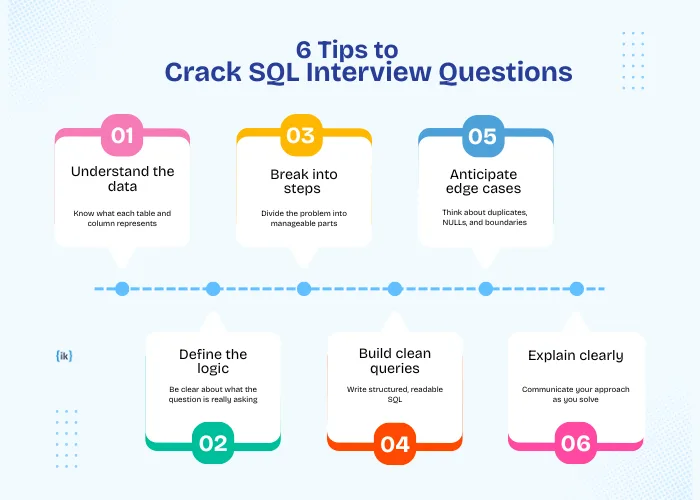
By the time you reach a complex SQL interview round, the interviewer already assumes you know basic syntax. What they are evaluating now is your thinking process, clarity, and confidence under pressure.
This section focuses on how to approach these interviews strategically, not just technically.
Tip 1: Clarify the Problem Before Writing any SQL
One of the biggest mistakes candidates make is jumping straight into writing a query.
When an interviewer asks something like:
“Find users who were active for four consecutive days.”
Do not immediately start typing.
Instead, clarify:
- What defines “active”?
- Is activity stored as a datetime or a date?
- Should timezone differences be considered?
- What if a user has multiple activities in one day?
This shows maturity.
Interviewers want to see that you think like someone who works with real data, not like someone solving a coding puzzle.
Often, the difference between a good and a great candidate is the number of smart, clarifying questions they ask.
Tip 2: Break the Problem into Logical Steps
Complex SQL questions are rarely solved in one clean line. They are solved in stages.
For example, consider:
“Calculate the change over time of products for a date span.”
A structured thinker would approach it like this:
- Filter the data within the given date range.
- Aggregate the metric per product per day (or month).
- Use a window function like LAG() to compare previous values.
- Apply a CASE statement to calculate growth or decline.
If you explain these steps before writing the final query, you demonstrate clarity and control.
Even if your syntax has minor errors, your structured thinking can still impress the interviewer.
Tip 3: Use CTEs to Show Clean Thinking
Many real-world SQL interview questions involve Common Table Expressions.
Take this example:
“Find customers with the highest orders between a date span.”
A strong approach might include:
- Converting a datetime to a date if needed
- Filtering within the range
- Aggregating order totals in a CTE
- Joining with the customer table
- Ranking results
Using CTEs shows that you know how to build readable, production-ready queries.
Messy nested subqueries often signal rushed thinking. Structured CTE logic signals professional experience.
Tip 4: Always Think About Edge Cases
Interviewers love edge cases. Candidates usually hate them.
Imagine this question:
“Show the latest used product.”
It sounds simple. You could use MAX() on a datetime column.
But what if:
- Two products were used at the same exact timestamp?
- The column contains NULL values?
- The timezone matters?
A strong candidate mentions these possibilities out loud.
You do not have to overcomplicate the solution. But acknowledging edge cases shows real-world awareness.
Tip 5: Know Your Window Functions Cold
If you are interviewing for a mid-level or senior role, window functions are not optional.
Questions like:
“Find users who were active for four consecutive days.”
Often require:
- Aggregating activity by date
- Using LAG() to compare consecutive rows
- Creating a grouping key based on date differences
- Using HAVING to filter streaks
If you struggle with partitioning logic, you will struggle with real-world analytics questions.
Spend time mastering:
- ROW_NUMBER()
- RANK()
- DENSE_RANK()
- LAG()
- LEAD()
These appear constantly in advanced interviews.
Tip 6: Explain Your Thinking While Writing the Query
Silence during an interview is uncomfortable.
Instead of typing quietly for five minutes, narrate your logic:
“I’ll first create a CTE to aggregate daily activity per user. Then I’ll use LAG to compare consecutive dates. After that, I’ll group sequences and filter users with at least four days.”
This reassures the interviewer that you are in control.
Even if you get stuck, they can guide you because they understand your thought process.
SQL interviews reward communication as much as correctness.
Tip 7: Practice Real Business Scenarios, Not Just LeetCode Problems
Many candidates prepare by solving isolated technical puzzles.
But real interviews ask questions like:
- Generate a report showing employees and their managers using a self-join.
- Find customers with the highest orders within a specific date span.
- Calculate product growth trends over time using aggregations and window functions.
These require combining concepts.
The more you practice layered problems, the more natural these interviews will feel.
Also Read: Top Database Questions to Ace Your Technical Interview
Build Production-Ready SQL Skills for FAANG Backend Interviews with Interview Kickstart
You’ve seen what backend interviews really test. It’s not just whether you can write code. It’s whether you can solve complex problems, think under pressure, and communicate like someone ready for serious engineering responsibility.
If you want structured preparation instead of random practice, the Backend Engineer Interview Prep course by Interview Kickstart is built exactly for that. The program is designed by FAANG+ engineering leaders and covers everything that actually shows up in interviews, from data structures and algorithms to system design and career strategy. You also get individualized teaching with 1:1 technical coaching, homework support, and detailed solution discussions so you’re never left guessing why something works.
On top of that, you’ll practice in live mock interviews with Silicon Valley engineers in real-world simulated environments. You receive personalized, constructive feedback to sharpen your performance, along with career-focused support like resume building, LinkedIn optimization, personal branding guidance, and behavioral interview workshops. If you’re aiming for a top backend engineering role, this kind of focused preparation can make the difference between trying again and finally breaking through.
Conclusion
Complex SQL interviews are less about remembering syntax and more about how clearly you think under pressure. Whether it’s self-joins, CTEs, window functions, or time-based analysis, interviewers are evaluating how you structure problems, handle edge cases, and explain your reasoning.
If you focus on building strong fundamentals, practicing real-world scenarios, and communicating your approach confidently, these interviews stop feeling unpredictable. SQL becomes less about tricks and more about disciplined problem-solving.
FAQs: Complex SQL Interview Questions
Q1. What are complex SQL interview questions?
Complex SQL interview questions go beyond basic SELECT statements. They typically involve multiple joins, window functions, aggregations, subqueries, date logic, and performance optimization to solve real-world business problems.
Q2. Are SQL interviews important for backend engineering roles?
Yes. For many backend roles, especially at product-based and FAANG companies, SQL is critical. Engineers are often expected to analyze data, debug production issues, and write efficient queries that interact with large databases.
Q3. How should I prepare for advanced SQL interview questions?
Focus on mastering joins, subqueries, CTEs, window functions, indexing concepts, and query optimization. Practice solving business-style problems rather than only isolated coding exercises.
Q4. Do FAANG companies ask SQL questions in backend interviews?
Yes, especially for data-heavy backend roles. FAANG interviews may include SQL questions that test analytical thinking, performance awareness, and the ability to translate business logic into structured queries.
Q5. How can I improve my performance in SQL interviews?
Practice explaining your thought process while solving problems. Work on mock interviews, strengthen your fundamentals, and review real-world scenarios that combine multiple SQL concepts in a single question.
References
- Most popular database technologies among developers worldwide
Recommended Reads: