Article written by Nahush Gowda under the guidance of Jacob Markus, Senior Data Scientist at Meta, AWS, and Apple leader, now coaching engineers to crack FAANG+ interviews. Reviewed by Vishal Rana, a versatile ML Engineer with deep expertise in data engineering, big data pipelines, advanced analytics, and AI-driven solutions.
The Amazon Data Engineer interview is known for being both technically demanding and culturally selective. Amazon doesn’t just look for people who can write efficient SQL or design scalable ETL pipelines, they look for people who can solve complex problems at a petabyte scale, make sound trade-offs, and consistently embody Amazon’s Leadership Principles.
While the technical bar is high, the process is equally focused on how you think, how you communicate, and whether you take ownership of your work. A strong candidate demonstrates not only engineering expertise but also the ability to connect data work directly to business impact, whether that’s optimizing recommendation systems, improving customer experience, or reducing operational costs.
In this guide, we’ll break down the Amazon Data Engineer interview process, share real-world interview questions, and outline preparation strategies that hiring managers actually look for.
Typical Job Requirements for an Amazon Data Engineer
Like most companies, Amazon treats job descriptions as a wish list rather than a strict checklist, so even if you don’t meet every single criterion, you may still be a strong candidate.
In general, most Amazon data engineering positions call for:
- 3+ years of professional experience in data engineering or a related field
- Strong skills in data modeling, data warehousing, and designing ETL pipelines
- Hands-on experience with AWS services
- Familiarity with NoSQL databases, as Amazon often works with non-relational data systems
While these are the common expectations, exceptional candidates who demonstrate strong problem-solving abilities and technical adaptability can often bypass certain requirements.
Amazon Data Engineer Interview Process
Amazon’s Data Engineer interview process is designed to evaluate not just your technical skills but also how well you’ll fit into the company’s culture.
The steps can shift a bit depending on the team or the seniority of the role, but generally, you can expect a series of stages that blend technical assessments with behavioral evaluations. The aim is to see if you can handle the scale, complexity, and ownership mindset Amazon is known for, while working the “Amazon way.”
1. Online Assessment (OA)
Format: Timed coding and SQL challenges
- Typically delivered through platforms like HackerRank.
- Focus areas: complex SQL joins, aggregations, window functions, and basic Python or data manipulation tasks.
- Expect scenario-based questions, such as analyzing e-commerce transaction logs to extract business insights.
💡 Bonus Tip
Practice under strict time limits. Interviewers aren’t only looking for correct answers but also efficient query design.
2. Technical Phone Screen
Format: 45–60 minutes with a data engineer or hiring manager
- Live coding: Write SQL queries, design schemas, and discuss indexing strategies.
- Data modeling: Convert a business scenario into a relational or dimensional model.
- AWS and ETL basics: May ask how to design a data pipeline with Glue, S3, and Redshift.
💡 Bonus Tip
Talk through your reasoning. Communication shows clarity of thought and problem-solving style.
3. Onsite / Virtual Loop
Format: 4–5 interview rounds, each 45–60 minutes
- SQL/ETL Round: Solve multiple queries, explain trade-offs, and debug pipeline issues.
- Data Modeling Round: Design scalable, normalized or denormalized schemas.
- Scenario/Case Study: Build an end-to-end data solution from vague requirements.
- Behavioral Round: Use the STAR method to answer Leadership Principle-based questions.
💡 Bonus Tip
Each round has a dedicated focus, but all interviewers assess both technical skill and cultural fit.
4. Bar-Raiser Round
Format: A senior Amazonian trained to evaluate long-term success potential
- Focus: High judgment, scalability thinking, and culture fit.
- This round holds significant weight as the bar-raiser has veto power.
- You may be asked broader, cross-functional questions that push you outside your comfort zone.
💡 Bonus Tip
Prepare stories that show consistent ownership, working through ambiguity, and influencing without authority.
What Do Interviewers Look For in an Amazon Data Engineer Interview?
In an Amazon Data Engineer interview, it’s not enough to simply land on the right answer. It is also important to show how you approach the problem, your reasoning, communication, and adaptability.
Amazon’s hiring bar is set deliberately high, aiming to find people who’ll thrive over the long haul. They’re looking for engineers who not only have the technical chops but also embody the company’s principles, bringing the same customer-obsessed, ownership-driven mindset to every challenge.
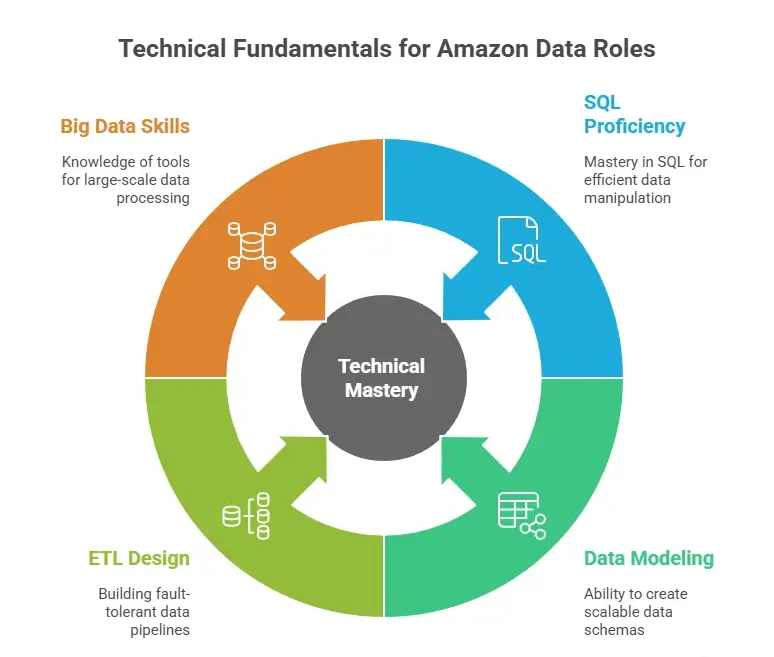
1. Strong Technical Fundamentals
Amazon expects you to demonstrate mastery in:
- SQL: Efficient joins, aggregations, window functions, CTEs, and performance optimization.
- Data Modeling: Translating vague business needs into scalable schemas.
- ETL Design: Building fault-tolerant pipelines with AWS tools or open-source frameworks.
- Big Data Skills: Spark, Hadoop, Kinesis, or Kafka knowledge for large-scale processing.
2. Communication & Collaboration
Hiring managers consistently rate clear communication as a top factor. This means:
- Explaining your thought process as you code.
- Justifying trade-offs (e.g., storage vs query speed, batch vs streaming).
- Asking clarifying questions before diving into a solution.
3. Leadership Principles Alignment
Every interviewer is trained to evaluate you against Amazon’s 16 Leadership Principles, including:
- Ownership – Acting as if you own the outcomes, not just tasks.
- Dive Deep – Proving you can uncover root causes, not just symptoms.
- Invent and Simplify – Balancing innovation with efficiency.
- Customer Obsession – Connecting your work to end-user value.

💡 Bonus Tip
Use the STAR method (Situation, Task, Action, Result) to keep behavioral answers structured and impact-focused.
Also Read: 35 Amazon Leadership Principles Interview Questions
4. Scalability Thinking
Amazon wants engineers who design for growth, not just meeting today’s requirements, but anticipating future needs.
- Avoid overfitting solutions to the sample data provided.
- Discuss partitioning, indexing, caching, and data lifecycle management.
5. Adaptability & Judgment
Sometimes you’ll get incomplete or ambiguous requirements. Interviewers want to see:
- How do you prioritize with limited data?
- How do you validate assumptions?
- Whether you can adapt when new constraints emerge mid-problem.
Key Interview Topics & Sample Question Areas
The Amazon Data Engineer interview covers a blend of technical and behavioral areas. Knowing the topic buckets and seeing sample questions helps you target your preparation efficiently.
1. SQL & Data Modeling
Amazon’s data is massive, so they expect efficient, optimized queries and solid schema design.
Focus Areas:
- Complex joins and subqueries
- Window functions (ROW_NUMBER, RANK, LAG, LEAD)
- Aggregations and grouping sets
- Query performance tuning (indexes, partitions)
- Dimensional modeling (star vs. snowflake)
Find the top 3 products by sales in each region for the past 30 days.
❌ Don’t say:
sql
SELECT
    region,
    product_id,
    SUM(sales) AS total_sales
FROM orders
WHERE order_date >= CURRENT_DATE - INTERVAL '30 days'
GROUP BY region, product_id
ORDER BY total_sales DESC
LIMIT 3;
This query looks fine at first glance, but ignores the per-region ranking requirement—it simply returns the top 3 overall. It also doesn’t address performance (no partitioning, indexing, or mention of execution plan analysis).
✅ Do say:
sql
SELECT region, product_id, total_sales
FROM (
    SELECT
        region,
        product_id,
        SUM(sales) AS total_sales,
        ROW_NUMBER() OVER (
            PARTITION BY region
            ORDER BY SUM(sales) DESC
        ) AS rn
    FROM orders
    WHERE order_date >= CURRENT_DATE - INTERVAL '30 days'
    GROUP BY region, product_id
) ranked
WHERE rn <= 3;
Then explain:
- Used ROW_NUMBER() partitioned by region to get top products within each region.
- Assumed large dataset, so partitioned the orders table by order_date and indexed on (region, product_id) to reduce scan time.
- Mentioned testing the execution plan to confirm minimal full-table scans.
This shows you understand both correctness and scalability, which is exactly what Amazon looks for.
More Example Questions (Practice with these questions):
- Write a SQL query to compute the average star ratings for each product, grouped by month.
- Identify customer IDs in dim_customer that appear more than once and return their counts.
- Given sales data, find the top 3 selling products per region in the last 30 days.
- Design a star schema for an e-commerce order management system.
- Write a SQL query to detect orphan records where order_items references a non-existent order_id in orders.
💡 Bonus Tip
If you get stuck, focus on performance optimization, especially when working with Amazon-scale datasets. Show that you’re thinking about indexes, partitions, and schema choice to make queries faster and storage more efficient.
2. ETL & Data Pipelines
Amazon relies heavily on automated, fault-tolerant ETL processes.
Focus Areas:
- Building and orchestrating ETL with AWS Glue, Lambda, and Step Functions
- Designing data lakes and warehouses with S3 and Redshift
- Incremental vs. full loads
- Handling schema evolution and late-arriving data
“Design a data pipeline to ingest real-time clickstream data from Kinesis into Redshift.”
❌ Don’t say:
“I would stream the clickstream data from Kinesis into an S3 bucket, then run a Glue job to transform it, and finally load it into Redshift.”
This answer is too high-level and misses critical points like error recovery, latency requirements, scaling considerations, and cost trade-offs. It also doesn’t explain how you’d ensure data completeness or schema alignment over time.
✅ Do say:
“I would use Kinesis Data Streams to capture the real-time clickstream events and process them with AWS Lambda for lightweight transformations and partitioning by event time. These events would land in S3 in Parquet format, optimized for analytics. From there, I’d use AWS Glue to run incremental ETL jobs that load data into Redshift Spectrum for near-real-time queries, and then batch into Redshift tables for aggregated reporting. This approach balances low latency ingestion with cost control, while maintaining schema flexibility for evolving clickstream event formats.”
This shows architecture depth, fault tolerance, and AWS fluency, exactly what Amazon looks for.
💡 Bonus Tip
Amazon loves performance and fault tolerance. When answering, emphasize error handling, monitoring, and recovery strategies, not just the “happy path” design. Always mention AWS-native tools that improve scalability and cost-efficiency.
More Example Questions (Practice with these questions):
- Design a real-time data pipeline to process clickstream data at Amazon scale.
- Explain how you’d implement Change Data Capture (CDC) for a large transactional database.
- Describe how to handle late-arriving data in a batch ETL process.
- Compare ETL vs ELT and explain when you’d choose one over the other
- How would you build a fault-tolerant data ingestion pipeline using AWS services like S3, Glue, and Kinesis?
3. Big Data Tools & Frameworks
For senior-level Amazon Data Engineer roles, interviews often include distributed data processing challenges. The focus is on whether you can optimize performance, design scalable architectures, and choose the right processing model for the task at hand.
Focus Areas:
- Apache Spark optimizations
- Hadoop ecosystem basics
- Streaming architecture with Kinesis or Kafka
- Data partitioning strategies for performance
“Explain how you would optimize a Spark job that’s running slower than expected.”
❌ Don’t say:
“I’d try to increase the cluster size or add more executors.”
This answer shows surface-level thinking and ignores root cause analysis, cost trade-offs, and code-level optimizations. Amazon wants you to diagnose first, then fix efficiently.
✅ Do say:
“First, I’d profile the Spark job using the Spark UI to identify bottlenecks—whether they’re in shuffles, skewed joins, or wide transformations. If I see shuffle-heavy stages, I’d:
- Use broadcast joins for small reference datasets.
- Repartition or coalesce datasets to match cluster parallelism.
- Cache intermediate results if they’re reused across stages.
- Optimize the number of shuffle partitions to balance between task overhead and parallelism.
If data skew is detected, I’d implement salting techniques to evenly distribute the workload. For I/O bottlenecks, I’d store data in Parquet with column pruning and predicate pushdown enabled.
Scaling the cluster would be my last step—only after ensuring code and data layout are optimized, because it’s the most expensive fix.”
This answer demonstrates systematic problem-solving, cost awareness, and deep Spark knowledge, a strong match for Amazon’s expectations.
More Example Questions (Practice with these questions):
- Explain how you would optimize a large Spark job that is running slowly on EMR.
- Compare and contrast Amazon Redshift, Athena, and EMR for analytics workloads.
- How would you design a data lake on AWS using S3, Glue, and Lake Formation?
- Describe how you’d handle data skew in a distributed processing framework like Spark or Hive.
- Explain your approach to choosing the right file format (Parquet, ORC, Avro, CSV) for a big data pipeline.
💡 Bonus Tip
Amazon looks for practical, measurable performance improvements. When answering, mention profiling tools, resource tuning, and trade-offs between latency, cost, and complexity.
4. Behavioral / Leadership Principles
At Amazon, behavioral evaluation is not a separate interview stage, it’s woven into every round. Your ability to demonstrate Amazon’s Leadership Principles (LPs) is just as important as your technical expertise.
Focus Areas:
- Problem ownership
- Diving deep into issues
- Balancing innovation and practicality
- Customer-first mindset
More Example Questions (Practice with these questions):
- Tell me about a time you had to dive deep into a complex data issue to identify the root cause.
- Describe a situation where you took ownership of a project outside your regular responsibilities.
- Give an example of when you invented and simplified a process to improve data workflows.
- Tell me about a time you made a decision with incomplete data and how it turned out.
- Describe a situation where you delivered results despite tight deadlines and competing priorities.
“Tell me about a time you discovered a major data quality issue late in a project. What did you do?”
❌ Don’t say:
“I quickly fixed the issue and informed my manager that the data was clean again.”
This answer lacks depth and ownership. It skips over root cause analysis, prevention strategies, and customer impact, three things Amazon interviewers look for.
✅ Do say:
“During a QA check, I found that 15% of recent transactions lacked location data just two days before release. I halted downstream processes to avoid bad analytics, traced the issue to an uncommunicated upstream schema change, restored the mapping, and backfilled missing records. I then added automated schema validation to our ETL, cutting incident detection time by 95% and preventing future customer-impacting errors.”
This answer shows deep problem-solving, proactive prevention, customer impact awareness, and strong ownership, exactly what Amazon wants in its engineers.
💡 Bonus Tip
Use the STAR method (Situation, Task, Action, Result) for clear, concise answers. Always connect your story back to customer value or measurable business impact.
Also Read: Master Behavioral Interview Questions with the STAR Technique
5. Case Study / System Design
For mid- to senior-level Amazon Data Engineer interviews, expect at least one open-ended system design question. These assess your ability to design scalable, fault-tolerant, and cost-effective architectures that align with Amazon’s high-availability standards.
How to approach a system design interview question:
- Clarify requirements: Ask about scale, latency, retention, and security needs.
- Start high-level: Outline the full data flow before detailing components.
- Justify choices: Compare tech options and explain why they fit the requirements.
- Address scalability: Mention partitioning, autoscaling, and spike handling.
- Plan for failure: Include replication, retries, backups, and monitoring.
- Balance cost & simplicity: Show awareness of budget and maintainability.
- Include security: Highlight encryption, access control, and compliance.
More Example Questions (Practice with these questions):
- Design an end-to-end real-time recommendation pipeline for Amazon Prime Video.
- Architect a data platform to process, store, and analyze billions of e-commerce transactions daily.
- Design a log analytics system that ingests terabytes of logs every hour and supports near-real-time querying.
- Create a scalable pipeline to power Alexa’s voice query analytics with both real-time and historical insights.
- Design a warehouse and data pipeline for Amazon’s “Frequently Bought Together” feature, supporting updates every few minutes.
Preparation Strategies That Actually Work
The difference between passing and failing an Amazon data engineer interview often comes down to targeted preparation. Random problem-solving won’t cut it; you need to practice the exact skills and scenarios Amazon tests for.
- Master the Online Assessment Format
- Use HackerRank or LeetCode SQL timed challenges to simulate Amazon’s OA.
- Prioritize problems with complex joins, aggregations, and ranking functions.
- Track time per question. Both speed and accuracy matter.
- Get Fluent in AWS Data Services
- Learn Redshift, Glue, Athena, EMR, S3, and Kinesis basics.
- Build a small project: Ingest CSV data from S3, transform with Glue, load into Redshift.
- Focus on IAM permissions, partitioning, and cost optimization, which are common discussion points in interviews.
- Practice Data Modeling Daily
- Take random scenarios (e.g., ride-sharing app, video streaming service) and des
- Design an end-to-end real-time recommendation pipeline for Amazon Prime Video.
- Architect a data platform to process, store, and analyze billions of e-commerce transactions daily.
- Design a log analytics system that ingests terabytes of logs every hour and supports near-real-time querying.
- Create a scalable pipeline to power Alexa’s voice query analytics with both real-time and historical insights.
- Design a warehouse and data pipeline for Amazon’s “Frequently Bought Together” feature, supporting updates every few minutes.
- Practice both normalized and dimensional models, explaining trade-offs.
- Be ready to diagram your solution clearly on a whiteboard or shared doc.
- Refine Behavioral Stories with STAR
- Write 10–12 STAR stories aligned to Leadership Principles.
- For each, highlight your individual contribution, not just team achievements.
- Practice telling them in 2–3 minutes without losing detail or clarity.
- Run Mock Interviews Under Pressure
- Pair with a peer or use platforms like Pramp or InterviewQuery.
- Simulate real conditions: video call, shared coding environment, timed solutions.
- Ask for feedback on clarity, structure, and trade-off reasoning.
- Review Your Past Work in Detail
- Be prepared to discuss metrics, bottlenecks, and impact from previous projects.
- Interviewers may drill deep into your resume. Expect “how” and “why” questions.
- Bring numbers: performance gains, cost savings, or scale improvements.
Simple Prep Timeline for Amazon Data Engineer Interview
Here is a simple prep timeline for your next Amazon data engineer interview.
| Timeline |
Focus |
Key Actions |
| Week 1 |
SQL basics, Behavioral prep |
– Practice joins, aggregations, windows, subqueries.- Timed SQL drills.- Study Leadership Principles.- Prepare 15–20 STAR stories with data-driven results. |
| Week 2 |
ETL design, AWS tools, Modeling |
– Learn batch & real-time ETL.- Hands-on with S3, Redshift, Glue, EMR, Kinesis, Lambda.- Practice star/snowflake schemas, normalization, indexing, partitioning. |
| Week 3 |
Full simulation |
– SQL, ETL, behavioral, and system design mocks.- Time exercises.- Get feedback and refine clarity. |
| Week 4 |
Fix gaps |
– Review weak spots.- Polish STAR stories.- Revisit SQL/AWS/data modeling.- Research Amazon projects and scale. |
| Interview Week |
Mental readiness |
– Light review.- Rest well.- Visualize success.- Stay calm and confident. |
Week 1 – SQL Fundamentals & Leadership Principles
Begin your preparation by strengthening SQL fundamentals. Focus on joins, aggregations, window functions, subqueries, and query optimization. Practice solving problems under timed conditions to simulate test scenarios.
At the same time, dive deep into Amazon’s Leadership Principles, as these are central to the behavioral portion of the interview. Prepare 15–20 STAR-format stories that align with principles such as Dive Deep, Ownership, and Invent & Simplify.
These stories should be data-driven, showcasing measurable outcomes and clear decision-making.
Week 2 – ETL, AWS Services & Data Modeling
Shift your attention to ETL concepts and tools, ensuring you understand pipeline design for both batch and real-time processing. Get hands-on experience with AWS services that Amazon frequently uses, including S3, Redshift, Glue, EMR, Kinesis, and Lambda.
Complement this with data modeling exercises like design star and snowflake schemas, normalize data structures, and work with indexing and partitioning strategies. This week is about developing the technical breadth needed to design scalable and efficient data solutions.
Week 3 – Mock Interviews & Timed Challenges
Now it’s time to put your skills to the test with live mock interviews. Simulate Amazon’s interview loop by including SQL problem-solving, ETL design scenarios, and behavioral questions.
Incorporate system design sessions where you build end-to-end data pipelines, and time each activity to match real interview constraints.
Seek feedback from peers, mentors, or AI-based mock interview platforms to refine both your technical solutions and your ability to explain them clearly.
Week 4 – Refinement & Targeting Weak Spots
This is your polishing stage. Review performance from previous mock interviews to identify technical or communication gaps.
Refine your STAR stories, making them concise, impactful, and easy to recall. Revisit any areas of weakness, whether it’s complex SQL queries, AWS service integrations, or data modeling concepts.
Also, research company-specific project contexts so you can speak to Amazon’s scale, AWS usage, and customer-centric approach.
Interview Week – Rest & Mental Readiness
In the final days before your interview, avoid cramming. Instead, lightly revisit your STAR stories and key technical concepts. The focus should be on maintaining confidence, clarity, and composure.
Get adequate rest, visualize your interview success, and enter the sessions with a calm, focused mindset. Amazon’s interviews can be intense, but a balanced state of mind will help you perform at your best.
Conclusion
With AI at the forefront, data engineering is evolving faster than ever, with GenAI, LLMs, and modern cloud architectures redefining what’s possible. To land and excel in top data roles at Amazon, Databricks, or FAANG+, you need more than technical know-how—you need the right frameworks, problem-solving patterns, and insider strategies that set elite engineers apart.
That’s exactly what the Data Engineering Masterclass delivers. Led by FAANG+ engineer, this immersive masterclass combines live problem-solving, AI-driven system design, and FAANG+ interview strategies to help you crack your dream role in 2025.
Whether you’re aiming for Amazon Data Engineer, Senior Big Data Architect, or any high-impact data role, this masterclass gives you the tools, confidence, and playbook to get there.