Job stability for engineers is no longer something you can take for granted. In the U.S. job market, engineers who can prove real results are far less likely to be at risk. This is why maintaining job stability for engineers requires tracking outcomes and communicating them weekly.
In 2025, U.S. employers announced more than 1.17 million job cuts across sectors1, with about 71,000 roles cut in November alone. Many of these cuts hit technology and engineering-related roles hardest, while other parts of the economy continue to hire.
At the same time, government projections show most engineering occupations are expected to have more openings than many other fields in the coming decade2.
This article delivers a self-audit scorecard, 30-day proof projects, a project selection model, and strategies to boost job stability for engineers, job security for engineers, and stability in engineering careers.
Key Takeaways
- Review financial health, project pipeline, and retention before accepting any role to ensure job stability for engineers.
- Deep expertise plus continuous learning protects long-term job stability for engineers, job security for engineers, and stability in engineering careers.
- Strong professional connections create opportunities when roles change, supporting job stability for engineers.
- Healthy teams and sustainable work matter more than pay alone for job security for engineers.
- Transferable skills and a backup plan are your best career insurance for stability in engineering careers.
What Does Job Stability for Engineers Really Mean in 2026?
Job stability for engineers now depends on two things. First, whether your work produces measurable results that managers can point to. Second, whether your team and sector face hiring pressure or ongoing demand.
Both factors determine whether you are likely to be protected when companies tighten budgets, impacting job security for engineers and stability in engineering careers.
How do Employers Define Job Stability Today?
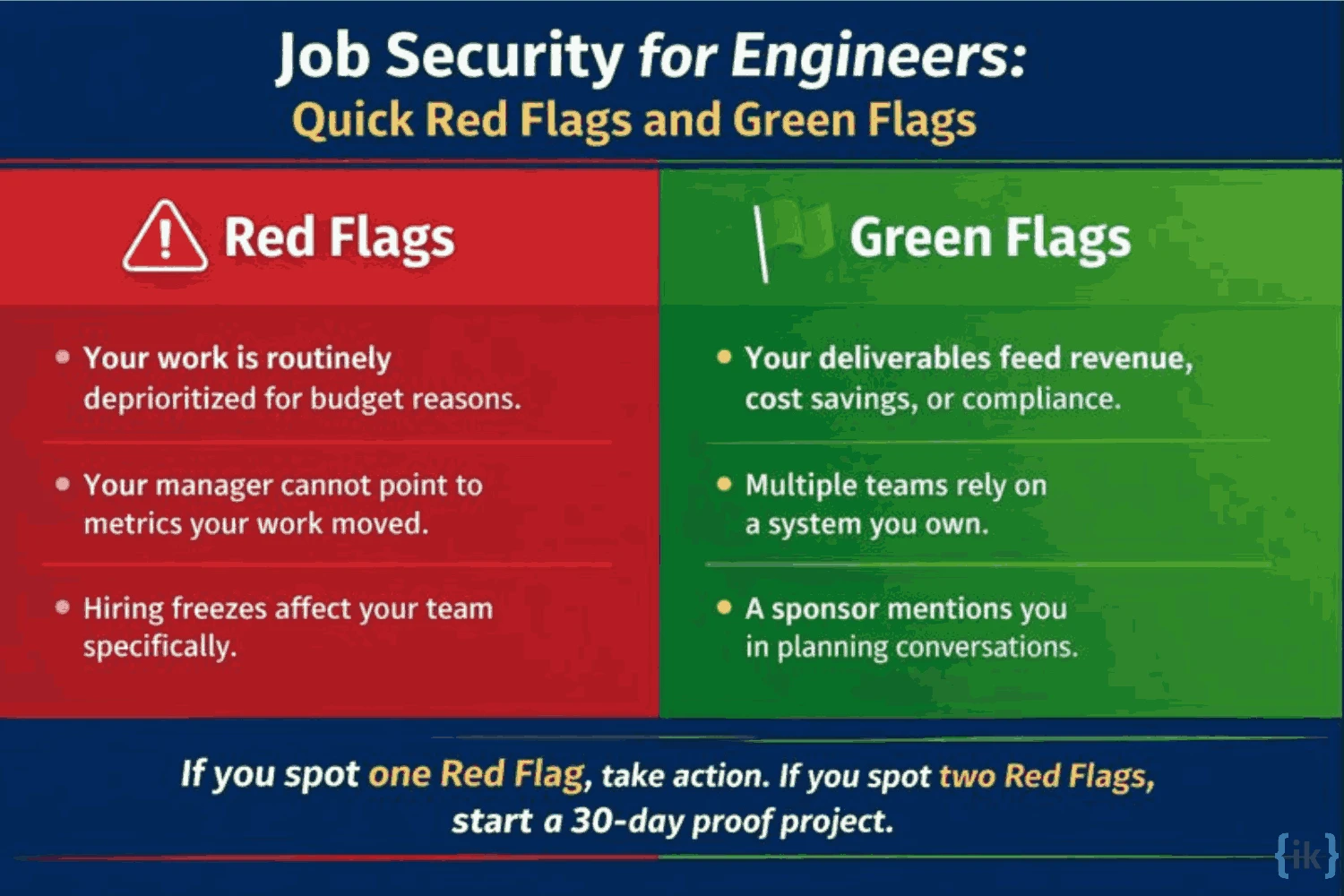
Employers assess job stability for engineers by asking two simple questions:
- Can this person demonstrate the outcomes their work produces?
- How hard would it be to replace that person quickly?
If your deliverables map to revenue, cost savings, or regulatory compliance, you are more likely to be retained, enhancing job security for engineers.
How are Engineering Roles Evaluated During Layoffs?
During cost reviews, companies triage roles by replaceability and link to core business outcomes.
- Roles tied to direct revenue enablement, core infrastructure, or compliance tend to be prioritized for job stability for engineers.
- Roles that are project-specific and not tied to measurable business outcomes face higher scrutiny.
When you prepare for a potential review, translate technical work into measurable business terms and provide one page of evidence that shows impact in minutes, supporting job security for engineers.
Also Read: How to Prepare for a FAANG Software Engineer Interview in 2026
Skills That Improve Job Stability for Engineers in 2026
Job stability for engineers depends less on titles and more on a specific set of skills that produce measurable business outcomes. Employers in 2026 are prioritizing work that ties directly to revenue, cost savings, reliability, and regulatory compliance.
Below are some skills that drive practical impact.
1. Core Technical Skills That Create Immediate Value
Cloud and infrastructure skills keep systems running and scale capacity for products, directly aiding job stability for engineers. Data center and energy work show higher investment, which supports demand for these skills. Systems design and reliability engineering reduce outages and operational cost which managers value during cuts.
Data fluency, including basic analytics and SQL, helps engineers turn operational work into evidence-based stories.
How to prove them quickly?
- Build a one-page playbook that reduces incident mean time to repair by a measurable percent and run a 30-day proof project. Include before and after metrics and estimated monthly savings.
- Create a small automation that reduces a repetitive process and measure the time saved per week across the team.
2. AI and Automation Literacy as a Multiplier
Companies are increasing investment in AI and automation, and engineers who can safely apply tooling will be more productive and harder to replace. McKinsey research3 shows a strong push to embed AI skills into daily workflows, and that companies that treat upskilling as change management get better results.
Here’s how you can prove it:
- Use a lightweight automation to cut a common engineering task. Document the script or workflow in a shared repo and show the weekly time saved.
- Deliver a short demo that shows how an AI-assisted workflow improves a routine analysis or debugging task and record the time difference.
Validation steps:
- Save the automation in source control with a README and a test case
- Measure time saved over two weeks and export the log or screenshot as proof
- Add the item to your resume as a quantified bullet and to your internal performance notes for stability in engineering careers
Also Read: How to Structure Your Software Engineering Resume?
3. Business and Communication Skills That Protect Roles
Technical work that is not visible becomes replaceable. Communicating impact with one-minute pitches and concise one-slide reports makes it easy for managers to defend you during cuts. Research on mission-critical roles shows that a small number of outcomes often determine retention decisions, so visibility matters.
Here’s how you can prove it and ensure stability in engineering careers:
- Write a one-page summary that ties a recent project to specific business outcomes such as revenue, uptime, or compliance. Share it in the next planning meeting.
- Create a quarterly dashboard card or status line that shows your primary metric and who benefits from it.
4. Specialization Versus Generalist Trade-Offs
Specialize when your field aligns with prioritized investment such as energy data centers or healthcare engineering. Deloitte reporting shows these areas receive targeted investment and hiring activity4.
Broaden when your current role is in high volatility teams, and you need transferable skills such as cloud and data fluency.
How to decide now?
- Use the self-assessment scorecard to rate domain demand and replaceability.
- If demand for your specialty is strong, focus on deepening impact with one large proof project for job stability for engineers.
- If demand is weak, pivot to one transferable skill and show a measurable outcome in 60 days.
Also Read: 10 Future-Proof Skills Every Engineer Should Learn in 2026 Before It’s Too Late
Self-Assessment Framework to Evaluate Job Stability for Engineers
Job stability for engineers is measurable and actionable. Use the framework below to determine where you stand today and which steps will most quickly improve your job security for engineers and your prospects for long term stability in engineering careers.
Quick Scorecard to Assess Current Risk
Score each item 0 to 2, where 0 means weak, 1 means acceptable, and 2 means strong. Add the five scores and divide by 5 to get a score from 0 to 2.
- Domain expertise: Do you have great technical skills that your employer cannot easily replace?
- Outcome evidence: Can you point to two projects with before and after metrics?
- Visibility: Does leadership or other teams cite your work in planning?
- Business link: Does your work map to revenue cost savings or compliance?
- Cross-team reliance: Do two or more teams depend on your system or data?
Score interpretation
- Low risk (1.6 to 2.0): Your job security for engineers is strong. Keep documenting impact.
- Medium risk (1.0 to 1.5): You need one proof project and better visibility.
- High risk (Below 1.0): Start a high-impact 30-day project and prepare contingency steps.
30-Day Proof Project Template to Improve Job Stability for Engineers
Use this table to plan and execute a focused 30-day project that creates measurable business impact and strengthens your job stability for engineers, job security for engineers, and stability in engineering careers.
| Phase | Objective | Key Actions | Output |
| Goal definition | Select one measurable outcome to improve in 30 days. | Choose a metric that matters to the business, such as reducing the mean time to repair incidents by 20%. | Clearly defined success metric. |
| Week 1 Planning | Define scope and establish baseline. | Identify stakeholders, record current metric value, set target improvement, create a one-page plan, and share with the manager. | Approved project plan with baseline and target. |
| Week 2 Execution | Implement the smallest change that can move the metric. | Ship the improvement or automation, track daily results, and remove the main blocker. | Working change and early performance data. |
| Week 3 Validation | Measure early impact and align with leadership. | Analyze the trend, prepare one interim slide with evidence, and discuss next steps with the manager. | Management feedback and validation. |
| Week 4 Reporting | Final measurement and scaling plan. | Compare before and after metrics, calculate percentage change, and propose next steps to expand impact. |
Use one before metric, one after metric, a short explanation of what you did, and an estimate of weekly or monthly savings. This format is easy for managers to share, and it improves your job security for engineers.
Also Read: How to Build a Layoff-Proof Tech Career: The Complete 2026 Survival Guide
How to Choose Proof Projects That Improve Job Stability for Engineers?
When hiring slows, engineers who can show clear business value are the ones most likely to stay, ensuring job stability for engineers. Completing tasks alone is no longer enough. Employers increasingly evaluate work based on measurable ROI and business impact.
This research-backed model helps you choose proof projects that deliver cost savings, revenue growth, or productivity gains so your work directly supports job stability for engineers.
By calculating the potential return on investment up front and tracking outcomes, engineers can prioritise work that advances stability in engineering careers.
Step 1: Define Measurable Business Outcomes
The first step in the impact model is to connect technical work to outcomes that executives truly care about. These usually fall into three categories:
- Cost savings: Reducing operational costs such as hosting spend or manual effort, which frees budget for innovation and job stability for engineers.
- Revenue enablement: Contributions that directly increase conversion, retention, or product usage.
- Productivity and reliability gains: Improvements that accelerate delivery or reduce downtime, enhancing job security for engineers.
Best practice is to define a metric in absolute units before starting work. This makes outcomes easy to quantify and defend in performance discussions.
Step 2: Prioritise Using a Simple ROI Calculation
Before committing time to any project, estimate the expected return using a basic ROI formula: ROI = (Value delivered minus cost of project) ÷ cost of project
This formula is widely used in business and project management because it turns technical outcomes into a financial or value estimate that executives can evaluate.
For example, if a change is estimated to save 24,000 USD annually but takes 40 hours of work to implement at an average loaded cost of 60 USD an hour, the payback period is quick, and the ROI is high.
When comparing alternatives, choose the one with the most favourable balance of expected impact and implementation cost.
Step 3: Rank Projects With a Simple Expected Value Score
Once you have defined outcomes and estimated ROI, rank your options using an expected value score. One simple way is:
Expected Value = Impact score × Confidence in execution
Impact score can be normalised from 1 to 5 based on expected business value, e.g., 5 for direct measurable savings and 1 for indirect or long-term value. Confidence can be estimated based on how well you know the domain and how fast the result can be measured.
By prioritizing the highest expected value projects, you focus on work that is most likely to move business needles and improve job stability for engineers.
Step 4: Track Results and Document Evidence
Once a project is underway, data collection should be proactive from day one. Export baseline data before any change and collect periodic performance logs. This ensures you can prove outcomes with evidence and helps when presenting results to sponsors and managers.
A simple proof slide that shows baseline metric, target, change, and actual result makes your work easy to defend and supports internal discussions about your role’s value for job stability for engineers.
“It’s not enough for you and your team to do great work; you need to make sure it is seen and appreciated.” — Rebecca Knight
Also read: How to List Projects on a Software Engineer Resume
Strategies to Increase Job Stability for Engineers
Improving job stability starts with choosing the right opportunities and building the right skills. Look for companies with diversified revenue, steady funding, and clear long-term roadmaps to secure job security for engineers.
During interviews, ask about project pipelines, engineering investment, and future technical priorities. These signals reveal how serious a company is about growth and retention.
Evaluate roles beyond salary. Flexibility, learning opportunities, and sustainable workloads matter more for long-term job stability for engineers than short-term pay increases.
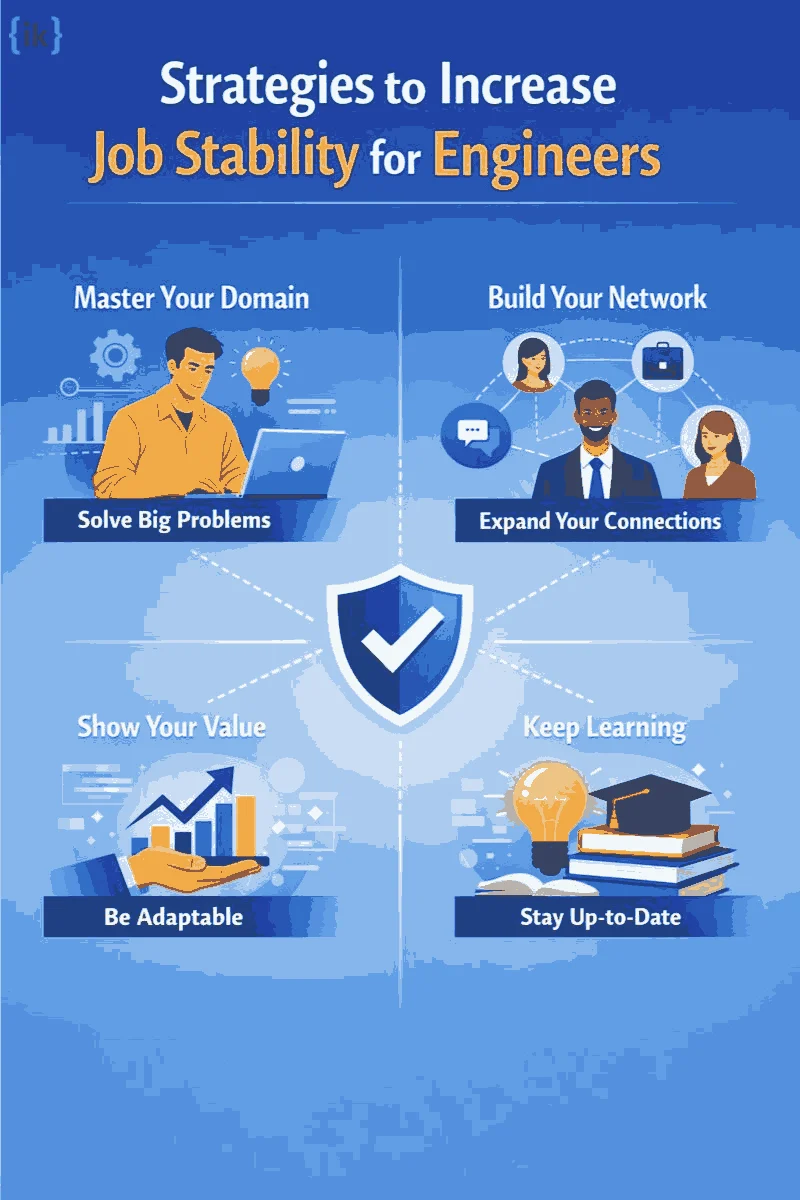
1. Master Your Domain and Solve Big Problems
Deep expertise makes you indispensable. Continuously learn new tools and trends, so you stay ahead of the curve. Go beyond your core duties by tackling projects that directly support the company’s goals and revenue. Be a problem-solver who contributes to job security for engineers meaningfully.
2. Build a Strong Network and Personal Brand
Establishing connections both inside and outside your company is key. Cultivate relationships with mentors, colleagues, and industry peers. A strong network serves as a safety net; if one opportunity ends, those connections often lead to the next role. Similarly, raise your profile by speaking at conferences, joining professional groups, or contributing to open-source projects.
3. Communicate Value and Stay Adaptable
Clearly articulate your achievements and how you’ve driven impact at work. Employers value engineers who can frame their contributions in business terms. At the same time, stay flexible by diversifying your skill set by balancing deep mastery of core technologies with learning adjacent areas.
4. Invest in Continuous Learning
Treat your career as a long-term investment. Embrace lifelong education by taking courses, attending workshops, or earning certifications to keep your skills fresh. This is how you future-proof your career against layoffs and automation for job security for engineers.
Even if current skills meet the job requirements, pick up new languages or frameworks on your own time. The most stable engineers are those who stay ahead of industry shifts.
Conclusion
Long-term job stability in engineering isn’t a matter of luck; it’s built through proactive choices. Mid-career engineers should evaluate opportunities carefully and continuously strengthen their own profile.
By focusing on companies with healthy roadmaps and high retention, while simultaneously deepening expertise, networking heavily, and staying adaptable, you create a robust safety net for your career.
In today’s market, the key is knowing which opportunities are worth the move. Prioritize roles and skills that offer true job stability for engineers, job security for engineers, and growth. In doing so, you’ll make your engineering career resilient against layoffs, market swings, and shifting technologies.
Remember, you ultimately generate your own job stability by being an indispensable, lifelong learner in your field.
FAQs: Job Stability for Engineers
Q1. Are FAANG roles still a stable career path?
Not always. FAANG companies still pay well, but layoffs and high performance pressure are common. Job stability for engineers depends more on your results and adaptability than the brand name.
Q2. How can I tell if a job offer is likely to be stable?
Check the company’s finances, turnover rate, and long-term roadmap. Ask how teams are funded and what they plan to build. Stable industries and strong internal demand matter more than hype for job security for engineers.
Q3. What should I focus on to improve my career stability?
Build strong technical skills, keep learning, and grow your network. Engineers who solve important problems and stay adaptable recover faster from job changes.
Q4. Does specializing in one skill help with job security?
Only if the skill stays in demand. It’s safer to master fundamentals and stay flexible across tools and domains for job stability for engineers.
Q5. Should I choose smaller companies for stability over big tech?
Sometimes. A well-funded mid-size company can be more stable than big tech during layoffs. Financial health matters more than company size.
References
- US Bureau of Labor Statistics projection for engineering job openings
- McKinsey report on AI skills adoption in engineering teams
- Deloitte outlook on engineering and construction investment priorities
Recommended Reads:
Software Engineering at the Largest Tech Firms in the World (FAANG)