A FAANG data engineer resume is your gateway to securing roles at elite tech companies like Meta, Amazon, Apple, Netflix, and Google. With recruiters spending only 6–8 seconds on an initial scan, your resume must immediately demonstrate technical expertise, measurable impact, and the ability to solve complex problems at scale.
Your resume is more than a list of skills; it’s a narrative that showcases quantifiable achievements, end-to-end project ownership, and business-relevant outcomes. It should be optimized for both ATS systems and human reviewers, ensuring your application gets noticed and considered for interviews.
This guide walks you through how to structure your resume strategically, highlight results with real-world examples, use ATS-friendly formatting, and implement expert tips to maximize visibility. By following these steps, you’ll be able to craft a FAANG-ready resume that clearly communicates your value and positions you for top-tier data engineering roles.
Key Takeaways
- FAANG data engineer resumes are critical for standing out in competitive hiring, requiring technical expertise, measurable impact, and problem-solving at scale.
- Recruiters and ATS prioritize clarity, concise achievement-driven bullets, and clean formatting over generic responsibilities or tool lists.
- Tailoring resumes with company-specific keywords, structured experience, and quantifiable results increases interview callbacks.
- Strong resumes tell a data story, showcasing ownership, scalability, and business-relevant outcomes through problem, action, and result achievements.
Why a Strong Resume Is Still the Key to Landing Top-Tier Jobs
You might believe that GitHub repositories or LeetCode scores alone demonstrate your technical ability. In reality, your resume is the first and most crucial tool for securing an interview. For FAANG data engineer roles, where thousands of candidates apply for a single position, only resumes that communicate clarity, measurable impact, and engineering scale advance. Coding challenges, interviews, and cultural fit follow later.
Here’s why a FAANG-ready resume is a strategic advantage:
1. ATS: The First Filter
FAANG companies rely on Applicant Tracking Systems (ATS) to automatically screen resumes. Incorrect formatting or missing keywords can prevent your application from reaching recruiters. ATS evaluates structure, keyword relevance, and readability, making optimization essential.
2. Recruiter Attention is Limited
Recruiters typically spend seconds scanning each resume. To capture their attention:
- Use clear section headings
- Highlight quantifiable achievements
- Maintain a clean and logical layout
3. Perception and Thought Leadership
Recruiters assess not just technical skills, but clarity of thinking and problem-solving approach. A disorganized resume can suggest a lack of structure in your work.
4. Your Resume as a Strategic Product
Consider your resume a product that demonstrates value:
- Clean design
- Clear, outcome-focused messaging
- Evidence of impact and ownership
A well-crafted FAANG resume positions you as a candidate who delivers results at scale and is ready for top-tier engineering challenges.
What FAANG Recruiters Look for in a Data Engineer Resume

Before refining your resume, it’s important to understand what recruiters are actually seeking in a FAANG data engineer resume. Contrary to popular belief, they’re not searching for perfection; they’re searching for clarity of impact and evidence of problem-solving at scale.
1. Quantifiable Impact
Recruiters are most impressed when technical efforts are tied to measurable business outcomes. Instead of describing what you were “responsible for,” describe what you achieved.
Ineffective: Worked on data pipelines for analytics.
Effective: Engineered Spark ETL pipelines on AWS EMR to process 25TB of data daily, reducing analytics latency by 35%.
Quantification transforms your resume from a static list into a story of progress and performance.
2. Technical Depth and System Design
Your resume should reveal the depth of your engineering thinking. FAANG data teams manage systems that ingest, clean, and analyze terabytes or even petabytes of information daily. Recruiters expect to see your understanding of:
- Distributed data systems
- Real-time streaming architectures
- Data warehouse design and optimization
- Cloud infrastructure (AWS, GCP, Azure)
- Reliability and automation frameworks
Mentioning tools is necessary, but what truly matters is how you use them to solve scale-related challenges. “Built a data pipeline using Spark” is good, but “Built a data pipeline that reduced processing time from six hours to ninety minutes” is excellent.
3. Leadership and Ownership
You don’t need a management title to show leadership. Ownership in data engineering is demonstrated by leading a migration project, mentoring new hires, or proactively improving data quality frameworks. FAANG recruiters often interpret leadership as the ability to take initiative and deliver end-to-end results.
4. Clean & Professional Formatting
Your resume should look as refined as the systems you build. Use a modern, readable font like Calibri or Arial, consistent spacing, and clean section headers. Recruiters don’t want to decode your design choices; they want to absorb your achievements. Simplicity signals professionalism.
Step-by-Step Guide to Create a FAANG-Ready Data Engineer Resume
Build a resume that speaks the language of top tech recruiters, optimized for ATS, rich in quantifiable impact, and structured to highlight your proficiency in scalable data pipelines, cloud platforms, and big data technologies.
Here are a few essential steps to help you craft a standout data engineering resume that meets FAANG standards:
- Header and contact information
- Professional summary
- Technical skills
- Experience
- Projects and contributions
Let’s look at these steps in detail and understand how you should write an FAAANG data engineer resume.
1. Header and Contact Information
This is where many candidates overcomplicate things. Keep it factual and machine-friendly.
Example:
Riya Nair | San Francisco, CA | riya.nair@email.com | linkedin.com/in/riyanair | github.com/riyadata
Avoid icons, color blocks, or multi-column designs. ATS systems struggle to parse those elements. A simple line of text communicates professionalism instantly.
2. Professional Summary
Your summary should be a quick insight into who you are, not a biography. Three sentences are enough. The best summaries link years of experience, key technologies, and business impact.
Example:
Data Engineer with 7 years of experience designing scalable data architectures and ETL pipelines across AWS and GCP. Skilled in Spark, Airflow, and Kafka, with a strong record of improving data reliability and reducing latency for real-time analytics systems. Passionate about transforming raw data into usable insights that power smarter products.
3. Technical Skills
Recruiters want clarity here. Group skills into logical categories rather than listing them in alphabetical order.
| Category | Tools |
| Programming | Python, Scala, SQL |
| Big Data & Streaming | Spark, Hadoop, Kafka, Hive |
| Cloud & Infrastructure | AWS (S3, EMR, Redshift), GCP (BigQuery, Dataflow) |
| Orchestration | Airflow, Luigi |
| Databases | PostgreSQL, MongoDB |
| DevOps & CI/CD | Docker, Jenkins, Git |
This format makes it easy for both humans and algorithms to understand your technical breadth.
4. Experience
This is the soul of your resume. FAANG recruiters focus heavily on how you describe your work. Each bullet should start with a strong verb, end with a measurable result, and remain concise.
Example 1:
Senior Data Engineer | Amazon | 20XX–Present
- Designed high-throughput Spark ETL jobs on AWS EMR, reducing daily data ingestion time from four hours to ninety minutes.
- Automated data quality checks with Airflow DAGs, cutting manual QA by 70% across five analytics teams.
- Partnered with ML engineers to integrate streaming data from Kafka into personalization pipelines used by 50M+ customers.
Example 2:
Data Engineer | Deloitte | 2016–2020
- Migrated legacy ETL workflows from SQL Server to GCP Dataflow, cutting infrastructure costs by 25%.
- Developed standardized schemas for 15+ data sources, improving query efficiency and reducing maintenance overhead.
Each bullet tells a story: problem, action, and result: the same structure FAANG interviewers expect in behavioral questions.
5. Projects and Contributions
If you’ve built open-source tools, worked on side projects, or contributed to community repositories, mention them. They reflect initiative and technical curiosity, traits FAANG teams prize.
Example:
- Open Source: Contributed to Apache Airflow, improving operator efficiency for AWS Glue integration.
- Personal Project: Developed a real-time IoT dashboard using Kafka Streams and Power BI, visualizing data from 2,000+ connected devices.
6. Education and Certifications
Be selective. Highlight what’s relevant to your target role.
- B.Tech in Computer Science
- AWS Certified Data Analytics Specialty
- Google Cloud Professional Data Engineer
Avoid crowding this section with every course you’ve taken. Two or three key certifications suffice.
Tailoring Your Resume for the FAANG Data Engineer Role
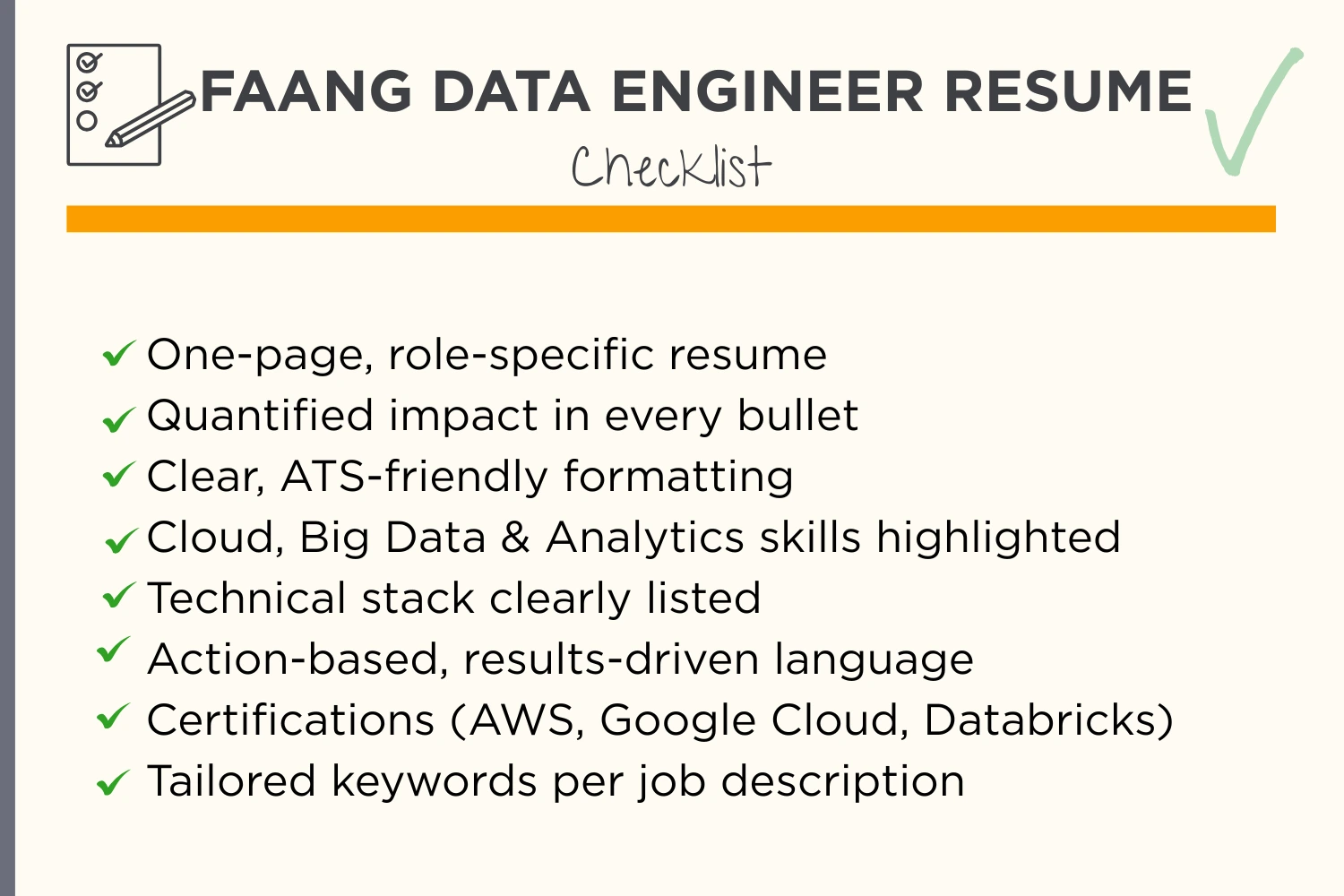
Every FAANG role has its own story. The data team at Netflix doesn’t operate like Google’s, and what Amazon calls a ‘data platform engineer’ is defined differently at Meta. That’s why a single version of your resume won’t work. Recruiters instantly recognize generic submissions; what they want is evidence that you understand their challenges and can help solve them.
1. Use Keywords Like an Engineer, Not a Marketer
Approach the job description like you would a data model, look for patterns and priorities. If a role emphasizes real-time analytics, highlight your work with Kafka or Flink. If it focuses on data reliability, show how you automated monitoring with Airflow or built fault-tolerant pipelines. Use the company’s language naturally; it signals that you speak their technical dialect.
2. Format for Humans and Machines
Your resume should read as clearly as clean code. Keep it single-column with standard headers like Experience and Skills, and avoid tables or graphics that break ATS parsing. Choose simple fonts and export your file as a clean PDF from Word or Google Docs. Clarity always wins over design tricks.
3. Tell a Data Story That Resonates
FAANG recruiters remember resumes that tell a story of impact, not activity. Turn tasks into outcomes. Don’t say, “Handled ETL jobs for reporting.” Instead, say, “Redesigned ETL pipelines to update data hourly, enabling faster insights and a 20% boost in experiment throughput.” This kind of phrasing connects your engineering choices to real business value, proving you don’t just process data, you move outcomes.
Real-World Example: The Data Engineering Resumes That Made It to FAANG
A well-crafted resume can help a strong candidate stand out. Even a single, carefully worded bullet point can capture a recruiter’s attention and highlight measurable impact.
Consider two versions of the same bullet point from a mid-level data engineer’s resume:
Before:
“Worked on ETL processes for user analytics.”
After:
“Designed and deployed ETL pipelines on AWS Glue and Spark to process 5 TB of daily user data, improving report latency by 75% and enabling near-real-time insights for product teams.”
As highlighted in the Harvard Business Review’s “How to Tell a Great Career Story” (2023), storytelling through quantifiable impact helps employers visualize how you think and execute. By turning tasks into outcomes, and outcomes into metrics, you transform your resume from a record of work into a narrative of growth and achievement.
The difference is immediate: clarity, scale, and credibility. The revised line demonstrates ownership, tools, and results. When recruiters see metrics, they see proof.
Common Mistakes You Must Avoid in Your FAANG Data Engineering Resume
Even highly qualified candidates can lose an opportunity due to simple, avoidable errors. In FAANG data engineering resumes, small oversights can prevent your application from passing ATS filters or capturing a recruiter’s attention. Paying attention to these fundamentals ensures your resume reflects your true skills and impact.
The most common issues include:
- Overloading the resume with tools but underplaying outcomes.
- Writing in dense paragraphs instead of concise bullets.
- Using jargon without clarity (“handled large-scale ETL” means nothing without metrics).
- Avoid layouts that have small fonts, inconsistent spacing, or confusing alignment.
- Sending the same resume to every FAANG company without personalization.
- A well-written resume is like clean code, which is readable, modular, and efficient.
Conclusion
A FAANG data engineer resume is more than a checklist of technologies; it’s proof that you can think strategically and deliver measurable results at scale. Recruiters at Meta, Amazon, Apple, Netflix, and Google aren’t swayed by buzzwords; they look for clarity, intent, and impact. When your resume shows how you optimized Spark pipelines, improved AWS efficiency, or cut data latency for millions of users, it signals that you understand both the code and the consequences.
The best resumes read like data stories, not task lists. They highlight ownership, how you built systems that were faster, more reliable, and more valuable to the business. A recruiter should be able to see, in just a few lines, the scale of your work and the purpose behind your choices. That balance of technical precision and narrative flow is what distinguishes a good engineer from a FAANG-ready one.
Think of your FAANG data engineer resume as your first real project, clean, optimized, and built to perform. Strip away clutter, focus on results, and make every line earn its place. Because at FAANG, standing out isn’t about knowing every tool; it’s about showing how your engineering decisions create lasting impact.
FAQ: FAANG Data Engineer Resume
1. How do I write a FAANG job description?
Focus on impact, technologies used, and cross-functional collaboration. Keep language concise and results-oriented, aiming for measurable outcomes (e.g., “Improved data pipeline latency by 30%”).
2. What makes a good FAANG resume template?
A single, clean page layout that highlights the accomplishments and metrics for each role. Clarity, consistency, and technical depth should be emphasized in the bullet points.
3. What is the ideal format for a FAANG resume?
Reverse chronological format with clearly labeled sections: Summary, Experience, Skills, and Education. Save in PDF format to preserve the layout.
4. How do you format the data engineer resume?
Emphasize tools used (Spark, SQL, Python), projects with measures of impact accomplished, and pipeline architecture experience. Use bullet-point structure in a problem-solution-result format.
5. What is the structure of a FAANG resume?
Sleek and easy-to-scan document, laden with impact statements featuring quantifications. Every bullet should make references to ownership, scale, or complexity in a technical sense.
References