Evidence of skills for tech professionals is the clearest signal hiring teams use to tell who can actually deliver results and who only sounds like they can. It is the difference between a conversation and a proven impact.
By 2025, 85% of companies1 report using skills-based hiring practices to evaluate talent. Nearly half of IT professionals who earned certifications reported receiving promotions or salary increases linked to those credentials in 2025. These trends mean proven work matters more than ever in the U.S. market2.
In this article, we will share practical skills assessment examples, resume and portfolio tactics, interview narratives, and a one-page checklist to help experienced tech professionals prove their value and win better roles faster.
Key Takeaways
- Evidence of skills for tech professionals beats claims, showing outcomes with dated artifacts and metrics.
- A small set of deep case studies is more persuasive than a long list of minor projects.
- Certifications matter when presented with context such as exam scope, issue date, and validated assessments.
- Every resume bullet should map to a 90-second interview story and a verifiable artifact.
- Soft skill claims must include a dated decision record or stakeholder note to act as proof of technical skills.
What Actually Counts as Evidence of Skills?
Hiring teams look for concrete proof, not promises. Evidence of skills for tech professionals typically falls into three repeatable categories that hiring managers trust.
Below are clear examples and quick checks you can run to make sure your evidence reads as credible and measurable
1. Skills Assessment Examples Trusted by Hiring Teams
Practical tests show you can do the work under time or real-world constraints. Common formats include timed coding challenges, take-home projects, pair programming sessions, and role-specific simulations.
A good assessment demonstrates both technical accuracy and delivery tradeoffs, such as speed, reliability, and maintainability.
To validate an assessment, include the problem statement, your deliverables, test cases, time spent, and a short reflection on tradeoffs and next steps.
This makes the result reproducible and easy for reviewers to verify. Skills-based hiring is growing, which makes standardized assessments a key way to provide proof of technical skills.
2. Work Samples and Portfolio Elements That Prove Impact
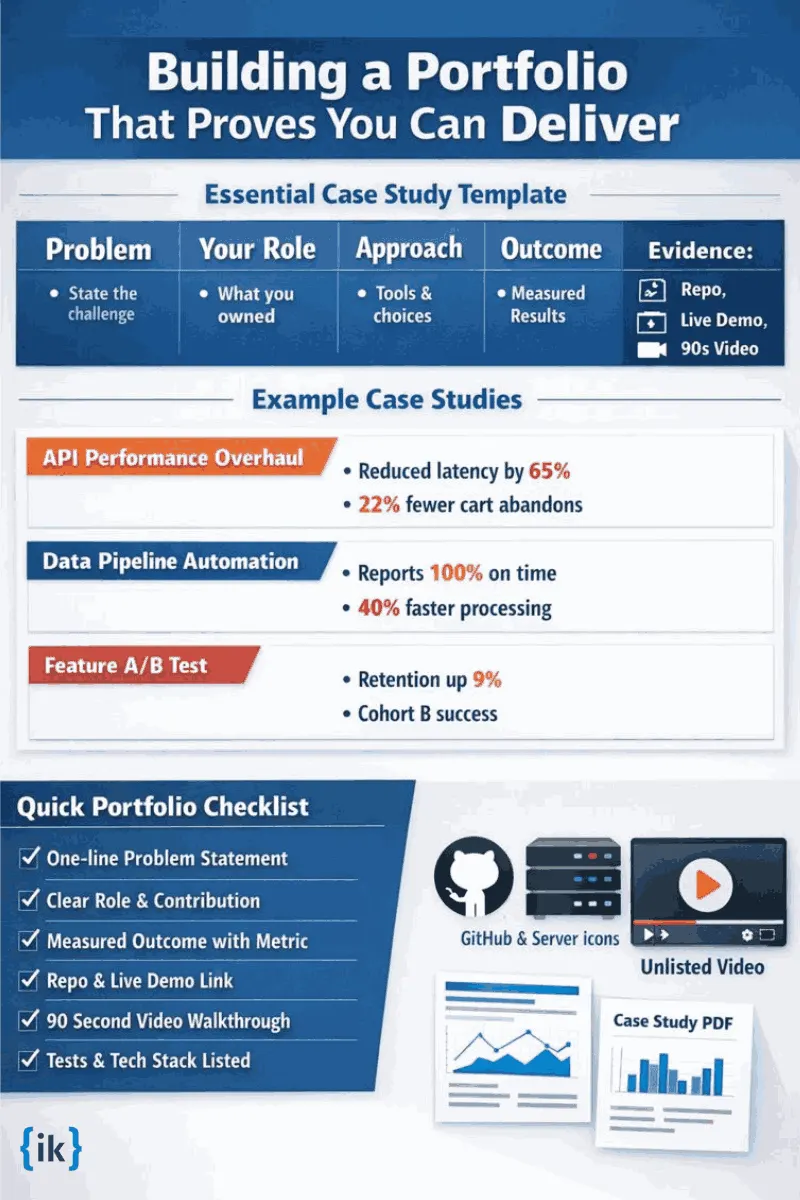
Work samples must show outcomes, not just activity. Use short case studies that follow a consistent template: Problem, approach, role, outcome, evidence.
Quantify the outcome whenever possible, for example:
Reduced page load time by 42 percent, increased throughput by 3x, or cut incident rate by 60 percent.
Host live demos, link to versioned code, and attach a short video walkthrough under two minutes. Quick checks to run before you publish include verifying that links work, the demo runs on another network, and sample data is anonymized.
This step shows how to show technical skills to busy reviewers and hiring teams who want measurable proof.
3. Certifications, Badges, and Verified Assessments That Matter
Certifications still provide value when they are tied to real assessments and employer recognition. The 2025 Pearson VUE report3 shows that many certified professionals received promotions or salary increases after certification, which makes credentials useful supporting evidence.
Present certificates with issue dates, exam scores where available, and a short note explaining the measurable skills validated by the credential. If a certification required a lab or simulation, mention that to increase trust.
Convert Projects Into Resume Bullets and Interview Narratives
For experienced roles, projects are only valuable when they clearly communicate evidence of skills for tech professionals. Hiring managers do not evaluate effort. They evaluate outcomes, ownership, and decision quality. Your job is to translate real project work into concise signals that act as proof of technical skills across resumes and interviews.
1. Turning Raw Project Work Into Resume-Ready Evidence
Most resumes fail because they describe responsibilities instead of evidence. Evidence of skills for tech professionals on a resume comes from a structured transformation, not rewriting. Use this four-step conversion method for every project.
- Step 1: Identify the decision you made: Do not start with tools or tasks. Start with the decision that shaped the outcome. This could be an architectural choice, a tradeoff, a prioritization call, or a technical risk you handled. This framing immediately shows how to show technical skills through judgment, not execution.
- Step 2: Attach a measurable technical outcome: Numbers are not optional. They are the strongest proof of technical skills. Use metrics hiring teams actually care about.
- Step 3: Clarify your scope and ownership: Senior hiring decisions hinge on scope. Make it explicit. This prevents your work from being mistaken as a team-only contribution.
- Step 4: Compress into a single high-signal bullet: Redesigned checkout API flow to eliminate blocking calls, reducing P95 latency by 42% and cutting timeout errors by 60% across peak traffic.
That single line communicates evidence of skills for tech professionals far better than five generic bullets.
2. High-Impact Resume Bullet Patterns You Can Reuse
Use these patterns repeatedly to show proof of technical skills without repetition.
- Performance and scalability: Improved X by Y percent by redesigning Z under A constraints.
- Reliability and systems ownership: Reduced failure rate from X to Y by introducing Z monitoring and recovery logic.
- Data and analytics: Built X pipeline processing Y records daily with Z percent accuracy improvement.
- Security and compliance: Mitigated X risk by implementing Y controls and auditing Z flows. Each pattern helps recruiters instantly see how to show technical skills in real production contexts.
3. Converting the Same Projects Into Interview Narratives
Interviews are where evidence of skills for tech professionals must survive scrutiny. The mistake most candidates make is telling stories chronologically instead of analytically.
Use this outcome-driven STAR structure:
- Situation: State the problem in one line. No backstory.
- Task: Clarify your responsibility and decision authority.
- Action: Focus on reasoning, not steps. This is where proof of technical skills lives.
- Result: Quantify and validate.
This structure shows evidence of skills for tech professionals in a way interviewers can trust and probe deeper.
4. Handling Follow-Up Questions Without Collapsing Your Story
Strong interviewers will test your claims. Prepare for this.
Common follow-ups:
- Why did you choose this approach over alternatives?
- What tradeoffs did you accept?
- What would you change if you had more time?
- What broke after launch, and how did you fix it?
Pre-emptively preparing these answers reinforces proof of technical skills and shows mature engineering judgment.
5. Aligning Resume Bullets and Interview Stories
Your resume and interview answers must reinforce each other.
- Every resume bullet should map to a 90-second interview story.
- Every major interview story should exist somewhere on your resume.
- Metrics used verbally should match written metrics.
- The tools mentioned should be secondary to decisions and outcomes.
This alignment dramatically strengthens evidence of skills for tech professionals because inconsistencies are one of the biggest red flags for hiring panels.
6. Quick Validation Test Before Applying
Before submitting applications, run this test. Ask yourself:
- Can I explain each resume bullet without opening my laptop?
- Can I defend each metric with context?
- Can I explain why my decision was better than the alternatives?
If yes, you have real proof of technical skills. If not, rewrite until you do.
Demonstrating Soft Skills and Cross-Functional Impact
Soft skills are proof, not fluff. For experienced people, leadership and collaboration move product metrics. Evidence of skills for tech professionals must therefore include simple, verifiable signals that hiring teams can check quickly.
What Hiring Teams Want You to Show?
- A decision you led with a dated artifact, such as a decision log, design sign-off, or architecture note.
- A before-and-after metric tied to the decision, for example incident rate down 60 percent or a feature adoption up 30 percent.
- A short stakeholder quote or a one-line email that confirms your role. This is lightweight proof of technical skills and influence.
Concrete Ways to Capture this Evidence Now

- Save a one-page decision record for every major cross-team call. Add date, attendees, options considered, and the outcome. Link this from your case study.
- Always take a baseline metric before work begins and record the same metric after rollout. A before-and-after comparison is the fastest way to show impact.
- Ask for a short stakeholder note after milestones. Anonymize if needed. These notes are usable evidence of skills for tech professionals.
- Keep meeting notes and demo recordings. Put timestamps next to the moment you explain a key decision so reviewers can quickly verify.
Common Mistakes When Presenting Evidence of Skills and How to Fix Them
Hiring teams reject claims that cannot be validated. When experienced pros present weak evidence, the problem is rarely skill; it is actually presentation.
Below are the six most common mistakes and exact fixes that turn flimsy claims into verified evidence of skills for tech professionals.
- Weak metrics or no metrics at all: Always attach a specific metric to every claim. If you cannot get an exact number, add a conservative, clearly labeled estimate and the measurement method. Example resume line change
- Vague ownership and scope: State what you owned and what you did not. Use phrases like owned end-to-end rollout or led performance tuning for service X. This tells reviewers whether your contributions are individual or team-level. That is how to show technical skills clearly.
- Evidence locked behind private links or missing reproducibility: Publish a sanitized demo or a short walkthrough video and include test logs or minimal repro steps. Live samples that run for reviewers are the clearest proof of technical skills.
- Over-reliance on buzzwords and tools instead of decisions: Lead with the decision and outcome, then mention tools. Replace the tool’s first bullets with the decision’s first bullets. Evidence of skills for tech professionals is about judgment and impact, not tool names.
- Soft skill claims with no artifacts: Attach a dated decision log, stakeholder email, or meeting minutes that name you. Small artifacts convert leadership statements into verifiable proof of technical skills.
- Inconsistent numbers across resume portfolio and interview answers: Standardize metrics in a single source of truth document and use that across all materials. If you say 40% in a resume, keep the same 40% in interviews and portfolio. Inconsistency kills trust.
Fix these common errors, and your evidence of skills for tech professionals will change from a set of claims into documentation that hiring teams can verify and trust.
Conclusion
Evidence of skills for tech professionals has become the deciding factor in hiring, especially as resumes and titles lose credibility. In a market where most candidates sound similar, real proof separates those who move forward from those who get filtered out early.
Strong evidence is not about doing more work. It is about presenting existing work clearly, measurably, and in a way that hiring teams can trust. Projects tied to outcomes, certifications explained with context, and interview stories backed by artifacts create confidence quickly.
If you take one thing from this article, let it be this: ‘Do not assume your skills are obvious.’ Make them visible, verifiable, and easy to evaluate. When your evidence of skills for tech professionals is clear, interviews become conversations about impact rather than explanations, and better roles follow naturally.
FAQs: Evidence of Skills for Tech Professionals
Q1. How can experienced tech professionals prove skills when code must stay private?
Use sanitized demos, short recorded walkthroughs, annotated logs, and dated decision records. Link to a private repo with a readme that contains minimal repro steps and a short demo video so reviewers can verify without exposing company IP.
Q2. Do certifications meaningfully improve promotion or pay outcomes?
Yes. There is a clear link between certification and career gains; many certified professionals reported promotions or raises after certification. Use certs with issue dates and context to increase trust.
Q3. How many projects should I include in a technical portfolio for senior roles?
Quality over quantity. For experienced tech professionals, pick 2–4 deep case studies that include metrics, artifacts, and a 90-second demo rather than a long list of small demos. Recruiters prefer a few verifiable wins.
Q4. What is the fastest way to convert a project into a high signal resume bullet?
Lead with the decision you own, add the measurable outcome, and state the scope. Here’s an example pattern: “Redesigned X to reduce Y by Z%; owned end-to-end rollout.” This pattern maps directly to interview stories.
Q5. How do I show technical skills in interviews beyond whiteboard problems?
Bring outcome-driven STAR stories and artifacts. Say where decision logs and demo links live, then be ready to walk interviewers through tradeoffs and validation steps. Interviewers trust verifiable artifacts more than claims.
References
- Skills-Based Hiring Is Now the Hiring Standard
- Certifications Are Directly Linked to Promotions and Pay Growth
- Certified Professionals See Promotions and Pay Hike
Recommended Reads