Great technical work often goes unnoticed when it is poorly explained. To communicate your technical strengths, you must turn complex projects into simple outcome-driven stories that decision-makers can quickly understand and remember.
LinkedIn’s 2025 Skills-Based Hiring1 report shows that a skills approach can expand the talent pool by a median of 6.1x for a typical job and as much as 15.9x in the US when employers search by skills instead of past job titles.
Hiring is changing fast. Nearly two-thirds of employers now use skills-based hiring and pre-hire assessments to test real ability, communication, and problem-solving. Recent reporting finds big upticks in test usage as employers try to separate authentic skill from polished applications2.
In this article, we’ll show you how to present your work on your resume, in interviews, and at work with real examples and templates that will make your technical strengths clear and hard to ignore.
Key Takeaways
- Results matter more than tools. Always lead with the outcome before explaining the technology.
- Use one simple story structure across resumes, interviews, and daily updates to stay consistent.
- Track metrics from day one so you can clearly communicate your technical strengths with proof.
- Make your technical skills at work visible through short updates, project summaries, and documented impact.
- Treat every project as practice for how to improve technical skills and turn learning into measurable results.
How to Present Technical Strengths in Interviews?
Communicate your technical strengths by telling a tight story that hiring teams can follow. Start with the problem you solved, then describe what you did, and end with the measurable result. Make every sentence earn its place.
1. One-Minute Pitch You Can Copy
Open with a one-line outcome. Follow with one line about your role and tech choice. Close with one metric. Example to copy. I help checkout teams reduce failures. I rebuilt the payment ingestion pipeline using Kafka and idempotent consumers.
That cut payment failures by 70% and raised weekly revenue by 4%. Practice until you can deliver it in sixty seconds. When you communicate your technical strengths, make the result the most memorable part.
2. Two Compact STAR Stories for Technical Rounds
Prepare two STAR stories ready to expand to two minutes. Keep each element brief.
Example One
- Situation: Checkout timeouts at peak.
- Task: Reduce failures without losing throughput.
- Action: Replaced synchronous calls with batched async workers and circuit breakers.
- Result: Failures fell from 7% to 1%, and throughput stayed stable.
Example Two with learning angle
- Situation: Model drift reduced recommendation quality.
- Task: Restore precision in four weeks.
- Action: Added validations, retraining, and ownership for features.
- Result: Precision rose 12 percent, and CTR improved 6 percent. Use how to improve technical skills as a short line to show growth after the result.
3. Live Tasks and Whiteboard Tactics
- During coding tests, narrate intent.
- Say why you picked an approach and name trade-offs.
- For system design, map the flow, pick one bottleneck, and show how you would measure success.
If you are asked to debug, think aloud and write one test case. These moves help you communicate your technical strengths under pressure.
Also read: How to Nail Your Next Technical Interview
How to Show Technical Strengths on Your Resume?
When you want to communicate your technical strengths, use the resume to prove impact, not just list tools. Your summary and top three bullets should show outcome, action, and result. That pattern makes it quick for a recruiter to scan and for an ATS to match.
1. Resume Structure and Where to Place Impact
Put this order near the top of the page:
- Header with contact and one link to work samples or GitHub.
- One line summary that captures your value and includes the primary keyword once in a natural phrase.
- Top three bullets under your current role that follow the outcome action result formula.
- Skills section with 6 to 12 targeted items that match the job description.
- Projects or appendix link for deeper technical proof.
2. A One-Line Summary Examples You Can Copy
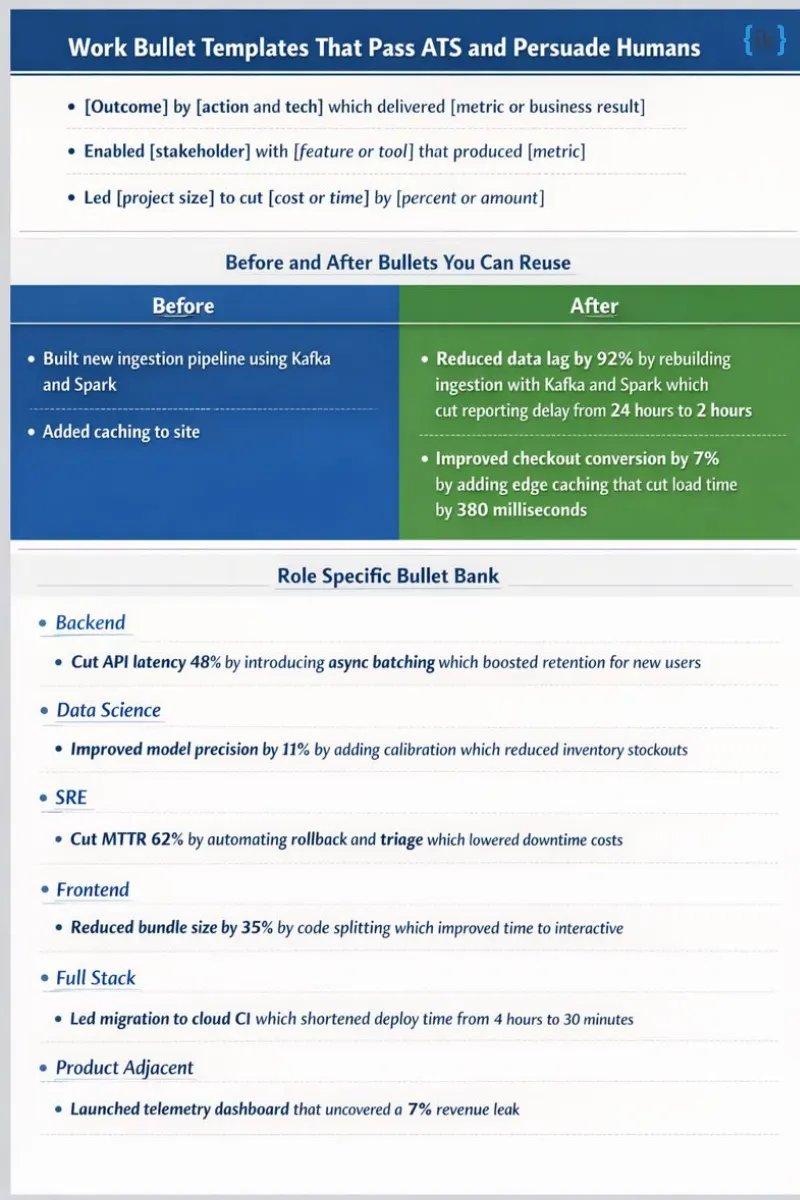
Keep it under 18 words and lead with impact.
- Summary example for backend: Reliable platform engineer who improves throughput and reduces failures. Communicate your technical strengths by focusing on reliability gains and measurable results.
- Summary example for data science: Forecasting leads who raises precision and cuts stockouts. Communicate your technical strengths using model metrics and business outcomes.
- Summary example for early IC: Full-stack engineer who ships features that increase activation. Communicate your technical strengths with clear metrics and one sentence on approach.
3. Best Practices for the Skills Section
List skills as short phrases, not long sentences. Order by relevance to the job. Include platform or tool names exactly as they appear in the posting. If you want to show technical skills at work, add one line under a relevant role linking to a short project readme or demo.
Also Read: How to List Skills on Your Software Engineer Resume
4. Projects Links and Proof
Add one page project links for deep technical proof. Use readme sections that show the problem approach, metrics, and a short how-to reproduce. Linking to repositories and demo videos makes it easy to validate claims. Showing how to improve technical skills with a short learning note in a project readme helps senior reviewers see growth.
5. ATS and Human Readability Checklist
- Does the top summary show impact and include the primary keyword once in a natural phrase?
- Do the first three bullets use the outcome action result formula?
- Are the key tools listed in the skills section exactly as in the job posting?
- Are metrics clear and verifiable?
- Is there a project link for deep proof?
How to Show Technical Strengths at Work and in Meetings?
When you want to communicate your technical strengths at work, make it easy for others to act. Use short written updates and crisp spoken lines so your contribution is visible and memorable.
Keep the same short story you use on your resume, so you communicate your technical strengths consistently.
1. Tactics to Speak in Cross-Functional Meetings?
Lead with the outcome, then name one tech choice and one measurable effect. Translate the technical detail into business terms for non-technical listeners. This is how you communicate your technical strengths to product design and leadership.
Use the phrase technical skills at work when you describe team contributions and keep deep detail for follow-up docs.
2. Ways to Document Outcomes for Performance Reviews
Keep a running log of metrics links, pull requests, and dashboards. Pull three concise examples for your review and add one sentence on how to improve the technical skills you used to solve the problem. Use those notes to plan how to improve technical skills over time.
Example weekly update to copy:
- Goal: Reduce checkout latency this week
- What I did: Implemented async batching for payment calls
- Impact: Latency down 42% and error rate down 60%
Use this format to communicate your technical strengths every week. Small repeated wins build a record that proves your impact.
How to Improve Technical Skills So You Can Communicate Them Better?
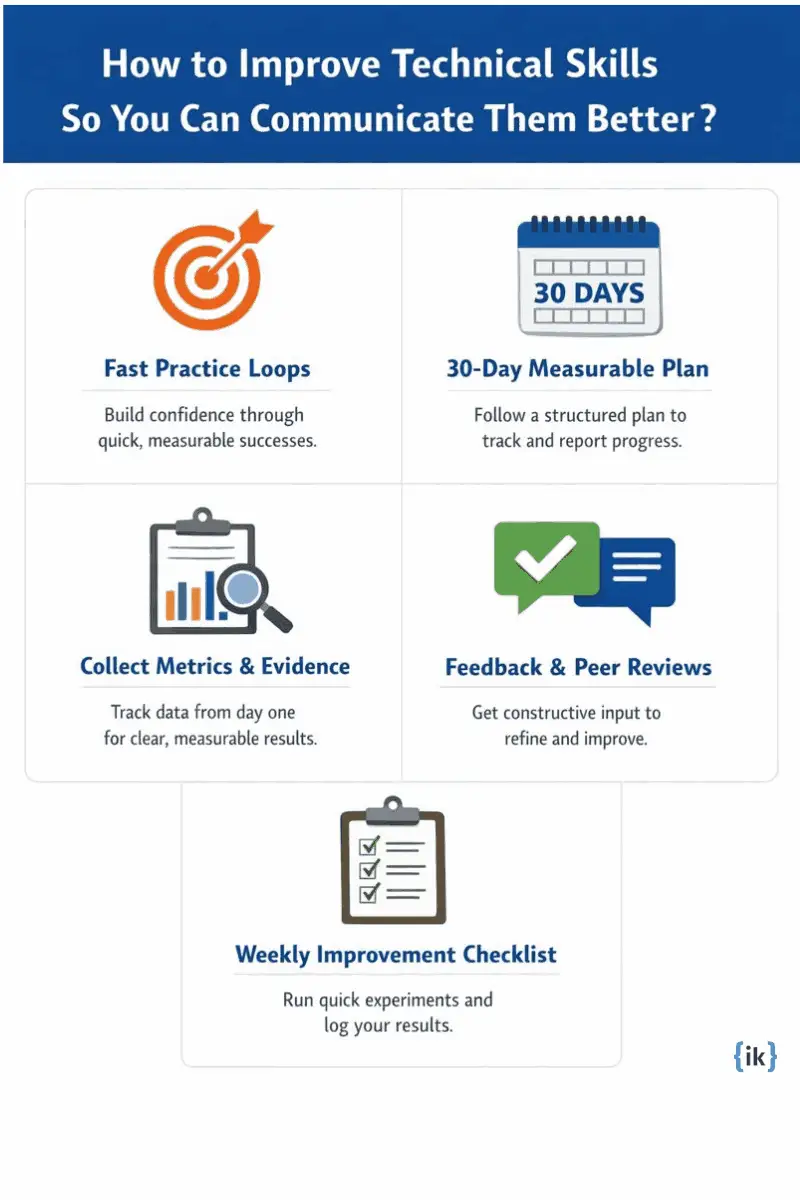
Improving what you do helps you communicate what you did. When you communicate your technical strengths with confidence, it is because you practiced measurable work and tracked outcomes. Build small wins so your stories are backed by data and by repeatable results.
1. Fast Practice Loops that Build Confidence
- Pick a focused problem and ship a measurable change in two weeks.
- Choose something you can measure.
- Release a small experiment.
- Record one metric before and after.
- Repeat this loop four times in a month.
Each loop gives you new evidence to communicate your technical strengths with numbers and concrete lessons.
2. 30-day Measurable Plan
- Week One: Pick the metric and the test.
- Week Two: Implement and ship.
- Week Three: Measure and iterate.
- Week Four: Write a short note that explains the outcome of the decision and the next step.
Save the note to your project’s README or personal resume appendix. This creates repeatable proof you can use when you communicate your technical strengths in interviews and reviews.
3. How to Collect Metrics and Evidence From Day One?
Instrument changes with simple telemetry. Track request latency error rate, user conversion, or CPU time. Keep raw numbers in a single spreadsheet or dashboard.
When you communicate your technical strengths, link to that dashboard or to a one-page appendix. If exact numbers are not available, use percentages or time saved estimates and label them as approximations.
4. Feedback and Peer Review Cycles
Share a short demo with one peer and ask for two things. Ask what was useful and ask what is unclear. Use that feedback to rewrite your one-line outcome and your one metric. This makes it easier to communicate your technical strengths to non-technical listeners.
5. Quick Checklist to Run Each Week
- Pick one experiment.
- Ship a measurable change.
- Save the metric. Write one short result line you can paste into a resume, a status update, or an interview answer.
Also Read: How to Introduce Yourself
Advanced Ways to Communicate Your Technical Strengths Beyond Resumes and Interviews
Use a few high ROI boosters to make your claims verifiable and shareable. Each booster below has when to use it, exact steps, a copyable template, how to measure impact, and common pitfalls. These extras help you communicate your technical strengths with proof, not promises.
1. Short Video Pitch and Demo
Use a video when roles value communication or product fit. A short clip helps reviewers judge clarity and ownership. Keep the length 60 to 90 seconds. Start with the problem. Say what you built and why. Show one metric and one visual if possible. End with where to see the code or demo.
- Sample Script: Hi, I am [name]. The problem was [one line]. I built [what] using [tech]. That cut [metric] by [number]. See the demo and code at [link].
- Where to Host: LinkedIn profile, portfolio page, GitHub repo readme, or a private link on YouTube or Vimeo.
- How to Measure ROI: Track views, conversions, and recruiter response rate for applications with a video versus those without.
- Common Mistakes: Avoid long, rambling explanations and vague claims. If you do not have metrics, say the observable benefit and label it as an estimate.
2. One-Page Project Summary
- When to Use: Use this for high complexity features or when your audience wants reproducible proof.
- Production Steps: Write the one-pager in markdown. Add a small chart or screenshot. Export to PDF and add to your portfolio and resume links.
- How to Measure ROI: Record recruiter and hiring manager follow-up requests for details. Count interview invites that mention the project.
- Common Mistakes: Do not bury the metric. Put the metric at the top so reviewers see impact fast.
3. GitHub Readme and Demo Links
- When to Use: Always do this for any code-heavy project. It is the easiest proof.
- Pro Tips: Add a small script that seeds sample data so reviewers can run the demo in five minutes.
- How to Measure ROI: Count repo clones, demo runs, and recruiter follow-ups that cite the repo.
- Common Mistakes: Do not leave dead links or missing instructions. A broken repo harms credibility.
4. Internal Talks, Demos, and Follow-Up Notes
- When to Use: Use this to turn small wins into recorded contributions at your company.
- Format to Use: 10-minute demo slide deck with problem, approach, outcome, and a short follow-up note with metrics and links.
- How to Measure ROI: Track citations in project docs, performance reviews, and promotion notes.
- Common Mistakes: Do not present without data or without a clear ask.
5. Badges Challenge Profiles and Curated Proof
- When to Use: Use high-quality challenge platforms and reputable certifications sparingly to support a story, not replace it.
- How to Measure ROI: Note recruiter responses and interview pass rates when badges are included.
- Pitfalls to Avoid: Low-value badges add noise. Only include badges that link to verified outcomes.
Conclusion
Your skills only create opportunities when others understand their value. That is why learning to communicate your technical strengths is no longer optional. It affects how fast you get interviews, how seriously your ideas are taken, and how your impact is measured at work.
Strong engineers do not just build systems. They explain outcomes. They show trade-offs. They back claims with metrics. Whether you are writing a resume, answering interview questions, or sharing updates with your team, the same rule applies. Lead with the result. Explain the decision. Prove the impact.
When you consistently apply this approach, your technical skills at work become visible, transferable, and trusted. And as you continue learning and tracking results, you also create a clear path for how to improve technical skills in ways that directly strengthen your career.
FAQs: Communicate your technical strengths
Q1. How do I quantify my technical impact when I don’t have product metrics?
Use proxies and qualitative measures. Convert time saved, error reductions, uptime improvements, test coverage, number of users affected, or scale (team size/users) into percentages or ranges. Label estimates honestly and keep a one-line note on how you derived the number. Recruiters prefer plausible, sourced numbers over vague claims.
Q2. How can I list confidential or NDA work on my resume without breaking rules?
Keep it high-level. Use industry descriptors (for example, Fortune 100 e-commerce client), focus on your role, approach, and outcome, and avoid names or proprietary details. Put a one-page summary behind a private link and say “details available under NDA” for interviews. Always read your NDA first.
Q3. How do I show team contributions on my resume without overstating my role?
State your role and the scope explicitly. Use phrasing like Led X component of Y project or Contributed core caching module used by Z teams. When metrics are team-level, attribute results with language such as Part of cross functional team that reduced X by Y. This is honest and still highlights impact.
Q4. How can I use AI or LLMs to write authentic resume bullets and interview scripts without sounding robotic?
Use LLMs as an editor, not a ghostwriter. Give the model concise facts, scope, and numbers, then ask it to produce short outcome first bullets. Tell the model to preserve your voice and never invent metrics. Use prompts that include the job description and a strict template, such as Outcome by Action, which delivers the metric.
Q5. How do I get managers and peers to document or endorse my technical work for promotions? <h3>
Make it easy for them. Keep a running one-page summary of wins with links and send it before 1:1s or review cycles. Ask for short written feedback or LinkedIn recommendations and offer a suggested sentence they can edit. Regularly surface results in status emails so leaders have ready quotes for reviews.
References
- Skills-based hiring is reshaping how companies evaluate talent
- Employers now test communication as seriously as technical ability
Related Articles