The data analyst vs data scientist debate is one of the most searched career questions in today’s tech landscape. And it is for a good reason. According to the World Economic Forum’s Future of Jobs Report 20251, data-based roles are the most in-demand in the tech world. It is among the fastest-growing professions globally, with millions of new positions expected by 2027.
Even though both roles sound similar with comparable-sounding titles, they differ fundamentally in scope, depth, and purpose.
Essentially, their distinction is very simple. A data analyst explains what happened, while a data scientist makes predictions about what will happen.
In this guide, we break down both roles across responsibilities, skills, salary, education, and career paths.
Key Takeaways
- Data analysts explain the past; data scientists predict the future, that single sentence captures the entire distinction.
- Data science requires deeper technical skills, particularly in machine learning, Python, and advanced statistics.
- Data scientists earn 20–40% more than analysts at comparable experience levels across US markets.
- Analysts can transition into data science by systematically building ML skills, a real portfolio, and deeper programming proficiency.
- Both careers are high-demand and well-compensated. The right choice depends on your strengths, timeline, and appetite for technical depth.
Data Analyst vs Data Scientist: Key Differences At A Glance
Before we explain both roles in detail, let’s understand the key differences between them.
The simplest way to understand data analyst vs data scientist is that an analyst follows a backwards approach to explain what has already happened, but a data scientist uses a forward-looking approach where they make data-based predictions.
Both roles are valuable for organizations, but they serve different purposes within a company.
| Aspect | Data Analyst | Data Scientist |
|---|---|---|
| Primary focus | What happened (descriptive) | What will happen (predictive) |
| Data types | Structured data | Structured + unstructured data |
| Key skills | SQL, Excel, Tableau, basic Python | Python, ML, deep learning, statistics |
| Tools | Excel, SQL, Power BI, Tableau | Python, R, TensorFlow, Spark |
| Education | Bachelor’s degree | Master’s or PhD |
| Salary range | $60K to $130K | $85K to $170K+ |
| Typical output | Reports, dashboards | Models, algorithms, predictions |
| Career entry point | More accessible | More advanced |
With this foundation in place, let us now understand what each role actually involves in day-to-day practice.
Also Read: Python Data Structures Interview Questions and Answers 2026
Data Analyst vs Data Scientist: Who Does What?
The best way to understand the differences between the two roles is at a definition level, and then comparing them on skills, salary, and career trajectory. Now let’s look at what each professional does in their day-to-day life.
Who is a Data Scientist?
A data scientist is a professional who works with large, complex datasets and uses advanced techniques such as ML, statistical modeling, and AI to build predictive models and solve high-stakes business problems. They perform such tasks even to prevent issues from surfacing.
The following are some of the key responsibilities of a data scientist:
- Collecting and processing large amounts of structured and unstructured data
- Building and deploying predictive models using ML algorithms
- Performing advanced statistical analysis to identify patterns
- Designing experiments and performing A/B tests to validate hypotheses
- Communicating outputs and findings to relevant stakeholders
You can think of a data scientist as a professional who builds the engine powering future decisions, and not just reads the dashboards.
Who is a Data Analyst?
A data analyst examines structured data to identify patterns, translate raw data into meaningful insights, and create dashboards to help businesses move faster and smarter.
Let’s look at some of the main responsibilities of a data analyst:
- Querying, cleaning, and transforming data from relational databases
- Analyzing trends within historical data
- Building dashboards and visualizations using tools such as Tableau, Power BI, etc.
- Making reports and presenting findings to related stakeholders
- Helping management make data-driven decisions
If a data scientist builds engines, a data analyst reads the gauges and explains the meaning of numbers to leadership.
Data Analyst vs Data Scientist: Key Roles and Responsibilities
A data scientist and a data analyst both work with data, but the processes they follow are vastly different from one another. Exploring these differences in their roles and responsibilities will give you deeper insight into both roles.
7 Key Responsibilities of a Data Scientist
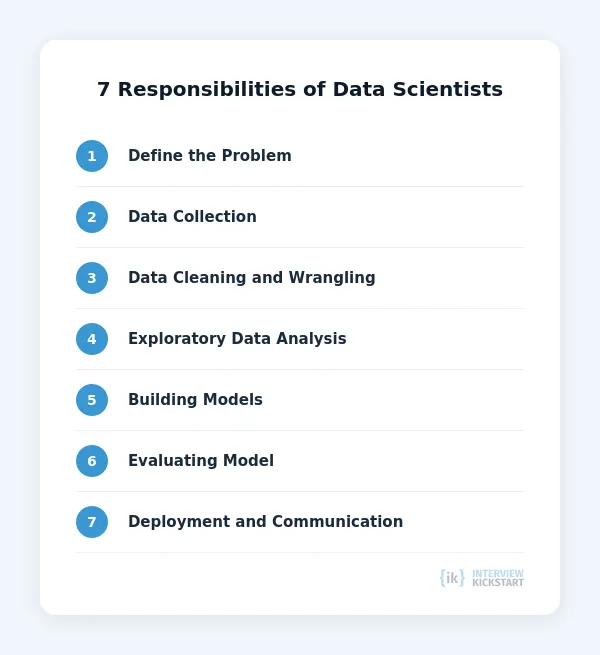
Data science is an iterative and research-based role that moves from raw data to deployment and decision-making systems. This process loops back on itself, unlike a linear reporting cycle.
There are 7 key responsibilities of a data scientist:
- Defining the problem: A data scientist frames business challenges into concrete, testable data-based problems that can be solved.
- Collecting data: Collect data from APIs, internal databases, third-party, and other sources.
- Data cleaning and wrangling: Data scientists find missing values, outliers, and inconsistencies across datasets.
- Exploratory data analysis: They identify patterns, correlations, and anomalies before doing any modeling.
- Building models: They select and train the appropriate ML or statistical models on prepared data.
- Evaluating models: Data scientists measure the performance of models using metrics such as accuracy, precision, recall, and more.
- Deployment and communication: They push models into production and translate results for stakeholders with little to no technical knowledge.
Each of these responsibilities informs the next. A technically sound data scientist knows when to cycle back and refine rather than push forward with a flawed foundation.
Also Read: Top Database Questions to Ace Your Technical Interview
4 Essential Responsibilities of a Data Analyst
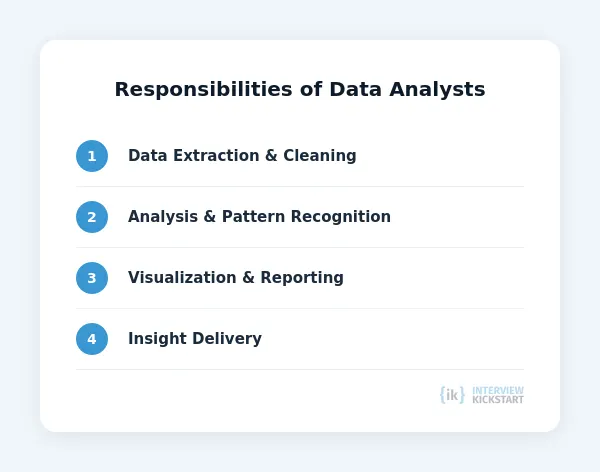
Compared to the role of a data scientist, data analysis is tighter and follows a structured workflow. It primarily focuses on delivering clear and timely insights to leadership. Here, the cycle is faster and repeated more than in data science, making the job of a data analyst operationally indispensable.
The following are 4 key functions data analysts are responsible for:
- Data extraction and cleaning: Data analysts pull data from databases using SQL. They also remove errors and standardize formats so data is easy to analyze.
- Analysis and pattern recognition: Data analysts apply different statistical techniques to identify trends, outliers, and business-relevant relationships.
- Visualization and reporting: Another key responsibility is building dashboards using platforms such as Tableau, Power BI, and Excel to help leadership make informed decisions.
- Insight delivery: Data analysts present findings to stakeholders with concrete and actionable recommendations.
Data analysts have to make sure that the right people have the right information at the right time.
Data Analysts vs Data Scientists: Skills Comparison
To understand the differences in data analyst and data scientist roles, look at the skills each profile requires. They both share a core foundation but vastly differ in technical depth and specialization.
Essential Skills for Data Analysts
The following are the core competencies of data analysts that help them in their day-to-day work across industries:
- SQL: The backbone of data querying. Data analysts use SQL daily to collect and manipulate data from relational databases.
- Excel: Used to perform quick analysis, pivot tables, and communicate results with business stakeholders.
- Tableau / Power BI: Data analysts should know how to build interactive dashboards and visual reports.
- Basic Python or R: Used to automate repetitive tasks and run lightweight statistical analysis.
- Statistics: Working knowledge of mean, median, variance, and hypothesis testing.
- Data cleaning: Real-world data is messy and unstructured. The ability to clean and fix data separates good analysts from great ones.
- Communication: Data analysts must translate technical information into simple language that all stakeholders can understand.
- Business acumen: Every insight a data analyst produces directly contributes to company goals. Strong business acumen makes every insight actionable.
Also Read: 20 Data Warehousing MCQs with Answers
Key Skills for Data Scientists

The data science domain requires a deeper and broader technical understanding, particularly in programming, advanced mathematics, and ML engineering.
- Python: The primary language used in data science, used for data manipulation, modeling, and automation.
- R: Essential for statistical computing, academic research, and specialized quantitative analysis.
- SQL: Essential for querying databases even at the most advanced levels of the role.
- Machine learning: Hands-on knowledge of supervised, unsupervised, and reinforcement learning algorithms.
- Deep learning: Understanding of neural network architectures and frameworks such as TensorFlow and PyTorch.
- Statistics: Advanced probability, Bayesian inference, and multivariate analysis to model decisions.
- Data wrangling: Processing large, messy datasets from different sources, including unstructured text, images, and logs.
- Big data: Familiarity with Hadoop, Spark, or cloud platforms like AWS, GCP, and Azure for working at scale.
- Communication: Even the most effective data scientists must be able to communicate sophisticated models to stakeholders.
Where the two roles overlap: SQL, Python, core statistics, and data visualization are skills shared by both roles. Building strength in these overlapping areas can give you a natural runway into data science.
Comparison of Data Analyst vs Data Scientist Salaries
One of the most decisive factors in any career decision is salary. There is a clear gap in the earnings of both professions. The table below compares compensation offered in both fields.
| Experience Level | Data Analyst (US) | Data Scientist (US) |
|---|---|---|
| Entry-level | $55,000 – $75,000 | $85,000 – $105,000 |
| Mid-level | $75,000 – $100,000 | $105,000 – $135,000 |
| Senior-level | $100,000 – $130,000 | $135,000 – $170,000+ |
These figures can differ based on location, industry, company size, and other factors. Compensation for a data scientist at a major tech firm in San Francisco will be at the upper end of the range, while a mid-level scientist at a regional company in a smaller market will be closer to the lower end.
That said, both roles consistently outperform the US national median wage benchmarks in all sectors, making them some of the most sought-after jobs in the country.
Data Analyst vs Data Science: Education and Career Path
While both roles might look similar, the road to each of them is very different. Each has specific educational requirements and offers different career progression.
Educational Requirements to Become a Data Analyst
One of the common education requirements for the role of a data analyst is a Bachelor’s degree in Computer Science, Statistics, Mathematics, Business, or a related discipline. This path is more accessible compared to that of data scientists. Any of the following certifications can accelerate your entry into the field:
- Google Data Analytics Certificate
- IBM Data Analyst Professional Certificate
- Tableau Desktop Specialist
Career progression: Junior Data Analyst → Data Analyst → Senior Data Analyst → Analytics Manager / BI Lead.
Educational Requirements to Become a Data Scientist
To land the role of a data scientist, a PhD or Master’s degree in Data Science, Computer Science, Statistics, or a quantitative field is preferred. However, candidates with a strong bachelor’s background supplemented by relevant certifications or bootcamp training can also break into the field.
The following certifications can help you become a data scientist:
- Google Advanced Data Analytics Certificate
- AWS Machine Learning Specialty
- TensorFlow Developer Certificate
Career progression: Junior Data Scientist → Data Scientist → Senior Data Scientist → ML Engineer / Data Science Manager.
Can a Data Analyst Become a Data Scientist?
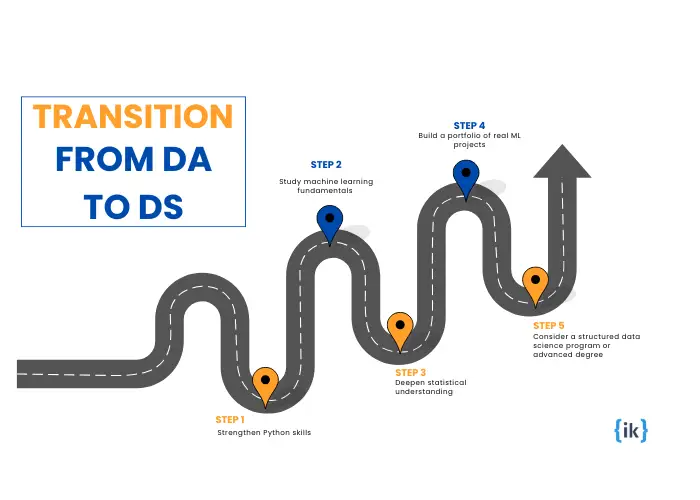
Yes. Transitioning from data analyst to data scientist is one of the more common transitions in the data profession. This move is entirely achievable but requires strategic and structured upskilling over time.
Here is the roadmap you can follow to make this transition:
- Polish and strengthen your Python skills. Go beyond scripting; focus on learning Pandas, Scikit-learn, and NumPy.
- Study the fundamentals of machine learning using structured courses.
- Deepen your statistical understanding, especially probability theory and inferential methods.
- Build a strong portfolio of real machine learning projects and upload them to platforms like GitHub and Kaggle to demonstrate end-to-end model building.
- Enroll in a structured data science program or pursue an advanced degree to compress the learning curve.
Data Analyst vs Data Scientist: Which Career Should You Choose?
This is the question every “vs” search is really asking, and it deserves a practical decision framework based on your strengths, interests, and goals.
Choose Data Analytics if:
- You enjoy working with business teams and translating numbers into clear decisions
- You prefer structured data and defined reporting cycles over open-ended experimentation
- You want a faster, more accessible entry point into the data domain
- Your natural strengths lie in Excel, SQL, data storytelling, and cross-functional communication
Choose Data Science if:
- You love writing code and have a genuine interest in mathematics and algorithms
- You want to build systems that predict outcomes instead of just describing what already happened
- You thrive in research-oriented, experimental environments with fewer guardrails
- You are willing to invest the time in advanced technical training
The following table goes deeper into the different factors that will help you choose one domain over the other:
| Factor | Data Analyst | Data Scientist |
|---|---|---|
| Math intensity | Moderate | High |
| Coding depth | Basic to intermediate | Advanced |
| Time to entry | 6–18 months | 2–5 years |
| Typical background | Business, Statistics, CS | CS, Statistics, Engineering |
| Day-to-day responsibilities | Reports, dashboards, queries | Modeling, experimentation, deployment |
Neither path is objectively better. Both come with their own set of challenges and reward different skill sets. The good news is that both are in high demand, pay well, and one can lead organically to the other.
Launch Your Data Science Career with Interview Kickstart
Knowing the differences between a data analyst and data science is only half the battle; getting hired is where most people get stuck. Interview Kickstart’s Data Science course is built specifically to close that gap. It is a 48-week, two-stage program that combines comprehensive technical training, programming, machine learning, data analysis, with dedicated interview preparation, all in as little as 7 hours per week.
The curriculum is designed and taught by active FAANG hiring managers, so you learn exactly what top-tier companies look for, not just what textbooks cover. What sets it apart is the preparation layer most programs skip entirely: personalized 1-on-1 coaching, individualized career skills development, and mock interviews in real, simulated environments with FAANG and Tier-1 interviewers. By the time you sit in the actual interview, you have already been there.
Conclusion
The data analyst vs data scientist comparison ultimately comes down to one clear distinction: analysts explain the past, scientists predict the future. Both roles are indispensable to modern organizations, and both rank among the most in-demand, well-compensated professions in the US economy. According to the World Economic Forum’s Future of Jobs Report, data roles will continue to dominate hiring trends well into the next decade.
If you are earlier in your career or prefer business-facing work, data analytics offers a strong and accessible entry point. If you have a foundation in math and programming and want to build systems that shape decisions at scale, data science offers both the intellectual challenge and the compensation to match.
Whichever path you choose, the careers are more connected than they are separate, and the right preparation makes all the difference.
FAQs: Data Analyst vs Data Scientist
Q1. What is the main difference between a data analyst and a data scientist?
Data analysts focus on interpreting existing data to explain what has already happened, using tools like SQL, Excel, and Tableau. Data scientists use advanced techniques like machine learning to predict future outcomes. Both work with data, but at very different levels of technical depth and complexity.
Q2. Is data science harder than data analytics?
Data science generally requires more advanced mathematics, programming, and machine learning knowledge, making it harder to break into. Data analytics has a lower barrier to entry but still demands strong analytical thinking, business judgment, and communication skills.
Q3. Can a data analyst become a data scientist?
Yes, it is one of the most common transitions in the profession. Most analysts make the move by learning Python, machine learning, and advanced statistics. Real-world business experience as an analyst is a genuine advantage, not a setback, during the shift.
Q4. Which pays more data analyst or data scientist?
Data scientists consistently earn more due to the advanced technical requirements of the role. See the salary comparison table above for a full breakdown by experience level.
Q5. Do I need a Master’s degree to become a data scientist?
Not always, but most employers prefer it. A strong project portfolio, relevant certifications, and demonstrated machine learning experience can substitute for a formal advanced degree, particularly at tech companies and startups that prioritize skills over credentials.
References
- The Future of Jobs Report 2025 – World Economic Forum
- Data Analyst Salary US
- Data Scientist Salary US
Recommended Reads: