Preparing for Amazon’s machine learning interviews can feel overwhelming, which is where this Amazon machine learning engineer interview preparation guide brings clarity and direction.
The demand for AI and machine learning talent is expanding worldwide, with hiring of AI engineering roles growing more than 25 percent year-over-year in 20251, according to LinkedIn’s AI Labor Market Update.
Global job trends also show that AI and machine learning specialists are two of the most the fastest-growing roles, and capabilities in this area are becoming essential across industries.
World Economic Forum data finds that technology-driven jobs like these are pivotal to the net creation of 170 million new roles by 20302, despite broader labor shifts.
This article shares what you need to know to prepare with confidence. You will learn key topics to master, common Amazon machine learning interview questions, and practical steps to succeed in interviews and advance your career.
Key Takeaways
- Amazon ML interviews reward structured thinking and clear reasoning more than flashy solutions.
- Production readiness and system-level judgment matter as much as model knowledge.
- Strong candidates explain tradeoffs using metrics and business impact.
- Coding clarity and communication can outweigh advanced ML theory.
- Disciplined preparation with feedback turns interviews into a repeatable process.
Amazon Machine Learning Engineer Interview Process Explained
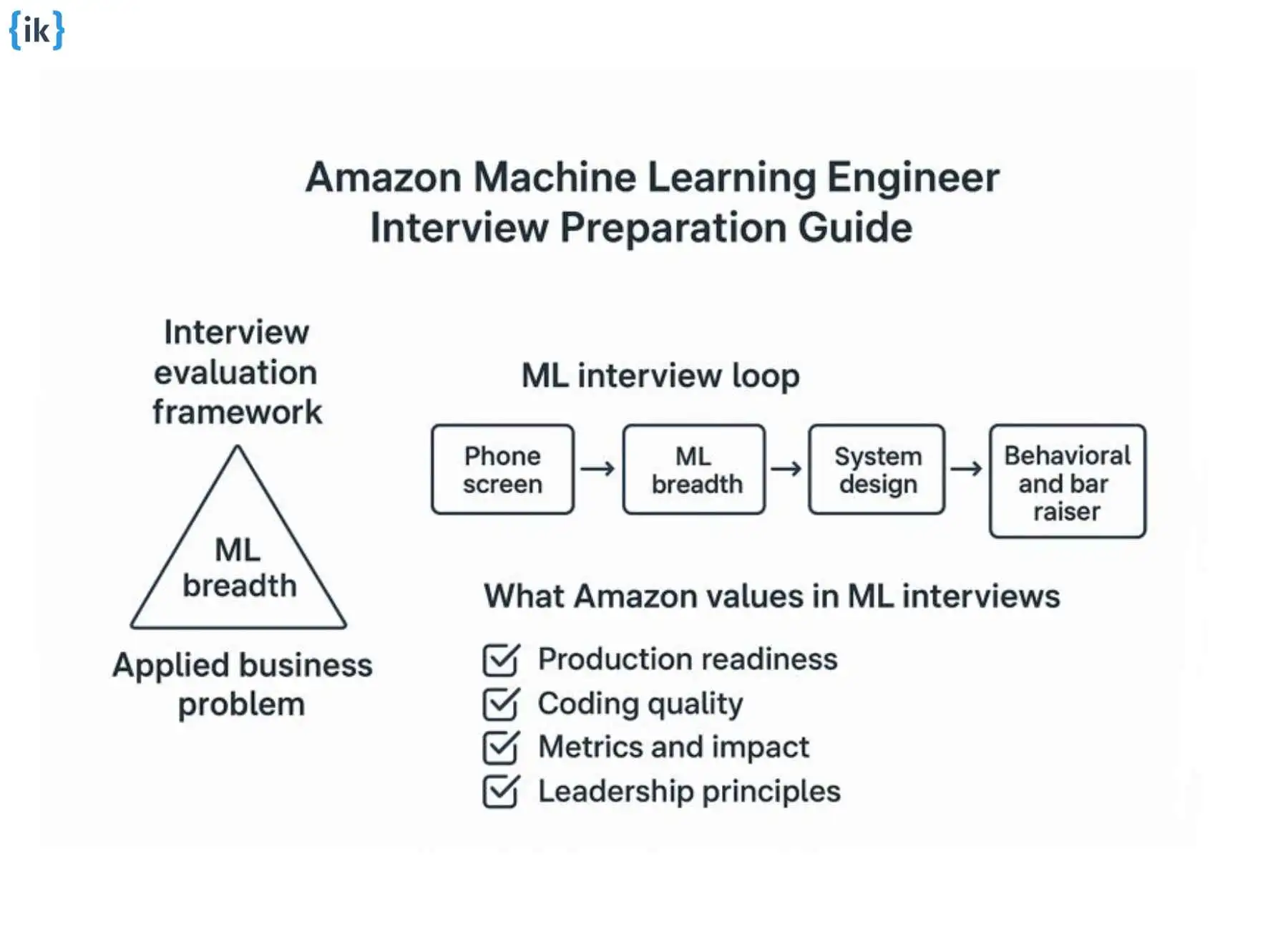
Preparing for Amazon’s ML interview loop requires focused and practical preparation. This Amazon machine learning engineer interview preparation guide reflects how Amazon evaluates candidates in real interview settings.
Amazon machine learning interviews typically assess candidates across three key areas:
- ML breadth is tested through core concepts, including algorithms, evaluation metrics, bias-variance tradeoffs, and when to use different models
- ML depth is evaluated through project deep dives, where interviewers look for ownership, technical judgment, and the ability to explain impact with clear metrics
- Applied problem solving focuses on real-world scenarios, requiring you to design end-to-end ML solutions while considering data, scale, and latency constraints
Production readiness matters as much as model knowledge:
- You should be able to reason clearly about data pipelines and feature quality, and explain how upstream data affects model performance
- Interviewers expect practical answers regarding data leakage, model monitoring, and drift handling, including the specific actions you would take in production
- Deployment choices and rollback plans should be clearly explained, with a direct link to customer and business outcomes
Coding remains a key evaluation factor:
- Candidates are expected to write clean, testable code under time pressure, often using standard data structures
- Weak coding performance can outweigh even the strongest ML theory, particularly for experienced engineers
Behavioral responses must be structured and impact-driven:
- Answers should align with Amazon’s leadership principles, particularly those emphasizing ownership and customer focus
- Strong responses are concise, metric-backed, and clear about tradeoffs
Mock interviews add real value:
- Practicing full interview loops helps surface gaps early
- Targeted feedback improves clarity, confidence, and decision-making
Looking for more guidance on machine learning engineer interviews? Watch this Interview Kickstart video to learn how top candidates approach machine learning interviews at FAANG companies and avoid common preparation mistakes.
Core Technical Topics to Master
Amazon ML interviews reward engineers who understand fundamentals and can apply them calmly to real problems. You do not need to know everything. You just need to know the right things well and explain them clearly.
Below are the technical areas that show up most often in real interview loops and matter the most.
1. Machine Learning Fundamentals and Statistics
You should be comfortable explaining how models behave, not just how they are trained. Interviewers often test intuition before equations.
Focus on:
- How do bias and variance affect model performance in real datasets?
- When regularization helps and when it hurts?
- Why did you choose one model family over another for a given problem?
A good rule of thumb is this. If you cannot explain a concept in simple language, you do not understand it well enough yet.
2. Model Evaluation and Metrics
Metric choice is a common failure point. Amazon cares about decisions, not default answers.
You should be able to:
- Pick metrics based on user impact, not convenience
- Explain precision, recall tradeoffs with real examples
- Discuss AUC, calibration, and thresholding in business terms
Many Amazon machine learning interview questions revolve around why a metric was chosen and what could go wrong with it.
3. Feature Engineering and Data Quality
Strong candidates think about data before models. Weak candidates jump straight to training. Be prepared to talk about:
- Handling missing values, outliers, and noisy data
- Detecting and preventing data leakage
- How feature distributions change over time
You should also explain how poor data quality shows up in production metrics and alerts
4. Choosing the Right Algorithms
You are not expected to list every algorithm. You are expected to simply justify your choices. Interviewers often ask:
- Why use a linear model instead of a tree-based one?
- When unsupervised methods make sense?
- How constraints like latency or interpretability affect model choice?
Clear reasoning here signals strong judgment.
5. Deep Learning for Applied ML Roles
Deep learning questions are practical, not academic. You should focus on:
- When transfer learning is useful
- Tradeoffs between accuracy and inference cost
- Basic ideas around model size, batching, and optimization
If you have deployed a model, be ready to explain what broke and how you fixed it
6. Experimentation and Validation
Amazon values engineers who understand uncertainty. You should know:
- The limits of offline validation
- How to design a safe A/B test?
- What to do when online results disagree with offline metrics?
This is a key part of machine learning engineer interview preparation and often separates senior candidates from junior ones.
7. Coding and Practical Implementation
ML engineers at Amazon are expected to code confidently. You should practice:
- Writing clean, readable code under time pressure
- Solving problems that combine data manipulation and logic
- Explaining time and space complexity clearly
Good ML knowledge cannot compensate for weak coding fundamentals.
Coding and Software Engineering Expectations
Amazon evaluates machine learning engineers as software engineers who build reliable systems, not notebook-only researchers. Coding rounds are designed to surface clarity of thought, correctness under pressure, and production-minded decision-making.
1. What does Amazon evaluate in Coding Rounds?
Coding interviews are not about exotic algorithms. They test how you reason, structure solutions, and handle edge cases in real time. Interviewers typically look for:
- A clear problem decomposition before writing code
- Correct handling of constraints and edge cases
- Readable, maintainable code that another engineer could extend
- The ability to reason about complexity and tradeoffs without overexplaining
Candidates often fail not because they cannot solve the problem, but because they rush into coding without structuring their approach.
2. Data Structures and Algorithms that Matter Most
Amazon favors depth in fundamentals over breadth in rare patterns. You should be consistently strong with:
- Hash maps and sets for frequency counting, grouping, and deduplication
- Arrays and strings for windowing, parsing, and indexing problems
- Trees for hierarchical reasoning and recursive traversal
- Graph traversal basics for dependency or reachability problems
Dynamic programming appears occasionally, but only in practical forms. Problems usually reward clear state definition and iteration over clever optimizations.
3. Writing Production-Quality Code in an Interview Setting
Code quality matters. Interviewers notice variable naming, function boundaries, and control flow. Strong candidates:
- Name variables and helper functions descriptively
- Avoid deeply nested logic unless necessary
- Handle invalid or unexpected input explicitly
- Pause to validate assumptions before finalizing code
Weak candidates produce code that works only for the happy path or requires the interviewer to infer intent.
4. Reasoning About Complexity and Scalability
After a working solution, interviewers usually probe scalability. You should be able to:
- State time and space complexity clearly
- Identify bottlenecks if the input size grows
- Suggest one reasonable optimization without rewriting everything
This discussion is less about formulas and more about demonstrating engineering judgment.
5. Integrating Coding with Data and ML Context
Many Amazon MLE coding problems blend logic with data manipulation. You may be asked to:
- Process structured or semi-structured data
- Aggregate statistics efficiently
- Implement lightweight preprocessing logic
These questions test whether you can move comfortably between data and code, which mirrors day-to-day ML engineering work.

This level of preparation aligns with what Amazon expects from experienced machine learning engineers.
Machine Learning System Design and Productionization
Amazon evaluates machine learning engineers not just on models but on end-to-end systems. The goal is to see if candidates can design ML solutions that are scalable, reliable, and maintainable in production. Strong candidates can balance algorithmic performance with operational constraints.
Key Expectations
1. End-to-End Architecture Thinking: Interviewers expect you to clearly describe how raw data flows through the system to actionable predictions. Include:
- Data ingestion
- Feature engineering and storage
- Model training and evaluation pipelines
- Serving layer
- Monitoring and alerting mechanisms
2. Scalability and latency tradeoffs: Amazon looks for candidates who can anticipate bottlenecks and design around them.
- How would your system handle millions of requests per second?
- How do you balance latency, throughput, and accuracy?
- When does a model become “too heavy” for production, and how would you optimize it?
3. Monitoring, Drift Detection, and Rollback: A deployed ML system rarely stays static.
- Demonstrate how you detect feature drift, model degradation, or data anomalies.
- Explain automated rollback procedures or staged rollouts.
- Connect monitoring metrics back to business KPIs.
4. Tradeoff Evaluation: Every design decision involves tradeoffs. Interviewers evaluate your reasoning more than your solution.
- Accuracy vs latency
- Complexity vs maintainability
- Offline retraining vs online updates
5. Security, Privacy, and Compliance: Amazon ML engineers must consider GDPR, PII, and internal privacy standards.
- How do you anonymize or encrypt sensitive data?
- How do you log and audit model decisions without leaking information?
6. Practical Example: We track prediction distribution daily. If the KL divergence exceeds 0.05, we trigger retraining and shadow evaluation before full rollout.
Practical Approach to System Design Questions
| Step | Key Focus | Details / Examples |
| 1. Clarify Requirements First | Understand system constraints | Latency, throughput, accuracy targets; data availability, storage, regulatory constraints |
| 2. Sketch High-Level Architecture | Visualize end-to-end flow | Ingestion → Features → Training → Serving → Monitoring. These include notes on scale and fault tolerance |
| 3. Discuss Components in Detail | Explain design choices | Feature engineering (batch vs streaming); training pipeline (hyperparameter tuning), retraining frequency; serving layer (online vs batch predictions), caching |
| 4. Quantify Tradeoffs | Show reasoning behind decisions | Provide metrics for throughput, latency, and accuracy; explain why one design was chosen over alternatives |
| 5. Anticipate Failures | Plan for robustness | Handle data drift, model degradation, and infrastructure outages; explain monitoring and alerting strategies |
Also Read: Key Advanced Machine Learning Interview Questions for Tech Interviews
Amazon Machine Learning Engineer Interview: Learn Formats, Timelines, and Preparation Strategy
Amazon interviews follow a structured and repeatable process. Understanding the format early helps you prepare with intent instead of guessing what might be asked. This Amazon machine learning engineer interview preparation guide focuses on what candidates actually experience across real interview loops.
1. Interview Stages and Typical Timeline
Most candidates go through a sequence of screening and evaluation rounds spread across several weeks.
- Initial recruiter screen: This conversation focuses on role fit, team alignment, and your previous ML experience. You should clearly summarize the scope of your work, the problems you addressed, and the impact you delivered.
- Technical phone screen: This round usually includes live coding or an ML fundamentals discussion. Expect questions that test clarity of thought, not trick questions. Strong candidates explain assumptions before jumping into solutions.
- Virtual onsite or loop interviews: The loop typically consists of multiple rounds covering coding, machine learning depth, system design, and behavioral interviews. Each interviewer evaluates a different signal, and feedback is aggregated to assess overall readiness.
Timelines vary, but the full process often spans two to four weeks, depending on scheduling and role urgency.
2. Common Interview Round Formats
Amazon interviews are practical and signal-driven. Each round has a clear purpose.
- Live coding rounds: These assess problem-solving, code quality, and communication. Interviewers pay attention to structure, edge cases, and reasoning under time pressure.
- Machine learning deep dives: These focus on fundamentals, metrics, modeling choices, and real-world ML challenges. Many Amazon machine learning interview questions are framed around past projects or hypothetical scenarios.
- ML system design interviews: Candidates are asked to design end-to-end systems. The emphasis is on architecture clarity, tradeoffs, scalability, and production readiness.
- Behavioral interviews: These are mapped directly to Amazon leadership principles. Interviewers look for ownership, customer focus, and data-driven decision-making in your stories.
3. Interview Policies and AI Tool Usage Expectations
Amazon expects interviews to reflect your individual skill level.
- External tools, including AI assistants, are not permitted during live interviews unless explicitly stated
- Candidates are evaluated on independent reasoning, clarity of explanation, and problem-solving approach
- Practicing without AI assistance before interviews helps build confidence and fluency
- Understanding these expectations early prevents surprises during live rounds
4. Structured 6 to 8 Week Preparation Plan
Here’s a focused timeline that can help you to cover depth without burnout. The goal is to align preparation with interview signals.
| Preparation Phase | Focus Areas | Key Activities |
| Weeks 1–2 | Foundations | Refresh ML fundamentals, evaluation metrics, and core coding patterns. Revisit past projects and practice explaining them clearly and concisely. |
| Weeks 3–4 | ML System Design | Focus on ML system design, feature engineering, and production scenarios. Practice structured explanations and discussing tradeoffs. |
| Weeks 5–6 | Practice & Simulation | Intensify coding practice and behavioral preparation. Run mock interviews and simulate real interview timing. |
| Weeks 7–8 | Refinement | Address weak areas, rehearse communication, and review leadership principle stories. Avoid learning new topics at this stage. |
5. Self-Assessment and Readiness Checkpoints
Preparation should be iterative and honest.
- Can you explain your ML projects without slides or notes?
- Can you write clean code while talking through your logic?
- Can you justify system design decisions with metrics?
- Can you connect your work to customer and business impact?
If the answer is yes across these areas, you are close to interview-ready.
Interview Day Strategy, Communication, and Follow-up
Even well-prepared candidates fail because execution breaks down under time pressure. This Amazon machine learning engineer interview preparation guide emphasizes disciplined communication and decision-making, which are core evaluation signals in Amazon interviews.
1. Start by Controlling the Problem Framing
Do not rush into answers. Strong candidates spend the first few minutes aligning with the interviewer.
- Restate the problem in your own words to confirm understanding
- Ask clarifying questions around constraints such as data size, latency, accuracy targets, and failure tolerance
- Explicitly state assumptions before moving forward
This approach shows structured thinking and reduces avoidable mistakes, especially in ML system design rounds.
2. Structure Answers Before Diving Deep
Interviewers evaluate how clearly you organize your thoughts.
- For coding and ML questions, outline your approach before implementation
- For design questions, move top-down from system goals to components
- For behavioral questions, follow a tight STAR flow with emphasis on decision points
Clear structure matters as much as correctness. This pattern appears consistently across Amazon machine learning interview questions.
3. Manage Time Intentionally in Each Round
Most interviews run for 45 to 60 minutes. Time mismanagement is a common failure mode.
- Spend the first 5 to 10 minutes on clarification and approach
- Allocate the bulk of time to execution and reasoning
- Leave room at the end for edge cases, tradeoffs, and follow-up questions
If you get stuck, verbalize your thinking and propose alternatives instead of going silent.
4. Communicate Tradeoffs and Metrics Concisely
Amazon interviewers care deeply about judgment.
- When choosing a model or design, explain why it fits the constraints
- Compare alternatives briefly using metrics like latency, cost, and accuracy
- Tie technical decisions to customer impact or business outcomes
This ability signals seniority and practical experience within a multi-agent AI framework of teams and systems, even if the term itself is not used explicitly.
5. Handle Follow-Up Questions Calmly
Interviewers often change constraints to test adaptability.
- Treat follow-ups as collaboration, not confrontation
- Acknowledge the new constraint and adjust your solution logically
- Avoid defending an approach rigidly when evidence suggests change
Strong candidates stay flexible while keeping their reasoning clear.
6. Debriefing and Next Steps
Your performance does not end when the call does.
- Write a short self-debrief while details are fresh. Note where you hesitated or overexplained
- If you move forward, use recruiter feedback to adjust quickly
- During offer discussions, be prepared to discuss scope, level, and growth expectations clearly
Candidates who reflect and iterate improve rapidly across loops.
Interview Kickstart Machine Learning Course for Amazon MLE Preparation
If you want structured preparation that aligns closely with what Amazon interviewers evaluate, Interview Kickstart’s Machine Learning Interview Masterclass can be a high-leverage resource.
This course is designed by engineers who have interviewed and hired at FAANG+ companies, and it combines technical rigour with real-world interview simulation.
Let’s look at the key features of the course:
- The curriculum includes structured live classes and coding/system design assignments split across 5 core areas, such as sorting, recursion, trees, and deep learning
- Participants typically spend 10–12 hours per week on the program, balancing live sessions, assignments, and mock practice
- The course offers mock interviews with FAANG and top-tier engineers in realistic simulated environments, with detailed feedback to sharpen reasoning and execution
The structured format, with live problem solving and hands-on coding, supports focused preparation. Mock interviews with detailed feedback are especially valuable for senior machine learning roles.
Conclusion
Amazon machine learning interviews reward clarity of thought, sound judgment, and production-minded decision-making. Success comes from understanding what signals interviewers look for and practicing how to demonstrate them consistently.
Use this Amazon machine learning engineer interview preparation guide as a framework, not a checklist. Focus on mastering fundamentals, articulating tradeoffs, and communicating impact clearly. Prepare with intent, practice under real conditions, and refine execution through feedback.
With the right structure and disciplined preparation, clearing the Amazon ML interview is a realistic and repeatable outcome, not a matter of luck.
FAQs: Amazon Machine Learning Engineer Interview Preparation Guide
Q1. How important are publications or research papers for Amazon MLE roles?
Publications are helpful but not required. Amazon prioritizes applied impact, production experience, and decision-making over academic credentials. Clear ownership of deployed systems often matters more than research depth.
Q2. Does Amazon expect MLEs to specialize in one ML domain?
Not necessarily. While domain depth helps, Amazon values engineers who can adapt across problem types such as ranking, forecasting, NLP, or anomaly detection, especially when business needs shift.
Q3. Can backend or data engineers transition into Amazon MLE roles?
Yes, many successful candidates come from adjacent roles. Strong signals include hands-on model deployment, ownership of ML pipelines, and the ability to reason about metrics and tradeoffs, not just data processing.
Q4. How much weight does team matching carry in Amazon ML interviews?
Team fit matters after technical readiness is established. Interviewers assess whether your experience aligns with the team’s ML maturity, data scale, and business goals, but it rarely overrides weak core signals.
Q5. Is it better to apply broadly or wait until fully prepared?
It is usually better to apply when you can consistently perform well in mock interviews. Amazon interview feedback is limited, so entering underprepared often wastes a serious future attempt.