In today’s time, almost all the enterprises, big or small, look out for AI skills when hiring for technical or non-technical roles. AI skills for resume have become essential across all job industries. Nowadays, AI technologies support businesses to enhance efficiency and streamline automated workflows. Whether you are in sales, marketing, HR, designing, or any other industry, AI has simply taken over the world from the tech labs to everyday work processes. From driverless cars to voice assistants to smart homes, AI solutions are evidently visible in our routine.
It’s important to get into competitive roles in any industry. Your resume needs to have AI skills highlighted to set you apart. From natural language processing to machine learning to real-time projects, each skill captures the attention of the hiring managers.
This article will guide you on why adding AI skills for resume can boost your career opportunities. You will learn how to present your AI proficiency strategically and in a recruiter-friendly way, using the correct keywords and measurable results that help to bypass ATS (Applicant Tracking Systems) scans.
Key Takeaways
- AI skills are reshaping hiring trends across both tech and non-tech roles.
- Showcasing AI knowledge on your resume helps you stand out in a competitive job market.
- Choosing role-specific AI skills aligns your profile with current hiring expectations.
- Strategic placement of AI skills improves your resume’s readability and ATS performance.
- Using ATS-optimized keywords ensures your resume ranks higher in digital screenings.
What are AI Skills?
AI skills refer to the ability of how artificial intelligence functions and being able to apply it effectively in real-world scenarios. These include competencies such as data analysis, prompt engineering, and the use of machine learning and automation tools. Once limited to the tech sector, AI skills for resume are now becoming essential across diverse job roles, including marketing, business, design, and more.
AI is extensively incorporated into many departments in today’s workplaces, including marketing, human resources, operations, sales, finance, and engineering. Experts use it for content drafting, trend analysis, workflow optimization, and enhancing data accuracy. Employers now demand that applicants know not only what artificial intelligence (AI) is capable of but also when and how to use it responsibly.
Adding AI skills for resume demonstrates that you are capable of using technology to enhance productivity, creativity, and the final results of your business. PwC’s 2025 AI Job Barometer Report¹ predicts that one in three jobs all over the world will already be associated with AI exposure, and the positions that require AI knowledge are developing 3.5 times quicker than those that don’t. The report also highlights that people with AI skills can earn 25% higher salaries in some fields, which shows how important these skills have become in the changing work market.
📊 Insight from PwC 2025 AI Job Barometer Report
AI is redefining what people do, not replacing people.” When you demonstrate your ability to leverage AI ethically and effectively, your profile becomes instantly more credible and recruiter-ready. Hiring managers can’t ignore your AI skills when you present your AI experience with quantifiable results, such as quicker, faster project cycles, smarter insights, or cost reductions.
Top AI Skills to Include in Your Resume
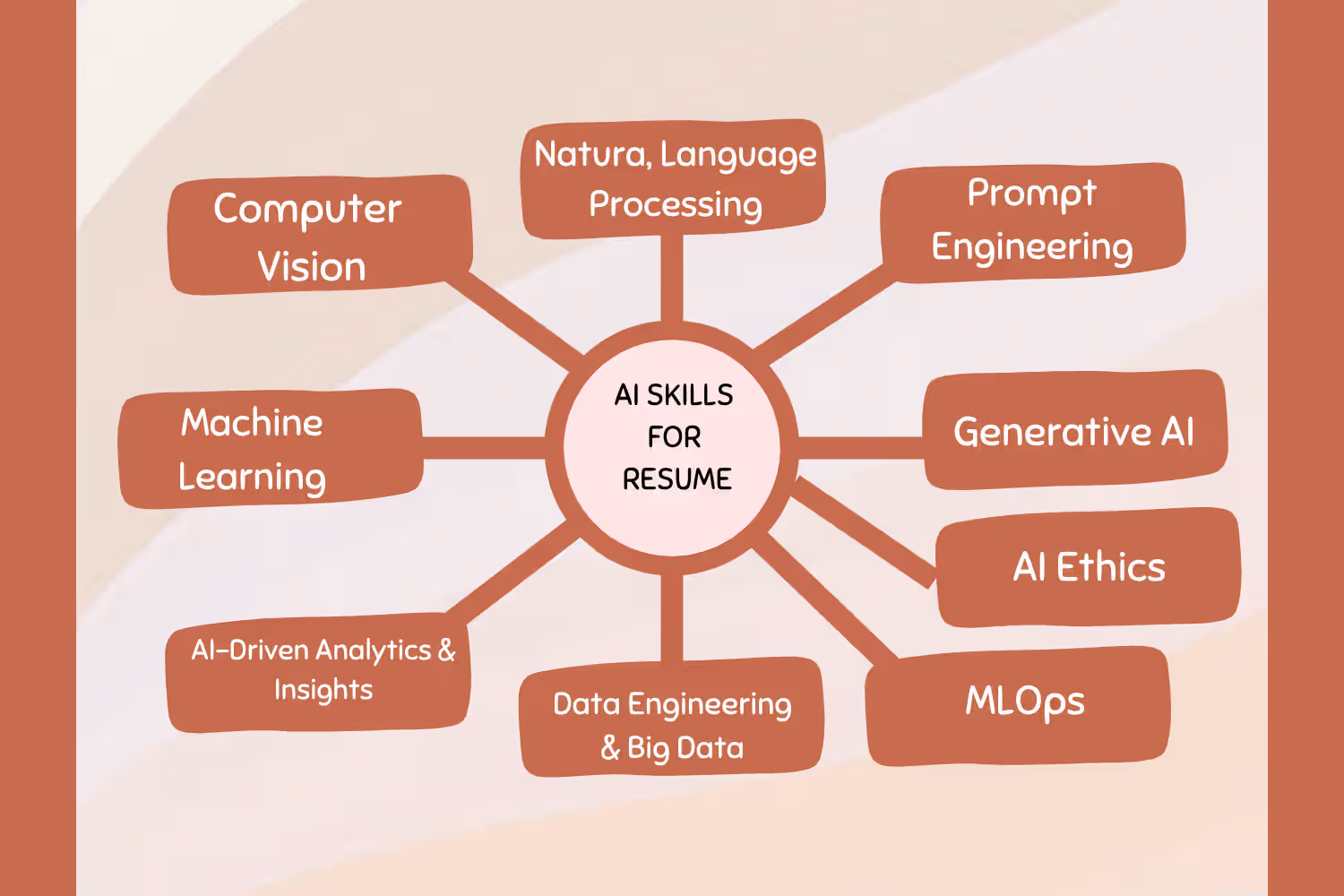
In today’s job market, AI skills for resume are relevant to the role you are applying for, and sync well with the ideal job setting. Recruiters want to see how you have used your AI skills to solve problems and get things done, like by making things more accurate, automating workflows in short to help businesses optimize certain processes or departments to reduce the repetitive tasks.
Below are the top 10 AI skills for resume identified through industry research and resume analysis. Each skill reflects what employers value most today: practical application, business impact, and adaptability. These AI skills for resume are shortlisted to help you highlight achievements that resonate with both technical and non-technical recruiters.
1. Natural Language Processing (NLP)
This is one of the most common AI skills for resume. Natural Language Processing (NLP) is the technology that lets machines understand and respond to human language. NLP takes input as raw text and converts it into useful information. It can do things like summarize reports, run chatbots, and analyze consumer comments. It fine-tunes artificial intelligence and machine learning to understand human language. It is for jobs that involve communication, data, or automation; it’s one of the most useful AI abilities.
ATS-friendly keywords: Text analytics, language modeling, AI text analysis, sentiment analysis, and chatbot creation are all other names for ATS.
How to showcase it: Experience + Skill section of the resume.
For example:
- Non-technical: Used AI technologies to look at customer comments and find service problems that keep happening.
- Technical: Used Python and Hugging Face to construct a model that analyzes client tone and classifies it.
Optional tools: NLTK, Google Cloud NLP, spaCy, Hugging Face, and OpenAI API
2. Prompt Engineering
Prompt engineering is another major AI skills for resume that you should possess in this day and age. It is the skill of communicating with AI effectively. This includes knowing how to frame questions, give instructions, and guide models toward useful, consistent results. It turns random AI output into reliable and repeatable outcomes. Recruiters value this skill because it shows how effectively you can use AI in real-world situations.
ATS-friendly keywords: System prompts, chain-of-thought, technical instruction design, RAG prompting, and prompt design.
How to showcase it: Experience + Skill section of the resume.
For example:
- Nontechnical: Built a shared prompt library for marketing briefs, which cut down on drafting time by 46% and made it easier to get approvals.
- Technical: Created retrieval-augmented prompts for an internal documentation bot, reducing analysts’ weekly workload by 90 minutes.
Optional tools: ChatGPT, Claude, Gemini, and Copilot
3. Generative AI (GenAI)
Generative AI tools accelerate everything from prototyping to documentation. Engineers who can design controlled, reproducible GenAI workflows demonstrate efficiency and judgment, two things every employer values over mere tool enthusiasm.
ATS-friendly keywords: LLM applications, copilots, RAG systems, generative models, AI-assisted creation
How to showcase it: Summary + Experience
For example:
- Non-technical: Used GenAI to draft client emails and campaign briefs, cutting revision time by 42% and boosting engagement.
- Technical: Made an internal RAG-based GenAI assistant that cut the time it took to look up data by 72% and increased ticket deflection by 11%.
Optional tools: ChatGPT, Copilot, Claude, Gemini, and Notion AI are all optional tools.
4. Machine Learning (ML)
Machine learning is also one of the key AI skills for resume. It indicates that you can build systems that can learn from data to make predictions, make better decisions, and find patterns over time. It entails creating models that can evaluate data, adjust based on feedback, and continuously improve performance, converting data into more intelligent, quicker, and accurate results.
ATS-friendly keywords: Predictive modeling, model tuning, regression/classification, deep learning
How to showcase it: Experience + Skill section of the resume.
For example:
- Non-technical: Developed a churn prediction model in collaboration with data scientists, which reduced cost per lead by 17% and increased customer retention by 6%.
- Technical: At fixed recall, a gradient-boosted classifier was created that improved model precision by 7%.
Optional tools: TensorFlow, PyTorch, XGBoost, and scikit-learn are optional tools.
5. Computer Vision
Computer vision is also one of the key AI skills for resume that helps machines understand visual information, such as finding flaws on a production line or face detection in images. It is used in many fields, including healthcare, retail, logistics, and automotive. On a resume, it demonstrates your ability to use images or videos to automate tasks (like quality inspection, inventory tracking, or document processing) and build intelligent applications that make data-driven decisions from visual inputs.
ATS-friendly keywords: image recognition, object detection, visual classification, AI vision systems, and deep learning
How to showcase it: Experience + Skill section of the resume.
For example:
- Non-technical: Used AI picture tagging to make it 35% faster to sort content for social media.
- Technical: Made an object detection model that found 92% of product problems in QA processes.
Optional tools: OpenCV, TensorFlow, PyTorch, YOLOv5, AWS Rekognition, and Google Cloud Vision as optional tools.
6. MLOps (Machine Learning Operations)
MLOps ensures that deployed models maintain their accuracy, compliance, and resilience thanks to MLOps. For machine learning, automation, monitoring, rollback, and drift control, it’s CI/CD. For senior engineers, this ability demonstrates operational maturity, a critical differentiator.
ATS-friendly keywords: Model ops, CI/CD, monitoring, observability, drift detection, rollback automation
How to showcase it: Skill + Experience section of the resume.
For example:
- Non-technical: Created a dashboard to monitor model health and cut down on 30% of AI-related incidents.
- Technical: Developed an automated retraining pipeline with a 99.95% uptime and a rollback time of less than five minutes.
Optional tools: MLflow, Weights & Biases, EvidentlyAI, Neptune.ai
7. Data Engineering & Big Data
Data engineering supports every AI project. AI is incapable of learning or adapting without scalable pipelines. Big data-experienced engineers make sure systems are scalable, quick, and cost-effective. In an AI-powered world, it’s the engine that powers analysis, modeling, and automation.
ATS-friendly keywords: Spark, Kafka, ETL/ELT, Data pipelines, Lakehouse architecture
How to showcase it: Skill + Experience section of the resume.
For example:
- Non-technical: Worked with the engineering team to streamline data flow, cutting dashboard refresh time by 60%.
- Technical: Built a Spark-based pipeline to process 50M+ records daily, reducing latency by 45%.
Optional tools: Databricks, Airflow, Snowflake, Kafka, Redshift
8. AI-Powered Data Analysis
The main goal of AI-driven analytics is to use artificial intelligence to interpret complex data and transform it into actionable insights. Finding patterns, forecasting results, and making decisions supported by data are more important than merely gathering data. This skill demonstrates your capacity to precisely define issues, select appropriate metrics, and apply AI tools to find insights that enhance strategy and performance.
ATS-friendly keywords: Data automation, AI data insights, predictive analytics, smart dashboards, AutoML, and insight generation are some synonyms for ATS.
How to showcase it: Experience + skill section of the resume.
For example:
- Non-technical: Campaign metrics were tracked using AI dashboards, which reduced reporting time by 40%.
- Technical: Developed an AutoML pipeline to predict sales trends, increasing forecast accuracy by 18%.
Optional tools: IBM Watson, Tableau GPT, AutoML, BigQuery ML, MonkeyLearn, and Power BI (AI features)
9. AI-Driven Analytics & Insights
The primary goal of analytics powered by AI is to apply artificial intelligence in understanding difficult data and transforming it into actionable insights. Data collection alone is not enough, and thus finding patterns, predicting outcomes, and taking decisions based on data are quite important. This ability indicates that you can accurately identify errors, choose the right measures, and use AI to uncover insights that optimize strategy and elevate performance.
ATS-friendly keywords: Data interpretation, quant analysis, predictive analytics, insight generation.
How to showcase it: Experience
For example:
- Non-technical: Three marketing tests were identified using AI dashboards, increasing ROAS by 17%.
- Technical: Using cohort analysis, constructed a KPI tree and discovered a retention driver that increased the rate by 4%.
Optional tools: Power BI, Tableau with AI add-ons, Python
10. AI Ethics
AI ethics is the practice that consists of the design, development, and deployment of artificial intelligence with the aim of guaranteeing fairness, transparency, and accountability. It is mainly concerned with the issues of bias prevention, privacy safeguarding, and trust building in AI systems.
Ethical AI is a shared goal among major global tech companies. IBM, which was among the first to actively implement ethical AI principles, along with Google, Microsoft, and OpenAI, aims to ensure that AI benefits society while minimizing risks, promoting technology that serves humanity responsibly, transparently, and equitably.
ATS-friendly keywords: AI governance, ethical AI, explainability, fairness, bias detection, and responsible AI.
How to showcase it: Experience + Skill section of the profile.
For example:
- Non-technical: Rewrote prompts to increase fairness in three languages and flagged biased outputs in the user-facing chatbot.
- Technical: By auditing the training dataset and eliminating biased attributes, the model’s fairness score increased by 22%.
Optional tools: Google What-If Tool, Lime, SHAP, Fairlearn, AI Fairness 360, and Responsible AI (Azure)
How to place AI Skills on your Resume

Your resume is not just about listing AI tools; it’s also about proving capability and impact. The best resumes show how you used AI and what changed because of it. Follow these quick placement rules to make your AI experience readable by both recruiters and Applicant Tracking Systems (ATS).
- Tailor your CV for each role, emphasizing the AI skills for resume that correspond with the job description.
- Relevant keyword usage incorporates synonymous terms (e.g., “predictive analytics” and “AI automation”) so that you can be easily found by applicant tracking systems.
- Highlight your accomplishments instead of saying “AI tools were applied,” state “AI‑powered dashboards helped in cutting down processing time by 40%.”
- Highlight specific project experience should have succinct bullet points to illustrate your role, the AI skill that was utilized, and the result.
- Mentioning important tools and technologies, such as frameworks such as TensorFlow, Python, or AutoML, would lend you authority.
- Include soft skills and context, share your technical AI skills, for instance, how you interpret results and apply insights.
- Start with a strong professional summary at the top, and present your AI skill profile clearly so that recruiters can understand it immediately.
- Resume formatting uses bullet points, clear formatting, and keeps the skills box free of too much jargon.
- Update your resume continuously with the growth of your AI experiences, and make your resume reflect new tools, outcomes, and projects by refreshing it.
By strategically putting AI skills for resume, you can attract the attention of recruiters, and it will help you to get your ideal job.
Conclusion
AI skills for resume have become essential across all industries, not just in technology roles. Mentioning tools like ChatGPT or TensorFlow on your resume reflects adaptability and readiness to work with emerging technologies. Earning relevant certifications further demonstrates your commitment to continuous learning and practical application.
Keep your resume structured and focused on results. Instead of simply listing tools, highlight how you have used AI to streamline workflows, reduce manual effort, or support data-driven decisions. Clear, specific examples show both capability and results while helping your resume perform well in ATS scans.
In short, hiring managers look for evidence of impact and highlight results like faster processes and higher accuracy that improve results. Present your AI skills for resume with clarity and confidence to show you do not just know the tools; you use them to create real, measurable value.
Get a Personalized AI Skills Roadmap Tailored to Your Resume
Before you start adding new AI skills for resume, it’s important to understand where you currently stand. Interview Kickstart’s AI Resume Analyzer breaks down your AI readiness in under a minute, giving you a clear score, identifying the exact skill gaps holding you back, and showing how your profile compares to what FAANG+ companies expect today
If you want a concrete, personalized plan to boost your resume, simply upload your resume (it’s free!). You’ll instantly get a detailed skill-gap analysis, your salary potential with AI skills, and a step-by-step career roadmap tailored to your background—so you know exactly what to learn next to become truly AI-ready.
FAQs: AI Skills for Resume
Q1. Which AI skills are most valued for engineers on a resume?
Engineers are expected to showcase their applied AI skillset through technologies such as ML, MLOps, and engineering for data, along with prompt engineering and generative AI deployment, besides giving measurable outcomes like model accuracy, latency reduction, or pipeline efficiency.
Q2. How can engineers demonstrate AI skills?
Use the formula Action, Skill/Tool, Outcome. For example: “The ML inference pipeline in production was deployed, latency was reduced by 35%, and 99.9% uptime was maintained.” Metrics usage makes the skill both proof-based and friendly for the Applicant Tracking System (ATS).
Q3. Should engineers list AI tools on their CV?
Absolutely, it is necessary to include only the tools that had a substantial influence on the results or those specified in the job description, like PyTorch, TensorFlow, MLflow, Databricks, Airflow, etc., along with the quantifiable business or technical impact, which should be indicated right after them.
Q4. How can AI skills demonstrate problem-solving ability for technical roles?
AI capabilities should be placed alongside critical and analytical thinking. For example, “Developed RAG prompts that cut policy lookup time by 70%” implies that the engineer knows how to effectively merge AI and systematic problem-solving.
Q5. How do engineers quantify AI project impact on a resume?
Use performance, efficiency, or reliability metrics to quantify the results. For example, model precision/recall, runtime reduction, error rate decrease, revenue impact, or time saved are all numbers that indicate a tangible business or technical improvement.